Author: Wellfitsource Product & Sourcing Team · Published: April 2025 · Updated: October 2026
The first file a new customer sends us is usually a photo. A competitor’s mat on Instagram, a Pinterest board, once a screenshot of a mat with the price circled in red and “can you beat this?” typed underneath. Fine. But a photo isn’t a spec, and before anything reaches the line that picture has to turn into about fifteen separate decisions — material, length, width, thickness, surface, base color, print method, logo position, edge finish, packaging. Each has its own price and, annoyingly, its own minimum.
Our sales team keeps a laminated copy of the spec sheet further down this page on their desks. What follows is basically the reasoning behind each line of it.
A note on the numbers: prices here come from our own 2026 quotes, FOB Shanghai, for a 183×61cm mat at around 500 units. Your quote will move with size, volume and the season’s raw material prices, but the gaps between options stay roughly where they are.
Quick Summary
- Three paths, three price tags: ODM catalog + your logo (MOQ 200–300), ODM modified (300–500), and full OEM to your own spec (500–1,000+). Most first orders should start on the first two.
- Eight things can be customized: material, size and shape, thickness, surface texture, color, print and logo, functional features (alignment lines, eyelets, fold grooves), and packaging.
- Material and size do most of the pricing. Logo methods then add roughly $0.20–$3.50 per mat, non-standard sizes $0.40–$1.20, a custom surface texture needs its own tooling, quoted case by case.
- The proof chain has four approvals: digital proof, color/print strike-off, pre-production sample, and a signed golden sample that bulk production is inspected against.
- The commonest customization mistake isn’t a wrong choice, it’s an unwritten one. Any spec you leave blank gets filled with the factory default.
OEM or ODM: Which Path You’re Actually On
Buyers use “OEM” for almost every custom order, but in yoga mats there are really three paths, and the factory will quote you very differently on each.
| Path | What You Change | Typical MOQ | Sampling | Best For |
|---|---|---|---|---|
| ODM catalog + logo | Logo, logo position, sometimes base color from stock | 200–300 | 1 round, 5–7 working days | Market tests, first PU orders, event and gifting runs |
| ODM modified | Catalog construction, plus your colors, size variant, print and packaging | 300–500 | 1–2 rounds | Most private label launches |
| Full OEM | Your own construction: material blend, layer thickness, texture, shape, everything | 500–1,000+ | 2–3 rounds, sometimes tooling | Established brands building a signature product |
Very few brands need full OEM on a first order. What makes a mat look like your mat is mostly color, print and packaging, and all three are available on the ODM-modified path at a fraction of the commitment. Full OEM earns its cost when you want something a catalog can’t give you: a proprietary surface pattern, an unusual layer construction, or a shape that needs its own cutting die.
One question we ask on almost every first call: “Is this mat replacing something you already sell, or is it new?” A replacement can usually be matched from catalog with modifications. A new product line is where the full OEM conversation starts.
The Eight Things You Can Customize
Each of these is one line on the spec sheet. Leave a line blank and the factory fills it in with whatever its line is already running.
| Customization | Common Options | Adds to FOB | Moves MOQ? | Needs a Sample? |
|---|---|---|---|---|
| Material | PVC, TPE, cork, PU, suede, natural rubber | Sets the base: $3.50–$20 | Yes | Yes |
| Size & shape | 183×61 standard, 183×66/68, 200–213cm, round, oval, die-cut | $0.40–$1.20; die $100–$200 | Sometimes | Yes |
| Thickness | 1.5mm travel to 15mm Pilates | Scales with material | Rarely | Yes |
| Surface texture | Stock emboss patterns or custom | Stock free; custom tooling quoted after evaluation | Yes (custom) | Yes |
| Color | Stock colors, Pantone match, two-tone, marbled | Pantone match ~$0.10–$0.40 | Yes (per color) | Swatch |
| Print & logo | Laser, silk screen, UV, sublimation, emboss | $0.20–$3.50 | Rarely | Yes |
| Functional features | Alignment lines, eyelets, fold grooves, edge binding | $0.15–$1.00 each | Rarely | Yes |
| Packaging | Strap, polybag, belly band, color box, carry bag | $0.10–$7.00 | Per format | Mock-up |
1. Material
Material comes first because it prices everything else. It sets your FOB range (roughly $3.50–$8 for PVC, $6–$14 for TPE, $8–$16 for cork, $12–$20 for PU over natural rubber), your realistic retail ceiling, and your compliance workload. Material also limits the rest of this list: sublimation printing works beautifully on PU and suede and not at all on TPE; laser engraving looks premium on cork and PU and does almost nothing on PVC.
The full material decision is in our yoga mat materials comparison. Two narrower comparisons buyers ask about often are TPE vs natural rubber on cost and positioning and what to verify on TPE safety and compliance. If you are heading for the premium end, our guide to custom PU yoga mats covers what can and can’t be changed on that construction.
2. Size and Shape
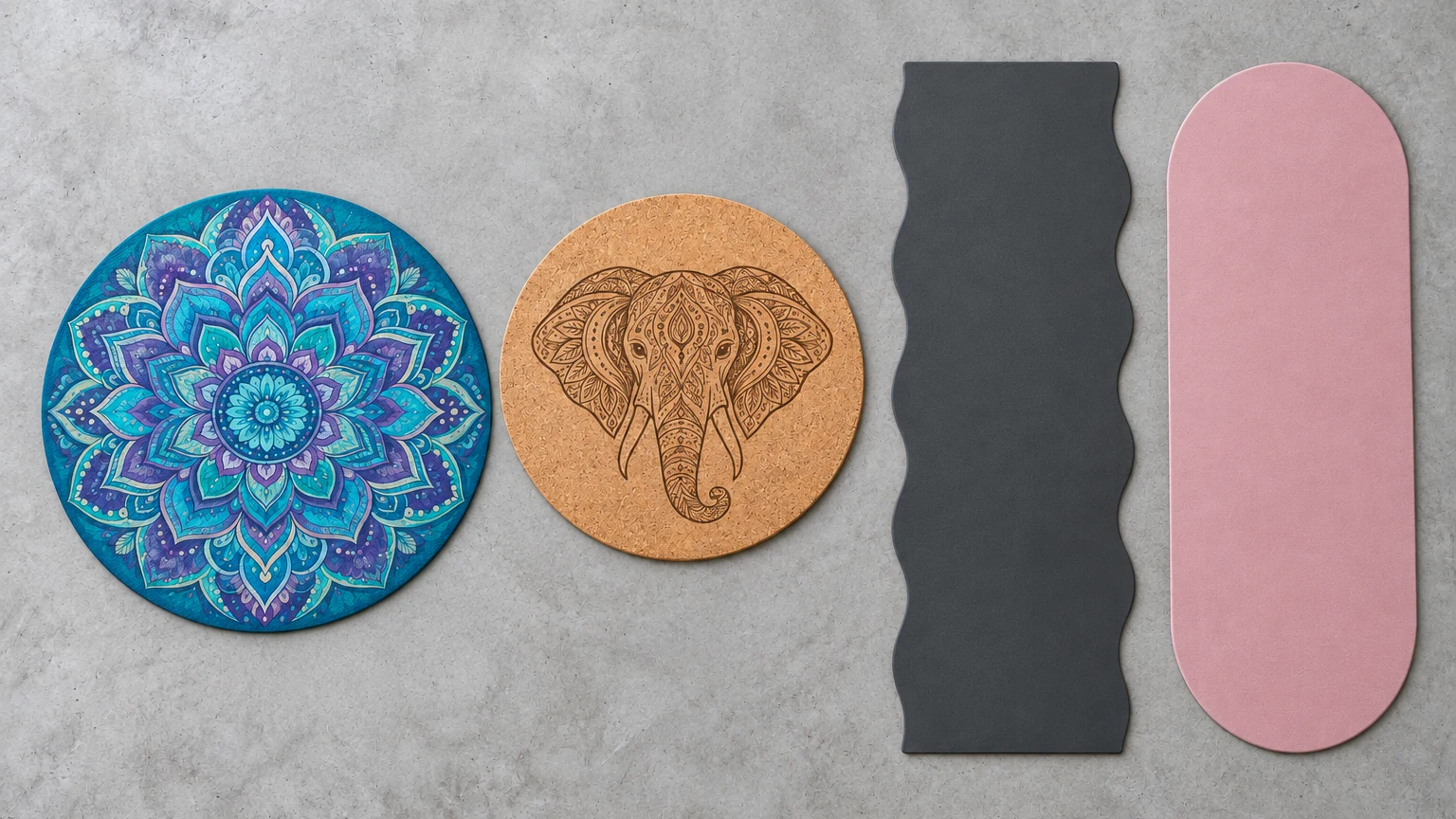
The 183×61cm rectangle is the cheapest mat to make because every line is set up for it. Moving away from it costs less than buyers expect: extended lengths and wider formats typically add $0.40–$1.20 per mat in material, with a one-time setup of $100–$200 only when the cut needs equipment changes. Our custom sizing guide has the full size table and a height-to-length chart you can reuse on a product page.
Shape is a different conversation. Round, oval and rounded-corner mats need their own cutting die, and the die is the cost, not the material. Round mats are popular for meditation and kids’ lines, and oval mats carry most of the shaped-Pilates market; how brands position them is covered in marketing oval Pilates mats.
3. Thickness
4–6mm covers most yoga orders, and 6mm is the best-selling single spec in the category. Below that you’re in travel-mat territory (1.5–2mm), and above 8mm you’re building something closer to a Pilates or exercise mat. The thickness choice changes more than comfort: it changes roll diameter, carton count and freight cost. A 6mm mat and an 8mm mat at the same FOB price do not cost the same to land.
If the line is crossing into Pilates, the Pilates vs yoga mat product line guide covers what changes beyond thickness. For travel formats, foldable yoga mats are their own construction decision, not just a thinner version of a standard mat.
4. Surface Texture
Most buyers pick from the factory’s stock emboss patterns: pebble, wave, fine grid, smooth. Stock patterns cost nothing extra. A proprietary pattern needs a new embossing mold. There’s no list price for one: we quote it after reviewing the pattern, its depth and the mat size. It only makes sense if the brand will reorder the same texture across several seasons. How texture depth and pattern affect barefoot stability, and how to write it into a spec, is in our surface texture guide.
5. Color
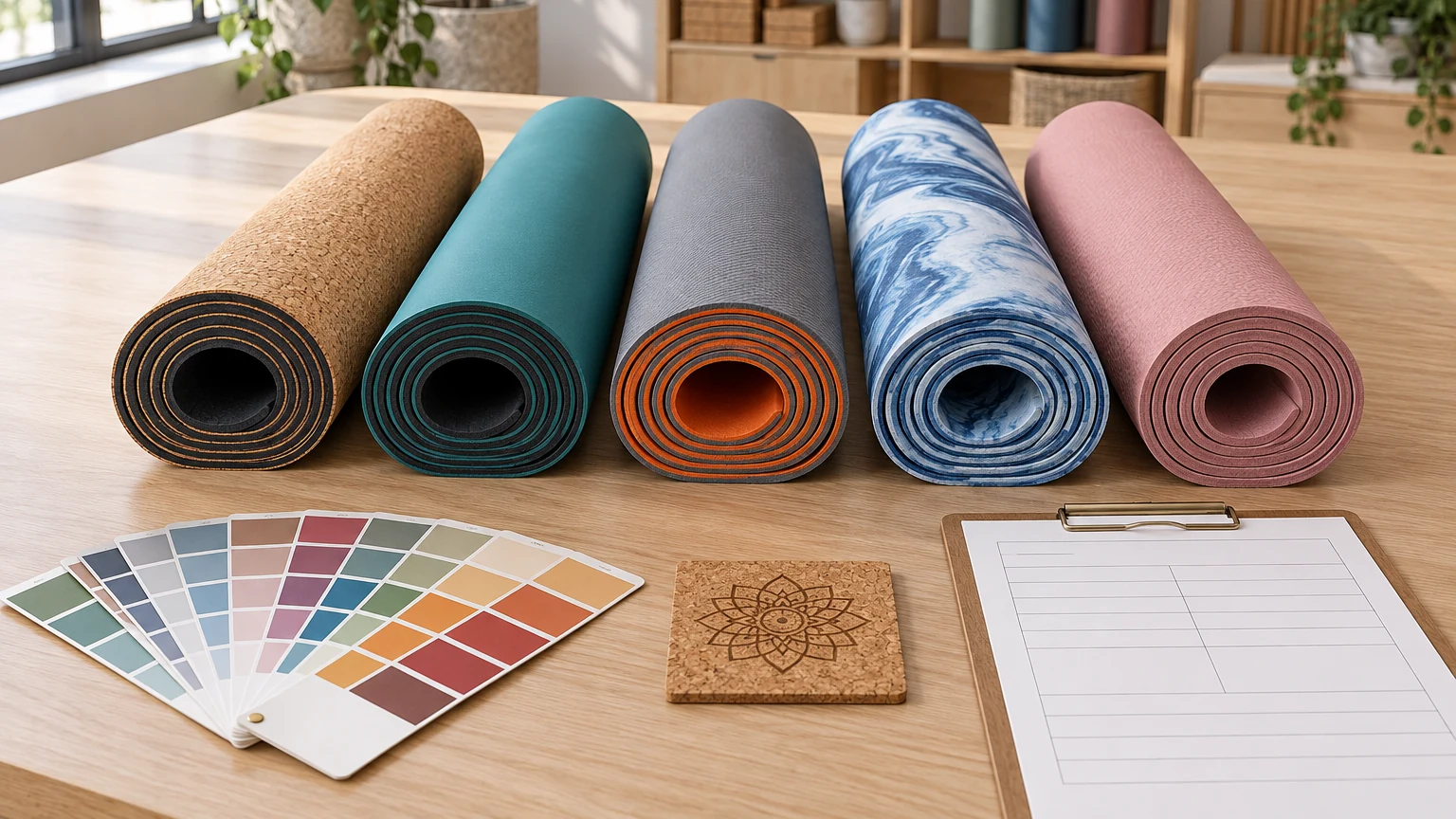
Stock colors have no extra cost and no color minimum. A Pantone-matched color usually adds $0.10–$0.40 per mat and carries its own minimum, often 300 units per color on TPE and PVC, because the compound has to be mixed as a batch. Two-tone TPE (a different color on each side) and marbled or tie-dye PU are popular upgrades that sit between stock and fully custom.
Color is also where approvals go wrong most often. Last spring a brand approved a pale sage from a PDF; on TPE under warehouse LEDs it read as grey, and the first carton photos came back with a single-word email: “grey?”. Since then we don’t start bulk on a Pantone color until a physical swatch has been signed, and the acceptable tolerance is written into the order. Which colors actually sell through, and which ones age badly in a catalog, is covered in yoga mat color trends for B2B buyers.
6. Print and Logo
This is where most of the branding happens, and the method has to match the material:
| Method | Works Best On | Look | Typical Adder |
|---|---|---|---|
| Laser engraving | Cork, PU | Tone-on-tone, premium, permanent | $0.30–$0.80 |
| Silk screen | TPE, PVC, NBR | Crisp spot colors, 1–3 colors | $0.20–$0.60 per color |
| UV print | Cork, PU, TPE | Full color, fine detail | $0.80–$2.00 |
| Sublimation | PU, suede microfiber | Edge-to-edge photographic print | $1.50–$3.50 |
| Embossing / debossing | TPE, NBR, rubber | Raised or pressed logo, no ink | Plate $100–$300 + small per-unit |
Picking the method is the easy part. Durability is harder: a logo that looks perfect on the sample can crack or fade at the hand-placement zone after six months of classes, which is why print durability after six months is worth reading before you commit. Then there’s consistency at volume: a logo that is centered on 50 mats and drifting 8mm on mat 3,000 is a QC problem, not a design one, and logo consistency on large orders covers how to specify against it.
For full-coverage designs, printed cork yoga mats explains which artwork prints well and which doesn’t, and pattern and print options covers stock pattern libraries versus fully custom artwork.
7. Functional Features
Small features that change how a mat is used, each adding roughly $0.15–$1.00:
- Alignment lines. Printed or laser-engraved guide lines, a strong seller in studio and online-class channels. Line layout is a design file like any other print. See alignment-line yoga mats.
- Eyelets. Metal grommets for wall or rail storage, mostly requested by studios. Specifying them changes the mat as well as the storage, as covered in studio mat storage and hanging specs.
- Fold grooves. Pressed fold lines that turn a foam mat into a folding travel product.
- Edge finish. Clean-cut, heat-sealed or bound edges. It matters most on thick foam and on mats that will be hung.
8. Packaging
Packaging decides what the customer sees before they touch the mat, and it also decides your carton count. The common formats run from a carry strap and polybag ($0.10–$0.40) through belly bands and printed boxes to full carry bags ($0.60–$7.00 depending on bag type). If a bag is part of the product, the mat and bag bundle guide shows what each bag format adds to cost, retail price and carton math. Labeling rules, retail-ready formats and the cost of over-designing a box are in yoga mat packaging design.
Which Customizations Survive at Which Order Size
Smaller brands mostly want to know one thing: “what can I actually get at 300 units?” From our order book:
| Order Size | Usually Available | Usually Not Worth It Yet |
|---|---|---|
| 200–300 | Logo (laser, screen, emboss), stock colors, stock textures, standard sizes, standard packaging with your label | Pantone colors on PVC/TPE, custom shapes, custom texture molds |
| 300–500 | All of the above, plus Pantone colors, size variants, full-color print, alignment lines, custom box | Proprietary texture molds, multi-layer constructions |
| 500–1,000 | Nearly everything, including die-cut shapes and multiple colorways | Very low per-colorway splits (e.g. 6 colors × 80 units) |
| 1,000+ | Full OEM: custom compound, custom texture tooling, signature shape | — |
If the budget is tight, put it where the customer looks. Nobody reviewing a mat on Amazon has ever mentioned the compound. How MOQ interacts with each customization choice is unpacked in how MOQ shapes custom yoga mat orders, and current price tiers and lead times are in the bulk order MOQ and pricing guide.
The Custom Spec Sheet: What to Send a Factory
A spec sheet doesn’t need to be elegant. It needs to be complete. This is the one-page version we wish every first inquiry arrived with:
| Field | Example Entry |
|---|---|
| Material & construction | TPE, single layer, two-tone |
| Dimensions | 183 × 61cm, ±1cm |
| Thickness | 6mm, ±0.3mm |
| Surface | Stock pebble texture, top side; smooth underside |
| Colors | Top Pantone 7535 C / bottom Pantone Cool Gray 9 C |
| Logo | Laser engrave, 8cm wide, centered 6cm from short edge |
| Features | Printed alignment lines, layout file attached |
| Packaging | Carry strap + recyclable belly band, 4-color print |
| Quantity | 500 units per colorway, 2 colorways |
| Market | US retail (Amazon + DTC) |
| Compliance | CA65 test report required before bulk |
| Target FOB | $7.50–$8.50 |
Two fields people leave out matter more than they think. Market tells the factory which compliance testing to plan for. Target FOB lets the factory say “this spec won’t hit that number, but this one will” instead of quoting the brief literally and losing you on price. Neither field commits you to anything.
From Proof to Production: The Four Approvals
There are four sign-offs before bulk. Buyers in a hurry sometimes ask to skip one. We get it — but each time we’ve agreed, the problem turned up on the production line, where the fix was scrapped material rather than an edited file.
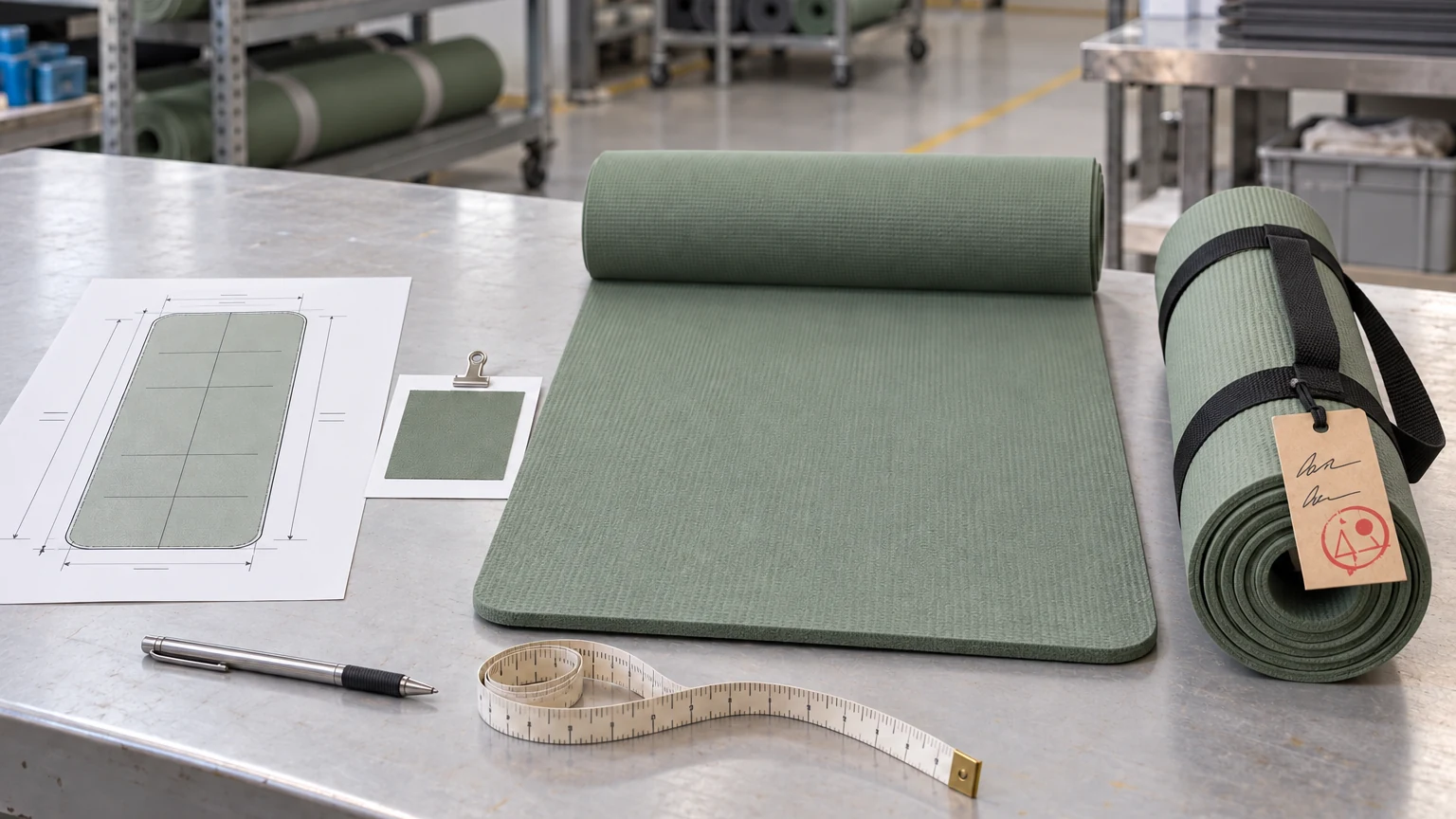
1. Digital proof. A flat drawing of the mat with dimensions, logo position, colors and line layout. Check measurements here, not on the sample. Moving a logo on a file takes a minute; moving it after the plate is made takes a new plate.
2. Strike-off and color swatch. For Pantone colors and printed designs, a physical swatch or a printed test piece on the actual material. This is where you find out that your pale sage reads grey on TPE, or that a fine line in your artwork fills in on cork.
3. Pre-production sample. A complete mat made on the production line, typically 5–10 working days. Roll it, unroll it, leave it flat overnight, clean it with whatever your customers will use. One client in Colorado tests every sample the same way: polished studio floor, socks on, a full sun salutation. Not exactly lab method. It has still caught two bases that slid on wood, which our measurements had passed.
4. Golden sample. The approved sample is signed, dated and kept by both sides. Bulk production is inspected against it, and it is the reference if anything is disputed later. A buyer who keeps no golden sample has nothing to point at when a batch comes out slightly different.
For first orders, plan one to two revision rounds. The full ordering sequence around these approvals (supplier shortlist, compliance, shipping) is in our yoga mat sourcing guide, the companion to this one.
Custom Mats by Buyer Type
Ask a studio owner and a DTC founder to rank the eight customizations above and you’ll get two nearly opposite lists. Roughly how it splits:
Private label and DTC brands spend on color, print and packaging, because those carry the brand on a product page. A common structure is one hero spec in two or three colorways, then line extensions later. Brands deciding between one mat and two tiers should read beginner vs performance yoga mat lines.
Activewear brands want the mat to match the apparel range, which means Pantone colors and a tightly controlled logo. The process from first sketch to delivered stock is laid out in personalizing yoga mats for an activewear brand.
Studios and gym chains prioritize durability, dark colors, eyelets for hanging and a small logo. Studio house mats and studio retail mats are often two different specs; see yoga mats for studios vs home use.
Event, corporate and co-branding buyers order short runs with heavy branding and fixed delivery dates. The pop-up event custom mat guide and the travel mat co-branding guide cover those formats.
Distributors and niche retailers customize across segments (plus-size, travel, kids) rather than deep into one SKU. Our specialty yoga mat sourcing guide maps which niches justify their own specification.
Five Customization Mistakes We See Every Season
- Customizing what the customer never sees. A bespoke compound in a mat sold on a product page that only shows color and logo. Put the budget where the customer looks.
- Too many colorways on a small order. We once produced 480 mats in six colors for a launch. Four months later the brand reordered 400 — all in the black.
- Picking a print method from a photo. Sublimation on a TPE mat isn’t possible, and fine-line UV artwork on coarse cork loses detail. Choose the method with the material, not after it.
- Approving color on a screen. Sign off on a physical swatch under the light your customers shop in.
- No target price on the brief. We can usually suggest a cheaper thickness or print method to land a price, but only if someone tells us the price.
Customizing with Wellfitsource
We make PVC, TPE, cork, PU and suede yoga mats in one facility in Yangzhou, so a brand can run a TPE core line and a PU flagship with one account manager, one QC standard and one container. Our yoga mat range covers the catalog constructions used for ODM orders. For custom work, we usually start from your photo and the spec sheet above and send a digital proof within a few working days.
Send us your spec sheet or a reference photo →
FAQ
What is the difference between OEM and ODM yoga mats?
ODM means you start from the factory’s existing mat design and add your branding, sometimes with modifications such as your colors or a size variant. OEM means the mat is built to your own specification: material blend, layer construction, texture, shape. ODM is faster and starts at 200–300 units; full OEM usually starts at 500–1,000 units and may need tooling.
What is the minimum order for custom yoga mats?
200–300 units for a catalog mat with your logo, 300–500 for most private label orders with custom colors and print, and 500–1,000 or more for a fully custom construction. Pantone colors often carry their own minimum per color, which is why many brands launch with two colorways rather than five.
How much does it cost to customize a yoga mat?
Material sets the base price, roughly $3.50–$20 FOB per mat. On top of that, a logo adds about $0.20–$3.50 depending on method, a non-standard size $0.40–$1.20, Pantone color matching $0.10–$0.40, and a custom surface texture needs one-time tooling that is quoted after we evaluate the pattern. Packaging can add anything from $0.10 for a strap to several dollars for a carry bag.
How long does a custom yoga mat order take?
Sampling takes 5–10 working days per round, with one or two rounds on a first order. Production then runs about three to five weeks for most materials, longer for PU because of lamination. Add four to six weeks of sea freight, and a first custom order typically lands 10–16 weeks after the first inquiry.
Can I customize the shape of a yoga mat?
Yes. Round, oval and rounded-corner mats are made with a custom cutting die, usually a one-time cost of $100–$200, and work best on TPE, cork and PU. Shaped mats generally need 500 units or more to spread the die cost sensibly.
The Custom Yoga Mat Library
Material
- Yoga mat materials compared: TPE vs PU vs Cork vs PVC, the material pillar
- TPE vs natural rubber · TPE safety and compliance · Custom PU yoga mats
Size, thickness and shape
Surface, color and print
- Surface texture · Color trends for buyers · Printed cork mats · Print durability · Logo consistency on large orders
Features and packaging
Product line planning
Ready to order?
- Yoga mat sourcing: the complete B2B buyer’s guide, the ordering pillar · MOQ and custom orders · Bulk MOQ, pricing, lead times