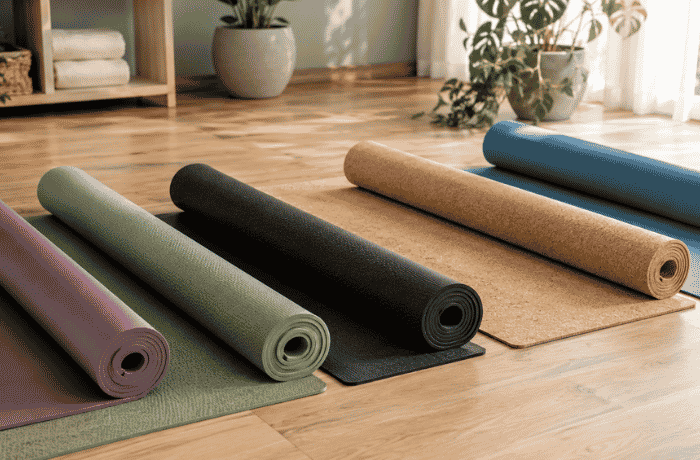
Ask five suppliers which yoga mat material is “best” and you will get five sales pitches. We run production lines for all four materials in the same facility, so we have no horse in that race — and our honest answer is that the question itself is wrong. PVC is the entry-level workhorse, TPE is the eco-friendly mid-tier, Cork delivers natural grip for the sustainability market, and PU is the premium choice for hot yoga and specialty retail. The right material depends on your target channel, retail price point, and compliance requirements — not on some absolute ranking.
Quick Summary
- PVC delivers the lowest FOB cost ($3.50–$8.00) and the widest color range, but faces REACH phthalate restrictions in the EU and growing consumer pushback on plastic-based products.
- TPE is the fastest-growing mid-tier material — recyclable, lighter than PVC, cleaner compliance profile, and suitable for brands positioning between $25–$55 retail.
- Cork is the go-to for sustainability-led brands; the natural grip-in-moisture property makes it a direct competitor to PU in the hot yoga segment at a lower price point.
- PU (natural rubber + polyurethane top layer) is the highest-margin material — $60–$150+ retail, best-in-class sweat-activated grip, and the standard specification for premium studio and DTC brands.
- Certifications vary significantly by material: PVC carries the highest REACH risk; PU requires natural rubber latex allergy labeling in the EU; all four materials require CA65 testing for US retail.
Why Material Choice Is a B2B Business Decision
Most sourcing guides compare yoga mat materials from a practitioner’s perspective — feel, grip, sustainability credentials. For B2B buyers, the decision is different. Material selection determines:
- Retail price ceiling — PVC cannot credibly sell above $35; PU can sell at $150+
- Gross margin — a higher FOB cost does not mean a lower margin if the retail price scales proportionally
- Compliance burden — PVC carries the highest regulatory risk in EU markets; PU requires latex allergy labeling
- Target channel fit — mass market and Amazon basics favor PVC and TPE; specialty retail and DTC premium favor Cork and PU
- Brand positioning — sustainability brands cannot use PVC; performance brands cannot use low-density TPE
Getting the material decision right before sampling is critical. We once watched a client lock in a PVC formulation for an EU launch before running REACH screening — the phthalate result came back over the limit, the compound had to be reformulated twice, and the launch slipped by nine weeks. Reformulating after a failed compliance test typically adds 6–10 weeks and $1,500–$4,000 in retesting and resampling costs, and none of it shows up in the original quote.
All Four Materials at a Glance
| Dimension | PVC | TPE | Cork | PU |
|---|---|---|---|---|
| Base material | PVC foam | Thermoplastic elastomer | Cork + rubber backing | Natural rubber |
| Top surface | PVC | TPE | Cork | Polyurethane microfiber |
| Typical thickness | 4–8mm | 4–6mm | 3–5mm cork + 1–2mm rubber | 3–5mm NR + 0.5–1mm PU |
| Weight (183×61cm) | 1.0–1.5 kg | 0.9–1.2 kg | 1.5–2.0 kg | 1.5–2.2 kg |
| Grip (dry) | Good | Good | Excellent | Excellent |
| Grip (wet/sweat) | Degrades | Degrades | Improves | Improves significantly |
| Durability | High | Medium-High | Medium | High |
| Eco credentials | Low (PVC = plastic) | Medium (recyclable) | High (natural material) | Medium (natural rubber base, synthetic top) |
| FOB cost range | $3.50–$8.00 | $6.00–$14.00 | $8.00–$16.00 | $12.00–$20.00 |
| Typical retail price | $15–$35 | $25–$55 | $45–$90 | $60–$150+ |
| EU REACH risk | High (phthalates) | Low | Low | Medium (rubber processing agents) |
| CA65 required (US) | Yes | Yes | Yes | Yes |
| Latex allergy labeling (EU) | No | No | No | Yes (natural rubber) |
| MOQ (OEM) | 500–1,000 units | 500–1,000 units | 300–500 units | 200–500 units |
| Sample lead time | 5–10 working days | 5–10 working days | 5–10 working days | 5–10 working days |
PVC Yoga Mat: The Volume Play
PVC yoga mats remain the dominant product by unit volume in the global yoga mat market — not because PVC is the best material, but because it is the most cost-effective to manufacture at scale. Nobody brags about PVC on their packaging anymore, yet it still moves more units through our facility than any other single material. For brands competing on price or building high-volume Amazon listings, PVC remains the starting point.
What PVC Does Well
Color range and print quality. PVC accepts the widest range of Pantone colors and supports full-surface printing with exceptional clarity. For brands where visual identity and colorway differentiation are central to positioning, PVC offers the most flexibility at the lowest cost.
Durability and dimensional stability. A well-manufactured PVC mat at 6mm thickness will maintain its shape and grip performance for 2–3 years under regular use. The material does not absorb water, making it easy to clean and consistent in performance across humidity conditions.
Price accessibility. At $3.50–$8.00 FOB, PVC mats support aggressive price positioning. For Amazon sellers competing in the $19.99–$29.99 range, PVC is the only material with workable margins at that price point.
Where PVC Falls Short
REACH compliance risk. PVC yoga mats are among the highest-risk products for REACH phthalate violations in the EU. Phthalate plasticizers (DEHP, DBP, BBP) are commonly used in PVC formulations and are on the ECHA SVHC candidate list with strict concentration limits. Brands exporting PVC mats to EU markets must commission REACH SVHC screening reports before shipment — and must be prepared to reformulate if the plasticizer compound fails.
Consumer perception. “PVC” is increasingly a negative signal for consumer-facing brands in wellness and sustainability. DTC brands targeting health-conscious buyers often avoid PVC in product copy entirely — which creates a brand authenticity problem when the material specification is visible on packaging or compliance labels.
Not suitable for hot yoga positioning. PVC grip degrades with sweat. A brand positioning for Bikram or power yoga cannot credibly use PVC at any price point.
Who PVC Is Right For
- Amazon FBA sellers building volume in the $19.99–$34.99 range
- Brands focused on mass-market or value retail channels
- Private label buyers testing category demand before committing to a premium material
- Gym and studio operators buying functional mats in bulk without brand positioning requirements
TPE Yoga Mat: The Eco-Friendly Mid-Tier
TPE yoga mats have grown from a niche alternative to PVC into the default mid-market specification over the past five years. The material is a thermoplastic elastomer blend — softer than PVC, lighter, recyclable at end of life, and free from the phthalate concerns that burden PVC in EU markets.
What TPE Does Well
Clean compliance profile. TPE does not use phthalate plasticizers, which eliminates the primary REACH risk associated with PVC. CA65 testing is still required for US market sales (colorants and other additives can trigger Prop 65 thresholds), but the reformulation risk is substantially lower than with PVC. For the full certification checklist and what to verify with a supplier before ordering, see our guide to TPE yoga mat safety and compliance.
Weight and portability. A 6mm TPE mat typically weighs 900g–1.2kg — meaningfully lighter than a cork or PU mat of equivalent thickness. For brands targeting the travel yoga segment or creating products for commuter-oriented practitioners, TPE’s weight advantage is a genuine selling point.
Sustainability positioning. TPE mats are marketed as recyclable, free from PVC, and often described as “eco-friendly.” While the eco credentials are weaker than cork or natural rubber (TPE is still a synthetic polymer), the positioning works in mid-market channels where “PVC-free” is sufficient differentiation.
Price-to-quality ratio at mid-tier. At $6–$14 FOB, TPE supports retail prices between $25–$55 with healthy margins. For brands that have graduated beyond PVC but cannot yet justify the cost of PU, TPE is the natural next step.
Where TPE Falls Short
Grip in wet conditions. Like PVC, TPE grip degrades with moisture. This is not a problem for general yoga practice but disqualifies TPE from hot yoga and high-intensity sweat scenarios.
Durability ceiling. TPE mats tend to show wear and surface compression faster than PVC or PU under heavy daily use. TPE is our highest-volume material and we still tell studio buyers this upfront: in a room running ten classes a day, a TPE house mat will look tired a year before a PVC one does. For studio environments with high-frequency use, TPE’s lifespan is shorter than PVC or natural rubber alternatives.
Limited premium positioning. A TPE mat can credibly retail at $55, but rarely above it. Attempting to position a TPE mat as a premium product in a market where cork and PU exist at the same price point is a difficult brand argument.
In practice, two follow-up questions come up in almost every TPE quote conversation we have. The first: “should we just go natural rubber for the eco story?” — sometimes yes, often no, and the TPE vs natural rubber comparison walks through when the step-up actually earns its cost. The second is thickness, where the answer is boring but true: the 6mm TPE spec has been the category’s best-selling default for years, and most brands should start there.
Who TPE Is Right For
- Brands positioning in the $25–$55 retail range with sustainability messaging
- Private label buyers targeting health-conscious consumers who want PVC-free without the cost of natural materials
- Amazon FBA sellers building credibility above the value tier
- Studio and fitness chain operators wanting a serviceable bulk mat with cleaner marketing claims
Cork Yoga Mat: The Natural Grip Specialist
Cork yoga mats occupy a specific and growing niche in the yoga market: practitioners who want natural materials, a firm grip surface, and sustainable credentials. Cork’s physical property of improving grip with moisture makes it the primary challenger to PU in the hot yoga and dynamic practice segment — at a lower price point than PU.
What Cork Does Well
Sweat-activated grip. Cork contains suberin, a natural waxy polymer that becomes tackier when wet. This means a cork yoga mat grips better during a sweaty practice than it does dry — the exact opposite of PVC and TPE, and comparable to PU. For brands targeting hot yoga without the cost premium of PU, cork is the most defensible natural alternative.
Natural antimicrobial properties. Cork is naturally resistant to bacteria, mold, and mildew. In shared studio environments where hygiene is a concern, cork’s antimicrobial properties are a genuine functional benefit — not just a marketing claim. It is also, in our experience, the spec detail that studio procurement teams ask about unprompted.
Sustainability story. Cork is harvested from the bark of cork oak trees without cutting them down, making it one of the most genuinely sustainable materials in the yoga mat market. For brands whose positioning is built around environmental accountability, cork offers a credible, verifiable story.
Premium visual identity. The natural texture and warm appearance of cork creates distinctive product photography that stands out in cluttered Amazon category pages and DTC product galleries. Cork also takes surface printing well — printed cork designs let brands combine the natural-material story with a differentiated visual identity in the same SKU.
Where Cork Falls Short
Weight. Cork is denser than TPE and comparable to PU in weight. A 183×61cm cork mat with rubber backing typically weighs 1.5–2.0kg. For the travel segment, this is a significant disadvantage.
Surface rigidity. Cork’s firm surface can feel hard relative to foam-based materials at equivalent thickness. This is a feature for experienced practitioners seeking stability, but a friction point for beginners expecting the cushioned feel of a foam mat.
Price point. Cork mats require natural cork material, which is more expensive than foam compounds. At $8–$16 FOB, cork commands retail prices of $45–$90 — a range that requires stronger brand authority and marketing to justify versus the TPE alternatives at the same price point. The cork orders that succeed, from what we see repeat, are the ones where the brand already had a sustainability story before the mat — not the ones hoping the material would create one.
Who Cork Is Right For
- Sustainability brands with strong brand identity and storytelling capability
- Hot yoga studios and brands targeting sweat-intensive practice
- DTC brands with audiences willing to pay $60–$90 for natural materials
- Premium private label lines looking for natural-material differentiation from TPE competitors
PU Yoga Mat: The Premium Performance Standard
PU yoga mats — natural rubber base with a polyurethane microfiber top layer — are the highest-margin product in the yoga mat category and the standard specification for premium studio brands, high-end DTC, and specialty retail placements.
The combination of a natural rubber base (firm cushioning, excellent energy return) with a PU microfiber surface (soft touch, sweat-activated grip, photographic-quality print capability) delivers the performance and visual premium that cannot be replicated in PVC, TPE, or even cork.
What Sets PU Apart for B2B Buyers
Grip that improves with sweat. PU microfiber becomes tackier under moisture — the mechanism is different from cork (suberin) but the functional result is the same. This property makes PU the dominant material in the hot yoga and power yoga premium segment; the spec details that matter for that positioning are covered in our PU mats for hot yoga guide.
Print quality and visual premium. Full-bleed sublimation printing on a PU surface achieves photographic-quality designs with color depth that PVC, TPE, and cork cannot match. For brands where the mat is also a brand communication tool, PU is the only material that supports truly premium visual execution.
Margin ceiling. A PU mat can credibly retail at $60, $90, $120, or $150. No other yoga mat material supports this price ceiling. At $12–$20 FOB and $80+ retail, the gross margin mathematics at scale are the strongest of any yoga mat material.
PU is also where specification conversations get long — natural rubber base thickness, PU layer weight, bundle configurations, latex labeling. Rather than compress all of that here, we keep it in a dedicated PU yoga mat sourcing guide.
Who PU Is Right For
- Premium DTC brands targeting serious practitioners and wellness consumers
- Studio brands creating a flagship product for their instructor or retail line
- Amazon FBA sellers who have validated demand in the $49.99+ price range and are ready to invest in differentiation
- Private label brands pitching to specialty retailers (REI, boutique yoga studios, wellness retailers)
Beyond the Big Four: Natural Rubber and Suede Microfiber
Two materials sit adjacent to the four above and come up regularly in sourcing conversations.
Natural rubber (without a PU top layer) is the strongest eco-positioning foam base available — biodegradable, high-density, excellent cushioning. Its trade-offs are weight, cost, and the EU latex allergy labeling requirement it shares with PU. Most brands encounter natural rubber as the step-up question from TPE; the TPE vs natural rubber comparison covers when that step-up earns its cost and when it doesn’t.
Suede microfiber is a surface option rather than a base material — a brushed microfiber top layer (usually over natural rubber) that takes full-surface sublimation printing exceptionally well and, like PU and cork, grips better when damp. It is the default choice for design-led brands where the mat surface is the canvas. Construction, print methods, and typical MOQs are covered in our suede yoga mat guide.
Whichever surface you choose, texture is a specification of its own — pattern depth and finish measurably affect barefoot stability, which is why surface texture deserves a line in the spec sheet rather than being left to factory default.
Certifications by Material: What Changes and What Stays the Same
| Certification | PVC | TPE | Cork | PU |
|---|---|---|---|---|
| REACH SVHC (EU) | 🔴 High risk — phthalate plasticizers commonly found | 🟡 Low-medium — colorant and additive screening needed | 🟢 Low risk — natural material, minimal restricted substances | 🟡 Medium — rubber processing agents require screening |
| CA65 / Prop 65 (US) | Required | Required | Required | Required |
| CE Marking (EU) | Required | Required | Required | Required |
| UKCA (UK) | Required | Required | Required | Required |
| Latex allergy label (EU) | Not required | Not required | Not required | Required — contains natural rubber |
| OEKO-TEX STANDARD 100 | Available — differentiates from non-certified PVC | Available | Available | Available — increasingly requested by EU buyers |
| BSCI Factory Audit | Required by most retailers | Required by most retailers | Required by most retailers | Required by most retailers |
The practical implication: PVC requires the most rigorous REACH testing and carries the highest reformulation risk for EU-bound products. PU adds a unique requirement — latex allergy labeling — that neither PVC, TPE, nor cork need. For all four materials, CA65 testing for US retail and CE marking for EU are non-negotiable.
Two related guides go deeper here: what “non-toxic” claims actually require in certification terms before they can go on packaging, and how to verify a certified yoga mat manufacturer — which documents to request and how to read an audit report.
Choosing the Right Material for Your Brand
This framework maps the four materials to the business scenarios where each is most likely to succeed.
| If your brand… | Recommended material |
|---|---|
| Is launching a first product on Amazon FBA with a budget under $10K | PVC — lowest MOQ cost, fastest demand validation |
| Is building a mid-market brand with sustainability messaging | TPE — clean compliance, PVC-free positioning, mid-tier margin |
| Targets hot yoga, power yoga, or any sweat-intensive practice | Cork (if sustainability is central) or PU (if premium performance is central) |
| Is pitching to specialty retailers or building a premium DTC brand | PU — the only material that supports $80+ retail without brand friction |
| Wants to match competitor products already selling at $45–$75 with cork positioning | Cork — credible challenger to PU at a lower entry cost |
| Has validated demand and wants to invest in product differentiation | OEM PU with custom texture — creates a defensible product competitors cannot replicate from the same factory catalog |
| Is sourcing for studio bulk supply (high use, low cost per unit) | PVC (functional) or TPE (if studio has sustainability policy) |
A note on mixed-range strategies: many scaling brands run TPE for their mid-tier SKU and PU for their flagship SKU simultaneously — using TPE to capture the accessible price point while PU anchors the premium brand narrative. Roughly a third of our repeat OEM accounts run exactly this two-material structure. It requires two separate factory relationships or a single supplier capable of both materials — and honestly, coordinating two factories for one product line is where we see most of the avoidable quality drift happen.
From Material Decision to Purchase Order
Material selection is the first of three decisions in a yoga mat sourcing project, and the next two each have their own guide:
Specification. Once the material is fixed, dimensions, thickness, surface finish, and branding method define the actual SKU. Start with custom sizing options and their OEM cost if your line extends beyond the 183×61cm standard, and how to personalize yoga mats for an activewear brand for the branding workflow from artwork to approved sample.
Ordering. The commercial layer — MOQ tiers, unit pricing, and lead times sets expectations for the quote stage, DDP vs FOB shipping terms determines your landed cost, and our buyer’s guide to yoga mat manufacturers in China covers how to shortlist suppliers before requesting samples.
Wellfitsource: All Four Materials, One Supplier
We manufacture all four yoga mat materials — PVC, TPE, cork, and PU — from our Yangzhou, Jiangsu facility, with ODM catalog options and full OEM customization across the entire yoga mat range.
For brands sourcing multiple materials — a TPE mid-tier and a PU flagship, for example — single-supplier sourcing eliminates the coordination overhead of managing separate factory relationships, separate BSCI audits, and separate quality standards. One account manager, one pre-shipment inspection standard, one invoice.
Compliance documentation available before sampling: We maintain current CA65 Prop 65 test reports, REACH SVHC screening reports, and CE Declarations of Conformity for our standard material specifications across all four mat types. Brands can review existing test documentation before committing to a sample order.
Sample lead time: 5–10 working days across all four materials.
MOQ: From 200 units (PU, ODM) to 500–1,000 units (PVC/TPE, OEM with custom tooling).
Request a material comparison sample set or a formal quote →
FAQ
Which yoga mat material has the best margins for private label brands?
On paper, PU — $12–$20 FOB versus $60–$150+ retail, because the retail premium far exceeds the manufacturing cost premium. But that answer assumes your brand can actually command $80+ retail, which is a brand question, not a material question. TPE often delivers stronger real-world margins for brands at the $25–$55 tier because the FOB cost ($6–$14) is low relative to achievable pricing in that segment. PVC has the lowest absolute margin in dollar terms despite the lowest FOB cost — the retail price ceiling limits the upside.
Can I source two different materials from the same factory?
Yes, provided the factory has production lines for both. At Wellfitsource, we manufacture PVC, TPE, cork, and PU from a single facility, which means brands running a multi-material product line can work with one supplier, one account manager, and one QC standard. This is particularly relevant for brands with a mid-tier TPE SKU and a premium PU SKU, or brands expanding from a PVC entry product into a cork or PU premium line.
Does switching from PVC to TPE or cork require new compliance testing?
Yes. Each material change requires new compliance testing because the chemical composition changes entirely. REACH SVHC test reports and CA65 test reports are material-specific — a clean report for a PVC formulation provides no information about a TPE compound. Budget 2–3 weeks and $400–$700 per market per material for compliance testing when transitioning materials.
Which material is best for a yoga studio buying in bulk?
For studio bulk purchases, the decision typically comes down to use frequency and cleaning protocol. High-frequency studio use (10+ sessions per day) favors PVC or PU for durability. Studios with sustainability policies or member wellness branding lean toward TPE or cork. Studios investing in premium equipment for instructor use or retail sales default to PU. For budget studio supply at the highest per-unit volume, PVC remains the most cost-effective choice.
The Yoga Mat Materials Library
This guide is the hub for our material-level coverage. Go deeper by material or by decision stage:
By material
- TPE: Safety and compliance checklist · TPE vs natural rubber · The 6mm best-seller spec
- PU: B2B sourcing guide · PU for hot yoga lines
- Cork: Printed cork design options
- Suede microfiber: Construction, printing, and MOQ
By decision stage
- Compliance: What “non-toxic” claims require · Verifying a certified manufacturer
- Surface & design: Texture and barefoot stability · Print durability after 6 months · 2026 color trends for buyers
- Specification: Custom sizing beyond 183cm · How MOQ shapes custom orders
- Ordering: Bulk MOQ tiers, pricing, lead times · DDP vs FOB landed cost · China manufacturer shortlist guide
- The bigger picture: The Complete OEM Fitness Equipment Manufacturing Guide