Author: Wellfitsource Product & Sourcing Team · Published: May 2025 · Updated: September 2026
Most studio owners pick the rack first and the mats second. That order feels natural — the wall is there, the budget line for fixtures is there — but it’s backwards. How a studio stores its house mats decides how they dry, how fast the edges wear, what the room smells like by Thursday, and whether a given material makes it to its first anniversary.
We make house mats for studios and gym chains, and the support emails that arrive around month six are remarkably repetitive. “The mats curl.” “The holes are tearing.” “The back room smells.” When we ask for a photo of where the mats live, the answer is almost always sitting right there in the picture: a mat that was never specified for the way it’s being stored.
Quick Summary
- Hanging storage is the hygiene and space winner for busy studios — mats dry fully and floor space stays clear — but it requires mats with reinforced hanging holes and a material that won’t stretch under its own weight.
- Rolled storage suits smaller studios and mixed-use rooms, and works with almost any material, but mats should be rolled top-side out to fight edge curl.
- Flat stacking is the most space-hungry and the worst for drying — best limited to low-frequency rooms.
- Material matters: TPE and PVC hang well; cork can crack at fold and hanging points; heavier natural rubber and PU mats need stronger hardware.
- Order specs that follow from storage: grommet holes, strap loops, anti-curl construction, darker colors for high-traffic rooms, and a matching mat towel or strap program.
Why Storage Belongs in the Mat Specification
Between one class and the next, storage quietly controls three things:
Drying. A mat wiped down after class still holds moisture on the surface and in any open texture. If it’s rolled or stacked damp, moisture gets trapped — which is where odor and mildew complaints come from, especially in hot yoga rooms.
Shape memory. Mats stored the same way for months take on that shape. Rolled mats develop edge curl; stacked mats compress unevenly; hung mats can stretch slightly if the material is soft and heavy.
Handling wear. Every time a student pulls a mat from storage, the edges and corners take the stress. A method that makes mats easy to grab one at a time wears them far less than one where students tug a mat out from under a stack.
A studio running ten classes a day handles its mats thousands of times a year. Small differences in how they’re stored compound quickly — which is why studio buyers get more out of a mat order when the storage plan is settled first. For the wider picture of how studio mats differ from home-use mats, see yoga mats for studios vs home use.
Hanging Storage: The High-Traffic Default
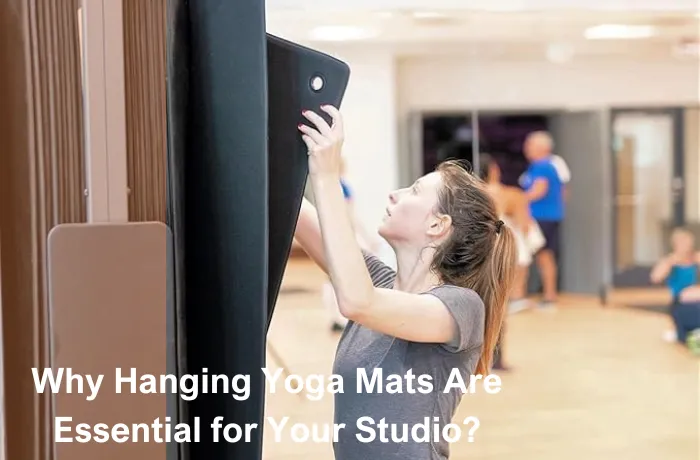
Wall-mounted hanging is the method most purpose-built studios end up with, for good reasons. Mats hang vertically, air circulates around both faces, floor space stays clear, and students can grab a single mat without disturbing the others. A simple wall rail with hooks set 5–8cm apart holds roughly 12–20 mats per meter of wall — a 6m wall in a 30-spot studio covers the whole class with room to spare.
What hanging asks of the mat:
- Hanging holes, reinforced. Mats are hung by holes near one short edge. The failure we see most often starts with a small saving: plain punched holes instead of reinforced ones. By month three or four, the holes on the most-used mats — always the ones nearest the door — have stretched into slots, and a few have torn through to the edge. The fix is metal grommets (eyelets) pressed into the holes, which spread the load and survive years of hanging. On a standard 61cm-wide mat we typically set two grommets with a 10–12mm inner diameter, about 3–4cm in from the short edge and 8–10cm in from each side, which keeps the mat hanging straight on standard studio hooks.
- A material that holds its shape under its own weight. TPE and PVC mats hang well. Heavier mats — natural rubber and PU over natural rubber, at 2kg and above — hang fine too but need sturdier hooks and grommets set a little further from the edge.
- Fully dry before hanging. Hanging is the best drying method, but only if mats aren’t dripping when they go up. After a normal class, a wipe-down and a minute of air is enough; after a hot yoga session at 38–40°C, give mats 10–15 minutes laid flat before they go on the wall.
Where hanging doesn’t suit: cork mats. Cork is firm, and hanging concentrates stress on a small area. Photos we’ve been sent of hung cork mats tend to show the same thing after a season — fine cracks fanning out from the hanging hole. Beautiful material, wrong storage. Studios that want cork should roll it or lay it flat.
Rolled Storage: Flexible, but Watch the Curl
Rolled storage — mats rolled and stood upright in a bin, cubby, or rack — is common in smaller studios, community rooms, and gyms where the yoga space doubles as something else. It works with almost every material and needs no special hardware.
What rolling asks of the mat:
- Roll top-side out. Almost everyone rolls a mat the other way by instinct, practice surface in. Rolling with the practice surface on the outside is the single most effective habit against edge curl, because the mat’s memory then pushes the edges down when it’s unrolled, not up. A laminated sign above the bin does more than any product feature here.
- Anti-curl construction helps. Some mats are built to lie flat faster after unrolling — typically denser compounds or mats with a slightly heavier base layer. Ask your supplier whether the mat you’re ordering lays flat quickly after being rolled for a day.
- Straps or bands keep rolls tidy. A mat strap or elastic band stops rolls loosening in the bin, which reduces the slow unravel that deforms edges over time.
- Give rolls air. Tightly packed bins trap moisture. Open-front cubbies or wire racks dry better than closed baskets.
Rolled storage is also where mat thickness matters most for capacity. A standard 183cm mat rolls to about 10cm across at 4mm, 12cm at 6mm, and 14cm at 8mm. That sounds like a small difference until you size the shelving: a 15×15cm cubby fits one 6mm roll comfortably, while 8mm rolls start jamming against the sides and get pulled out by their edges.
Flat Stacking: Use It Sparingly
Stacking mats flat on shelves or the floor is the simplest method and the least demanding on hardware. It’s also the worst for drying, the most space-hungry, and the hardest on the mats at the bottom, which carry the compression of everything above them.
If stacking is the only option, keep stacks short — roughly 10–15 mats per shelf — rotate which mats get used so the bottom of the pile doesn’t wear unevenly, and make sure mats are completely dry before they go on the pile. For low-frequency rooms such as a monthly workshop space or a corporate wellness room used a few times a week, stacking is perfectly workable.
Storage Method × Material: A Quick Reference
| Material | Hanging | Rolled | Flat Stacked | Notes |
|---|---|---|---|---|
| PVC | ✓ Excellent | ✓ Good | ✓ Good | Durable, holds shape well; the classic studio house mat |
| TPE | ✓ Good | ✓ Good | ⚠ Compresses | Light and easy to hang; softer grades compress when stacked |
| Natural rubber | ✓ Good (strong hooks) | ✓ Good | ✓ Good | Heavy; keep away from windows — sunlight degrades it |
| PU over natural rubber | ✓ Good (strong hooks) | ✓ Good | ✓ Good | Wipe dry before storing to protect the PU surface |
| Cork | ✗ Not recommended | ✓ Good | ✓ Good | Can crack at hanging points and fold lines |
For the full material trade-offs beyond storage — cost, grip, compliance — see our yoga mat materials comparison.
The Studio Order: Specifications That Follow from Storage
Once the storage method is set, these are the details worth writing into a house-mat order:
1. Grommets for hanging studios. Specify metal grommets, their number (usually two), and placement from the edge. Grommet color can match the mat or your brand palette. It’s a small unit-cost addition that prevents the most common hanging failure.
2. Color choice for maintenance. Darker colors — black, charcoal, navy, deep green — hide sweat marks and wear far better in high-traffic rooms. Many studios choose dark house mats and keep brighter colors for the retail shelf.
3. Size consistency. Mats that are all the same size hang evenly and stack neatly. If the studio uses extra-long or extra-wide mats for some students, plan storage for them separately. The options and their cost are covered in our custom sizing guide.
4. Branding that survives cleaning. House mats get wiped down after every class, often with disinfectant. Printed logos on the practice surface can fade under that routine; laser engraving or placing the logo near the hanging edge lasts longer. See how printing holds up after six months for the detail.
5. Accessories that support storage. Rolled-storage studios benefit from matching yoga straps to keep rolls tight. Hot yoga studios often pair mats with yoga towels, which reduce how much sweat reaches the mat in the first place — and make drying and storage easier.
6. Order quantity with a buffer. A reasonable planning figure is one mat per student spot plus a 10–15% rotation buffer, which lets mats rest and dry between heavy sessions and covers replacements without an emergency reorder. Order sizing and pricing tiers are covered in our bulk yoga mat MOQ guide.
Hygiene Routine by Storage Method
A consistent routine keeps house mats in service longer, whatever the storage:
- After every class: wipe the practice surface with a mild, mat-safe cleaner; let it air briefly before storing.
- Daily: for hanging studios, check that mats have space between them; for rolled storage, leave bin fronts open overnight.
- Weekly: deeper clean of the full mat surface, and wipe down hooks, bins, or shelves.
- Monthly: rotate mats between high-use and low-use positions; inspect grommets, edges, and surfaces for early wear.
Avoid harsh solvents and undiluted bleach on any material — they speed up surface breakdown and print fading. Natural rubber and PU mats in particular prefer gentle cleaners.
Sourcing Studio House Mats from Wellfitsource
We produce studio house mats in PVC, TPE, natural rubber, and PU with grommet hanging holes as a standard option, alongside the straps and towels that go with them. For studio chains, we can match size, color, grommet placement, and branding across multiple locations so every studio’s mats hang and look the same. Full specifications are available across our yoga mat range.
If you’re planning a studio order from scratch, our yoga mat sourcing guide walks through the full process from specification to delivery.
FAQ
What is the best way to store yoga mats in a studio?
It depends on how hard the room works. A studio running classes all day is almost always better off hanging mats on a wall rail — they dry properly and nobody digs through a pile. A smaller or shared room can roll mats into open cubbies without trouble. Flat stacking is fine for a room used a few times a week, and not much else.
Do yoga mats need holes to be hung?
Yes. Hanging mats need holes near one short edge, and for daily use those holes should be reinforced with metal grommets. Unreinforced holes in foam tear over time. Grommets can be specified when ordering mats from a manufacturer.
Can you hang a cork yoga mat?
It’s not recommended. Cork is firm and can crack at hanging points and along the hanging edge. Cork mats are better stored rolled or flat.
How do you stop yoga mats from curling?
Roll mats with the practice surface facing out, use straps to keep rolls from loosening, and choose mats with denser construction that lies flat quickly. Hanging storage avoids curl altogether.
How many mats should a studio order?
A practical starting point is one mat per student spot plus a 10–15% buffer. The buffer lets mats rest and dry between heavy sessions and covers wear-related replacements.