Author: Wellfitsource Product & Sourcing Team · Published: October 2025 · Updated: November 2026
The most common MOQ question we get is a plain one: “What’s your minimum?” The honest answer is that there isn’t one number. Fifty PU mats from stock is possible. Fifty custom-colored TPE mats isn’t, and the reason has nothing to do with how badly a factory wants the order.
A minimum exists because something in production has a fixed size: a batch of mixed compound, a lamination run, a cutting die, a printing screen. Once you know which of those your order touches, you can usually work out the minimum yourself, and you can see which customization to drop if the number is too high.
This page is about what each order size allows. For unit price and lead time by tier, see our bulk order MOQ and pricing guide.
Quick Summary
- There’s no single minimum. It depends on the material and on which customizations you add.
- Stock mats on a natural rubber base start lowest, at 50–200 units. That covers PU, suede and cork tops in standard sizes and stock colors, and no other materials.
- Catalog specs with your logo start at 200–300 units. Pantone colors usually need about 300 per color.
- TPE and PVC start higher, at 300–500, because the color is mixed into the compound batch.
- To lower a minimum, drop the customization that causes it. Stock color and standard size do the most.
Why Minimums Exist
Each one traces back to a physical limit in production:
| What sets the minimum | Why | Affects |
|---|---|---|
| Compound batch | TPE and PVC are mixed in batches, and the color goes in with the mix. A small color run wastes most of a batch. | Pantone colors on TPE and PVC |
| Lamination run | Setting up a PU, cork or suede lamination for a non-standard spec takes time and material before the first good mat comes off. | Custom layer specs, colored rubber bases |
| Cutting die | A non-rectangular shape needs its own die, usually $100–$200 one-time, which needs a reasonable number of mats to spread across. | Round, oval and shaped mats |
| Print setup | Each screen or plate has a setup cost, and each design is a separate run. | Multi-color logos, multiple designs |
| Embossing tooling | A proprietary surface pattern needs its own mold, quoted after evaluation. | Custom textures |
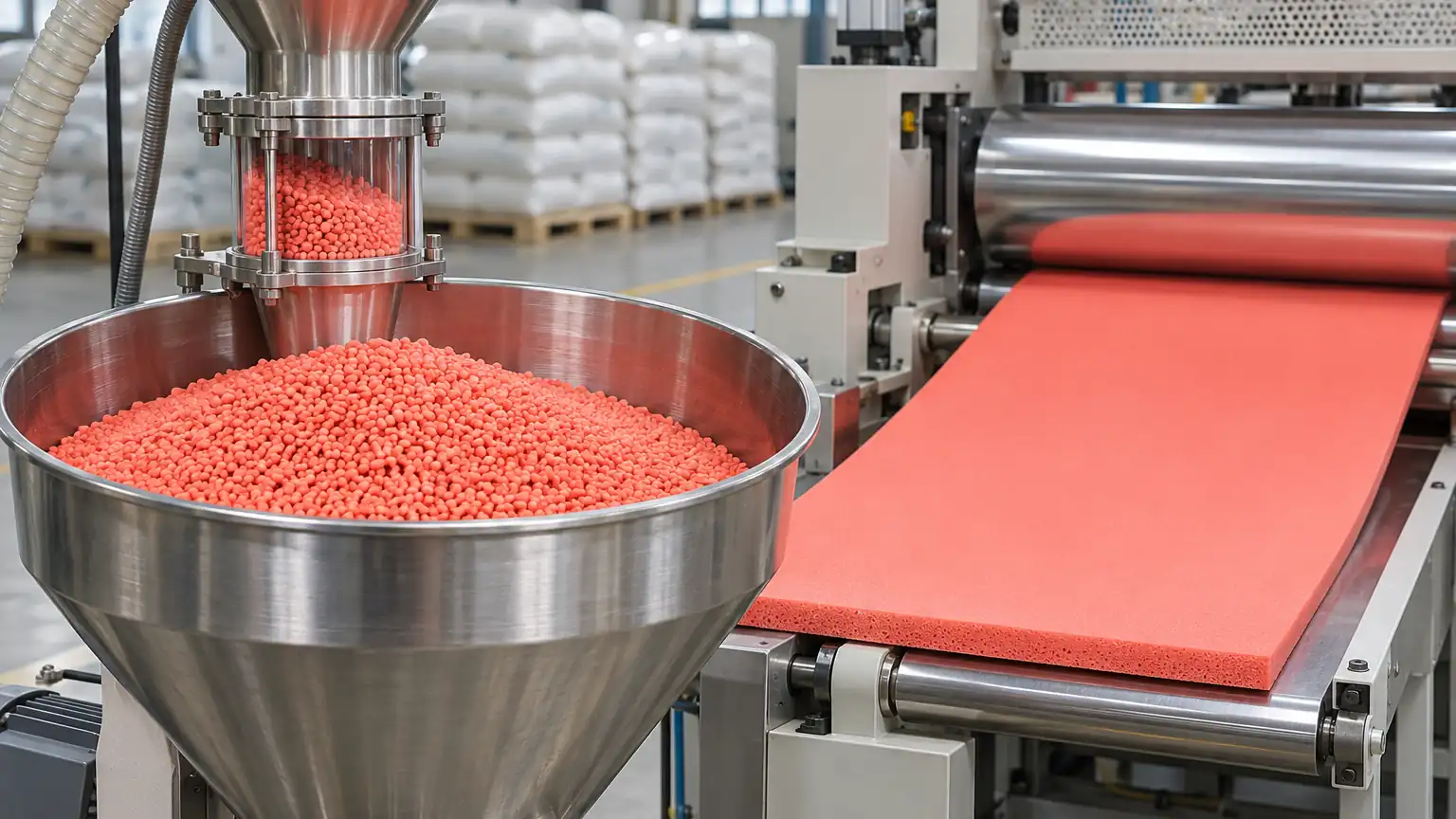
That’s why a logo rarely moves the minimum and a color often does. Laser engraving a logo needs a file and a machine setting. A Pantone TPE color needs its own batch of material.
What You Can Get at Each Quantity
| Order size | What’s realistic | What isn’t yet |
|---|---|---|
| 50–200 | Stock PU, suede or cork on natural rubber: standard size, stock color | Any other material; custom color, custom size or shape |
| 200–300 | Catalog spec with your logo; printed suede from 200 per design; stock colors | Pantone colors on TPE or PVC; shaped mats |
| 300–500 | Pantone colors (about 300 per color), TPE and PVC with your logo, size variants, alignment lines, custom packaging | Custom texture molds, shaped mats in small runs |
| 500–1,000 | Shaped mats, several colorways, most full-custom specs | Very thin splits across many colors |
| 1,000+ | Custom compound, proprietary texture, signature construction | — |
The stock option under 200 units
We do take orders of 50–200 mats, under one condition: the mat has to be on a natural rubber base and already in stock, which means PU, suede or cork tops in regular sizes and regular colors. It doesn’t apply to TPE, PVC or anything else.
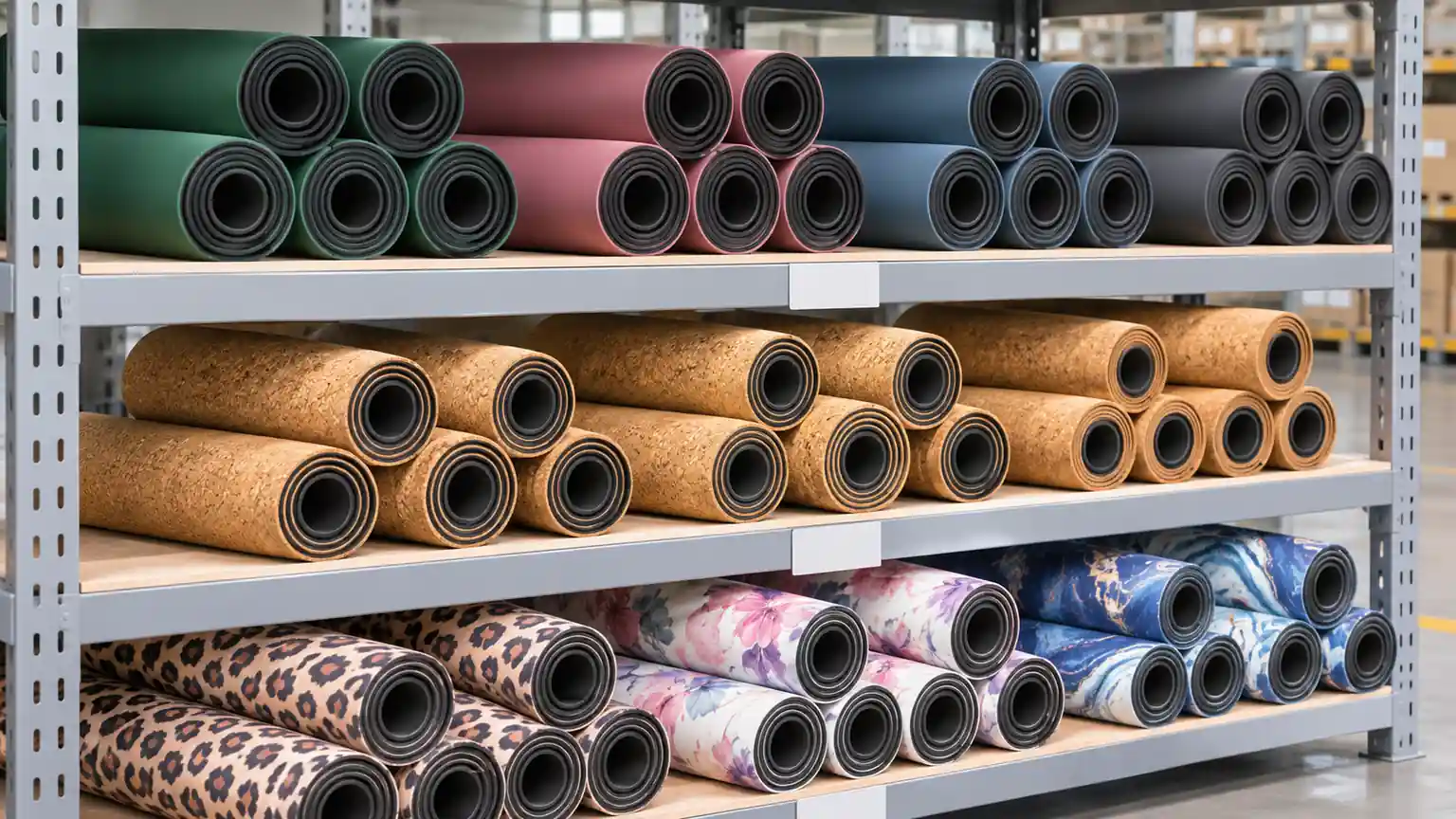
This isn’t a custom order. You’re buying an existing product, which makes it a sensible way to test a material with real customers or check quality before committing to a custom run. It’s less useful if you’re trying to launch a differentiated brand, because anyone can buy the same mat. Ask what branding is available on stock orders before you plan around it; the options are narrower than on a production order.
Minimums by Material
| Material | Stock, standard size and color | Catalog + logo | Pantone color | Full custom |
|---|---|---|---|---|
| PU on natural rubber | 50–200 | 200–300 | ~300 per color | 500+ |
| Suede on natural rubber | 50–200 | 200 per design (printed) | Included in print | 500+ |
| Cork on natural rubber | 50–200 | 300–500 | Printed design, 300–500 | 500+ |
| TPE | Not offered at this level | 300–500 | ~300 per color | 500–1,000+ |
| PVC | Not offered at this level | 500 | ~300 per color | 500–1,000+ |
It surprises some buyers that the premium materials have the lowest entry point. The reason is that PU, suede and cork tops are laminated onto a shared natural rubber base, so a factory can hold them as stock and run smaller lots. TPE and PVC are built around compound batches that favor bigger runs. Choosing between the materials on grounds other than the minimum is covered in our yoga mat materials comparison.
Can You Mix Colors to Reach the MOQ?
Usually not for custom colors, and usually yes for stock ones.
Stock colors: a catalog order of 300 mats can generally be split across stock colors, because no special batch is involved. There may be a minimum per color, often 50–100.
Pantone colors: each one is its own batch, so the minimum applies per color. Three Pantone colors at 100 each is three undersized batches, not one 300-mat order.
Printed designs: the minimum is per design, for the same reason. How that plays out for pattern orders is in leopard print and patterned yoga mats.
Different products: mats, straps and blocks each have their own minimums, but ordering them together can help with freight and sometimes with negotiating the smaller lines.
How to Get a Minimum Down
If a quote comes back with a number you can’t reach, ask which customization is causing it, then decide what to give up. In order of how much they usually help:
- Switch to a stock color. This removes the compound batch and is the biggest single reduction on TPE and PVC.
- Use a standard size. 183×61cm or 183×68cm needs no setup. Non-standard sizes are covered in our custom sizing guide.
- Reduce colorways. Two colors at 300 each are usually better than five at 120, even if you could get them.
- Use one print color or laser engraving. Fewer screens, less setup.
- Consider a material with a lower entry point. If TPE at 500 is out of reach, PU or printed suede at 200–300 may not be, though the unit price is higher.
- Pay for the setup. On some customizations a one-time fee can stand in for volume. It’s worth asking.
Be wary of a supplier who quotes a very low minimum on a fully custom spec. The compound batch doesn’t get smaller because someone said yes. The usual explanation is that your order is being made from leftover material or passed to another workshop, and color consistency tends to be the first thing to suffer.
Choosing a Quantity for a First Order
Three questions decide it:
What are you testing? If you’re testing whether customers want the material, stock mats at 50–200 will answer that. If you’re testing your brand, you need your logo and color, which means 200–500.
What can you sell in six months? A mat is bulky to store. A slightly higher unit price on 300 mats you can sell beats a lower one on 1,000 sitting in a warehouse.
What will the landed cost be? Small orders pay more per mat for freight as well. Order size changes the shipping math, as shown in yoga mat freight costs.
Everything you can customize, and what each option adds to the unit price, is in the custom yoga mat OEM and ODM guide. The wider ordering process is in our yoga mat sourcing guide.
MOQ at Wellfitsource
Send us the spec you have in mind and the quantity you’re aiming for. We’ll tell you which item is setting the minimum, and what the number becomes if you change it. For quantities under 200, we’ll check what’s currently in stock across our natural rubber range. For everything else, our yoga mat range shows the constructions available.
Send your spec and target quantity →
FAQ
What is the minimum order for custom yoga mats?
Usually 200–300 units for a catalog mat with your logo, 300–500 for TPE and PVC or for Pantone colors, and 500 or more for fully custom specifications and shaped mats. Stock PU, suede and cork mats on a natural rubber base can start at 50–200 units in standard sizes and colors.
Can I order fewer than 100 yoga mats?
Only as stock product: PU, suede or cork tops on a natural rubber base, in regular sizes and colors. Other materials, and custom colors or sizes, have higher minimums because of how they’re produced.
Why is the MOQ higher for TPE than for PU?
TPE color is mixed into a compound batch, and a small run wastes most of it. PU tops are laminated onto a natural rubber base, which allows smaller lots, particularly for stock colors. PU still costs more per mat.
Can I mix colors to reach the minimum order?
Stock colors can usually be split across one order, often with a minimum of 50–100 per color. Pantone-matched colors can’t, because each color is its own batch and carries its own minimum of about 300.
Does adding a logo increase the MOQ?
Rarely. Laser engraving and one-color printing need little setup, so a logo usually doesn’t change the minimum on a catalog order. Colors, shapes and custom textures are what push it up.