Author: Wellfitsource Product & Sourcing Team · Published: March 2025 · Updated: September 2026
Cork is the most photogenic surface in the yoga mat category and the least forgiving one to print on. Designers hand us artwork built for a white canvas — soft gradients, pale sage tones, a thin white line running the length of the mat — and we have to explain that cork is a warm tan substrate with visible grain, and it will do something to every one of those choices.
None of that means cork is a bad canvas. Printed cork mats sell at $60–$110 retail and photograph better than anything else we make. It just means the design decisions and the production decisions have to happen in the same conversation, which is what this guide is for.
Quick Summary
- Cork is a tan, grainy substrate. Every printed color sits on top of that, so light colors read warmer and whites need an opaque base layer or a laser-engraved alternative.
- Three print methods dominate: UV printing for full-color designs, laser engraving for tonal logos and line art, and heat transfer for solid graphics — each with different costs and design limits.
- Bold line art and high-contrast graphics survive; fine gradients and pastels fight the grain.
- Batch tone variation is normal in a natural material. Specify an acceptable tone range at sampling rather than discovering it at inspection.
- Typical printed cork FOB runs $9–$18 depending on cork grade, backing thickness, and print coverage; MOQ usually starts at 300–500 units.
Why Cork Prints Differently from Every Other Mat Surface
Three properties of cork drive every design decision:
It has a color of its own. Cork sheet ranges from pale honey to mid-brown depending on grade and batch. Printing on it is closer to printing on kraft paper than on white card — inks shift warm, and any color lighter than the substrate needs an opaque white underbase to read correctly.
It has visible grain. Cork’s surface is a mosaic of granules with natural variation in tone and texture. Fine detail — hairline rules, small text, subtle tonal gradients — competes with that pattern and loses. Bold shapes and clear contrast win.
It absorbs. Cork is porous, so ink behaves differently than it does on a sealed PU or TPE surface. Edges are slightly softer, coverage takes more ink, and the amount of ink laid down affects both the look and the surface feel.
That last point matters more than it sounds. Heavy full-coverage printing on cork can slightly reduce the natural grip that makes cork worth choosing in the first place — cork’s suberin content is what gives it that tackiness when damp, and a thick ink layer sits between the hand and the cork. Designs that leave open cork in the main contact zones keep the performance intact. It’s the kind of trade-off that doesn’t appear in a design review unless someone raises it.
The Three Print Methods
| Method | Best For | Color Range | Relative Cost | Notes |
|---|---|---|---|---|
| UV printing | Full-color artwork, photographic designs, alignment lines | Full CMYK, white ink available as underbase | Medium–High | The default for printed cork; coverage area drives cost |
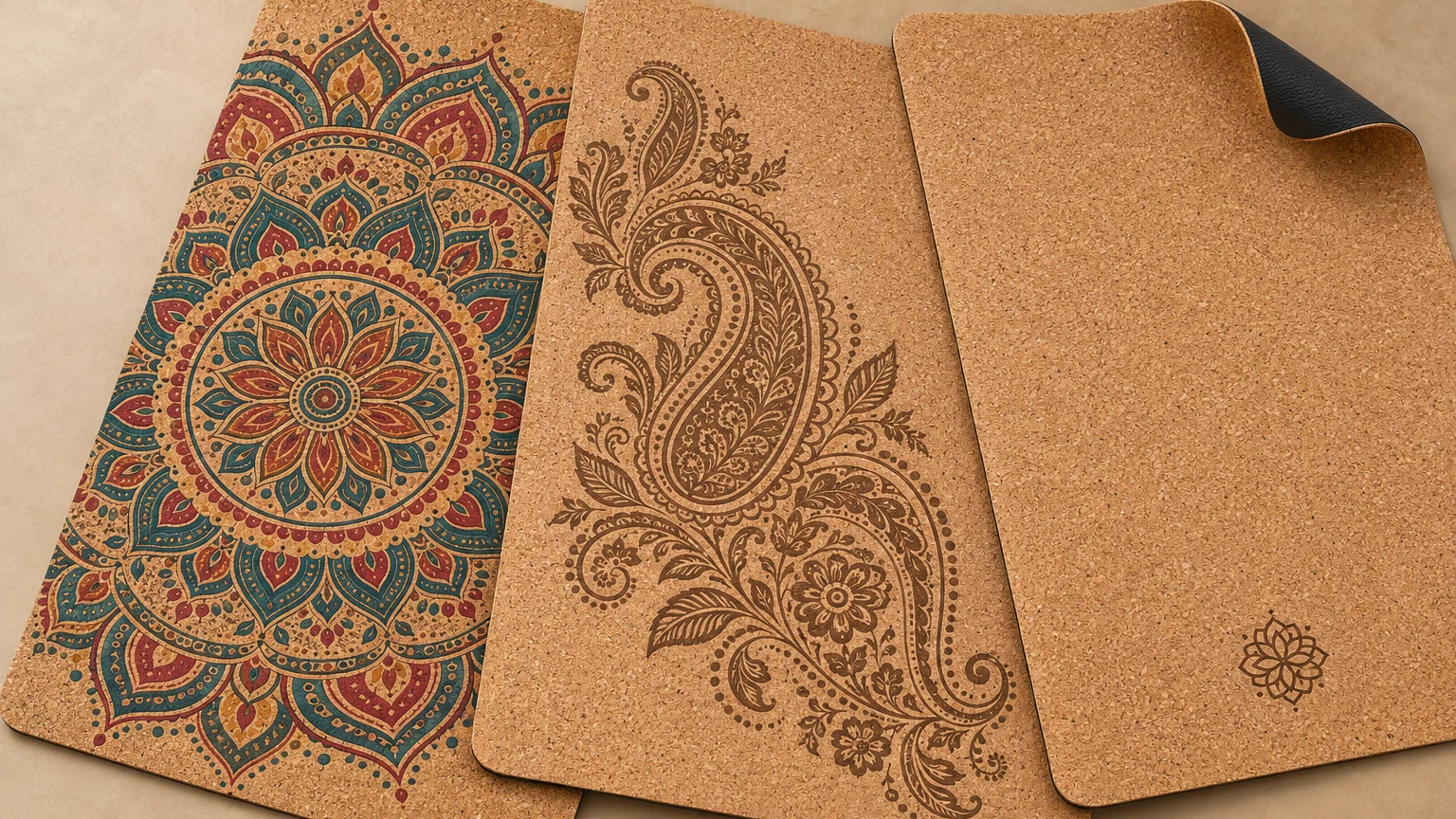
| Laser engraving | Logos, mandalas, line art, tonal patterns | None — burns a darker tone into the cork | Low–Medium | No ink, no wear-off, premium tactile look; single tone only |
| Heat transfer | Solid graphics, simple multi-color designs | Good, limited on very fine detail | Medium | Film layer sits on the surface; affects feel more than UV |
UV printing is where most brands land. It handles full-color artwork, allows white ink as an underbase for light colors, and gives the crisp result people expect from product photography. Cost scales with coverage: a corner logo is cheap, a full-bleed 183×61cm design is not.
Laser engraving is the underrated option. It burns a tonal mark directly into the cork — no ink to fade, no layer to peel, and a tactile quality that reads as expensive. It cannot do color, which rules it out for most patterned designs, but for a brand mark, a mandala, or alignment guides it is both cheaper and more durable than printing.
Heat transfer works for bold graphics but lays a film across the surface. Worth considering for a promotional run; usually not the right choice for a premium line.
Print longevity differs by method and shows up in customer reviews around month four to six — the patterns are covered in print durability on yoga mats.
Design Rules That Save a Sampling Round
If your designer has never worked on cork, these six points prevent most of the rework we see:
- Assume a tan background, not white. Ask for artwork mocked up on a cork-colored base before approval. A design that sings on a white screen can look muddy on the real substrate.
- White needs an underbase. Pure white on cork requires a layer of opaque white ink beneath it, which costs more and slightly changes the surface feel. Designs that avoid large white areas cost less and wear better.
- Avoid fine gradients. Soft tonal transitions fight cork’s grain and often band. Flat color blocks and bold line work hold up far better.
- Set a minimum line weight. Hairlines vanish into the grain. As a working rule, keep lines and text strokes at 1mm or heavier.
- Leave a safe margin at the edges. Cutting tolerance on mats is a few millimetres either way, so designs that run precisely to the edge can end up visually off-center. Either full-bleed the design deliberately or keep critical elements 10mm inside the edge.
- Keep the palm and foot zones lighter. Heavy coverage in the main contact areas is where reduced grip and visible wear show up first.
Cork Grade, Backing, and What You’re Actually Buying
The print gets the attention; the construction determines whether the mat survives. A printed cork mat is a cork surface layer bonded to a rubber backing, and three specifications define it:
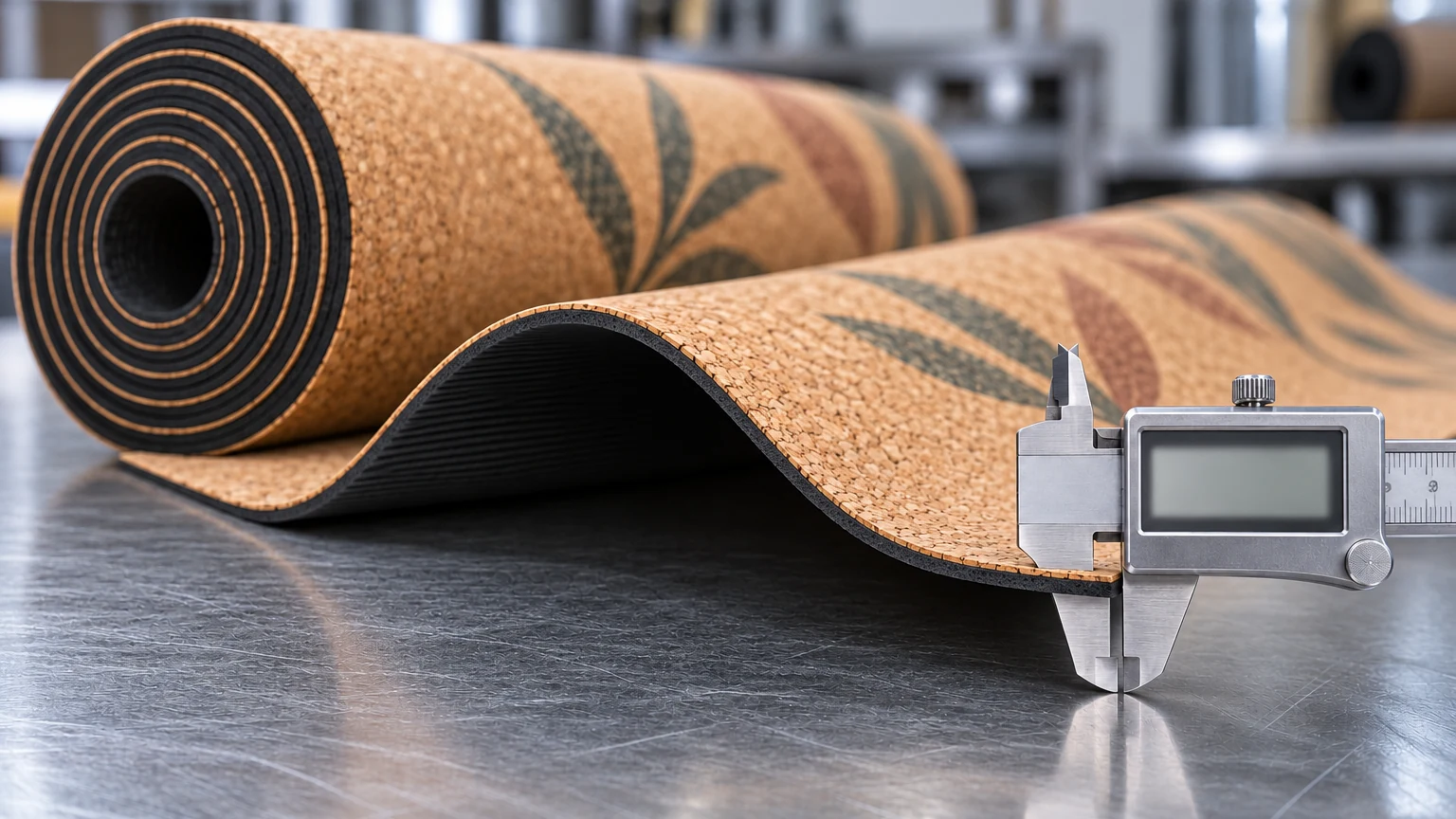
Cork layer thickness is typically 1–2mm. Thicker cork wears longer but costs more and adds weight.
Rubber backing thickness is usually 3–4mm, and it does the cushioning work. Total mat thickness for a standard printed cork mat is 4–5mm. Going thicker adds weight quickly — cork mats are already among the heaviest at 1.5–2.0kg for a standard size.
Cork grade affects appearance more than performance: finer granule grades look more uniform and photograph better, coarser grades cost less and read as more rustic. Ask to see both at sampling; the difference is obvious in hand and invisible in a spec sheet.
Bond quality is the failure point to ask about. Delamination between cork and rubber — usually at the edges, usually after repeated rolling — is the complaint that ends a cork program. Ask what adhesive system the factory uses and whether they run a peel test.
For how cork compares with the other mat materials on grip, cost, and compliance, see our yoga mat materials comparison.
Costs, MOQ, and Sampling
Printed cork mats typically run $9–$18 FOB for standard 183×61cm constructions. The variables, in order of impact: cork grade and thickness, rubber backing thickness, print method, and print coverage. A laser-engraved logo on a standard cork mat sits near the bottom of that range; a full-bleed UV print with white underbase on a premium cork grade sits at the top.
MOQ generally starts at 300–500 units for printed cork — lower than PVC or TPE, because cork doesn’t require the same compound batching. Custom cork grades or unusual dimensions push it higher.
Sampling is where cork programs are won or lost. Two rounds is normal: a first proof to check color translation onto the substrate, and a second to confirm corrections. Budget 2–4 weeks. We would rather run an extra proof than have a brand approve a digital rendering and meet the real thing at production.
One specific thing to ask for: a print proof on the actual cork batch, not on a sample from an earlier lot. Cork tone varies between batches, and the same ink reads differently against a honey-toned sheet than a darker one. Specify an acceptable tone range in writing — most disagreements at inspection are about tone, not print quality.
The full sequence from material choice through sampling and shipping is covered in our yoga mat sourcing guide, and the commercial tiers are in the bulk order MOQ and pricing guide.
The Sustainability Story — and How to Say It Accurately
Cork has the strongest environmental story in the category, and it is worth telling precisely rather than loosely.
Cork is harvested by stripping bark from cork oak trees, which regrow it over roughly nine years without the tree being cut down. That is genuinely renewable and easy to verify. What you cannot claim without qualification is that the finished mat is biodegradable or compostable — a printed cork mat is a cork layer bonded to rubber with adhesive and covered in ink, and the assembled product does not behave like raw cork at end of life.
The defensible version: “natural cork surface, harvested without felling the tree, bonded to a natural rubber base.” Precise, verifiable, and stronger than a vague “eco-friendly” claim. What certification language actually requires is covered in our guide to non-toxic and eco claims on yoga mats.
One more compliance note specific to cork mats with rubber backing: the natural rubber base means latex allergy labeling applies in the EU, exactly as it does for rubber and PU mats.
Producing Printed Cork Mats with Wellfitsource
We manufacture cork yoga mats with UV printing, laser engraving, and heat transfer at our Yangzhou facility, and we’ll tell you at the artwork stage which method fits the design rather than after the first proof disappoints.
For brands running cork alongside other materials — a TPE entry SKU and a printed cork premium line, for instance — both come from one facility with one QC standard. The full product range is at yoga mats, and the design-to-production workflow for branded mats is covered in personalizing yoga mats for an activewear brand.
Send artwork for a cork print assessment →
FAQ
Can you print full-color designs on cork yoga mats?
Yes, with UV printing, including white ink as an underbase for light colors. The constraint is not color range but substrate: cork is tan and grainy, so colors shift warm and fine gradients compete with the grain. Bold shapes and high-contrast artwork translate best.
How much does a printed cork yoga mat cost to produce?
Typically $9–$18 FOB for a standard 183×61cm mat, driven by cork grade, cork and rubber layer thickness, print method, and coverage area. A laser-engraved logo sits near the bottom of the range; a full-bleed UV print with white underbase sits at the top.
Does printing affect cork’s grip?
Heavy full-coverage printing can slightly reduce the natural tackiness cork develops when damp, because the ink layer sits between hand and cork. Designs that leave the main palm and foot contact zones relatively open preserve the grip that makes cork worth specifying.
What is the MOQ for custom printed cork mats?
Usually 300–500 units, which is lower than PVC or TPE because cork does not require the same compound batching. Custom cork grades, non-standard dimensions, or unusual backing specs raise it.
Can printed cork mats be called biodegradable?
No. Cork itself is a natural, renewably harvested material, but a finished mat is cork bonded to rubber with adhesive and printed with ink, and the assembled product does not biodegrade as raw cork would. Describe the material accurately — “natural cork harvested without felling the tree” — rather than making an end-of-life claim about the finished mat.