Author: Wellfitsource Product & Sourcing Team · Published: July 2025 · Updated: October 2026
Alignment lines are the cheapest feature that changes how a yoga mat sells. A set of guide lines adds well under a dollar to the unit cost, and on a product page it gives the customer a reason to choose this mat over the plain one next to it. Teachers like them because “front foot on the center line” is quicker than walking over to adjust someone.
Two things have to be settled: the layout, and how it gets onto the mat. People spend their time on the first. The second matters more, because it depends on the material and it’s what decides whether the lines are still crisp a year in. (Prices on this page: our 2026 quotes, 183×61cm mats.)
Quick Summary
- Four layout families cover most orders: center line only, center line with hand and foot guides, a full angle system, and a custom layout drawn for the brand.
- The marking method follows the material: laser engraving on PU and cork, screen print on TPE and PVC, printing as part of the design on suede.
- Lines add about $0.30–$0.80 per mat and carry no separate MOQ on catalog layouts.
- Engraved lines don’t wear; printed lines can, especially where hands and feet land.
- Don’t copy a well-known layout. Some alignment systems are registered designs. Draw your own or start from a neutral library layout.
Layout Options
| Layout | What’s on the mat | Who buys it |
|---|---|---|
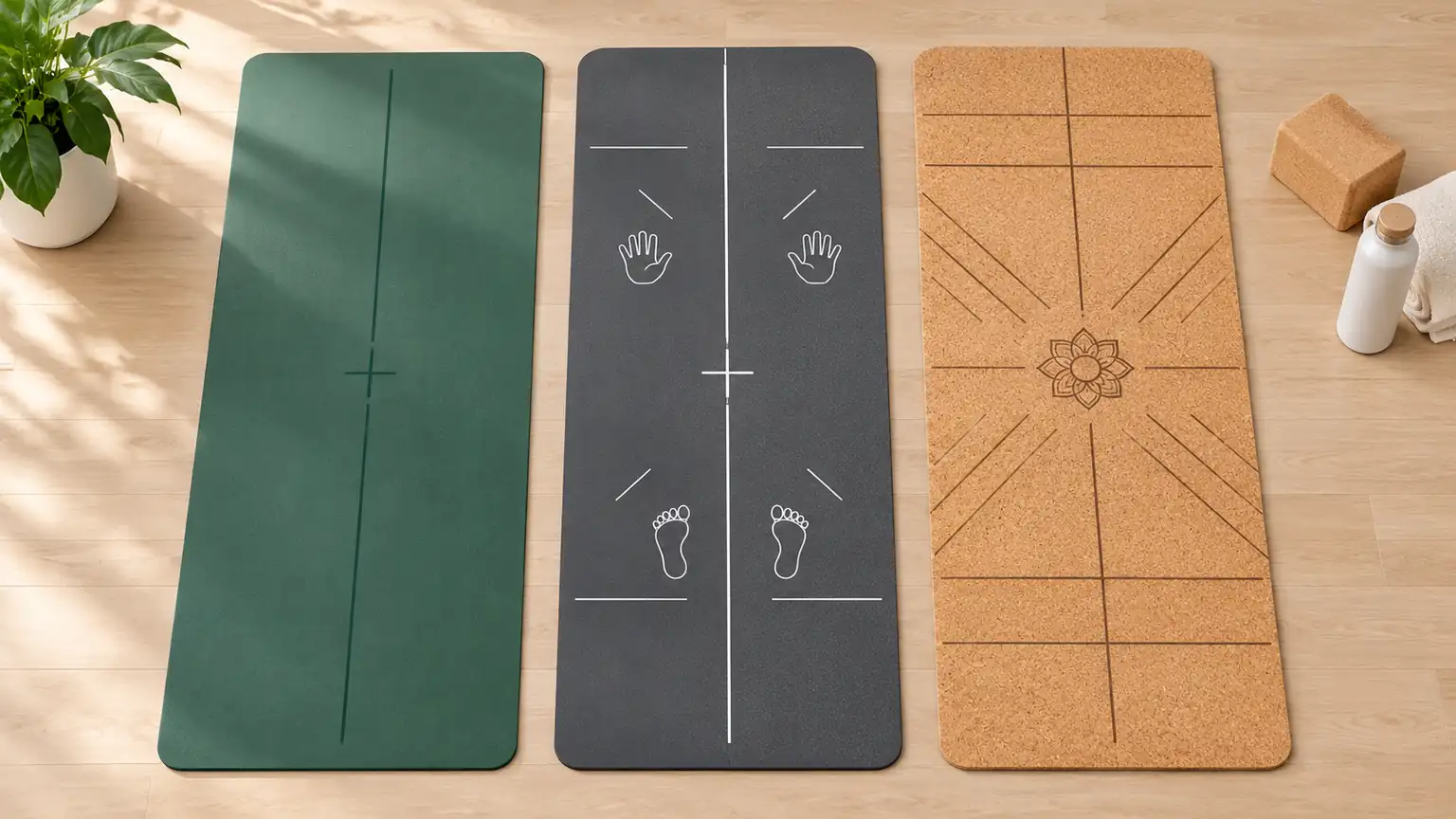
| Center line | One line down the length, sometimes a cross mark at the middle | Minimalist brands, studios that want a clean look |
| Center line + guides | Center line, a midpoint cross, hand and foot markers at each end | The general-purpose option for retail |
| Full angle system | Center line, horizontal bands, 45° diagonals for foot angles | Beginner lines, online class brands, teacher-training mats |
| Custom layout | A layout drawn for the brand, often with a logo or motif at the center | Brands that want the lines to be recognizably theirs |
More lines aren’t automatically better. The full angle system is the most helpful for a beginner following a video class at home, where nobody is there to correct a stance; that use is the subject of our piece on alignment mats for virtual classes. On a premium studio mat the same layout can look busy, and many premium brands deliberately choose a single center line and a small midpoint mark.
A layout that works for one mat size doesn’t automatically work for another. Hand and foot guides are positioned for a typical stance on a 183cm mat. Put the same file on a 200cm or a kids’ 150cm mat and the markers sit in the wrong place. Each size needs its own drawing, and that’s a five-minute job if it’s asked for at the proof stage and a reprint if it isn’t. Size options are in our yoga mat size chart.
How the Lines Are Made
| Method | Materials | Look | Wear | Adds |
|---|---|---|---|---|
| Laser engraving | PU, cork | Tone-on-tone, slightly recessed | Permanent | $0.30–$0.80 |
| Screen print | TPE, PVC, NBR | Contrasting color, flat | Can fade at contact zones | $0.20–$0.60 per color |
| Printed with the design | Suede, PU (heat transfer) | Any color, part of the artwork | As durable as the print | Included in print cost |
| Molded / embossed | TPE | Raised or pressed into the surface | Permanent | Tooling quoted after evaluation |
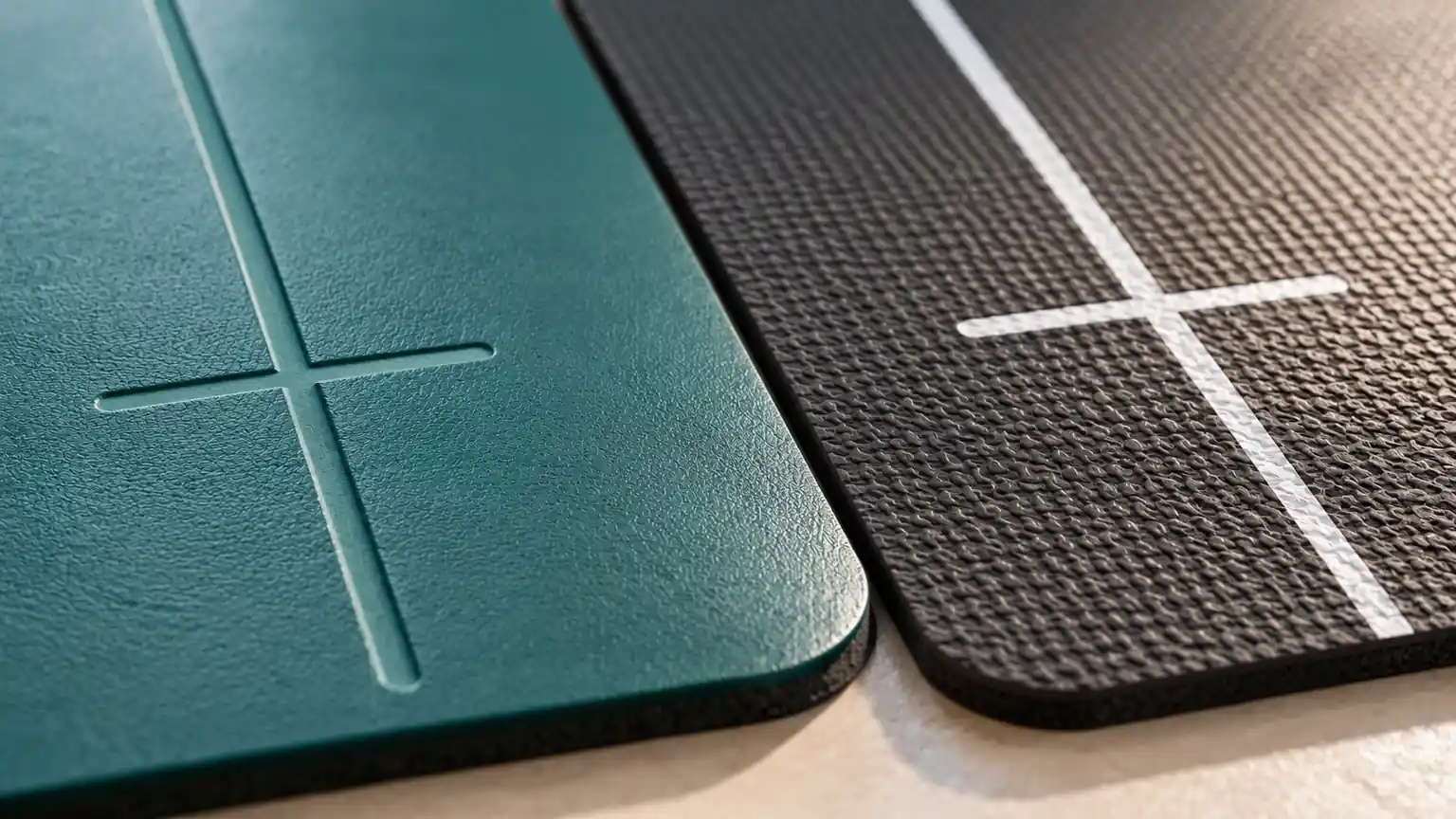
Laser engraving is what you see on most premium alignment mats. The laser removes a hair’s depth of the surface, so the line is a shade lighter or darker than the mat around it. Nothing is added, so nothing can peel, and grip isn’t affected. Its one weakness is contrast: on very pale PU colors the lines can be hard to see, so ask for an engraving test on your actual color. The PU-specific details are in our guide to custom PU yoga mats.
Screen print is how lines go onto TPE and PVC. It gives strong contrast, white on a dark mat being the classic, at very low cost. The trade-off is wear. Ink sits on top of the surface, and the places where hands and feet press and twist are exactly where alignment marks are. A well-cured print lasts; a poorly cured one starts to break up within months. What to ask for is in print durability after six months.
On suede and printed PU the lines are simply part of the artwork file, set up the same way as any all-over pattern.
Molded lines on TPE are pressed into the mat by the embossing roller, so they’re permanent and need no ink. They also need their own tooling, which is only worth doing for a layout you’ll run for years.
One practical point on color: lines should be visible but quiet. A white line on a black mat photographs well; in a dim studio it can be distracting. Tone-on-tone engraving, or a printed line two shades off the base color, is what most studios end up choosing.
What to Put in the Specification
Alignment lines are a measured feature, so they need measurements. A complete brief has:
- The layout file, vector, at full mat size, one per mat size.
- Line weight. 1–2mm is typical. Under 1mm, engraved lines get hard to see and printed lines break up.
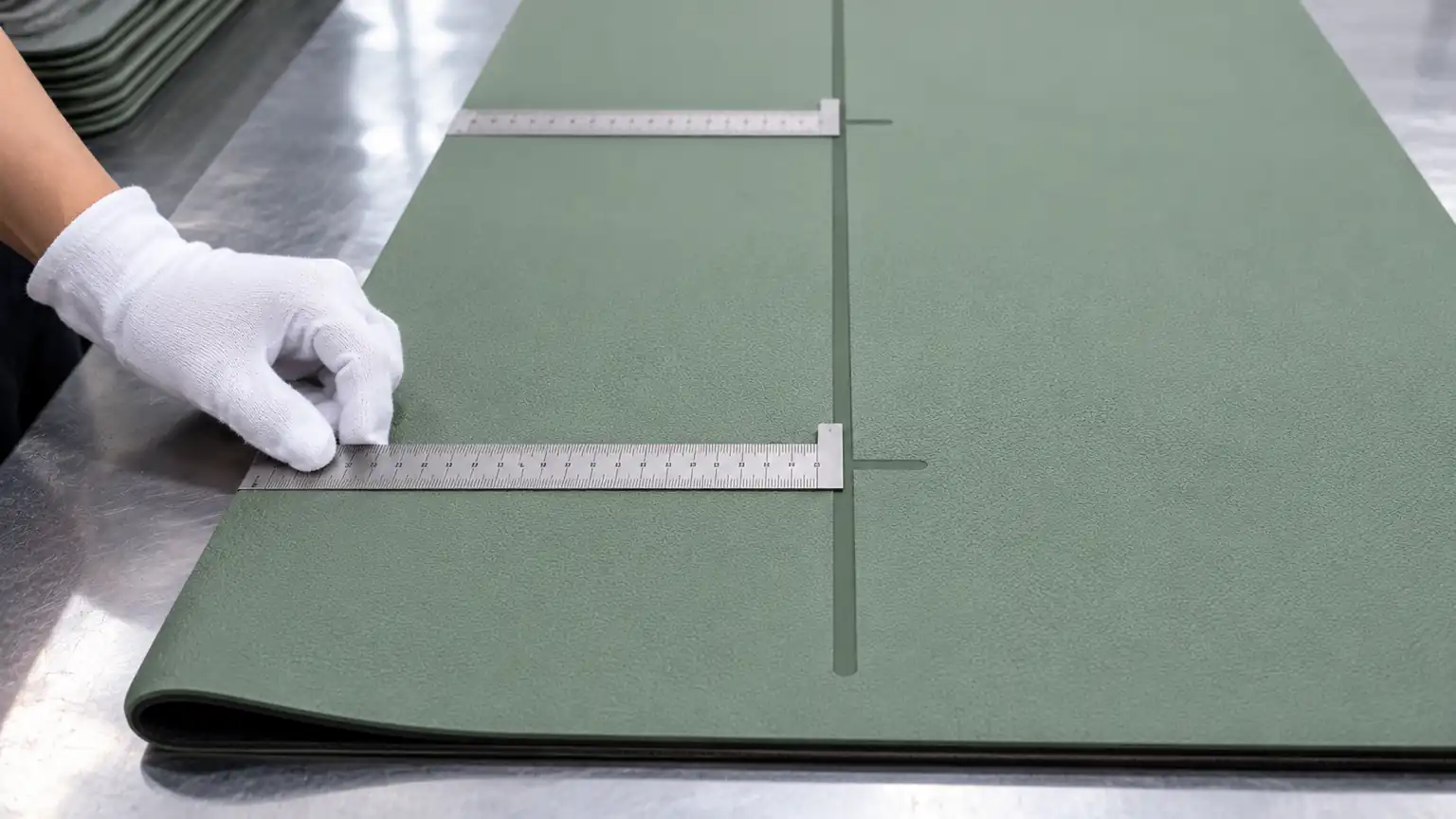
- Position tolerance. ±3mm from the drawing is realistic. The center line should be checked for being centered, since a center line 5mm off is the first thing a customer notices.
- Which side and which end. Obvious until a batch arrives with the logo at the foot end.
- Line color, as a Pantone reference for printed lines, or “tone-on-tone” for engraving.
- Logo placement relative to the lines. A logo on the center line needs the same centering tolerance as the line itself.
At sampling, lay the mat flat and measure from each long edge to the center line at both ends and the middle. Three measurements, a minute’s work, and it tells you whether the line is straight and centered. Then fold the mat in half lengthwise: on a symmetric layout the markers on each side should meet.
On larger orders, line position is one of the items that drifts between the first carton and the last. The controls are the ones used for logos, described in logo consistency on large orders.
Whose Layout Is It?
A few alignment systems on the market are protected, either as registered designs or as trademarks for the layout’s name. A buyer who sends a photo of a famous alignment mat and asks for “the same lines” is asking for a copy, and it’s the buyer’s brand that would be selling it.
There are two safe routes. Start from a neutral library layout, the generic center line and guide marks that nobody owns, and add your logo. Or have your own layout drawn. A custom layout doesn’t need to be complicated to be distinctive: a different midpoint symbol, guide marks in your brand’s shape language, your own spacing. Once it’s yours, say in the order that the file isn’t to be used for other customers.
Who Orders Alignment Mats
Studios buy them as house mats and for retail. Teachers use the lines as shared reference points, and a studio’s own layout with its logo at the center works as quiet branding in every class photo. Studio spec priorities are covered in yoga mats for studios vs home use.
Online class and app brands want the mat to match the cues in their videos: “left heel on the second band”. For them the layout is part of the teaching method, and it’s nearly always custom.
Retail brands with a beginner line use a full angle system as the feature that separates the beginner mat from the standard one, often at a small price premium. How beginner and advanced products are told apart is in beginner vs advanced yoga mats.
Lines are rarely the only custom feature on an order. Eyelets, fold grooves, color, packaging: the custom yoga mat OEM and ODM guide goes through them one by one.
Alignment Mats from Wellfitsource
We make alignment-line mats in PU, cork, TPE, PVC and suede, with a library of neutral layouts and a design service for custom ones. Send us your mat size, material and either a layout file or a rough sketch; we return a dimensioned proof showing every line’s position before sampling. Our yoga mat range shows the constructions available.
Send your layout or sketch for a dimensioned proof →
FAQ
What are alignment lines on a yoga mat for?
They’re guide marks, typically a center line, a midpoint mark and hand and foot guides, that help a practitioner place hands and feet symmetrically and at consistent angles. They’re most useful for beginners and for people following classes at home.
How are alignment lines put on a yoga mat?
By laser engraving on PU and cork, by screen printing on TPE and PVC, or as part of the printed design on suede and printed PU. Lines can also be molded into TPE with dedicated tooling.
Do alignment lines wear off?
Laser-engraved and molded lines are permanent. Screen-printed lines can fade over time where hands and feet press, so print quality and curing matter. Ask for a rub test at the sample stage.
How much do alignment lines add to the cost of a yoga mat?
Roughly $0.30–$0.80 per mat for laser engraving and $0.20–$0.60 per color for screen printing. On printed suede or PU mats the lines are part of the artwork and add nothing extra.
Can I have my own alignment layout?
Yes. Supply a vector file or a sketch and the factory will produce a dimensioned proof. A custom layout is also the way to avoid copying protected alignment systems owned by other brands.