Author: Wellfitsource Product & Sourcing Team · Published: June 2025 · Updated: October 2026
Leopard print is the pattern request that never quite goes away. It comes round every couple of seasons, usually from activewear brands matching a legging print, and the brief is nearly always a single photo and the words “like this, but ours”.
What the photo doesn’t tell us is where the pattern will come from (our library, an adapted version, or the brand’s own file), what the mat is made of, and who owns the drawing. Minimum order, price and sampling time all hang on those three. The same goes for florals, marble, mandalas and geometric repeats, so read “leopard” below as shorthand for any all-over print.
Figures below are from our own 2026 quotes for 183×61cm mats, FOB Shanghai.
Quick Summary
- There are three ways to get a pattern: pick a stock design, modify a stock design (recolor, rescale, add a logo), or supply fully custom artwork.
- Material decides what’s printable. Suede microfiber and PU take full-color all-over prints; cork takes UV print with a natural tint; TPE and PVC are limited to simpler effects.
- All-over print adds about $1.50–$3.50 per mat and usually needs 200–300 units per design.
- Artwork should be full size (183×61cm plus bleed) at 150dpi or better, with Pantone references for the colors that matter.
- Don’t copy a brand’s pattern. Animal prints as such are free to use; a specific designer’s drawing of one is not.
Three Routes to a Pattern
| Route | What you do | MOQ per design | Sampling | Good for |
|---|---|---|---|---|
| Stock design | Choose from the factory’s pattern library, add your logo | 200 | 5–7 working days | Testing a print trend, gifting, fast launches |
| Modified stock | Recolor, rescale or combine library patterns | 200–300 | 7–10 working days | Matching a brand palette without commissioning art |
| Custom artwork | Supply your own print-ready file | 300 | 7–10 working days, 1–2 rounds | Brand-owned prints, apparel matching, artist collaborations |
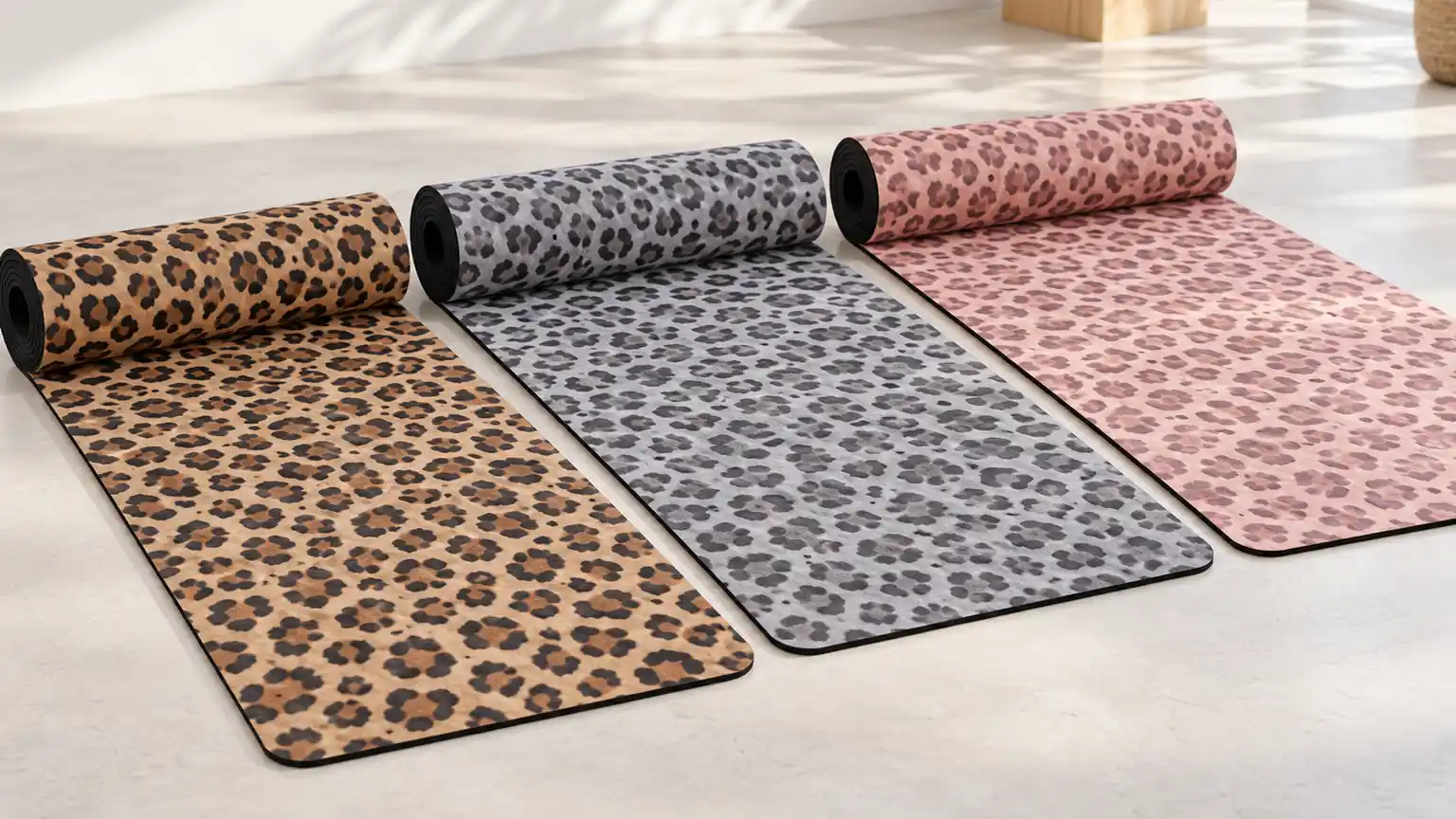
Most leopard print orders sit in the middle row. The rosette pattern itself comes from the library; what changes is the ground color and the scale. A classic tan-and-black leopard, a grey snow-leopard version and a blush-pink fashion version are the same drawing in three colorways, and they’ll be treated as three designs for MOQ purposes.
Custom artwork is worth it when the print is the brand. An activewear label whose signature print runs across leggings, bras and bags wants exactly that print on the mat, not something similar. (For the wider job of fitting a mat into an apparel range, see personalizing yoga mats for an activewear brand.)
Which Materials Take a Pattern
This is where a lot of pattern briefs change direction, because the material a brand had in mind often can’t carry the print it wants.
| Material | Print method | What it can do | Limits |
|---|---|---|---|
| Suede microfiber over rubber | Sublimation | Edge-to-edge, photographic color, fine detail | Needs a damp surface for best grip; hand-wash care |
| PU over rubber | Heat-transfer print | Full color, crisp edges | Printed surface feels slightly different from plain PU |
| Cork | UV print | Full color over a visible cork grain | Cork’s tan base warms every color; no true white |
| TPE | Screen print, two-tone layers | Spot-color motifs, 1–3 colors | No all-over photographic print |
| PVC | Printed film layer or screen print | All-over patterns at low cost | Lower-end look; restricted in some retail channels |
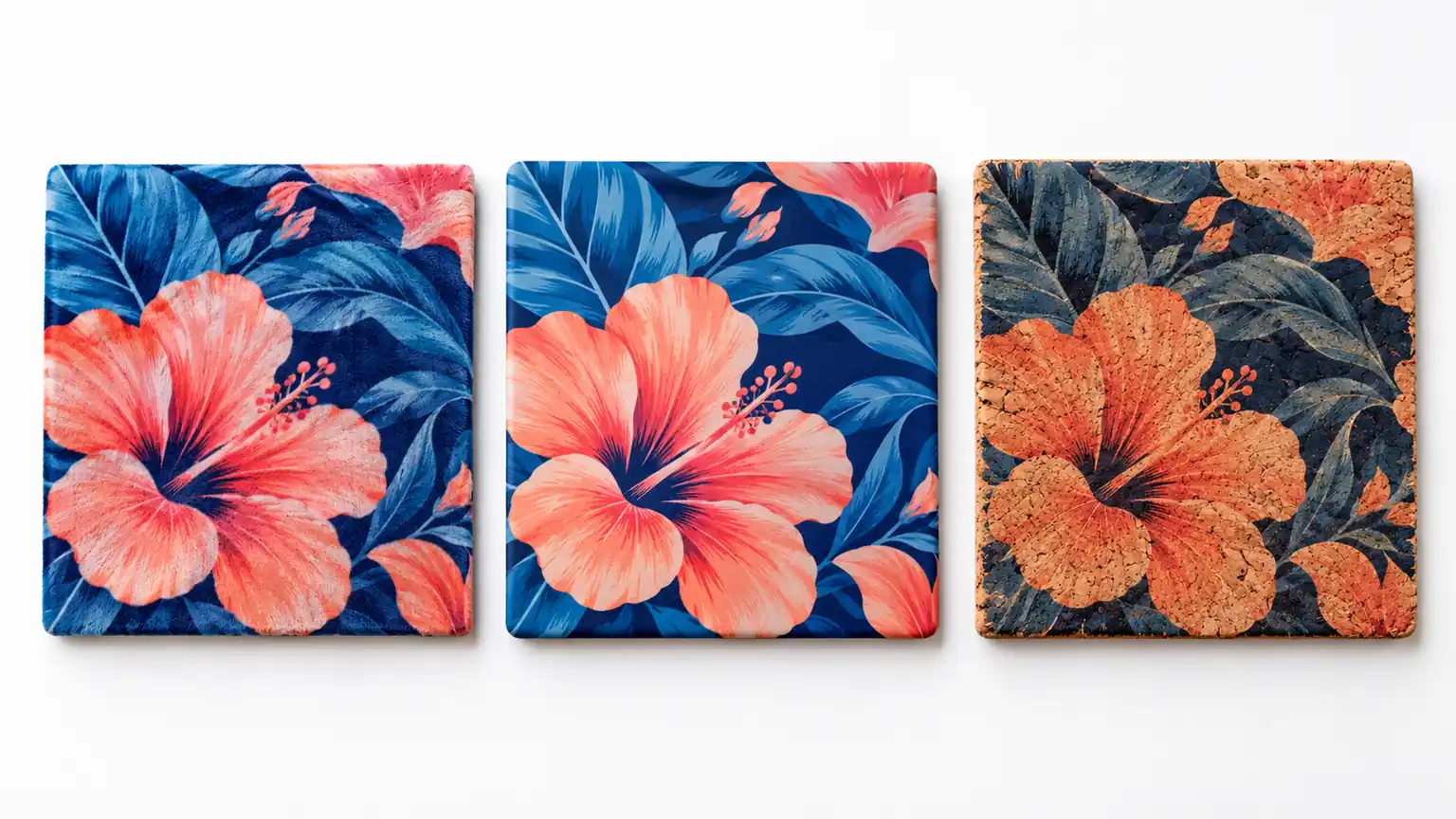
For leopard and other animal prints, suede is the natural choice. The soft texture suits the pattern, color saturation is the best of any mat surface, and the whole top is printable right to the edge. Our suede yoga mat range is where most of our patterned orders are made.
PU is the option when the brand wants a pattern on a grippy studio mat. Cork works well for prints designed for it: dark line work, earthy colors, mandalas. A pale pastel leopard on cork will come out warmer and darker than the file, every time. We wrote up cork’s quirks separately in printed cork yoga mats.
TPE buyers who want a pattern usually end up with one of two things: a marbled or two-tone mat where the “pattern” is in the material itself, or a screen-printed motif such as a border or a corner design in one or two colors. Both look good. Neither is leopard print. If the pattern matters more than the material, change the material; the options are compared in our yoga mat materials comparison.
Preparing Artwork That Prints Properly
Plenty of the custom files we receive need rework before they can be printed, and each round costs a few days. Our prepress checklist, more or less as it’s pinned up:
- Full size. 183×61cm (or your mat size) at 150–300dpi, or vector artwork (AI, PDF, EPS).
- Bleed. 3–5mm extra on every side, so the cut doesn’t leave a white edge.
- A safe zone. Keep logos, text and any alignment lines at least 2cm in from the edge. Cutting tolerance is about ±3mm, and a logo sitting on the edge will look off-center on some mats.
- Pantone references for brand colors. The rest of the print can be CMYK, but name the colors that must match.
- Seamless repeats for all-over patterns. A leopard repeat with a visible join line down the middle of the mat is the most common artwork fault we see.
- Scale shown at actual size. Rosettes that look right on a phone screen can be either tiny or enormous on a 183cm mat. Print a section at 100% on office paper and lay it on the floor before you send the file.
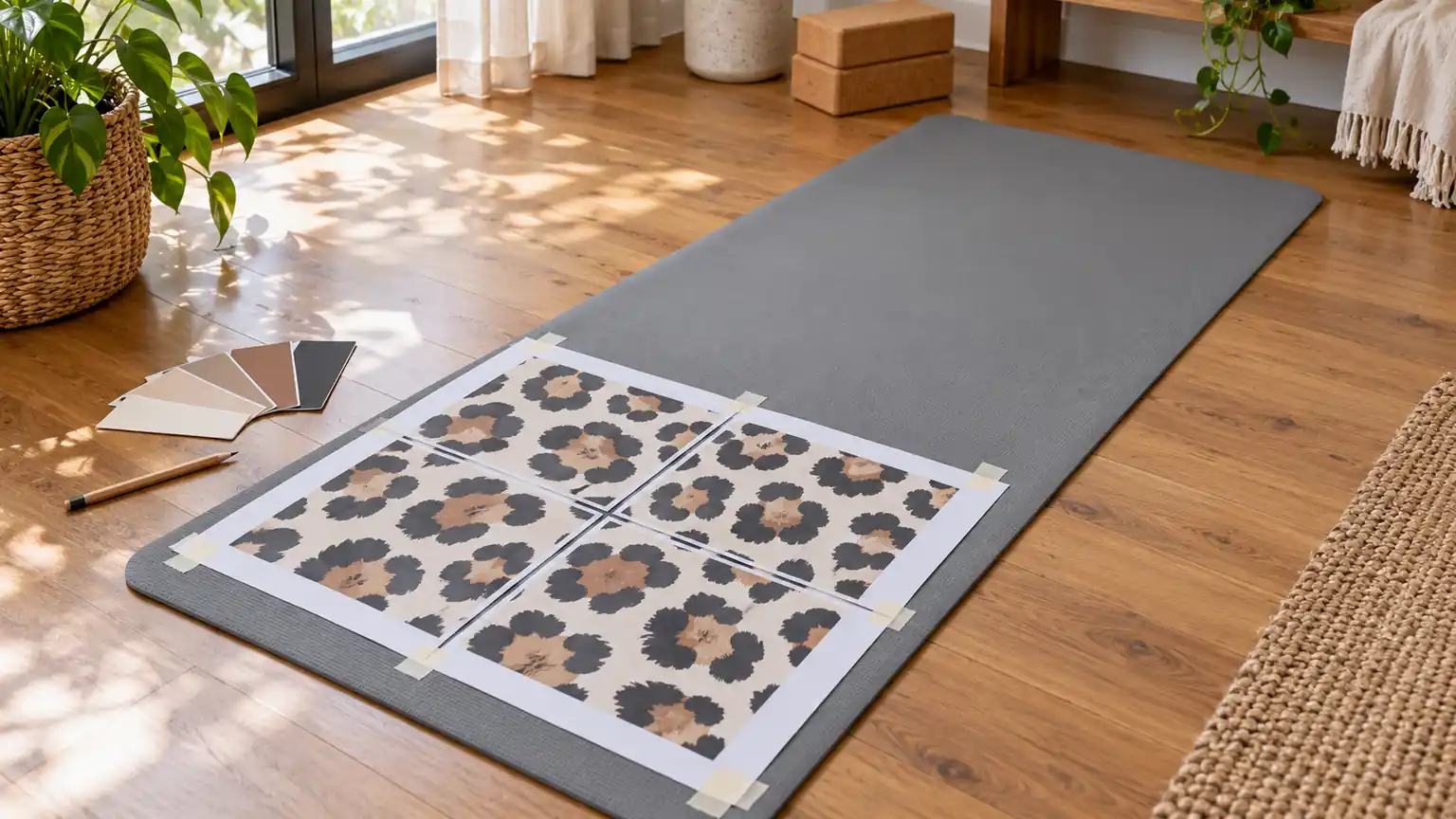
On scale: animal prints on mats generally look best with the motif larger than it would be on clothing. Leggings wrap around a leg; a mat lies flat and is seen from standing height.
Cost, MOQ and Lead Time
| Item | Typical figure |
|---|---|
| All-over print (suede, PU) | +$1.50–$3.50 per mat over plain |
| UV print on cork | +$0.80–$2.00 |
| Screen-printed motif (TPE, PVC) | +$0.20–$0.60 per color |
| MOQ per design | 200–300 units |
| Sampling | 5–10 working days per round |
| Artwork setup | Usually included; complex redraws quoted separately |
The MOQ is per design, not per order. Three leopard colorways at 100 each won’t meet it; one colorway at 300 will. For a first patterned order, two designs at 200–300 each is a sensible ceiling, and it’s kinder to your stock position than five designs you have to sell through. There’s more on that arithmetic in how MOQ shapes custom yoga mat orders.
Prints go out of fashion sooner than plain colors do, which is the other reason to keep runs small. The brands we see reorder prints most reliably run them as seasonal capsules beside a plain core range; yoga mat color trends for buyers looks at the same question for solids.
Who Owns the Pattern
Short, and worth reading before you send that reference photo.
Stock designs belong to the factory’s library and can be sold to anyone. If you want a pattern nobody else can order, it has to be yours.
Custom artwork you supply remains yours. Say so in the order, and ask that the files are not added to the library or shown to other customers.
Somebody else’s pattern is the problem case. Leopard print as an idea belongs to no one. A particular brand’s drawing of it, with its specific rosette shapes and layout, is that brand’s copyright, and so are well-known designer florals and licensed characters. We turn down requests to reproduce another brand’s print from a photo, and a supplier who agrees to do it is handing you the legal risk along with the mats.
Checking a Patterned Sample
Beyond the usual sample checks, a printed mat needs four more:
- Color against your reference, in daylight. Check the ground color first; it’s the largest area and the one customers judge.
- The repeat join. Look along the length for a line where the pattern doesn’t meet.
- Edges. No unprinted sliver along any side.
- Rub and stretch. Rub a printed area hard with a damp cloth, then roll the mat tightly and unroll it. Color on the cloth or cracks in the print mean the method or the curing needs to change.
None of these tell you how the print looks after a year of use where hands and feet land; for that, read print durability after six months. And if the print is only one of several things you’re customizing, the custom yoga mat OEM and ODM guide has the rest: size, thickness, packaging.
Patterned Mats from Wellfitsource
We print patterned mats on suede, PU and cork in our Yangzhou facility, from our own pattern library or your artwork. Send a reference image and the material you have in mind; we’ll tell you whether that material can carry the print, suggest the closest alternative if it can’t, and return a digital proof at full mat size before any sample is made.
Send your pattern or reference image for a proof →
FAQ
What is the minimum order for custom leopard print yoga mats?
Usually 200 units for a stock leopard design with your logo, and 200–300 units per design for recolored or fully custom artwork. Each colorway counts as a separate design.
Which yoga mat material is best for leopard print?
Suede microfiber over natural rubber. It takes edge-to-edge sublimation print with the strongest color and suits the texture of an animal print. PU is the alternative when a grippier studio surface is wanted.
Can you print any pattern on a TPE yoga mat?
No. TPE takes screen-printed motifs in one to three spot colors and can be made in two-tone or marbled effects, but it cannot carry an all-over photographic print. For a full pattern, suede, PU or cork is needed.
What file format do I need for a custom printed yoga mat?
A vector file (AI, PDF, EPS) or a full-size image at 150–300dpi, with 3–5mm bleed on each side and Pantone references for key brand colors. All-over patterns should be set up as seamless repeats.
Can I use a pattern I found online on my yoga mats?
Only if you have the right to use it. Generic motifs are free to redraw, but a specific brand’s or designer’s artwork is protected by copyright. Use a stock design, license the artwork, or commission your own.