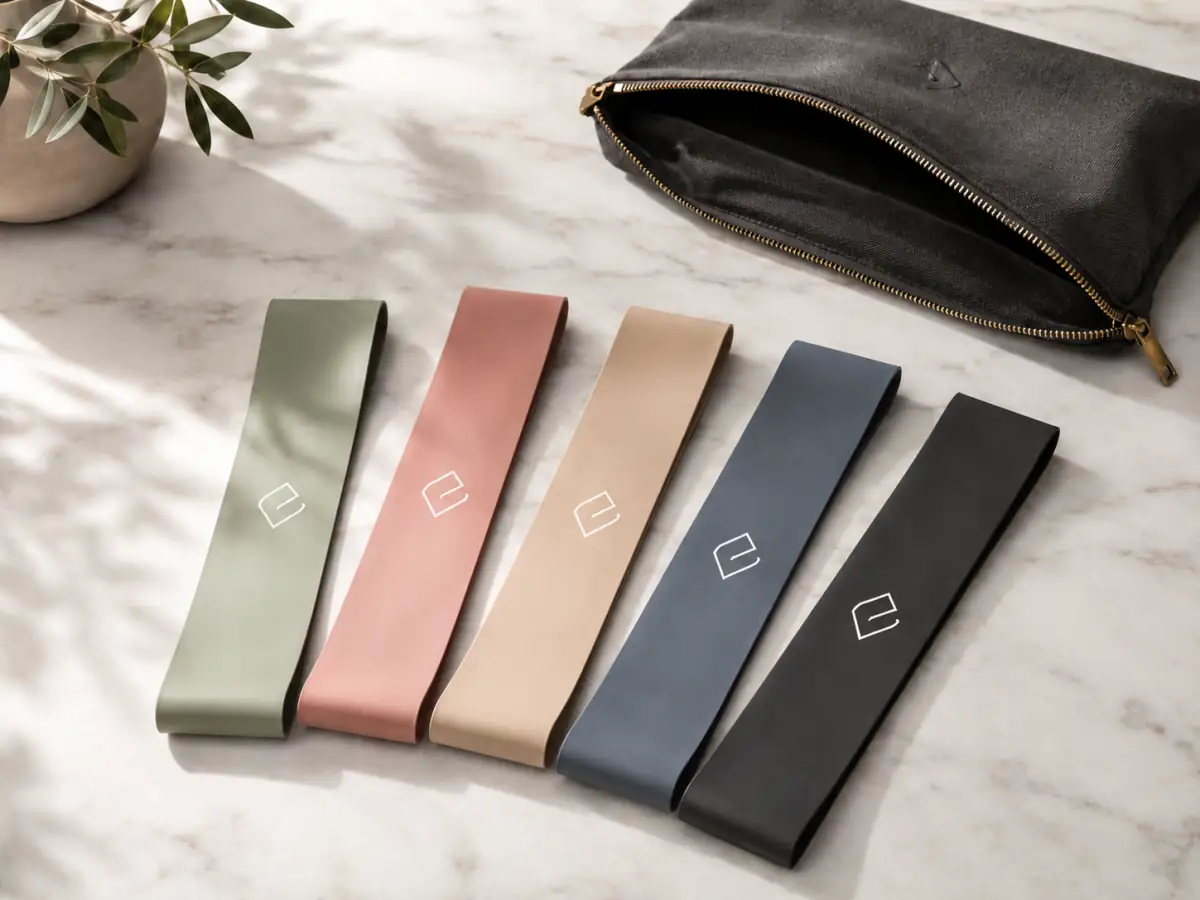
Pick up a branded resistance band and a generic one. The generic band is functional — it stretches, it provides resistance, it does the job. The branded one has a logo that sits cleanly on the surface, a color that reads as intentional rather than arbitrary, and a zip pouch that closes with a satisfying click. The product inside is similar. The thing you are holding is different.
That difference — between a product and a brand — is what private label resistance band sourcing produces. The MOQ to get there is lower than most buyers expect, and the customization scope is wider than most buyers realize when they first start the conversation.
This guide covers what private label actually means for resistance bands at B2B order scales, what customization is available at each MOQ tier, what the branding options are in practice, and how to structure the specification so that the second production run matches the first.
Quick Summary
- Private label resistance bands are available from 100 units (fabric-covered bands, stock elastic) to 300 units (TPE or latex bands with custom logo and color). Full customization — custom compound color, custom packaging design, proprietary color coding — is accessible at 300–500 units for most configurations.
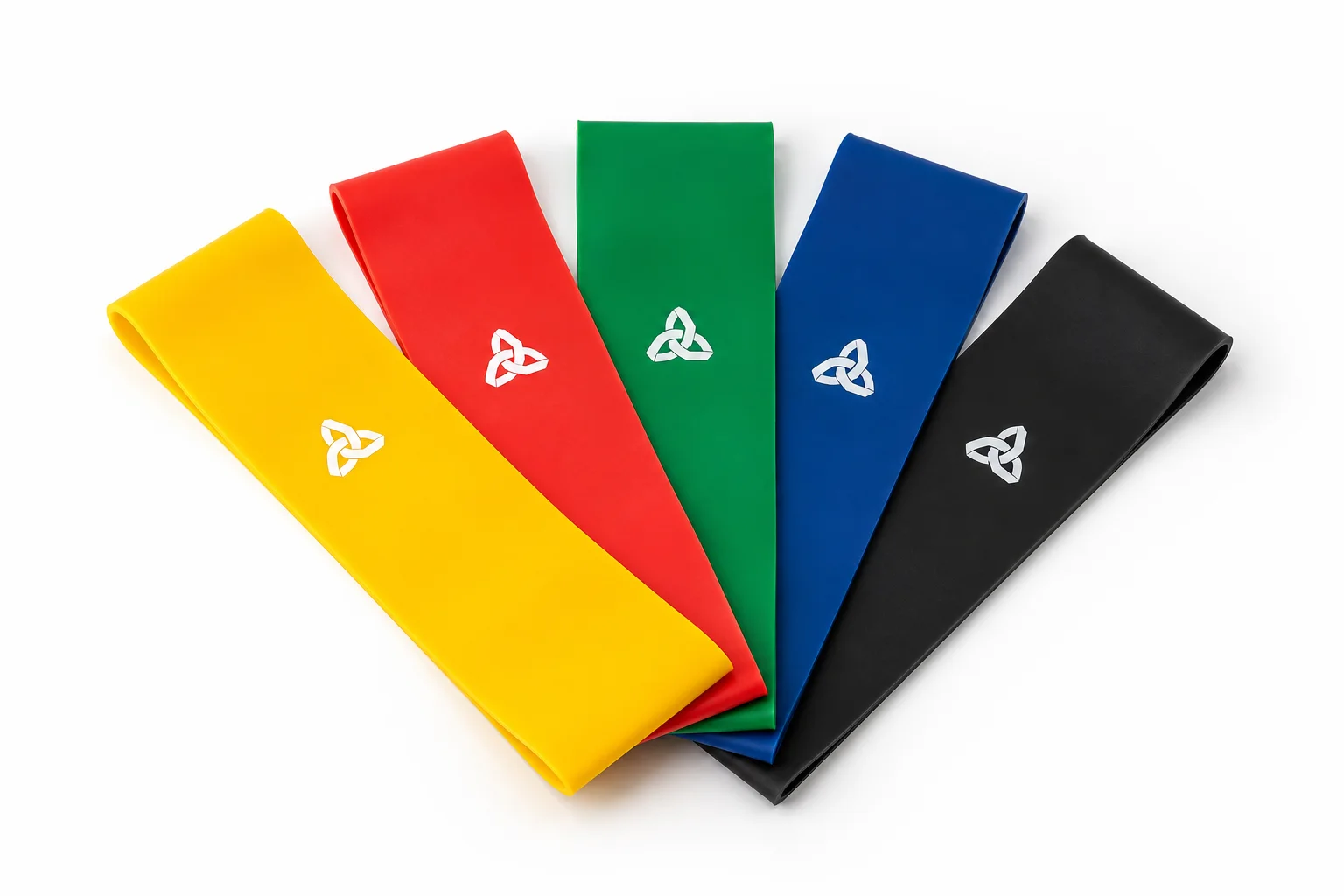
- Logo application methods differ significantly: screen print sits on the surface and is the most common; heat transfer produces finer detail; emboss/deboss creates a tactile impression in the band material itself; woven labels are available on fabric-covered bands. Each has different durability and aesthetic profiles.
- Custom compound color (Pantone-matched band color) requires a compound chip approval before production — the color you see on screen and the Pantone fan deck is not the same as the color in a stretched elastic compound. Physical approval is non-negotiable.
- Packaging is where most of the brand differentiation happens in this category. A zip pouch with a full-bleed printed insert card distinguishes a product at retail more than the band color or logo placement. Packaging specification should be treated as equal in priority to band specification.
- A signed specification document — covering logo placement with measurements, color Pantone reference, Shore A hardness, and packaging specification — is what protects your private label from drifting on the second production run.
What Private Label Means for Resistance Bands
In the resistance band category, “private label” spans a wide range. At the minimum end: a stock band in a factory’s standard color, with your logo screen-printed on the surface and your hang tag on the packaging. At the maximum end: a custom compound color formulated to your Pantone reference, a proprietary resistance level color coding system, a custom zip pouch with full-bleed brand artwork, and an exclusive agreement that prevents the factory from selling the same specification to your competitors.
Both are private label. The sourcing conversation needs to establish which version you are building — and that conversation produces very different MOQs, lead times, and cost structures.
For most first-time private label resistance band buyers, the right starting point is somewhere in the middle: stock elastic compound in a brand-aligned color from the factory’s existing range, logo print and custom packaging, and a specification document that locks down what “this product” means before the second order is placed. This approach keeps MOQ at 300 units and lead time at the standard 35–45 days, while producing a product that is visibly yours on a retail shelf or in an Amazon listing.
Customization by MOQ Tier
| MOQ | What’s Available |
|---|---|
| 100 units | Fabric-covered bands, stock elastic colors, logo on hang tag or pouch only. Band surface: no custom print. Limited packaging options. |
| 200 units | Fabric-covered bands, custom sublimation print on band surface, standard zip pouch with custom insert card. |
| 300 units | TPE or latex bands, logo screen print or heat transfer on band surface, custom Pantone color from factory’s existing compound range, custom packaging design (poly bag, zip pouch, header card). |
| 300–500 units | Custom Pantone compound color (outside existing range), proprietary resistance level color coding, custom packaging tooling (custom-size pouch or box). |
| 500+ units | Full compound exclusivity option, custom mold texture, premium packaging formats (rigid gift box, custom tube), extended warranty terms. |
The jump from 300 to 500 units unlocks the customization that makes a product genuinely harder to replicate: a color that isn’t in the factory’s standard range, a texture that isn’t in their standard mold library, a packaging format that requires dedicated tooling. Below 500 units, the customization is real but the elements are available to any buyer meeting the same MOQ.
Logo Application: Four Methods with Different Results
Screen Print
The most common logo application method for TPE and latex resistance bands. Ink is pushed through a mesh screen directly onto the band surface. The result is a flat, clean logo with good color saturation on a flat band.
Durability: 3–6 months of regular use before fading begins at the edges of the print. The fade is gradual and often only noticed by the buyer, not the end user. For studio-use bands cleaned daily, expect the shorter end of this range. For home-use bands used a few times per week, the longer end.
Best for: simple logos, text-based marks, 1–2 color designs. Multi-color screen print is possible but each color adds setup cost and registration complexity.
Heat Transfer
A pre-printed film is applied to the band surface with heat and pressure. Allows finer detail than screen print — photographic quality design elements, gradients, and small text are all achievable. The transferred image sits slightly above the band surface and can be felt with a fingertip.
Durability: slightly lower than screen print on high-friction surfaces. For bands that are handled and stretched frequently, heat transfer edges can lift at the perimeter within 60–90 days of regular use. For bands that are primarily worn or used in lower-friction applications (ankle bands, light resistance), durability is comparable to screen print.
Best for: logos with fine detail, gradients, multi-color designs, or designs where screen print registration would be imprecise.
Emboss / Deboss
The logo is pressed into the band material using a heated die. The result is a tactile impression — slightly raised (emboss) or recessed (deboss) — with no ink or film. The brand identity is structural, not applied.
An embossed logo on a resistance band reads differently from a printed one. There is no color, no contrast — just the logo as texture. In natural light it’s subtle; in a product photograph with raking light it becomes the main visual event. Brands that want a premium, understated aesthetic often specify emboss.
Durability: indefinite. There is nothing to fade or lift — the impression is in the material.
MOQ for emboss/deboss: requires a custom die for each logo shape, typically $80–$200 tooling cost. MOQ is otherwise standard (300 units). The tooling cost is owned by the buyer once paid.
Best for: premium TPE or latex bands, brands with a clean geometric logo that translates to a single-color impression, products positioned at higher retail price points.
Woven Label (Fabric Bands Only)
For fabric-covered resistance bands, a woven label — the same type as clothing care labels — can be integrated into the band’s fabric shell or sewn onto the loop. Woven labels survive machine washing and repeated stretching without any visible degradation.
Best for: fabric resistance bands, brands that also produce apparel (label consistency across categories), premium studio and wellness program products.
Custom Compound Color: How It Actually Works
Telling a factory “I want my bands in Pantone 7494 C” and receiving bands in Pantone 7494 C are two different things. The gap between the reference and the result is where most private label color problems originate.
Resistance band compound — TPE or latex — scatters and absorbs light differently than coated paper stock, which is what Pantone references are formulated for. The same Pantone number produces a different visual result in stretched elastic compound than in a printed ink.
The correct process:
Step 1 — Provide the Pantone reference. The factory’s compound team uses it as a starting target, not a guaranteed output.
Step 2 — Request a compound chip. A small slab of the mixed compound, unstretched, in the target color. This arrives in 5–8 business days and shows you the actual color before any production commitment.
Step 3 — Evaluate the chip in context. Look at the compound chip under your intended end-use lighting — natural daylight, retail fluorescent, or studio ambient. Compare it to your brand’s other physical materials (packaging, carry bag, apparel if applicable). If the chip reads correctly in all three, approve it. If it doesn’t, redirect with specific feedback: “too warm,” “too gray,” “needs more blue.”
Step 4 — Production from the approved chip. The factory matches the production compound batch to the approved chip. Specify allowable variance: Delta E < 3 for premium product, Delta E < 5 for standard commercial.
This process adds 8–14 days to the sampling phase but prevents the production run from arriving in a color that can’t be approved.
For brands building a multi-product line, the resistance level color coding system — which color maps to which resistance level — is a separate decision from the base compound color. Custom color coding across light / medium / heavy / extra-heavy / x-heavy requires 5 compound colors, each through the chip approval process. For the full color coding specification context, see resistance band color coding and level standards.
Packaging: Where the Brand Actually Lives
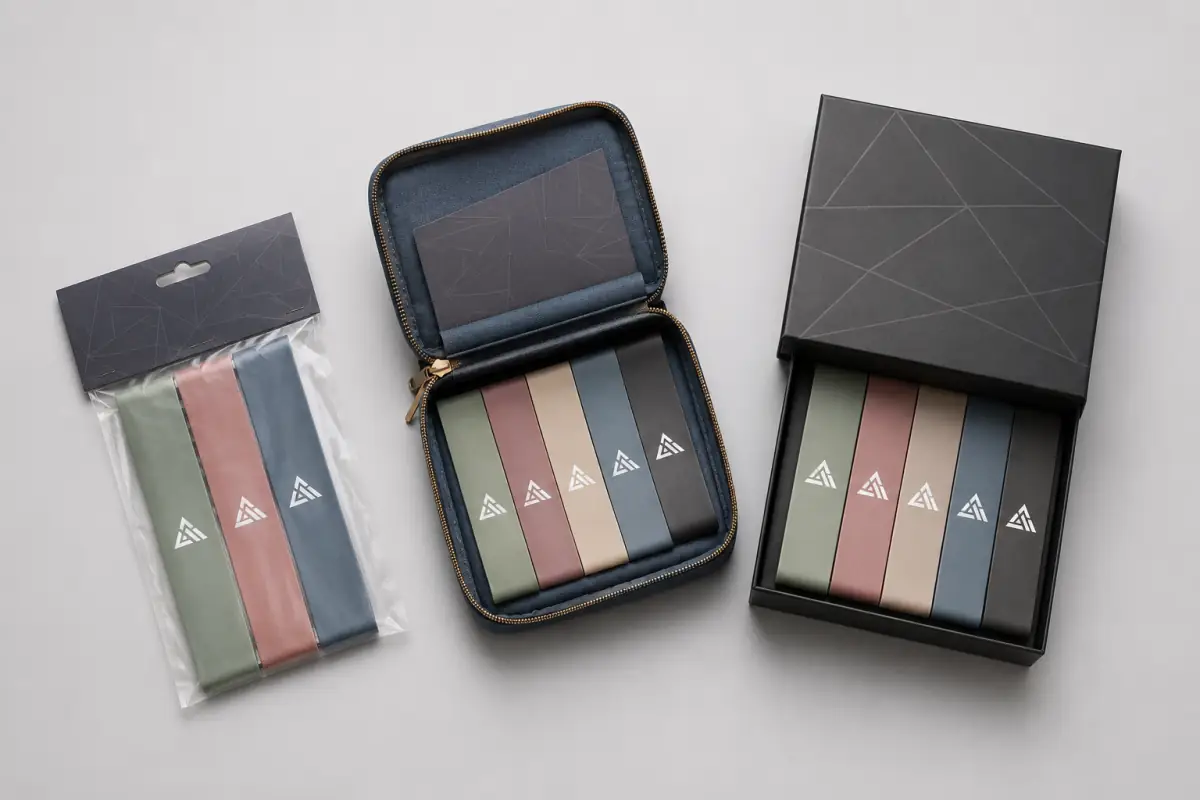
In resistance band B2B, packaging is underspecified more often than the band itself. A buyer who spends three rounds of sample approval on the band’s color and logo will sometimes accept the first packaging sample without close review — and then discover at retail that the packaging reads cheaper than the product.
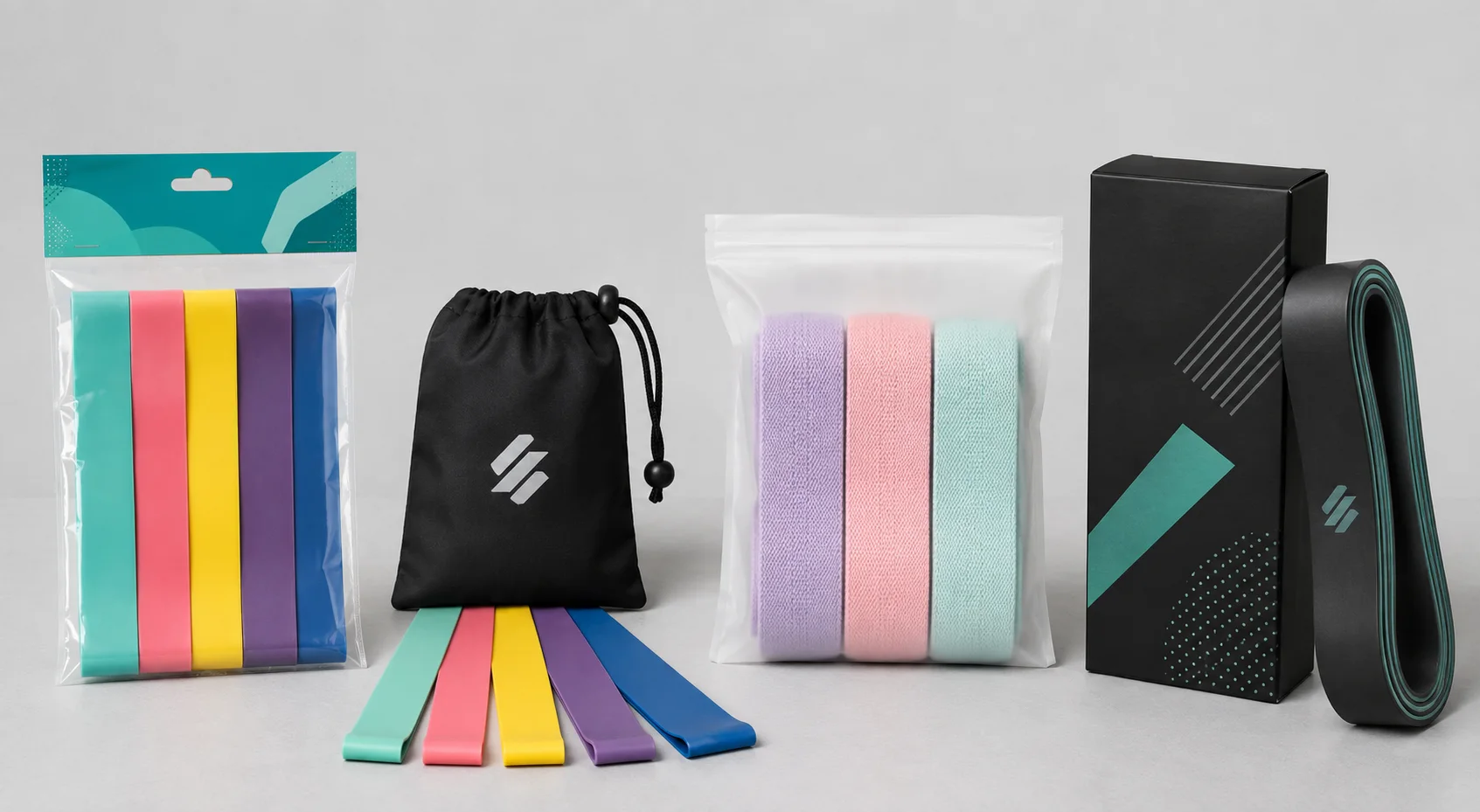
The packaging formats available and what each communicates:
OPP poly bag with header card. The baseline format. A sealed poly bag with a printed hanging card clipped to the top. Communicates: entry-level product. Appropriate for promotional pricing, high-volume mass retail, and products where the band is the message and packaging is purely functional. MOQ for custom header cards is typically 500–1,000 units (separately from the band MOQ).
Zip pouch with printed insert. A zippered fabric or woven pouch (typically 18–25cm) with a printed card inside. The pouch serves double duty as product packaging and a storage solution the customer keeps. When a customer stores their bands in the branded pouch between uses, your brand is present every time they use the product. This format is the most common private label configuration for sets of 3–5 bands.
The full zip pouch specification — size, material options, zipper quality grades, and what can be customized at which MOQ — is covered in detail in the resistance band set packaging guide.
Rigid gift box. A two-piece rigid box, typically printed full-bleed on the lid. This is the premium set format — appropriate for $40–$80 retail price points, corporate wellness gift sets, and products where the unboxing experience is part of the value proposition. Cost premium over zip pouch: 60–120% per unit. Lead time extension: 5–10 additional days for box production.
Custom tube or cylinder. A cylindrical container, often with a printed label wrapped around it, that holds a rolled set of bands. Distinctive shelf presence in retail environments. Less common than box or pouch formats, but useful for brands that want a packaging format that stands out in the resistance band section of a sporting goods retailer.
Packaging Specification Details
A packaging specification for private label resistance bands should cover:
- Pouch or box dimensions — both the outer packaging size and the internal dimensions needed to accommodate the specific band set rolled or folded
- Material and weight — pouch fabric weight (typically 200–300 gsm for a quality feel), box board weight (typically 1,200–1,800 gsm)
- Print specification — full color, finish (matte lamination vs gloss vs soft-touch), and which surfaces are printed
- Logo placement and size on packaging — same precision as band logo: measurements, not just “centered”
- Zipper quality (if applicable) — pull weight, brand spec (YKK vs generic), and whether the zipper matches the brand color
- Compliance labels — country of origin, material composition, allergen warning (required for latex), barcode placement
Protecting Your Spec Across Reorders
The most common private label resistance band problem is a reorder that doesn’t match the original. The color is slightly different. The pouch zipper feels cheaper. The logo placement has shifted. The product is still good — but it’s not the same product.
This happens when the original order was approved by sample but not documented by specification. “Same as approved sample” is not a specification. It is an instruction to a factory account manager who may not be the same person on the second order, working from institutional memory of what your approved sample looked like.
The specification document that prevents this contains:
- Band material, width (±0.5mm tolerance), thickness (±0.1mm), and Shore A hardness (±3 points)
- Logo: vector file reference, placement with measurements from band edge, print method, color (Pantone for ink, compound chip reference for band color)
- Resistance level color assignments: which compound Pantone or chip reference corresponds to each resistance level
- Packaging: all specifications from the list above
- Reference sample number: the factory holds one approved sample (signed and dated) against which each production run is compared
With this document, a reorder is an execution of the existing specification, not a re-interpretation of a memory. A new factory account manager, a new production supervisor, or a gap of 18 months between orders doesn’t change the output — because the specification doesn’t change.
For how resistance level specification interacts with band width and thickness parameters, the resistance level OEM specification guide covers the technical parameters by resistance category.
FAQ
Can we use our own packaging design files?
Yes. Most factories accept buyer-supplied print files in AI, EPS, or PDF format (CMYK color mode, 300 DPI minimum for photographic elements). The factory’s art team performs a print-readiness check — confirming bleed margins, text safety zones, and that colors are within the printing gamut for the chosen print method and finish. Revisions to print files that don’t pass this check add 3–5 days to the sample timeline. Having a designer familiar with print specifications prepare the files before submission avoids most revision cycles.
How do we handle MOQ when we need multiple resistance levels?
For a 5-band set at 300 units (300 sets, 5 resistance levels), the factory produces 300 units of each resistance level — 1,500 individual bands total. The 300-unit MOQ applies to the set quantity, not the individual band quantity. For a buyer who wants to sell bands individually (not in sets), each resistance level (color) would require its own 300-unit minimum per color, totaling 1,500 units for a 5-level line. Confirm with the factory how they calculate MOQ before assuming set-based vs individual-band calculation.
Is our logo considered our intellectual property once we pay for the die?
The logo itself is your intellectual property regardless of who made the die. The die (physical tooling) is owned by whoever paid for it — typically the buyer after paying the tooling fee. A tooling fee receipt with your company name as the paying party is evidence of ownership. Some factories attempt to retain die ownership when the buyer hasn’t explicitly paid a separate tooling fee; in these cases, confirm die ownership in writing before the first production run. A factory that holds your tooling holds leverage over your sourcing — moving to a new factory means paying for new tooling.
Can we order a small quantity to test market before committing to 300 units?
Some factories offer paid pre-production samples — 10–20 units in your actual specification — at a higher per-unit cost. These are not fully QC-controlled production runs, but they allow market testing or internal review before committing to the full MOQ. This option is not universally available; ask explicitly during the inquiry stage. For buyers with an existing design and a known market, ordering at the standard MOQ with a clear sell-through plan is usually more efficient than testing at high per-unit cost and then reordering.
What happens if we want to add a new SKU (new resistance level or new color) to an existing line?
Adding a new SKU to an existing private label line requires a new production run for that SKU at the minimum quantity (300 units for a new TPE color). If the new SKU uses a compound color that’s already in the factory’s approved library (an existing color you’ve used before), the setup is simpler — no new chip approval required. If it’s a new color, the chip approval process adds 8–14 days to the sampling phase. Most brands build their resistance band line incrementally: 3–5 SKUs at launch, adding additional resistance levels or color variants in subsequent seasons as the line proves itself.
Related reading:
– OEM Resistance Band Sourcing: Complete B2B Guide — the full sourcing framework: material selection, lead times, channel requirements, and supplier qualification
– Resistance Band Set Packaging: Bulk, Retail-Ready & Gift Box Formats — packaging format comparison, spec requirements, and channel fit by packaging type
– Custom Resistance Band Colors & Level Coding — how to design and specify a color coding system across your resistance level range
– Resistance Band Resistance Levels: OEM Specification Guide — the technical spec parameters (width, thickness, force values) that define each resistance level