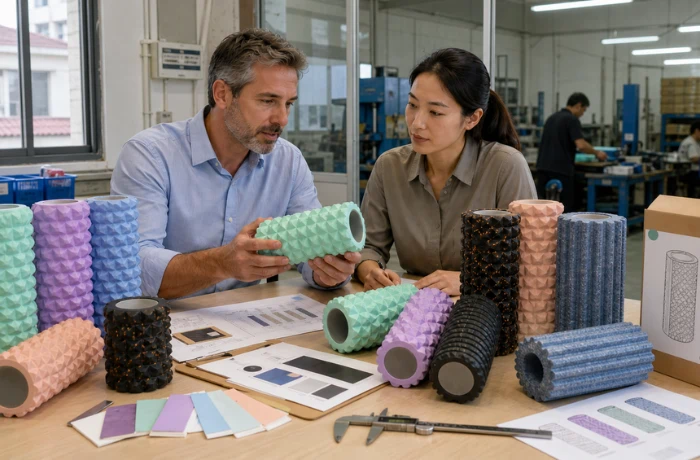
Two factories quote the same product at the same price. One has a QC process that catches dimensional drift before goods ship. The other has a QC process that exists on paper. You won’t know which is which from the quote. You will know from the questions you ask before you order — and from whether you can get clear answers to those questions.
Evaluating a resistance band manufacturer is not about finding a factory that can make resistance bands. Most can. It is about finding a factory whose production consistency, quality control process, compliance documentation, and communication practices can support a branded product line across multiple production runs — where the second order matches the first, and the fifth order matches the second.
This guide covers the criteria that distinguish a capable OEM resistance band factory from a vendor that will deliver inconsistent results at scale, the questions to ask during initial qualification, and how to interpret what you find.
Quick Summary
- The most important factory capability for resistance bands is compound mixing control — whether the factory mixes its own compound (better color and resistance consistency) or purchases pre-mixed compound from a third party (less control over batch-to-batch variation). Ask directly which approach the factory uses.
- Factory QC documentation — dimensional tolerance records, resistance force test logs, colorimetric measurement data from production runs — is the evidence of whether quality control is a real process or a paper one. A factory that cannot produce recent QC records is a factory without a reliable QC process.
- Compliance history for target export markets (CA65 test reports for US, REACH test reports for EU) indicates whether the factory has produced for these markets before. A factory with no prior compliance testing history can still produce compliant product, but the compliance documentation will take longer and cost more to generate for the first order.
- Minimum run size vs claimed capability: a factory that offers 50-unit trial runs is typically either outsourcing to a third party or operating at a scale where quality control systems are applied inconsistently. For branded resistance bands, 300 units is the practical minimum for a production run worth the quality management overhead.
- Communication speed and accuracy — how quickly and precisely the factory answers technical questions during the inquiry stage — is a reliable predictor of communication quality during production. A factory that takes five days to answer a direct question about compound mixing will not respond faster when a QC issue arises mid-production.
Capability Criteria

1. Compound Mixing: In-House vs Purchased
This is the single most consequential capability distinction in resistance band manufacturing. Two approaches exist:
In-house compound mixing: The factory purchases raw TPE resin or natural latex and mixes its own compound — adding pigments, processing aids, and stabilizers to a formulation they control. This means they can: – Adjust compound formulation to hit a specific color reference or performance target – Control batch-to-batch consistency by testing each compound batch before production – Provide documented compound formulations that make QC verification meaningful – Reformulate when a CA65 or REACH issue is identified
Purchased pre-mixed compound: The factory buys ready-to-use compound in fixed colors from a compound supplier and runs it through their production equipment. This limits: – Color options to the compound supplier’s catalog – Consistency to whatever variation the compound supplier’s batches have – The factory’s ability to address compliance or color drift issues (they cannot reformulate — they change suppliers)
How to confirm which approach a factory uses: Ask directly: “Do you mix your own TPE compound, or do you purchase pre-mixed compound?” A factory that mixes in-house will describe the process — resin grades, pigment systems, mixing equipment. A factory using purchased compound will name a compound supplier or describe ordering pre-colored material. Some factories do both: in-house mixing for standard colors, purchased compound for specialty colors. This is acceptable; confirm which applies to your specific specification.
2. Production Equipment
The key equipment for flat loop resistance band production: – Extrusion or calendar line: Produces flat sheet or tube stock from the compound. Width consistency and thickness consistency are set by the die and roll settings on this equipment. Ask: “What is your tolerance control for band width? How often is the die calibrated?” – Cutting equipment: Cuts flat sheet into band widths and lengths. Dimensional consistency depends on blade quality and maintenance frequency. – Vulcanization equipment (latex): Heat-curing ovens for natural latex. Temperature control is critical — under-curing produces weak bands; over-curing degrades elasticity. Ask: “What temperature and time specification do you use for vulcanization? How is oven temperature monitored?” – Logo application equipment: Screen printing press, heat transfer press, or emboss die press. The capability and capacity of this equipment determines logo quality and throughput.
3. QC Infrastructure
Quality control in a capable factory operates at three points: incoming material inspection, in-process measurement, and finished goods testing.
Incoming material: The factory should inspect raw compound, pigment, and packaging components before they enter production. Ask: “What is your incoming material inspection process? What do you check?”
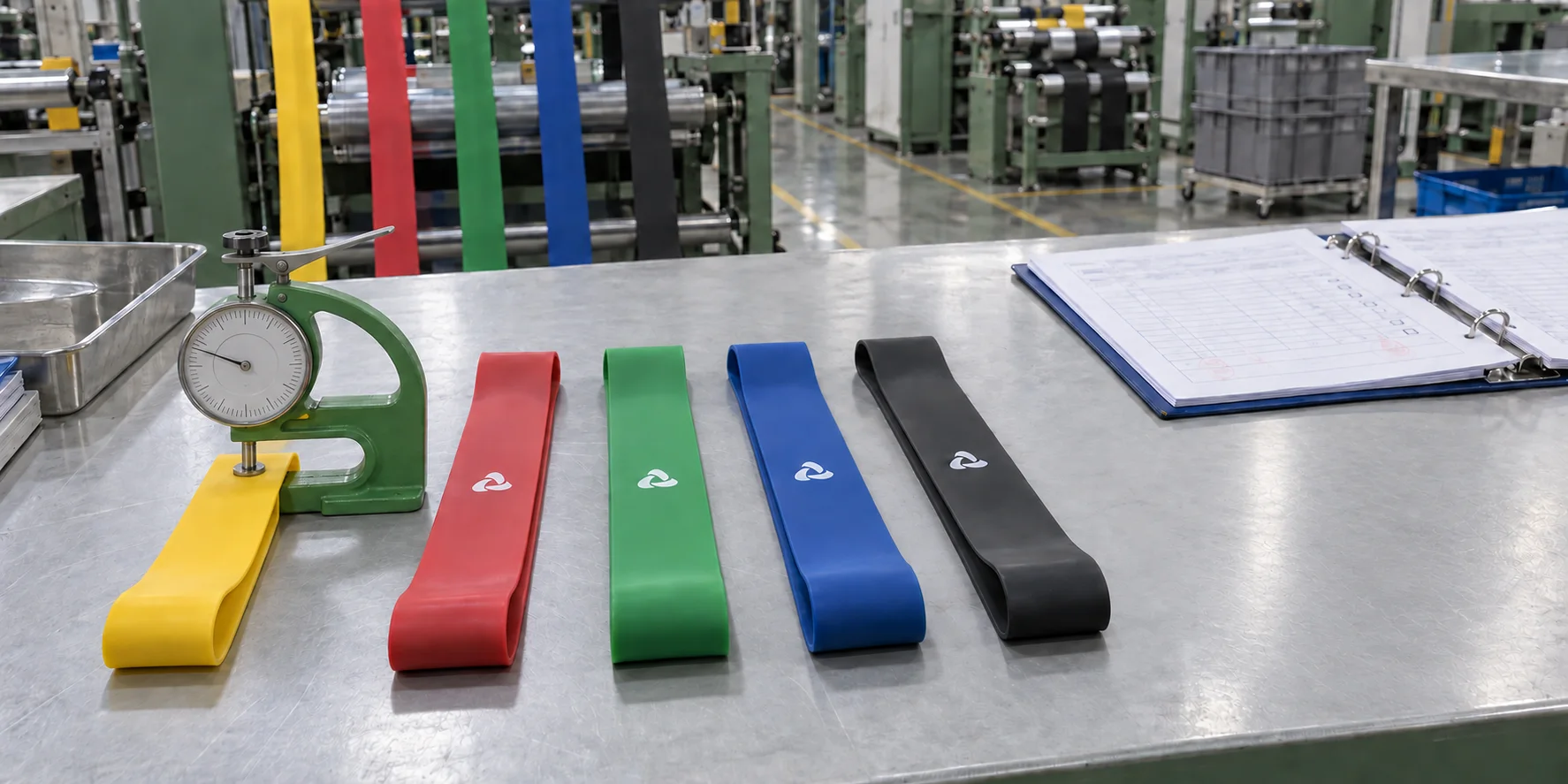
In-process: Width and thickness measurements should be taken at regular intervals during production — at minimum, at the start of each production shift and when a die or roll is changed. Ask: “How often do you measure band width and thickness during a production run? What equipment do you use?”
Finished goods: Resistance testing on a sample of finished bands (force gauge at defined elongation) should be part of the QC sign-off before goods are packed. Color comparison against the approved chip (visual or colorimetric) should be documented. Ask: “Can you show me QC records from a recent production run?” The answer to this question is more informative than any description of their process.
4. Capacity and Scale
Capacity affects both lead time reliability and quality management. A factory with a daily output of 5,000 bands per production line running a 1,500-band order (300 sets × 5 bands) will finish in 1–2 days of line time and have its full QC attention on the order. A factory with the same daily output running 30 concurrent orders may schedule your order on a half-day slot with shared QC resources.
Ask: “What is your current production capacity for flat loop resistance bands? What is your typical order book at this time of year?” A factory that cannot answer the second question (or gives a vague answer) does not have visibility into its own schedule — which is a production planning problem that affects your lead time.
5. Export Experience and Compliance Documentation
A factory’s compliance documentation history tells you what markets they have supplied before: – CA65 test reports: Indicates prior US market sales and an established test process – REACH test reports: Indicates prior EU market sales – Amazon SDS documents: Indicates prior Amazon seller supply and familiarity with Amazon’s compliance requirements – FDA or EU regulatory filings: Rare for resistance bands specifically, but relevant if the product is positioned for medical or PT use
A factory with extensive export history for your target markets has compliance documentation on file and a process for updating it. A factory without prior export to your target market needs to generate all documentation from scratch, which adds cost and timeline to the first order.
Qualification Questions: What to Ask and How to Interpret the Answers
Q1: Do you mix your own compound or purchase pre-mixed?
Strong answer: “We mix our own TPE compound. Our compound team blends [resin grades] with pigments and processing aids. We test each batch for [specific properties] before releasing to the production floor.”
Weak answer: “We use high-quality TPE compound.” (Doesn’t answer the question. Follow up: “From which supplier?”)
Q2: Can you provide QC records from a recent production run?
Strong answer: Factory sends a sample QC report showing dimensional measurements (width, thickness with tolerances noted), color comparison data, and force test results from the production run.
Weak answer: “Our quality is very strict. We have 100% quality control.” (Not an answer. Ask again for specific records.)
No answer: The factory does not have documented QC records. This is a red flag — not necessarily disqualifying if the factory is otherwise capable, but means any QC commitments in the purchase order terms are unverifiable claims.
Q3: What CA65 and REACH test reports do you have on file?
Strong answer: Factory provides test report numbers, issuing laboratory names, and report dates within the last 18 months. Follows up with PDFs within 24 hours.
Weak answer: “We can get the test reports.” (They don’t have them. Asking for them later may produce documents that were commissioned after your inquiry, which may not reflect current production compound.)
Q4: What is your minimum order quantity for a branded 5-band set?
Strong answer: “300 sets for a standard logo screen print with stock compound colors. 500 sets if you want a custom compound color outside our existing range.”
Weak answer: “We can do any quantity. Even 50 sets.” This is the clearest signal of either a broker (not a factory) or a factory that outsources small orders to uncontrolled third parties.
Q5: Who will be our account manager, and what is their English communication capacity?
Why this matters: Production problems surface as communication problems. If the person managing your account cannot read a specification document accurately, receive a QC rejection and understand why, or escalate a production issue to the factory floor supervisor in real time — the quality control you negotiated on paper is inoperable in practice.
What to look for: Clear, specific answers to technical questions in the first two exchanges. An account manager who responds to “What is your tolerance for band width?” with a specific measurement and a tolerance range is a different quality of communication than one who responds with “Our width is very consistent.”
Factory Audit: What to Check On-Site or Via Third-Party Audit
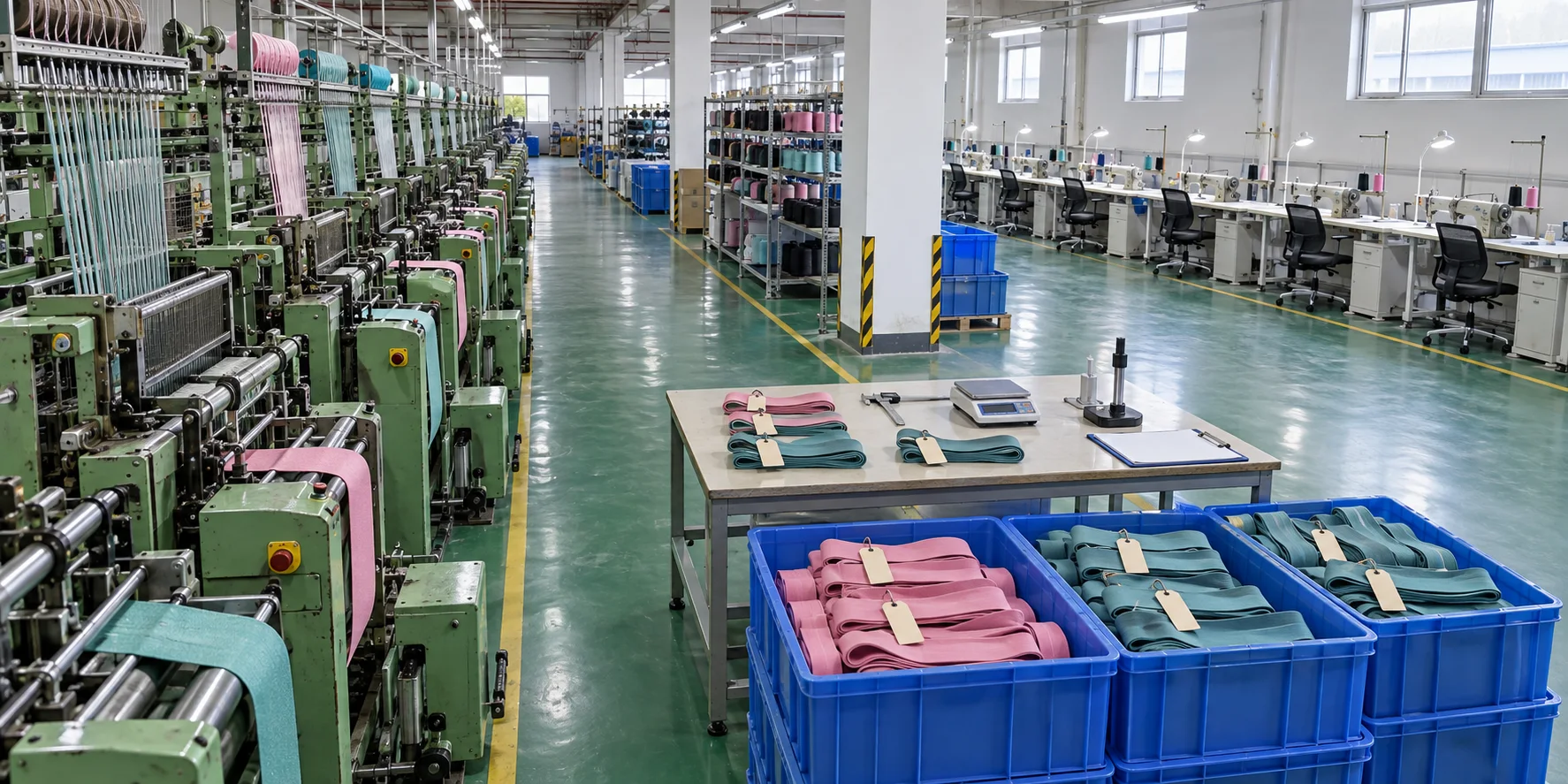
An on-site factory audit or a third-party social compliance and capability audit (BSCI, SA8000, or a capability-specific audit from an inspection firm) covers:
Facility and equipment:
– [ ] Compound mixing area: equipment, raw material storage, batch records
– [ ] Extrusion or calendar line: condition, calibration records
– [ ] Cutting equipment: blade condition, maintenance log
– [ ] Logo application equipment: condition, registration accuracy
– [ ] QC lab: measuring equipment (calipers, force gauge, colorimeter), calibration certificates
QC documentation:
– [ ] In-process measurement records from the last three production runs
– [ ] Finished goods test records (force, color, dimensions)
– [ ] Rejection and rework records (what goes wrong and how often)
– [ ] Corrective action records (how problems were resolved)
Compliance:
– [ ] CA65 test reports with issuing lab name and date
– [ ] REACH test reports with issuing lab name and date
Business operations:
– [ ] Business license and export license
– [ ] Customer reference list (other brands they produce for)
– [ ] Subcontracting disclosure (do they outsource any part of production?)
The subcontracting question is particularly important. A factory that outsources cutting, logo application, or packaging to a third party that you haven’t evaluated is effectively a factory with an unknown quality tier in its production chain.
FAQ
Is a factory audit necessary for a first order?
Not mandatory, but recommended for orders above approximately $10,000 or for products that will carry significant brand equity. A third-party audit from a firm like SGS or Intertek costs $300–$600 and produces a report covering facility condition, QC process, and compliance documentation. The cost is a fraction of a production run that fails QC at inspection or generates returns at retail. For smaller first orders, a detailed qualification questionnaire (using the questions above) is a reasonable substitute.
How do we evaluate a factory we can only communicate with remotely?
Remote qualification follows the same criteria but relies on documentary evidence rather than physical observation. Request: QC records from a recent production run, compliance test reports, photos of the production facility and equipment, and a video call where the account manager answers the qualification questions live. The quality of their answers in a live call is harder to prepare for and more revealing than written responses.
What is the difference between a factory and a trading company?
A factory owns and operates the production equipment. A trading company sources orders and places them with factories, adding a margin. Trading companies can be legitimate intermediaries — they sometimes provide better customer service, language support, and quality coordination than the factory’s own team. The risk is that you have no direct relationship with or visibility into the factory actually producing your product, which limits your ability to solve problems when they arise. For branded private label products where specification consistency across reorders is critical, a direct factory relationship is preferable.
How many production runs should we see from a factory before considering them a reliable supplier?
One successful order demonstrates that the factory can produce your product once. Two successful orders — with the second run matching the first — demonstrates that they can maintain consistency across a repeat. Three to five successful orders, including at least one where a problem arose and was resolved satisfactorily, is when a factory becomes a reliable supplier in a meaningful sense. Reserve the language “trusted supplier” for factories where you have evidence of how they perform when something goes wrong, not just when everything goes right.
Related reading:
– OEM Resistance Band Sourcing: Complete B2B Guide — full sourcing framework including supplier qualification criteria
– Resistance Band MOQ & Lead Times: Chinese OEM Factory Guide — how factory capacity and production schedule affect your lead time
– Resistance Band Compliance: REACH, CA65 & Safety Standards — compliance documentation checklist to verify during factory qualification
– Resistance Band Resistance Levels: OEM Specification Guide — technical specifications to verify the factory can meet and document