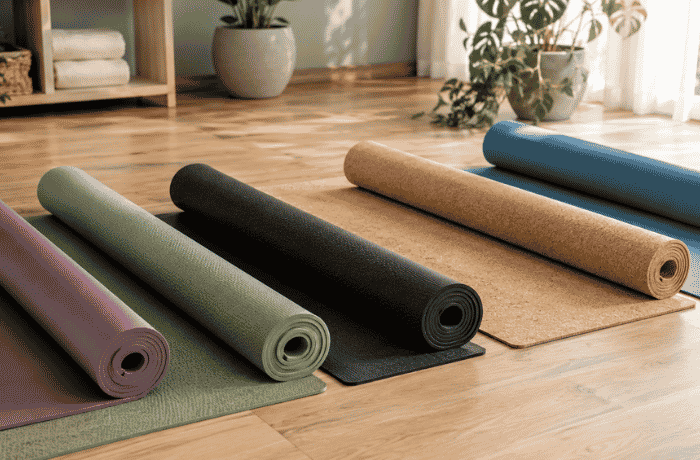
PU yoga mats are the premium tier of the yoga mat category — natural rubber base, polyurethane top layer, superior sweat-activated grip, and the surface quality that commands $60–$150+ at retail. For B2B buyers and private label brands, PU mats represent the highest-margin product in the yoga mat category, but they also carry the most demanding compliance requirements and the tightest specification tolerances. This guide covers everything sourcing teams need to know: materials, MOQ, certifications, customization, and accessory bundle configurations.
Quick Summary
- PU yoga mats use a natural rubber base (typically 3–5mm) topped with a polyurethane microfiber layer — the combination delivers grip that improves with moisture, which is why they dominate the premium yoga and hot yoga market.
- REACH chemical compliance is non-negotiable for EU-bound PU mats; CA65 Prop 65 testing is the standard requirement for US retail and Amazon.
- MOQ for custom PU yoga mats starts at 200–500 units depending on size and print complexity; PU is higher-cost than TPE and PVC but supports retail prices 2–4× higher.
- PU mats are the natural anchor product for bundle kit orders — pairing with yoga blocks, straps, carry bags, and bolsters into a single retail unit increases AOV and differentiates from single-SKU competitors.
- Lead time for PU yoga mat samples is 5–10 working days; production lead time runs 45–60 days due to the lamination and curing process specific to PU construction.
Why B2B Buyers Choose PU Over Other Yoga Mat Materials
The yoga mat market splits broadly into four material tiers. Understanding where PU sits in that hierarchy is the first step to positioning it correctly in your product line.
| Material | Base | Top Layer | Key Selling Point | Typical Retail Price | B2B Position |
|---|---|---|---|---|---|
| PVC | PVC foam | PVC | Entry-level, durable, price-accessible | $15–$35 | High volume, low margin |
| TPE | Thermoplastic elastomer | TPE | Eco-friendly alternative to PVC, lighter | $25–$55 | Mid-tier, growing demand |
| Natural Rubber | Natural rubber | Natural rubber or jute | Sustainable, good grip, heavy | $50–$100 | Premium, niche certification needs |
| PU (Polyurethane) | Natural rubber | PU microfiber | Best grip in class, premium feel, sweat-activated | $60–$150+ | Highest margin, selective buyers |
PU wins in three scenarios that B2B buyers care about:
Hot yoga positioning. Sweat activates PU’s grip rather than degrading it. For brands targeting the Bikram, hot yoga, and power yoga segment, PU is the only material that consistently outperforms in wet conditions. This makes it the standard specification for studio-branded mats and premium DTC products.
Premium retail placement. Specialty fitness retailers (REI, lululemon accessories ranges, independent yoga studios) default to PU for their highest price-point offerings. A private label brand with a PU product has a credible path into these channels; a PVC or TPE brand does not.
Brand margin logic. A PU mat costs more to manufacture — $12–$20 FOB depending on natural rubber percentage, PU layer thickness, and print complexity — but supports retail prices that deliver 50–65% gross margin even with Amazon fees or retail markup absorbed.
PU Yoga Mat Specifications: What B2B Buyers Must Specify
Vague briefs produce vague quotes. These are the parameters that determine cost, quality, and compliance for PU yoga mats.
Natural Rubber Base
The base layer drives cost and performance more than any other variable. Standard options:
- 3.5mm natural rubber: Entry-level PU mat. Good grip, adequate cushioning. Suitable for brands positioning in the $60–$80 retail range.
- 4mm natural rubber: The most common specification for premium B2B orders. Balances cost, cushioning, and durability across most yoga styles.
- 5mm natural rubber: Maximum cushioning. Preferred by restorative yoga brands and studio operators concerned about joint comfort on hard floors.
Natural rubber percentage matters for REACH compliance and for latex allergy declarations. Specify the natural rubber content percentage (typically 80–95% natural, balance synthetic additives) and request REACH SVHC test results specific to your rubber compound.
PU Top Layer
The polyurethane microfiber layer is what defines the premium touch and sweat-activated grip. Key specs:
- Layer thickness: 0.5mm–1.0mm PU coating. Thicker coatings improve durability but add cost.
- Surface texture: Smooth, suede-effect, or patterned emboss. Embossed alignment lines are a popular customization for studio-branded mats.
- Print capability: Sublimation printing directly onto PU surface achieves photographic-quality designs. Screen printing is available for simpler logo placements. Specify whether print must extend to the mat edge or whether a border is acceptable.
Standard Size Options and Custom Sizing
| Format | Standard Dimensions | Best For |
|---|---|---|
| Standard | 183cm × 61cm | General retail, most studio programs |
| Wide | 183cm × 68cm | Hot yoga, additional stability appeal |
| Extra wide | 200cm × 76cm | Premium tier, brand differentiation opportunity |
| Travel | 183cm × 61cm × 1.5mm | Lightweight travel segment |
Custom sizing is available with a tooling fee of $300–$800 depending on mold complexity and whether a new cutting die is required.
Accessory Bundle Configurations for B2B Buyers
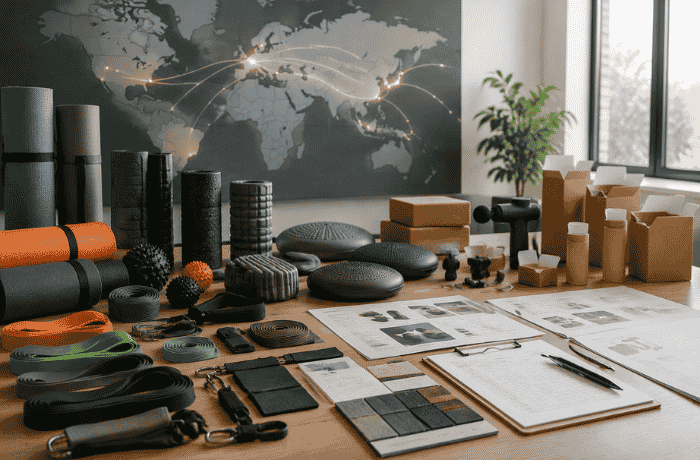
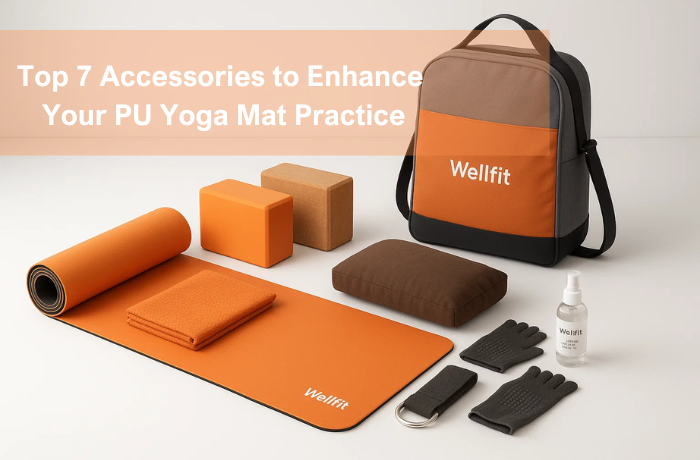
PU yoga mats are rarely optimized as a standalone product at the B2B level. The highest-margin configuration is a branded bundle kit — a coordinated accessory set that ships as a single retail unit under your brand name.
Why Bundle Kits Work for Private Label Brands
A standalone PU yoga mat at $79.99 competes in a crowded category. A PU yoga mat bundled with a matching microfiber yoga towel, two cork blocks, a cotton strap, and a carry bag at $129.99 faces a dramatically thinner competitive field — and the per-unit margin on the bundle is typically higher than the sum of the individual parts because the sourcing consolidation reduces per-unit freight and packaging cost.
Bundle kit assembly is available from a single supplier when all components are sourced from the same manufacturing relationship, eliminating the quality inconsistency and logistics complexity of assembling kits from multiple factories.
Core Accessory Categories Available for Bundle Configuration
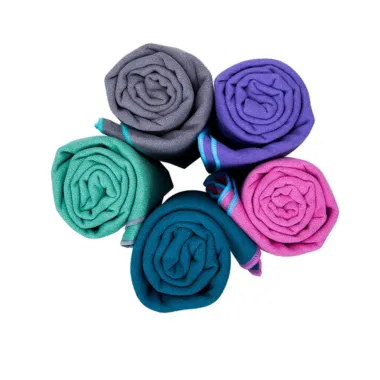
The most common PU mat companion product. A microfiber towel in the same colorway as the mat creates a coordinated set that photographs well for listings and strengthens brand identity.
Specifications to brief: dimensions (standard 183cm × 61cm), GSM weight (typically 280–350 GSM for absorbency), corner pocket configuration (prevents towel shifting during practice), and custom print coverage.
MOQ: 300–500 units. Lead time: 25–35 days from order confirmation.
Yoga Blocks (Cork or EVA Foam)
Cork blocks command premium positioning — natural material, firm grip, aesthetic that photographs well. EVA foam blocks are lighter, lower cost, and suitable for mid-tier bundle configurations. For brands also looking at a cork yoga mat as a companion SKU, cork blocks create a natural, unified sustainable product line.
Specifications: Standard dimensions 23cm × 15cm × 10cm. Custom engraving (logo, brand name) is available on cork blocks. Color options for EVA blocks include any Pantone reference.
MOQ: 300–500 units per SKU. Lead time: 20–30 days.
Cotton or nylon straps with metal D-ring or plastic buckle. Most commonly spec’d at 183cm or 244cm (6ft or 8ft) length, 3.8cm width. Custom woven label or screen-printed logo placement available.
MOQ: 500 units. Lead time: 20–30 days.
Carry Bag
A branded carry bag completes the bundle and solves a practical customer problem — transporting the mat. Canvas, polyester, or recycled material options. Custom embroidery or screen print for logo placement. Side pocket configuration for accessories storage.
MOQ: 300 units. Lead time: 25–35 days.
Yoga Bolster (for Studio and Restorative Brands)
Rectangular or cylindrical bolsters with removable cotton covers. Filling options: kapok, buckwheat hulls, or polyester fiberfill. Custom cover fabric, color, and print available.
MOQ: 100–300 units. Lead time: 30–40 days.
Sample Bundle Kit Configuration
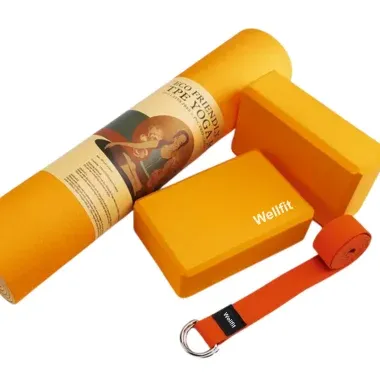
A representative premium bundle for a DTC brand targeting the hot yoga segment:
| Item | Spec | Est. Unit Cost (FOB) |
|---|---|---|
| PU yoga mat (4mm NR, 183×61cm) | Full-color sublimation print | $14.00–$18.00 |
| Microfiber towel (300 GSM, matching colorway) | Screen print logo | $3.50–$5.00 |
| Cork blocks × 2 | Laser engraved logo | $5.00–$8.00 |
| Cotton strap (183cm) | Woven label | $1.50–$2.50 |
| Canvas carry bag | Embroidered logo | $4.00–$6.00 |
| Custom printed retail box | Full color | $2.50–$4.00 |
| Total kit cost (FOB) | $31.00–$43.50 |
At a $129.99 retail price, that’s a 67–76% gross margin before channel fees. Even after Amazon fees (~30% for this category), the brand retains 37–46% net margin — substantially higher than a standalone mat.
Certifications for PU Yoga Mats
PU mats have specific certification requirements that differ from PVC and TPE mats due to the natural rubber base layer.
REACH (EU Market)
The natural rubber in PU mats must be screened for SVHC (Substances of Very High Concern), including processing chemicals and vulcanization agents that may contain restricted substances. The PU top layer must also be tested for phthalates and other coatings compounds. A full REACH SVHC screening report from an EU-recognized lab (SGS, TÜV, Bureau Veritas) is required before placing goods on the EU market.
Cost: €300–€600 per SKU · Timeline: 2–3 weeks
CA65 / Prop 65 (US Market)
Natural rubber yoga mats are one of the highest-risk product categories for Prop 65 enforcement in the US. Key substances of concern include N-nitrosodiphenylamine (rubber processing chemical), isoprene residues, and chemical additives in the PU coating. CA65 test reports from an ILAC-accredited lab are the standard documentation request from US retailers, Amazon seller central, and B2B buyers.
Cost: $400–$700 per SKU · Timeline: 2–3 weeks
CE Marking (EU)
PU yoga mats fall under the EU General Product Safety Directive. A Declaration of Conformity and supporting technical file are required. For mats with no electronic components, this is a manufacturer self-declaration route supported by the REACH test results and material safety data.
Natural Rubber Latex Allergy Labeling
EU and several national markets (Germany, France) require latex allergy warnings on products containing natural rubber. The standard label reads: “Contains natural rubber latex which may cause allergic reactions.” This must appear on retail packaging and in product listings for EU channels.
Customization Options for Private Label Brands
PU yoga mats support the deepest customization available in the yoga mat category. The following options are available for private label orders:
Surface print: Full-bleed sublimation printing across the entire mat face. Design files in AI or EPS format, minimum 150 DPI at print scale.
Embossed texture: Custom surface texture pattern (alignment lines, brand pattern, geometric designs) embossed into the PU layer. Requires tooling investment ($800–$1,500 for new texture pattern) but creates a signature brand element that cannot be replicated by competitors ordering from the same factory’s catalog.
Custom dimensions: Any non-standard size with cutting die tooling.
Colorway matching: PU base color (rubber) and top layer (PU microfiber) color can be matched to Pantone references. Note: the natural rubber base limits the range of achievable base colors to dark tones; the PU layer accepts a full color range.
Packaging: Retail box, poly tube, or rolled-in-strap configurations. Custom printed retail boxes with brand artwork available with 500+ unit orders.
Hang tag and labeling: Custom hang tag design, QR code linking to brand registration or video content, certification marks (REACH, CA65) printed on packaging.
MOQ and Lead Times
| Order Type | MOQ | Sample Lead Time | Production Lead Time |
|---|---|---|---|
| ODM (catalog PU mat, logo only) | 50–100 units | 5–10 working days | 20–25 days |
| OEM (custom print, standard size) | 200–500 units | 5–10 working days | 25–30 days |
| OEM (custom print + custom size) | 300–500 units | 5–10 working days | 30–35 days |
| Bundle kit (mat + 2–4 accessories) | 300–500 sets | 10–15 working days | 35–40 days |
Lead times reflect current production scheduling from our Yangzhou, Jiangsu facility. Add 18–22 days sea freight for US West Coast delivery; 35–45 days for East Coast and European ports.
How Wellfitsource Services This Category
We manufacture PU yoga mats and the full range of complementary accessories from a single facility in Yangzhou, Jiangsu, serving 820+ B2B buyers across North America, Europe, and Australia. Our position in this category:
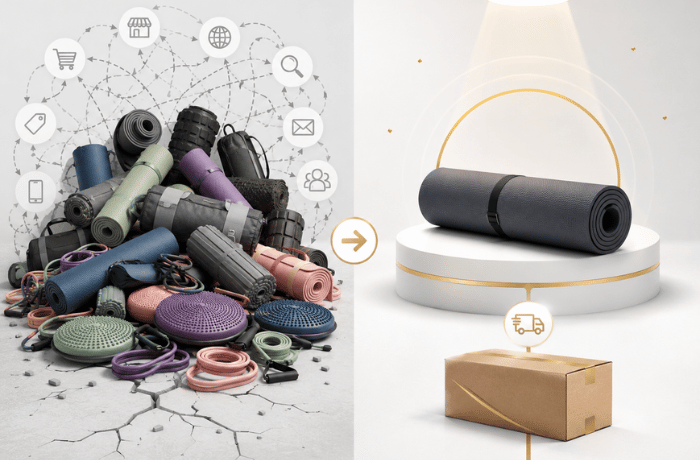
Single-source bundle capability. PU yoga mats, yoga accessories (towels, blocks, straps), foam rollers, resistance bands, and foam balance pads are all manufactured in-house. Brands ordering a bundle kit work with one account manager, one invoice, one shipment, and one QC standard — rather than coordinating three to five separate suppliers for the same retail unit.
Compliance documentation ready. We maintain current REACH SVHC screening reports, CA65 Prop 65 test reports, and CE Declarations of Conformity for our standard PU mat material specifications. Brands sourcing from our standard materials receive this documentation alongside samples and do not need to commission fresh testing from zero.
SGS-certified BSCI audit. Our facility holds a current BSCI social compliance audit issued by SGS, available for review before sampling begins. ISO 9001 quality management system certification is also maintained.
5–10 working day sample lead time across the PU mat range, including custom-printed samples on your design artwork.
Dedicated account management. Each client account is assigned a consistent English-speaking account manager across sampling, production, and post-shipment.
If you’re evaluating PU yoga mats for private label sourcing — whether for your first order or for a product line expansion — we’re glad to share specification options and a formal quote based on your requirements.
FAQ
What is the minimum order for custom PU yoga mats with our brand logo?
For ODM configurations (custom logo on our standard PU mat specs), the minimum order is 50–100 units. For OEM configurations with custom full-bleed sublimation print artwork, the minimum is 200–500 units. Bundle kit orders (PU mat + accessories) start at 300–500 sets. All samples — including custom-printed samples on your artwork — are available before committing to a production order.
Do PU yoga mats require different certifications than PVC or TPE mats?
Yes. The natural rubber base in PU mats introduces specific REACH SVHC considerations (rubber processing chemicals and vulcanization agents) that PVC and TPE mats do not have. PU mats also require latex allergy labeling for EU markets. CA65 testing is essential for US market sales, as natural rubber products are a higher-priority category for Prop 65 enforcement actions. We can provide current compliance test reports for our standard PU mat materials before you place a sample order.
What customization is available for the PU mat surface?
Full-bleed sublimation printing (photographic quality), custom embossed texture patterns, color-matched PU microfiber layer, custom dimensions, and branded packaging. For brands wanting a proprietary surface texture — alignment grids, brand motifs, custom grip patterns — we can develop custom emboss tooling, which creates a mat surface that cannot be replicated from our standard catalog. Tooling for a custom texture pattern typically costs $800–$1,500 and is owned by the client. Brands interested in a suede yoga mat option will find a similar surface-feel construction with slightly different material positioning.
Can you produce matching accessories in the same colorway as our PU mat?
Yes. Microfiber yoga towels, carry bags, and fabric yoga straps can all be produced in Pantone-matched colorways to coordinate with your mat design. Cork blocks can be laser-engraved with your brand logo. We regularly produce full coordinated sets — mat, towel, blocks, strap, and bag — as a single retail bundle with unified brand identity across all components.
What is the price range for PU yoga mats at wholesale / OEM?
FOB pricing for PU yoga mats ranges from $12–$20 per unit depending on: natural rubber base thickness (3.5mm vs. 4mm vs. 5mm), print complexity (logo placement vs. full sublimation), custom sizing, and packaging type. Bundle kit pricing ranges from $31–$44 per set (mat + towel + 2 blocks + strap + bag + retail box). All prices are FOB Shanghai port and exclude freight, import duties, and third-party inspection.
Related: The Complete OEM Fitness Equipment Manufacturing Guide — factory evaluation, certifications, MOQ benchmarks across the full yoga and fitness accessories range.