Author: Wellfitsource Product & Sourcing Team · Published: June 2025 · Updated: October 2026
Suede yoga mats aren’t suede. There’s no leather in them. The top is a brushed polyester microfiber that feels like suede, laminated onto a natural rubber or TPE base. The name stuck because of how the surface feels under the hand, and it’s what customers search for.
For a brand, the suede mat does two jobs better than anything else in the category. It carries full-color artwork with the strongest color of any mat surface, and it grips better when wet than when dry. Those two properties decide who buys it. It also has trade-offs worth knowing before you build a line around it.
Prices below are from our 2026 quotes, FOB Shanghai.
Quick Summary
- Construction: a polyester microfiber top laminated to natural rubber (most common) or TPE. Standard total thickness is 3.5–4mm; travel versions are 1.5mm.
- Grip works backwards: suede is grippier damp than dry. That makes it strong for hot and sweaty classes and needs explaining on the product page.
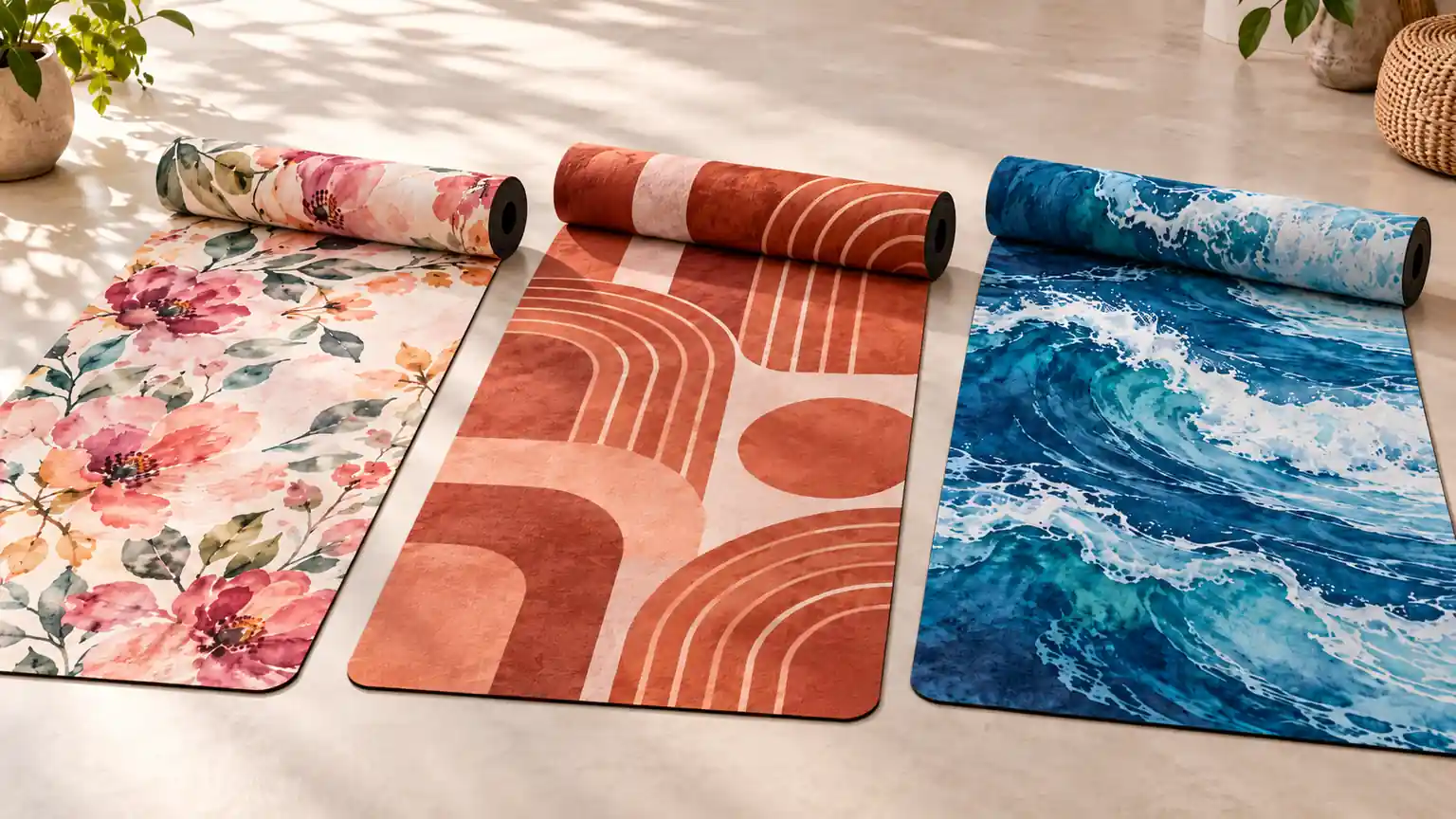
- It’s the best print surface in the category. Sublimation dyes the fibers themselves, edge to edge, with photographic detail.
- Typical FOB is about $10–$16 on natural rubber and $7–$11 on TPE, with MOQ from 200 units.
- Who buys it: art-led and pattern-led brands, hot yoga lines, travel mats, and gifting.
How a Suede Mat Is Built
| Layer | Options | Notes |
|---|---|---|
| Top | Brushed polyester microfiber, standard or recycled-PET | Takes sublimation print; feel varies with fiber density |
| Base | Natural rubber or TPE | Rubber is heavier and grips floors better; TPE is lighter and latex-free |
| Total thickness | 1.5mm (travel), 3.5–4mm (standard), up to 6mm | Most of the thickness is the base |
| Size | 183×61, 183×68cm; custom | Standard sizes carry the lowest MOQ |
| Weight | ~0.9–1.1kg (1.5mm), ~2.0–2.4kg (4mm on rubber) | TPE bases come in lighter |
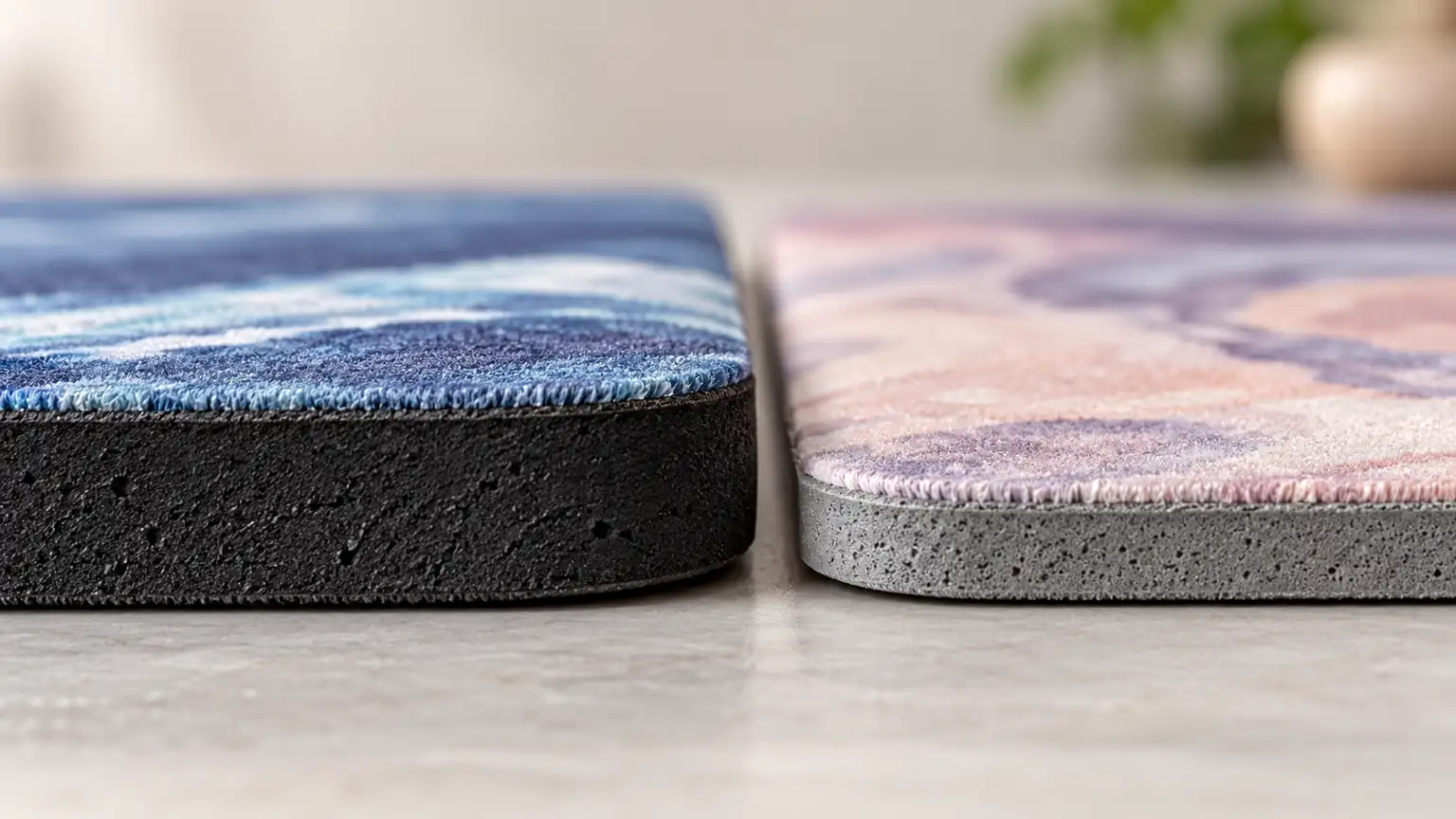
Two choices matter most at specification.
Rubber or TPE base. Natural rubber gives the heavier, more planted mat that studio and premium buyers expect, and it holds the floor better. TPE is lighter, cheaper and latex-free, which suits travel lines and customers with latex sensitivity. The rest of that trade-off is in our comparison of TPE vs natural rubber.
Recycled microfiber. Microfiber tops are often made from recycled polyester, partly from PET bottles. It’s a genuine sustainability point, and it only works on packaging if the supplier can document the recycled content. Ask for it in writing, and see what eco and non-toxic claims need behind them.
Wet Grip: the Feature That Needs Explaining
Suede microfiber gets grippier when it’s damp. The fibers hold a little moisture and the contact with skin improves. Dry, straight out of the box in a cool room, the surface can feel smoother than a rubber or PU mat.
That’s an advantage in hot and sweaty classes, where most other surfaces get slippery. It’s also the source of a predictable complaint: a customer unrolls the new mat, does a downward dog with dry hands, and decides it’s slippery.
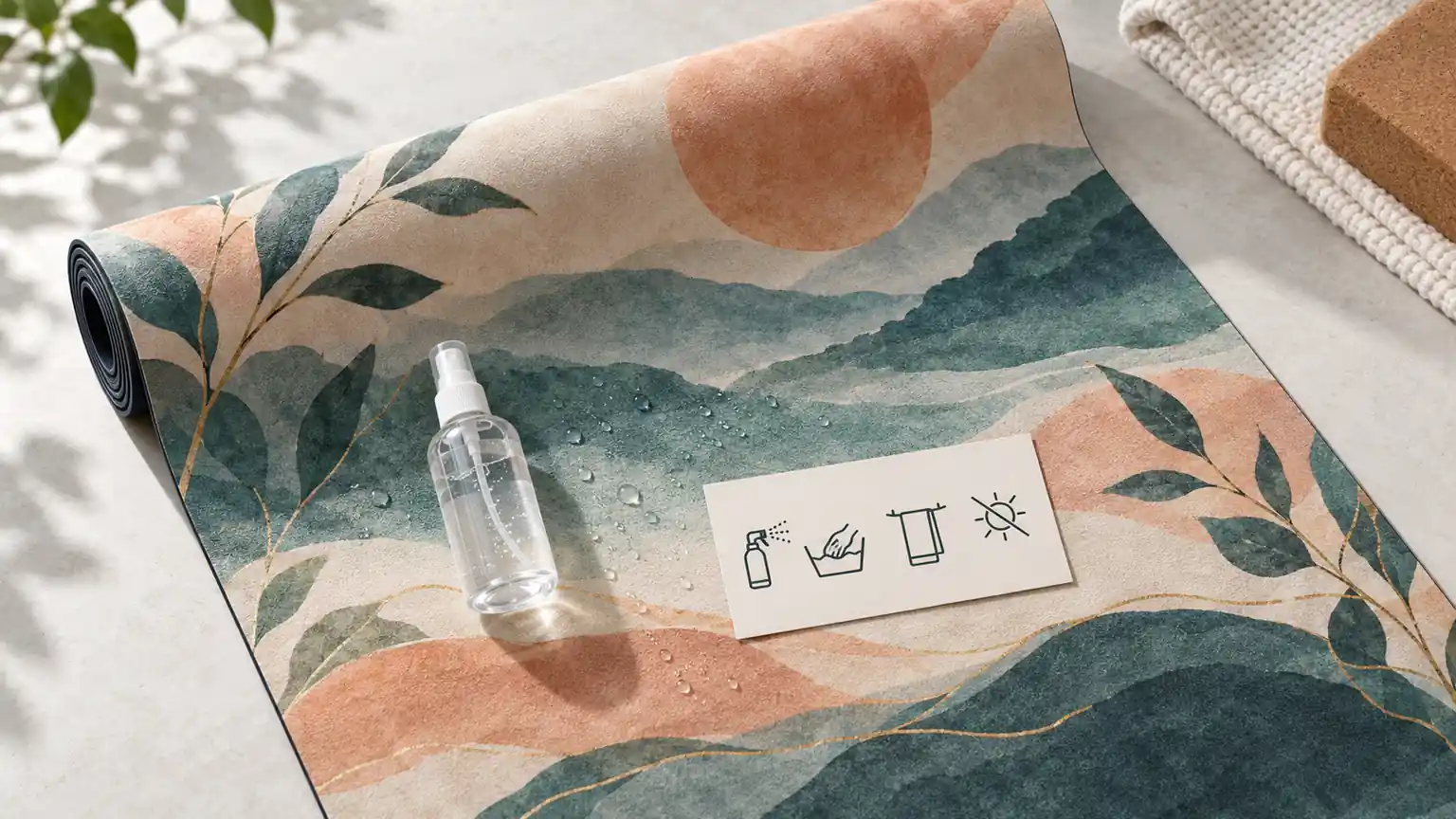
The fix costs nothing. Tell the customer, on the product page and on a card in the box, to mist the surface lightly before practice. Brands that do this rarely get the complaint; brands that don’t get it in reviews.
For how suede’s wet grip compares with PU and cork, see the yoga mat materials comparison, and for the PU side of hot yoga specifically, our guide to PU mats for hot yoga lines.
Why Suede Is the Best Print Surface
On most mats, print sits on top of the surface. On suede, sublimation turns the ink into a gas that dyes the polyester fibers, so the color is inside the fiber. That’s why suede mats can carry full-coverage, photographic artwork right to the edge, and why the print doesn’t crack or peel the way a surface print can.
Three practical limits:
- Polyester only. Sublimation needs polyester fibers. It doesn’t work on cotton, cork or rubber.
- Colors read slightly softer than on a glossy surface, because the brushed fibers scatter light. Very bright neon colors lose a little punch.
- Fine text and thin lines blur slightly at the fiber level. Keep text at least 4–5mm high.
Suede is also where most leopard, floral and art-led mats are made. Pattern sourcing routes, artwork file requirements and design ownership are covered in leopard print and patterned yoga mats. Logos can also go on by laser engraving, UV print or embossing, and how those hold up over time is in print durability after six months.
Care, Washing and Durability
Washable, carefully. Many suede mats can be hand-washed, and some travel versions can go in a washing machine on a cold, gentle cycle, then air-dried flat. Whether yours can depends on the base and the bond; get the factory to confirm, and test one sample through a wash before you print “machine washable” on anything.
Drying. Always flat or hung, never in a dryer or direct strong sun, which can weaken the bond and fade the print over time.
Wear. The brushed surface can pill or flatten slightly at the hand zones after heavy use. Denser microfiber resists this better; compare samples by rubbing a patch firmly a few dozen times.
The washing instructions are worth turning into a care card shipped with the mat. It reduces “it got ruined in the wash” returns and makes the product feel finished.
Price, MOQ and Lead Time
| Item | Typical figure |
|---|---|
| Suede on natural rubber, 3.5–4mm, 183×61cm, printed | $10–$16 FOB |
| Suede on TPE, 4mm, printed | $7–$11 FOB |
| Travel suede, 1.5mm | $7–$12 FOB |
| MOQ | 200 units per design |
| Sample | 5–10 working days |
| Production after sample approval | about 4–6 weeks |
Full-color print is usually included in suede pricing, because the top is printed as part of production anyway. The MOQ is per design: three artworks at 70 units each don’t make 200. How MOQ interacts with design choices is covered in how MOQ shapes custom yoga mat orders.
Who Buys Suede Mats
Art-led and pattern-led brands. If the mat’s selling point is the artwork, suede is the obvious surface. Most of our patterned mat orders are made on it.
Hot yoga lines. Wet grip makes suede a credible alternative to PU at a lower price, particularly for brands that also want a printed design.
Travel mats. At 1.5mm on a thin rubber or TPE base, suede folds or rolls small, and its washability is a real advantage for a mat that travels. Folding constructions are covered in foldable yoga mats.
Gifting and corporate. A fully printed mat with a company’s artwork makes a strong gift, and the 200-unit MOQ fits event and corporate runs.
Suede is less suited to buyers who need the firmest, most stable surface for dry, balance-heavy practice, or who want the lowest possible unit price. For those, rubber-based or TPE mats fit better.
Suede Mats from Wellfitsource
We make suede yoga mats on natural rubber and TPE bases in our Yangzhou facility, with full-color sublimation from your artwork or our pattern library. Before sampling, we send a full-size digital proof so you can check scale and placement. If your design is pale or very fine, we’ll tell you at proof stage how it will read on microfiber, which saves a sample round.
Send your artwork for a suede proof →
FAQ
What is a suede yoga mat made of?
A brushed polyester microfiber top layer that feels like suede, laminated to a natural rubber or TPE base. There is no leather in it. The microfiber is often made from recycled polyester.
Are suede yoga mats slippery?
They can feel smooth when completely dry. Suede microfiber becomes grippier when slightly damp, so a light mist of water before practice improves grip, and the mat performs well in sweaty or hot classes.
Can you print on a suede yoga mat?
Yes. Suede is the best surface in the category for full-color printing. Sublimation dyes the polyester fibers directly, so artwork can run edge to edge with photographic detail and won’t peel off.
Can suede yoga mats be washed?
Many can be hand-washed, and some travel versions can go in a washing machine on a cold, gentle cycle. Always air-dry flat. Confirm washability with the factory before putting it on packaging.
What is the MOQ for custom suede yoga mats?
Usually 200 units per design. Typical FOB is about $10–$16 for a printed 4mm suede mat on natural rubber and $7–$11 on a TPE base.