Author: Wellfitsource Product & Sourcing Team · Published: July 2025 · Updated: September 2026
Brands extending from yoga into Pilates usually start by asking whether they need a different mat at all. It’s a fair question — both are floor practices on a rectangular mat, and plenty of people use one mat for both.
From the production side the answer is narrower than people expect: the two mats differ in three specifications and are otherwise the same product. Get those three right and a Pilates SKU is a low-risk extension with a buyer who is easier to reach than the yoga customer.
Get them wrong and you’ve shipped a yoga mat with a Pilates label. Studio buyers spot that in about four seconds — they press a thumb into the mat at the trade show booth, and if it bottoms out, the conversation is over.
Quick Summary
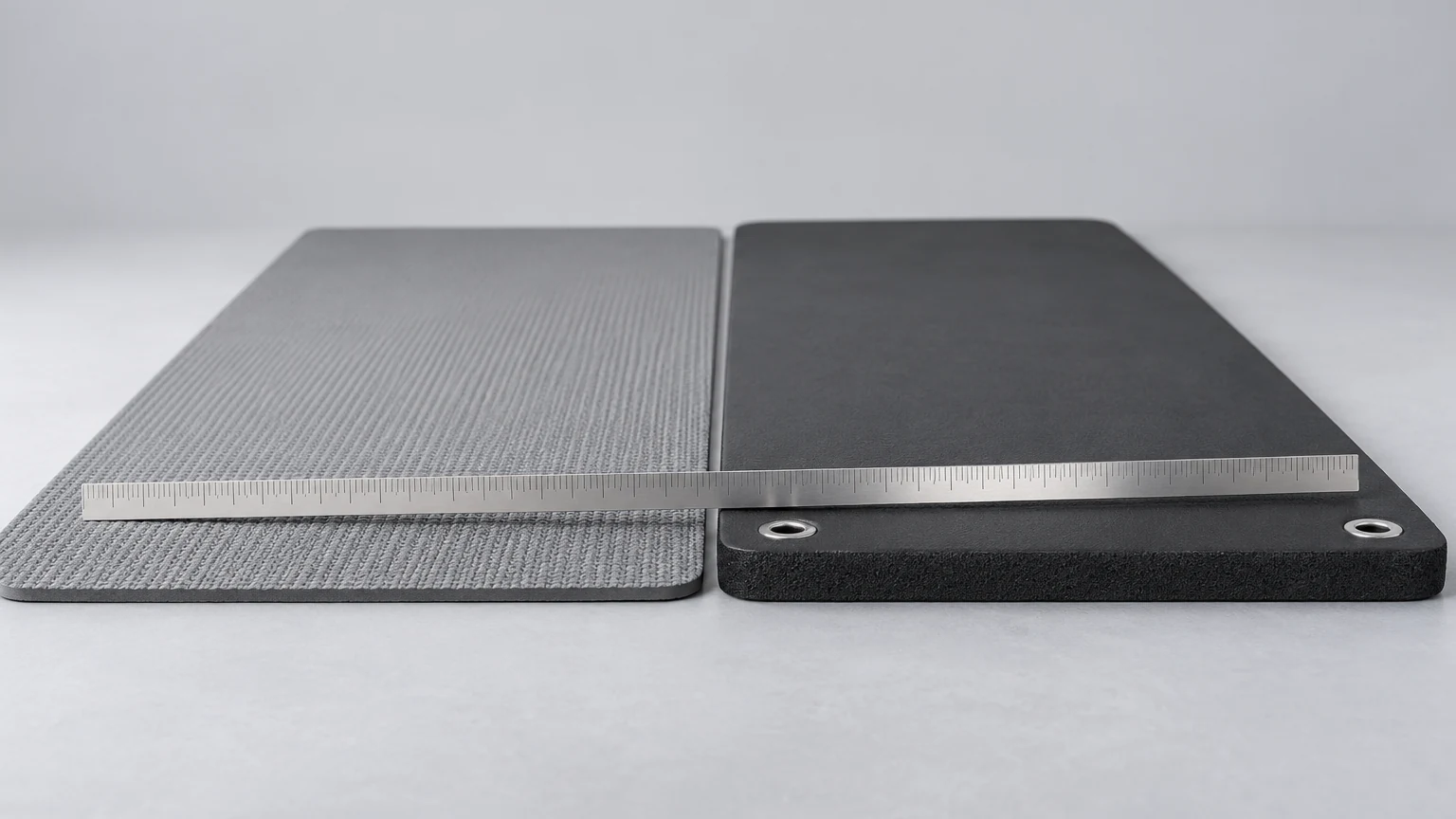
- Thickness is the main difference: Pilates mats run 8–15mm against yoga’s 4–6mm, because the practice puts spine, tailbone, and shoulder blades on the floor.
- Grip priorities flip. Yoga needs surface traction for standing poses; Pilates needs a stable, cushioned, slightly smoother surface that won’t grab skin during rolling movements.
- Material shifts too: NBR and thick TPE dominate Pilates mats, where PU and cork dominate premium yoga.
- The buyers differ. Pilates mats sell to studios, physiotherapy clinics, and rehab-adjacent channels as much as to consumers.
- It is a genuine line extension, not a relabel — but it shares suppliers, tooling logic, and branding methods with your yoga line.
Why the Practice Changes the Product
You don’t need the exercise-science version. The relevant difference for a product person is simple: in yoga, most of the load goes through hands and feet, standing on the mat. In Pilates, most of the load goes through the spine, pelvis, and shoulder blades, lying on the mat and often rolling along it.
That produces three requirements:
More cushioning under bone. Rolling through the spine on a 4mm mat on a hard floor is uncomfortable enough that clients notice within a class. 8mm and above is where the complaints stop.
Stability under that cushioning. Soft is not the goal — soft and unstable is worse than thin and firm. A Pilates mat needs to compress without feeling squishy, which is a density question rather than a thickness question.
A surface that doesn’t grab. Yoga surfaces are designed to stop hands and feet sliding. Pilates involves skin sliding along the mat during rolling movements, so an aggressively tacky surface is a drawback rather than a feature.
The Specification Differences, Side by Side
| Specification | Yoga Mat | Pilates Mat |
|---|---|---|
| Thickness | 4–6mm standard | 8–15mm standard |
| Typical dimensions | 183×61cm | 180×60cm, also 183×61cm; wider options common |
| Common materials | TPE, PU over rubber, cork, PVC | NBR foam, high-density TPE, EVA |
| Surface | Textured for grip, sweat-activated on premium | Smoother, closed-cell, wipe-clean |
| Priority | Traction and feel | Cushioning with stability |
| Weight | 0.9–2.2kg | 0.9–1.6kg (foam is light even when thick) |
| Typical FOB | $3.50–$20 by material | $4–$10 |
| Typical retail | $25–$150+ | $25–$60 |
| Common extras | Carry strap, bag | Eyelets for hanging, carry strap |
Two things stand out in that table for anyone planning an assortment. First, Pilates mats have a lower price ceiling — they’re a functional product, and the premium-material story that carries a $120 yoga mat doesn’t transfer. Second, they are light for their bulk, because the thickness comes from foam. That affects your carton math: Pilates mats take more cubic volume per unit than yoga mats, but not much more weight.
Materials: Where NBR Enters the Picture
The material most buyers meet for the first time in Pilates is NBR foam — the thick, matte, slightly spongy black or colored foam used in most 10–15mm mats. It is light, it cushions well, it’s inexpensive, and it wipes clean, which is why studios and clinics buy it in volume.
Its trade-offs are honest ones: it is less durable than rubber under heavy use, it can show compression marks over time, and it has no premium story. For a $30 studio mat, none of that matters. For a $90 retail product, NBR is the wrong material.
High-density TPE at 8–10mm is the middle answer: better recovery than NBR, cleaner sustainability positioning, higher cost. It’s what we’d suggest for a brand that wants a Pilates mat consistent with a TPE yoga line. The material trade-offs across the whole category are in our yoga mat materials comparison.
What doesn’t transfer: a PU-over-rubber construction at 12mm. We costed one once, for a brand that wanted its Pilates mat to feel like its flagship yoga mat. The result weighed close to 4kg and priced past $40 FOB before branding. Nobody ordered it, correctly. Premium yoga materials don’t scale up in thickness — that is the main reason a Pilates mat is a separate product rather than a thicker version of your best seller.
What Studio and Clinic Buyers Ask For
Pilates mats sell into a channel mix that skews more institutional than yoga:
Pilates and reformer studios buy mat-work mats in quantity, usually 10mm or above, usually dark colors, and they care about wipe-down cleaning and stacking. Many want eyelets for hanging — the storage method drives the specification, which is covered in our guide to studio mat storage and the specs it requires.
Physiotherapy and rehab clinics want thickness, easy disinfection, and a surface that stands up to daily cleaning products. They are less price-sensitive than studios and more specification-driven.
Consumer retail and e-commerce wants 8–10mm — thick enough to read as a Pilates product, thin enough to roll and store at home. This is the band where a brand can sell both Pilates and general floor-exercise use from one SKU.
Corporate wellness programs buy Pilates-thickness mats more often than yoga-thickness ones, because a thicker mat is more forgiving for participants of mixed ability on an office floor.
How to Add Pilates to an Existing Yoga Line
The straightforward version, in the order we’d do it:
1. Pick one thickness to start. 10mm covers the widest range of buyers. Adding 8mm and 15mm variants later is easy; launching three thicknesses at once triples your inventory risk for one product.
2. Decide the channel before the material. Studio and clinic focus points to NBR at a keen price. Retail and DTC focus points to high-density TPE with a better surface finish.
3. Reuse your branding method. Whatever logo method your yoga line uses — screen print, laser, embossing — generally transfers, with the caveat that foam takes debossing better than fine printing. Branding workflow is covered in personalizing yoga mats for an activewear brand.
4. Recalculate the carton. Thicker mats mean fewer units per carton and a different cubic figure. Don’t assume your yoga carton spec carries over; ask for a fresh quote including carton dimensions and units per carton.
5. Keep the naming honest. If the mat is 8mm and genuinely dual-purpose, market it that way — “Pilates and floor exercise mat” sells to more people than a Pilates-only claim on a mat that yoga customers would also happily buy.
If you’re considering an oval or shaped Pilates mat rather than a standard rectangle, the positioning question is covered in our guide to marketing oval Pilates mats. And for the ordering process itself — MOQ tiers, sampling, lead times — the yoga mat sourcing guide applies unchanged to Pilates mats.
MOQ, Pricing, and What to Check at Sampling
Pilates mats sit at $4–$10 FOB for standard constructions, with thickness and material the main drivers. MOQ is typically 500–1,000 units for NBR and high-density TPE, in line with other foam-based products.
Three checks at the sample stage that matter more here than on a yoga mat:
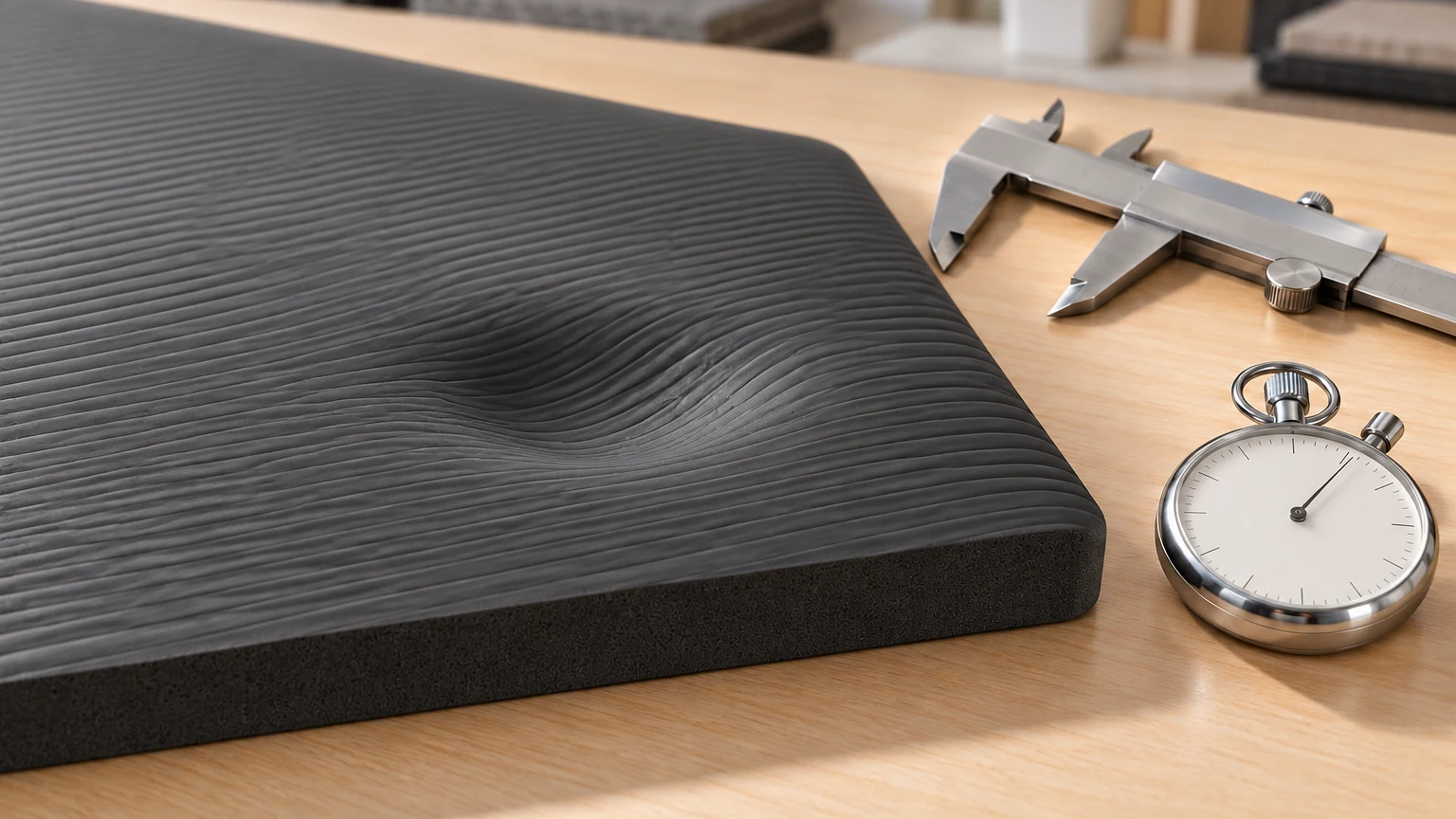
Compression recovery. Press a knee or elbow into the sample hard for thirty seconds and watch how fast the dent disappears. This is the test studio buyers run on our booth samples, and it is the right one: slow recovery in a brand-new mat means visible body impressions within months of daily studio use.
Edge integrity. Thick foam mats fail at the edges first, especially where they’re rolled or hung. Check the edge finish and, if you’re specifying eyelets, check how the foam is reinforced around them.
Surface after cleaning. Wipe the sample with the disinfectant a studio would actually use and see what happens to the surface. Clinics clean daily, and a surface that goes tacky or chalky after repeated disinfection will generate complaints.
Producing Pilates Mats with Wellfitsource
We manufacture Pilates-thickness mats alongside our yoga mat range — including the thick mat and workout mat formats that cover most Pilates specifications — in NBR and high-density TPE, with eyelets, straps, and the same branding methods as our yoga line.
For brands running both, the practical benefit is one supplier, one QC standard, and one shipment for two product families that sell to overlapping buyers.
Request a Pilates mat sample or quote →
FAQ
What is the difference between a Pilates mat and a yoga mat?
Thickness, surface, and material. Pilates mats run 8–15mm against 4–6mm for yoga, because Pilates loads the spine and pelvis on the floor rather than hands and feet. Pilates surfaces are smoother and closed-cell for cushioning and cleaning; yoga surfaces are textured for traction. Pilates mats are usually NBR or high-density TPE foam, while premium yoga mats use PU, rubber, or cork.
Can one mat be used for both yoga and Pilates?
An 8mm dual-purpose mat works reasonably for both, which is why that thickness sells well in retail. Dedicated practitioners tend to want different mats: a 4–6mm textured mat for yoga standing work and a 10mm+ cushioned mat for Pilates mat work.
What thickness should a Pilates mat be?
8–15mm, with 10mm the best single choice for a first SKU. Studios and clinics often prefer 10–15mm for spine comfort; retail buyers lean toward 8–10mm because it rolls and stores more easily at home.
What material is best for Pilates mats?
NBR foam for studio and clinic supply, where price, light weight, and wipe-clean performance matter most. High-density TPE for retail lines that need better compression recovery and a cleaner sustainability story. Premium yoga materials like PU over natural rubber do not scale well to Pilates thickness.
What is the MOQ for custom Pilates mats?
Typically 500–1,000 units for NBR and high-density TPE, similar to other foam-based mats. Custom dimensions, eyelets, and branding can be specified within that quantity without a separate minimum in most cases.