Quick buying rule: choose a foam roller manufacturer that can prove repeatability at scale. The factory should document your material choice, density, surface finish, odor control, logo tolerance, packaging standard, MOQ, lead time, and sample-to-bulk consistency before you approve production.
You are not buying a one-off sample. You are buying the ability to deliver the same feel, look, and packaging across an entire wholesale or private label order. If the approved sample feels firm and supportive, the bulk order should not arrive softer, uneven, smelly, poorly branded, or packed in cartons that crush during shipping.
A good supplier will help you lock a golden sample, explain how they control firmness and surface finish during production, and show how they prevent carton damage, color drift, and logo placement issues in bulk shipments. If your project involves custom color, logo, packaging, or recovery kit development, review the custom foam roller options before finalizing supplier requirements.
This guide is for distributors, private label fitness brands, wellness retailers, rehab product buyers, and sourcing teams preparing RFQs, samples, or first bulk orders for foam roller programs.
Quick Answer: What Makes a Good Foam Roller Manufacturer?
A good foam roller manufacturer can do three things consistently: make the right foam, make it feel the same in bulk, and ship it so it arrives looking retail-ready.
Look for these capabilities:
- Material control (EVA/EPP): They can match your spec and keep it stable from batch to batch.
- Density + firmness consistency: The roller shouldn’t feel “tight” and supportive in the sample, then turn “flat” or uneven under body weight in bulk.
- Surface finish control: Clean edges, no pitting, no sticky/tacky spots, no seam issues on textured rollers.
- Low-odor standard: No sharp smell when the carton opens.
- Branding precision: Logo placement, color match, and print/emboss depth stay aligned across cartons.
- Packaging discipline: Cartons are designed for handling, not just for leaving the factory.
Micro-summary: A “good” supplier isn’t the one who says yes to everything. It’s the one who can explain how they keep the feel, look, and packaging identical at scale.
For a baseline example of what most buyers expect from a private label partner—materials, customization paths, and QC checkpoints—see the WellfitSource foam roller manufacturer.
Why Choosing the Right Foam Roller Supplier Is Not Just About Price
Cheap foam rollers don’t fail on day one in your warehouse. They fail later—when customers feel the difference.
Here’s the risk pattern buyers see most:
- Returns spike because the bulk run feels harder/softer than the sample.
- Reviews mention odor (“chemical smell”) and you can’t fix it after it ships.
- Textured rollers look inconsistent—some sharp, some shallow, some with surface defects.
- Packaging arrives crushed or scuffed, and your brand takes the hit even if the foam is fine.
In practice, the “savings” on unit price is usually smaller than the cost of one messy cycle: rework, refunds, chargebacks, and delayed launches.
If you sell on Amazon or through retail, consistency matters even more because your customer compares by feel: a roller can be “springy” and supportive, or it can feel dead and uneven once it takes real body weight.
Foam Roller Manufacturer vs Trading Supplier: What Should Buyers Check?
This isn’t about which model is morally better. It’s about who owns the outcome when something goes wrong.
If you’ll be judged on consistency (feel, finish, packaging), choose the partner who can control the process—not just relay messages.
When a Manufacturer Makes More Sense
A manufacturer makes more sense when you need:
- Tight control of density/firmness and surface finish (especially for textured rollers)
- Private label packaging (retail boxes, inserts, barcode placement, carton standards)
- Repeatability across reorders (same feel, same color, same logo placement)
- Clear responsibility for QC and corrective actions if bulk deviates from samples
If your brand promise includes “this feels the same every time,” you want the factory close to the process.
When a Trading Supplier May Still Be Useful
A trading supplier can be useful when you:
- want to bundle multiple categories from different factories into one shipment
- need fast assortment testing with minimal customization
- already have your own QC/inspection partner and can manage cross-factory coordination
The tradeoff: if the bulk run arrives “off,” you may spend more time tracing root cause—because the party you’re talking to isn’t the party controlling the foam.
5 Questions to Ask Your Foam Roller Supplier Before Ordering
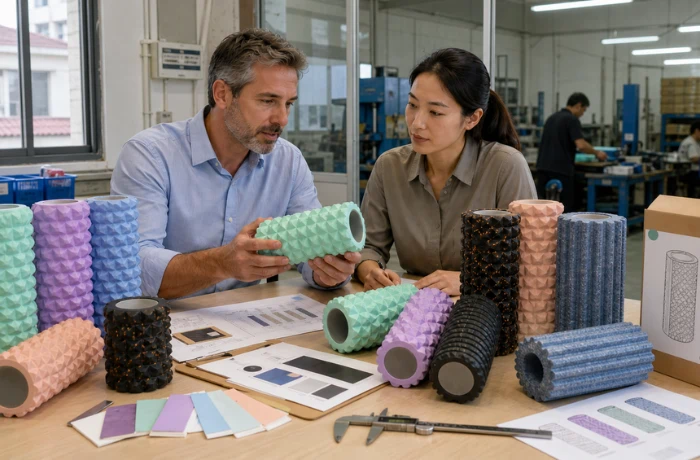
These are the questions that prevent the classic “sample was perfect, bulk was not” story.
Can You Match My Material, Density, and Size Requirements?
Start with an RFQ spec that forces clarity:
- Material: EVA or EPP (for private label recovery kits, they’re usually safer starting points when you need more consistent firmness). Low-density PE may still fit entry-level products, but don’t select it only for cost.
- Size: length + diameter (if you’re unsure, point to your size requirements using a reference like this foam roller size guide)
- Structure: hollow vs solid (if relevant)
- Surface: smooth vs textured pattern
Pro tip: Ask the supplier to confirm the material and density they’ll use in writing, not just “we can do it.”
Can I Approve a Sample Before Bulk Production?
You’re not just buying a sample. You’re creating a control reference.
Ask for:
- a pre-production sample that matches your final spec
- a signed “golden sample” process (you keep one, they keep one)
- a clear statement of what happens if bulk deviates (rework, replacement, credit)
Micro-summary: The best suppliers don’t resist sample approvals. They treat them as the contract for feel and finish.
How Do You Control Odor, Surface Finish, and Firmness?
These are sensory issues customers notice immediately.
Ask:
- How do you prevent a sharp smell when cartons are opened?
- What are your checks for surface defects (pitting, inconsistent texture, rough edges)?
- How do you keep firmness consistent so the roller doesn’t feel “too hard” in one batch and “soft” in the next?
If a supplier can’t explain their in-process checks, you’re guessing.
What Private Label Options Do You Support?
Private label isn’t just a logo.
Confirm:
- logo method (print/emboss) and placement tolerances
- color matching process (and what range they can hold across batches)
- packaging options (bulk pack vs retail box vs insert + label)
- kit options (e.g., roller + accessories) and whether it affects MOQ and lead time
A strong private label partner will also confirm what’s realistic: which textures or colors are stable in EVA vs EPP, and what changes increase scrap risk.
How Do You Handle Packaging, Lead Time, and Shipment Issues?
This is where “cheap” becomes expensive.
Ask for:
- your target MOQ range (often 500–1,000 units per SKU depending on spec/customization)
- target lead times: 4–6 weeks for samples and 8–12 weeks for bulk (confirm if your timeline fits)
- carton standards (burst strength, corner protection, inner polybag, dividers if needed)
- what happens if cartons arrive crushed or scuffed (documentation, claim workflow)
Micro-summary: If your packaging arrives damaged, customers blame your brand—not the factory.
How to Evaluate Foam Roller Quality Before Bulk Orders
You don’t need a lab to catch most problems. You need a consistent inspection routine.
Material Consistency
Check:
- Material is clearly defined (EVA vs EPP) and stable across samples
- No unexpected substitutions “to help cost”
If you’re aligning your assortment to EVA/EPP, use an internal reference that compares the tradeoffs—like this foam roller materials guide—and make that your sourcing baseline.
Density and Firmness
Do a simple, repeatable feel test:
- Press with body weight: does it feel supportive and “springy,” or does it compress and stay “flat”?
- Compare two units side by side: do they feel the same under load?
If the supplier can’t hold firmness, you’ll see it in customer feedback fast.
Surface Feel and Rolling Resistance
Run a palm test and a fabric test:
- Palm: any tacky/sticky spots or rough edges?
- Fabric: does it snag or feel uneven?
Textured rollers should feel intentional—not sharp in one spot and shallow in another.
Odor and Packaging Experience
Open the carton like a customer would.
- Any sharp smell?
- Does the roller smell stronger when it’s warmed slightly (e.g., sitting in a warm room)?
- Is the packaging clean and dry, or does it feel dusty/handled?
Odor and unboxing are part of quality. Your customer experiences them before they ever roll.
Logo, Color, and Bulk Consistency
This is where private label projects usually slip.
Verify:
- logo placement doesn’t drift (measure from a fixed point)
- print/emboss depth is consistent
- color looks consistent under the same lighting
Your hard rule is correct: bulk production should replicate the approved sample’s firmness, surface feel, logo placement, and packaging format.
Private Label Foam Roller Manufacturing: What Buyers Should Confirm
Before you pay for bulk, confirm the limits.
For buyers planning custom color, logo placement, packaging, or recovery kit configurations, the custom foam roller page gives a clearer view of available private label directions before sampling.
- Customization boundaries: Which sizes/textures/colors are stable in EVA vs EPP?
- Packaging scope: bulk cartons vs retail boxes; inserts; barcode labels; multi-pack bundles.
- Kit planning: If you’re selling a recovery kit, confirm how many SKUs can ship together without carton damage.
- Change control: What happens when you change color, texture, or logo method? (Often it changes MOQ and lead time.)
Private label itself isn’t hard—uncontrolled variation is. Lock the spec and manage changes like a product team.
MOQ, Lead Time, and Cost: What Affects the Final Quote?
Your final quote is driven by how much variation you introduce.
If you’re building a wholesale foam roller program across multiple channels (Amazon, retail, studio), price isn’t the only variable—reorder stability is.
Common cost/MOQ drivers:
- material choice (EVA vs EPP)
- texture complexity (molds and scrap risk)
- number of colors and logo methods
- retail packaging (boxes, inserts, labeling)
- number of SKUs in the same PO (each variation can raise MOQ)
If you’re targeting 500–1,000 units per SKU, align your first run around fewer variations. One solid hero SKU that reorders cleanly often beats five “almost the same” SKUs that never repeat.
Unit Price vs Landed Cost
A low unit price can still become an expensive order, because several costs sit outside the per-piece quote. Before comparing suppliers, put every quote on the same basis:
- Trade terms: an FOB price stops at the port of loading; CIF adds sea freight and insurance to your port; DDP includes delivery and import duties. Two quotes on different terms aren’t comparable.
- Freight by volume: foam rollers are light but bulky, so freight is driven by carton volume, not weight. Ask for carton dimensions and units per carton with the quote, not after it.
- Duties and taxes: import duty and VAT or GST depend on your market and the HS code used. Confirm the code with your customs broker before you set retail pricing.
- One-time charges: new molds, special textures, custom colors, printing plates and packaging artwork are often quoted separately. Ask for the full list of one-time and per-unit customization charges in writing.
Once quotes are lined up this way, the real gap between two suppliers is often quite different from what the unit prices suggested.
Packaging and Shipping Risks Buyers Often Underestimate
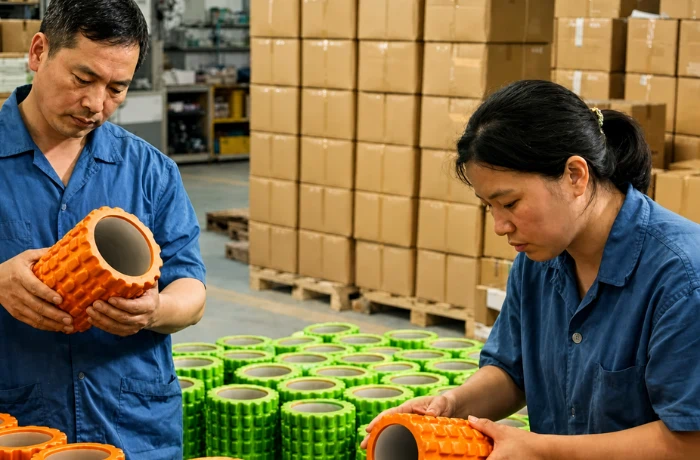
Packaging is a performance spec.
The common misses:
- Volumetric shipping surprises: foam rollers ship big, not heavy.
- Carton compression: rollers can arrive slightly deformed if packed poorly or stacked hard.
- Retail damage: scuffs, crushed corners, torn shrink wrap—small damage that kills retail trust.
If the carton can’t survive handling, you’re not shipping a product—you’re shipping a support ticket.
If you’re deciding between hollow and solid structures for shipping durability and feel, use a direct comparison like the hollow vs solid foam roller comparison and lock that choice before you finalize packaging.
Red Flags When Choosing a Foam Roller Supplier
These signals show up early—if you pay attention.
- They won’t answer density/firmness questions beyond “high quality.”
- They avoid sample approval or resist trial orders.
- Everything is “no problem” but nothing is documented.
- They can’t describe QC checkpoints for surface finish, odor, and logo placement.
- Their quote is dramatically lower with no explanation (material substitution risk).
- They won’t discuss how they handle complaints (no corrective-action mindset).
A practical note from the buying side: when a supplier resists a small first order, treat it as a signal about how flexible they’ll be on sampling, documentation, and corrective actions later.
Foam Roller Supplier Evaluation Checklist
Use this checklist to compare suppliers side by side.
- Spec clarity
- Material confirmed (EVA or EPP) and documented
- Size (length + diameter) confirmed
- Structure confirmed (hollow/solid) if relevant
- Surface texture/finish documented
- Sample and consistency controls
- Pre-production sample approved
- “Golden sample” retained by both parties
- Bulk replication commitment documented (feel + finish + branding + packaging)
- Quality control
- Firmness/density control method explained
- Surface defect inspection steps defined
- Odor standard discussed and verified
- Private label execution
- Logo method + placement tolerance defined
- Color match process confirmed
- Packaging format confirmed (bulk vs retail-ready)
- Commercial terms and logistics
- MOQ confirmed (target 500–1,000 units per SKU)
- Lead time confirmed (4–6 weeks samples; 8–12 weeks bulk)
- Carton standard and protection plan confirmed
- Issue-handling workflow defined for shipment damage
FAQ
What should I ask a foam roller manufacturer before ordering?
Ask about material (EVA/EPP), density/firmness controls, sample approval and golden sample process, private label tolerances (logo placement + color match), packaging/carton standards, and what happens if bulk deviates from the approved sample.
How do I know if a foam roller supplier is good for private label orders?
They document your spec, offer a clear sampling workflow, can explain QC checkpoints for feel/finish/odor, and can show how they keep branding and packaging consistent across production lots.
What affects MOQ for private label foam rollers?
Material choice, number of colors, logo method, packaging complexity, and the number of SKU variations in the same order. More variation typically increases MOQ because it increases setup and scrap risk.
What are the main quality risks in bulk foam roller orders?
Sample-to-bulk drift in density/firmness and surface finish, odor complaints, logo placement drift, color inconsistency, and packaging/carton damage that makes a product look used before it’s opened.
Is the cheapest supplier always safe for bulk and private label orders?
Not usually. The hidden cost shows up as returns, review damage, delayed launches, and rework when the bulk run doesn’t match the approved sample or arrives with packaging damage.
Next Step for Wholesale and Private Label Buyers
If you’re comparing foam roller suppliers, send one clean spec pack (material, size, structure, surface texture, logo placement, packaging format, target MOQ, and timeline). That’s how you get quotes you can actually compare.
If you’d like a quick pre-purchase check, WellfitSource can help review whether your supplier requirements are realistic before you invest in sampling or bulk production.