Launching a private label fitness brand means sourcing products from an OEM or ODM manufacturer, branding them as your own, and selling through your chosen channel — Amazon, DTC, retail, or wholesale. The core decisions happen before you spend a dollar on inventory: product selection, manufacturer vetting, compliance, and channel strategy.
Quick Summary
- Start with one SKU in one product category — trying to launch a full range on a first order is the most common reason new private label brands fail.
- Choose your channel before your product — Amazon FBA, DTC, and wholesale each require different packaging specs, certifications, and minimum order logic.
- Factory vetting is the highest-leverage decision you’ll make — a poor factory relationship poisons every subsequent step.
- Certifications must be planned into material selection before sampling — retrofitting compliance after production is expensive and slow.
- Margins work backward from retail price: know your landed cost, channel fees, and target gross margin before placing your first order.
What “Private Label” Actually Means in Fitness
Private label in fitness means an existing manufacturer produces a product — a yoga mat, foam roller, resistance band, or balance pad — and you sell it under your brand name. You don’t own a factory. You own the brand, the customer relationship, and in most cases the product specification.
This is distinct from reselling (buying wholesale inventory someone else has already branded) and from white labeling (placing your logo on a completely standard catalog product with zero spec customization). True private label sits between those two: you have enough specification control to differentiate the product, but you’re not building a factory to make it.
The fitness category is one of the most accessible for private label because:
- The manufacturing base in Asia (particularly Jiangsu, Zhejiang, and Guangdong provinces) is deep and competitive
- Product categories like yoga mats and resistance bands have relatively low tooling costs ($800–$3,000 vs. $50,000+ for injection-molded hard goods)
- Consumer demand for branded wellness products continues to grow across DTC, Amazon, and specialty retail channels
Step 1: Choose One Product and One Channel
The Product Selection Trap
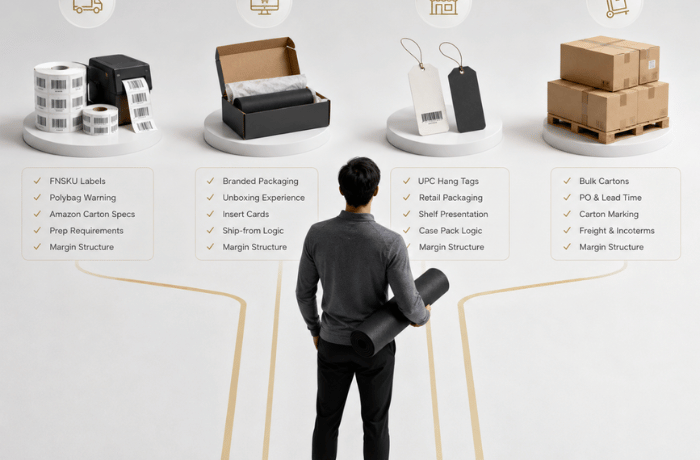
The single most expensive mistake first-time private label founders make is ordering a “full range” — yoga mat, foam roller, resistance bands, balance pad, and a carry bag — on their first order. Each additional SKU multiplies the complexity: more sampling rounds, more certification testing, more packaging artwork, more listings to manage, more inventory risk if the product doesn’t perform.
Start with one product. The criteria:
Demand signal: Is there consistent search volume for this product keyword on Amazon or Google? Are competitors reordering (not just listing)? Avoid trend-chased categories where search volume is spiking but no brand has established reorder history.
Differentiation opportunity: Can you specify something meaningfully different from the generic catalog version? For yoga mats, this might be a specific dual-density foam construction, a wider-than-standard width (80cm vs. 61cm), or a premium natural rubber backing. If you can’t articulate a product differentiation in one sentence, you’re building a price war SKU.
Certification fit: Does your target channel and market have certification requirements you can meet with your budget? A EU-bound product needs CE and REACH. A US retail product needs CA65. Know this before choosing the material.
Channel Selection Changes Everything
Your sales channel determines your packaging spec, MOQ logic, margin requirements, and certification needs before you contact a single factory.
| Channel | Key Requirements | Packaging Spec | Typical First Order |
|---|---|---|---|
| Amazon FBA | ASIN ready, barcode labeling, FNSKU stickers, suffocation warning on poly bags | Retail-ready poly bag or box | 300–500 units |
| DTC (own website) | Brand packaging for unboxing experience, 3PL-friendly carton config | Custom branded box or mailer | 200–500 units |
| Wholesale / Retail | Retailer compliance manual, EDI capability (larger retailers), UPC, hang tags | Retail-ready with hangtag and UPC | 500–1,000 units |
| B2B / Studio Supply | Case pack pricing, invoice-ready, possible BSCI requirement | Bulk carton, minimal retail packaging | 200–500 units |
Picking Amazon FBA first is often the right call for a first-time brand: the demand signal is visible, the feedback loop is fast (reviews), and the logistics infrastructure (FBA fulfillment) lets you operate lean. The tradeoff is Amazon’s fee structure and the difficulty of building a brand relationship with customers.
Step 2: Find and Vet Your Manufacturer
Where to Find Manufacturers
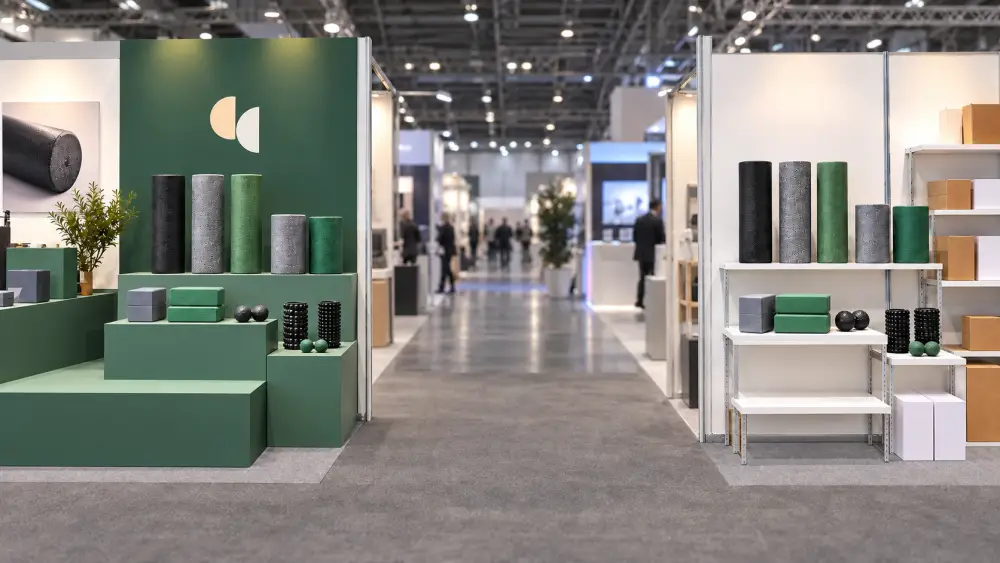
Trade shows: Canton Fair (Guangzhou, April and October) and ISPO (Munich, January) are the two highest-leverage sourcing events for fitness. Meeting a factory in person compresses six months of email vetting into two days.
Sourcing platforms: Alibaba and Global Sources list thousands of factories. The filtering work is on you — verified supplier badges are paid placements, not quality assessments. Use platforms to build a candidate list, then vet through direct contact.
Referrals: If you know a brand selling a non-competing product in the same category, ask who they manufacture with. A warm factory introduction from an existing client is the highest-trust starting point.
The 4-Question Factory Vetting Framework
Before requesting a quote, get answers to these four questions:
1. “What markets do you currently export to, and can you provide buyer references?” A factory exporting to the US and EU for 3+ years knows the documentation, certifications, and logistics that market requires. References from existing buyers in your country are the most valuable signal of reliability.
2. “Can you send your current BSCI audit report and ISO 9001 certificate?” Legitimate export-focused factories have these. The BSCI report should name SGS, TÜV, or another amfori-approved auditor. The ISO 9001 certificate should have a verifiable certificate number.
3. “Who owns the mold tooling once the tooling fee is paid?” The correct answer is: you do. Any factory that hedges on this — “we keep the mold but guarantee exclusivity” — is setting up leverage over your future orders.
4. “What is your process if production goods don’t match the approved sample?” A factory with a real QC process has a documented non-conformance procedure. Vague answers (“we’ll fix it”) reveal that disputes will be handled reactively rather than systematically.
For a complete framework on evaluating OEM manufacturers — including the 6-point evaluation rubric and red flags to watch for — see the complete OEM fitness equipment manufacturing guide.
What a qualified factory looks like in practice: Wellfitsource manufactures yoga mats, foam rollers, resistance bands, and balance pads from its Yangzhou, Jiangsu facility and serves 820+ B2B buyers across North America, Europe, and Australia. Every account is assigned a dedicated English-speaking account manager. BSCI audit reports (SGS-certified) and compliance test documentation (CA65, CE, REACH) are available for each product category on request before sampling begins. Sample lead time across the full product range is 5–10 working days.
Step 3: Develop Your Product Specification
From Idea to Technical Brief
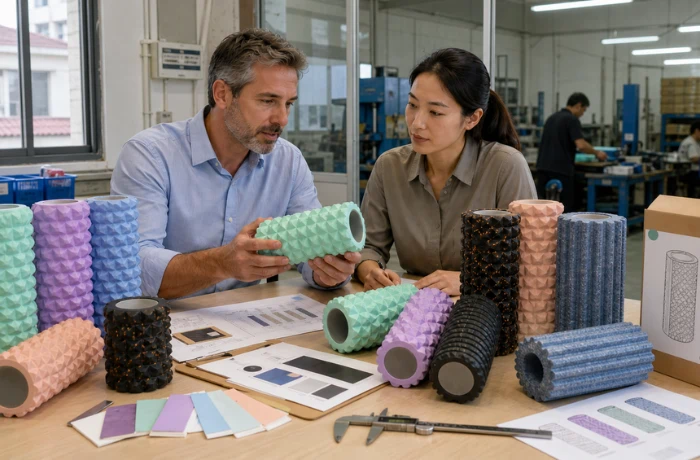
A manufacturer cannot build your product from a Pinterest board. You need a technical brief that specifies:
- Material and grade: For yoga mats — TPE, PVC, PU rubber, cork, or natural rubber; for foam rollers — EPE, EVA, or PE; for resistance bands — latex percentage or fabric GSM
- Dimensions with tolerances: Length × Width × Thickness, e.g., 183cm × 61cm × 6mm ±0.5mm
- Density / hardness: ILD rating for foam; Shore A hardness for rubber compounds
- Surface finish: Smooth, textured, embossed pattern, or printed design
- Color: Pantone reference codes — never describe colors in words
- Logo placement: Dimensions, position, print method (screen print / heat transfer / deboss / laser etch)
- Packaging: Poly bag only, hangtag, retail box, custom print, carton configuration
The more precise your brief, the closer your first sample will be to your vision — and the less money you spend on revision rounds.
OEM vs. ODM: Which Path for a First Launch
ODM (factory provides the design, you add logo): faster to market (4–6 weeks), lower MOQ, no tooling cost. The right choice if you’re validating demand before committing to a differentiated product.
OEM (you provide the spec, factory builds to it): full IP ownership, product differentiation, higher MOQ and tooling cost ($800–$3,000 per SKU), 8–12 weeks to first shipment. The right choice once you have demand evidence and a clear product thesis.
Most first launches start ODM. Once the product proves itself — consistent reorders, positive reviews, clear customer feedback on what to improve — the founder commissions OEM tooling for v2 with the differentiated spec.
Step 4: Plan Compliance Before Sampling
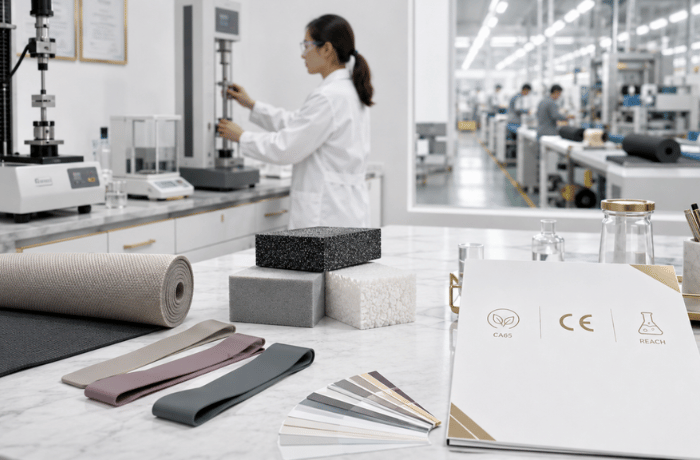
This step is consistently skipped by first-time founders and consistently creates expensive problems.
Certifications must be planned into material selection, not bolted on after production. Here’s why: if you’ve already ordered 1,000 PVC yoga mats using a plasticizer compound that fails REACH phthalate testing, your options are rework (expensive, often impossible at scale), disposal, or selling into markets where REACH doesn’t apply. None of these are good.
Certification Checklist by Channel
Selling on Amazon US / US DTC:
- CA65 (Prop 65) test report from an ILAC-accredited lab — $300–$700, 2–3 weeks
- This is the compliance document US retailers and Amazon will ask for if challenged
Selling in EU / UK:
- CE marking (Declaration of Conformity + technical file) — €400–€2,500, 3–6 weeks
- REACH SVHC screening report — €200–€600, 2–3 weeks
- UKCA marking if shipping to Great Britain — mirrors CE process with UKAS-accredited lab
Selling to any major retailer (US or EU):
- BSCI audit from your factory (SGS or TÜV issued) — factory cost $600–$1,500
- ISO 9001 certificate from your factory
Commission testing at the sampling stage so you can reformulate before committing to a production run. Budget $500–$1,500 for compliance testing on a single product going to a single market.
Working with a manufacturer that already holds current compliance documentation for its standard materials significantly reduces this risk. Wellfitsource maintains CA65 Prop 65 test reports, CE declarations, and REACH SVHC screening reports for its core yoga mat, foam roller, and resistance band product lines — meaning brands sourcing from existing materials can receive compliance documentation alongside samples rather than commissioning fresh testing from scratch.
Step 5: Build Your Brand Identity
What Brand Identity Actually Needs to Cover
Private label brand identity for fitness doesn’t need to be complex. At launch, you need:
Brand name and logo: Registrable as a trademark in your target market. Run a trademark search before spending on design. In the US, the USPTO TESS database is free. In the EU, use the EUIPO eSearch tool.
Packaging design: Your packaging is your first physical brand touchpoint. For Amazon, packaging is largely invisible inside an FBA box — invest in the product label and the brand name recognition. For DTC, packaging is the unboxing experience — worth investing in printed mailer boxes and tissue paper.
Brand voice and positioning: Who is this brand for, and what does it stand for? A yoga mat brand targeting serious practitioners positions differently from one targeting casual home exercisers. Your positioning affects your price point, your imagery, and your copy — and it should be decided before you brief a designer, not after.
Registered trademark: File for trademark registration before launch if you’re serious. The process takes 8–12 months in the US but establishes your priority date from filing. Brand Registry on Amazon (which gives you A+ content access and protections against listing hijacking) requires a registered trademark.
Step 6: Calculate Your Margin Before Ordering
This calculation should happen before you place a sample order, not after you receive a production quote.
The Margin Math
Work backwards from your target retail price:
Example: Yoga mat, Amazon US, $39.99 retail price
| Cost Item | Estimate |
|---|---|
| Factory cost (FOB, 500 units TPE mat) | $7.00/unit |
| Sea freight + import duty (6.5%) | $1.30/unit |
| Amazon FBA fee (storage + fulfillment) | $5.50/unit |
| Amazon referral fee (15%) | $6.00/unit |
| Packaging + labeling | $0.80/unit |
| Compliance testing (amortized) | $0.60/unit |
| Total cost | $21.20/unit |
| Gross margin at $39.99 | $18.79 = 47% |
47% gross margin before advertising, returns, and overhead. Amazon sellers typically need 40–50% gross margin to fund profitable advertising at scale. If your margin calculation comes in below 35%, reprice, reduce costs, or choose a different product.
The Pricing Sanity Check
Before finalizing your price point, check three competitors’ pricing on your target channel. If you’re entering a category where the market leader is at $24.99 and your landed cost is $15, you have a margin problem at $29.99 and a positioning problem at $24.99. Entering below the market leader on price is rarely a sustainable strategy for a new private label brand.
Step 7: Place Your First Order and Prepare for Launch
What to Confirm Before Production Sign-Off
Before approving the production run, have in hand:
- ✅ Signed production approval form (PAF) with the approved sample retained
- ✅ Compliance test report(s) for your target market
- ✅ Finalized packaging artwork with all required labeling (barcode, suffocation warning, country of origin, care instructions)
- ✅ Confirmed freight forwarder and delivery timeline
- ✅ Amazon listing draft created (if FBA) — don’t wait until goods arrive
Timeline: Concept to First Sale
For a DTC or Amazon brand launching with an ODM product:
| Phase | Duration |
|---|---|
| Factory vetting and RFQ | 2–3 weeks |
| Sampling | 5–10 working days |
| Sample review + revision (if needed) | 1–2 weeks |
| Compliance testing | 2–3 weeks (can run in parallel with revision) |
| Production order + manufacturing | 4–5 weeks |
| Sea freight (China to US West Coast) | 3–4 weeks |
| FBA prep / 3PL receiving | 1–2 weeks |
| Total: concept to in-stock | ~14–18 weeks |
Plan backwards from your target launch date and add two weeks of buffer. The most common launch delay is compliance testing requiring a reformulation, which adds 3–4 weeks to the timeline.
Common Mistakes That Sink First-Time Private Label Launches
Ordering too many units on the first run. 500 units of a yoga mat you haven’t sold yet is manageable. 2,000 units of a product that doesn’t convert is a warehouse problem. Start with the factory’s minimum — or negotiate it down — until you have sell-through data.
Choosing a factory based on price alone. The cheapest quote in fitness OEM manufacturing is almost never the best choice. A factory pricing 30–40% below market is cutting costs somewhere — materials, QC, or labor compliance. Any of those shortcuts becomes your problem when the goods arrive.
Skipping compliance until a buyer asks. The scenario: you’ve sold 800 units, a retailer asks for your CA65 report, you commission testing and discover the foam fails, your listing gets flagged. Build compliance into the launch budget, not the crisis budget.
Trying to sell on every channel at launch. Amazon FBA, your own Shopify store, Instagram shopping, and a wholesale pitch to a local gym chain — all at once. Pick one channel, prove the product and the margin, then expand.
How Wellfitsource Supports Private Label Fitness Brands
We work with fitness brand founders, DTC sellers, Amazon FBA businesses, and wellness distributors at every stage of the launch journey described in this guide — from first-SKU ODM sampling through multi-SKU OEM scaling.
Product Range
Our manufacturing facility in Yangzhou, Jiangsu covers the core yoga and fitness accessories categories:
| Product Category | Materials Available | ODM | OEM (Custom) |
|---|---|---|---|
| Yoga mats | PVC, TPE, PU natural rubber, cork | ✅ | ✅ |
| Foam rollers | EPE, EVA, PE foam | ✅ | ✅ |
| Resistance bands | Latex (5-layer), fabric/TPE glute bands | ✅ | ✅ |
| Foam balance pads | EPE, EVA | ✅ | ✅ |
| Bundle kits | Mat + roller + bands + accessories | ✅ | ✅ |
Bundle kit customization — a yoga mat, foam roller, and resistance band set packaged as a single retail unit — is one of our most requested services for brands targeting the premium DTC and gifting market.
What We Provide at Each Stage of Your Launch
Sampling (5–10 working days): Samples across the full product range ship within 5–10 working days of receiving your specification brief. For ODM products using existing materials, samples are available from our catalog. For OEM products requiring custom tooling, we provide a tooling timeline and cost estimate upfront.
Compliance documentation: We maintain current CA65 Prop 65 test reports, CE Declarations of Conformity, REACH SVHC screening reports, and a SGS-certified BSCI audit report for our facility. Brands sourcing from our standard material specifications receive this documentation package alongside samples — you are not starting compliance from zero.
OEM tooling and IP protection: All custom molds developed under OEM agreements are registered to the client upon full payment of the tooling fee. We sign NDAs before design review. We do not supply identical tooling to competing brands.
Dedicated account management: Every client account is assigned a dedicated English-speaking account manager who remains consistent across sampling, production, and post-shipment. We do not rotate accounts to junior staff after order confirmation.
Production transparency: We support mid-production third-party QC inspections (QIMA, Bureau Veritas, Intertek) on all orders. Pre-shipment AQL inspection reports are available on request.
Who We Work With
Our B2B client base spans 820+ buyers globally, including:
- Fitness brand founders launching their first private label product on Amazon FBA or DTC
- Established wellness brands scaling from ODM into OEM with differentiated product specs
- Amazon FBA sellers seeking compliance-ready products and consolidated SKU sourcing
- Yoga studios and fitness studios ordering branded accessories for retail and member programs
- Wellness distributors in North America, Europe, and Australia sourcing private label product lines
Starting a Conversation
If you’re at the product selection stage, we’re glad to share MOQ and pricing ranges before you commit to sampling. If you have a specification brief ready, we can return a formal quote within 3–5 business days.
FAQ
How much money do I need to launch a private label fitness brand?
A realistic minimum budget for a single-SKU private label launch on Amazon FBA with ODM sourcing: $8,000–$15,000. This covers: 300–500 units of inventory ($3,000–$6,000), sea freight and duties ($500–$800), compliance testing ($500–$1,000), packaging design and printing ($500–$1,500), Amazon listing photography ($400–$800), and 60–90 days of advertising budget ($1,500–$3,000). Brands launching with less than $5,000 typically cannot absorb a slow first month without running out of inventory capital.
Can I launch a fitness brand without visiting the factory?
Yes — the majority of private label brands are launched without a factory visit, particularly at the startup stage. Video factory tours, sample ordering, third-party QC inspections, and reference checks from existing buyers can substitute for most of what an in-person visit provides. That said, visiting your factory within the first two years of a growing brand relationship provides intangible benefits in trust, communication quality, and production priority that remote relationships rarely replicate.
Should I use a sourcing agent or go direct to factory?
A sourcing agent earns 5–10% commission and provides value if you’re sourcing multiple product categories, have no Mandarin language capability, or are new enough to need someone to navigate factory negotiations on your behalf. Going direct — which is entirely possible with English-speaking export-focused factories — saves the commission but requires more time and sourcing competence. For a single-SKU launch with a factory that has English-speaking sales staff, direct is usually the better starting point.
How do I protect my brand from Amazon listing hijackers?
Three layers of protection: (1) Register your trademark and enroll in Amazon Brand Registry — this gives you access to project zero and IP accelerator tools. (2) Use OEM tooling with your brand’s proprietary design so the factory cannot supply identical products to third parties. (3) Use unique packaging with serialized holographic authenticity labels that signal counterfeit vs. genuine to buyers. No protection is absolute, but these three reduce the risk significantly.
Related: The Complete OEM Fitness Equipment Manufacturing Guide — factory evaluation, certifications by market, MOQ benchmarks, and the 6-step production process.