The moment a first-time bulk buyer opens a factory quote and sees the unit price column, something clicks. At 100 units, the number looks reasonable. At 300 units, it drops noticeably. At 500 units, it drops again. The math starts working — except the buyer doesn’t yet know which tier they’re actually eligible for, what the real landed cost is after freight and duty, or how long they’ll be waiting before the goods arrive.
Most “bulk yoga mat” conversations start with price and stall on everything else. This guide covers the complete picture: what MOQ tiers exist, how unit pricing scales at each level, what payment and shipping terms apply, and what order planning decisions lock in your cost before you’ve submitted a single PO.
Quick Summary
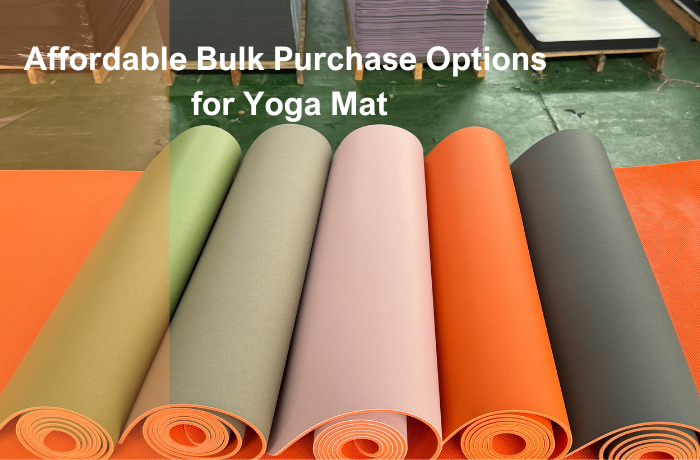
- Yoga mat bulk orders in the B2B market typically operate across three MOQ tiers: entry (300–500 units), mid-scale (500–1,000 units), and volume (1,000+ units). Each tier unlocks different pricing, customization options, and payment flexibility.
- Material choice — TPE vs PU — affects both the per-unit cost floor and the MOQ threshold. PU yoga mats can be ordered from 100 units, often at a lower entry point than comparable TPE custom runs.
- “Affordable” in bulk sourcing is a landed cost question, not a FOB price question. Freight, import duty (3.4% for most yoga mat HTS codes into the US), and inspection fees add 25–40% to the FOB price depending on order size and shipping mode.
- Payment terms are negotiable — and the leverage shifts significantly once you’ve completed one production cycle with a supplier.
- Lead times for standard bulk orders run 25–45 days from order confirmation, not from inquiry. Planning backwards from a launch or restock date requires accounting for sampling, approval, production, and freight — not just production alone.
The Three Bulk Order Tiers — and What Changes at Each
Bulk yoga mat sourcing is not a single price point with volume discounts applied. It’s a series of thresholds where different capabilities unlock. Understanding which tier you’re entering determines not just the unit price but the customization options, the flexibility on payment, and the supplier’s willingness to carry inspection risk.
Tier 1: Entry Bulk (300–500 Units)
At this order scale, you’re working within a factory’s standard product library: existing compounds, existing mold tooling, standard color options from their current Pantone reference set. The customization available is typically logo placement (screen print or emboss), color selection from existing options, and basic packaging specification.
What changes at 300 units versus buying retail or through a distributor:
- Unit pricing: 30–45% below distributor pricing on equivalent specification
- Lead time: 25–35 days from order confirmation (production only; sampling and approval add 10–14 days if not already completed)
- Payment terms: Most factories at this tier require 30–50% deposit on order confirmation, balance before shipment
- Customization scope: Logo placement, color selection from existing range, standard packaging
What doesn’t change at this tier: you’re working with the factory’s existing tooling and compound mix. If you want a proprietary compound, a custom mold, or a specific Shore A hardness outside the standard range, 300–500 units is generally not the threshold where those conversations are productive.
Tier 2: Mid-Scale (500–1,000 Units)
At 500 units, the production economics shift in ways that meaningfully expand your negotiating position. Full sublimation printing — photographic-quality, full-bleed coverage across the mat surface — becomes economically rational at this tier. The amortized cost of print setup across 500+ units drops the per-mat print premium to a manageable level.
What changes at 500 units:
- Customization scope: Full sublimation printing, custom colorway specification via Pantone (compound color, not just print), custom packaging design
- Unit pricing: Additional 8–15% reduction from Tier 1, depending on material and specification complexity
- Payment terms: 30% deposit becomes negotiable to lower percentages for buyers with an established relationship; some factories open L/C discussions at this volume
- Supplier responsiveness: At 500+ units, you become a meaningful account at most mid-size factories. Response times improve; engineering support for specification questions becomes available
Tier 3: Volume (1,000+ Units)
At 1,000 units and above, the sourcing conversation changes character. You’re no longer selecting from a product library — you’re commissioning production. Custom compound development, proprietary texture specification, dedicated production windows, and buffer stock agreements all become realistic to negotiate.
For buyers building a private label brand or supplying a studio chain at scale, this is the tier where supplier relationship investment pays back in specification control and consistency. A factory that holds 50 units of your specification in buffer stock — available for 14-day delivery to cover replacement orders — is a supply program relationship, not a transaction.
Unit pricing at this tier is 15–25% below Tier 2, depending on material complexity and annual volume commitment.
TPE vs PU: How Material Choice Affects Your Bulk Entry Point
Material selection is usually framed as a performance decision. In bulk ordering, it’s also a cash flow and MOQ decision.
[Standard yoga mat materials and their B2B trade-offs are covered in detail in our Yoga Mat Materials Guide. This section focuses specifically on how material choice affects bulk order economics.]
TPE yoga mats are the most commonly sourced material in bulk B2B orders. The standard compound is widely available, and factories maintain existing tooling for standard TPE formats. Entry MOQ for standard TPE is typically 300 units. Custom TPE compound (specific Shore A, custom color outside standard range) typically requires 500+ units to justify the compound adjustment.
PU yoga mats have a different MOQ structure. Because PU mat production involves a lamination process rather than a full-foam pour, factories can run smaller batches economically. At Wellfitsource, standard PU yoga mat runs start from 100 units — the entry point is lower than TPE custom runs, with PU’s premium wet-grip performance included. For buyers targeting studio operators, hot yoga facilities, or premium retail price points, PU often delivers better economics at the entry tier than equivalent TPE custom specification.
You can review the full PU yoga mat range and specifications to compare format options before making a sourcing inquiry.
For buyers uncertain which material best fits their channel, the full yoga mat range covers TPE, PU, cork, and specialty formats with the B2B spec details needed to compare — MOQ, standard dimensions, surface options, and compliance certification availability.
The Real Cost of a Bulk Order: Landed Price vs FOB Price
A factory quote shows FOB price. The number buyers make sourcing decisions on is landed price. The gap between the two is where bulk order math frequently breaks.
For a US-bound yoga mat shipment, landed price = FOB price + freight + import duty + inland delivery + any inspection fees.
Freight: Sea freight from China to US West Coast ports runs $1.20–$2.00 per mat for a full container load at 500+ units. At smaller quantities (300–499 units), you’re likely on LCL (less-than-container-load), where freight cost per unit is higher — typically $1.80–$2.80 per mat depending on carton dimensions and port of entry.
Import duty: Most standard yoga mats import into the US at 3.4% of the FOB value under the applicable HTS codes. TPE mats and PU mats are generally in the same duty bracket, though the classification depends on the dominant material composition. Your freight forwarder or customs broker should confirm HTS classification before you finalize sourcing.
Inspection: A pre-shipment inspection from a third-party inspector (SGS, Bureau Veritas, or similar) runs $200–$350 for a standard yoga mat order, covering AQL sampling, dimensional measurement, logo placement check, and basic functional testing. At 300 units, the inspection cost adds approximately $0.70–$1.15 per mat. At 1,000 units, the same inspection is $0.20–$0.35 per mat. Skipping inspection to save cost is a decision that occasionally costs significantly more than the inspection itself when goods need to be reworked or re-shipped.
Practical example — 500-unit TPE order, US West Coast delivery:
| Cost component | Per-unit estimate |
|---|---|
| FOB unit price (standard TPE, logo print) | $5.80 |
| Sea freight (FCL share, WC port) | $1.40 |
| Import duty (3.4% of FOB) | $0.20 |
| Inspection (shared across 500 units) | $0.55 |
| Inland delivery (port to warehouse) | $0.30 |
| Total landed cost | $8.25 |
The FOB price was $5.80. The landed price is $8.25 — 42% higher. This is the number that should appear in margin calculations, not the factory quote.
For a detailed breakdown of how shipping terms affect who pays which portion of this cost, the DDP vs FOB comparison guide covers the trade-offs for yoga mat buyers specifically.
Payment Terms: What’s Standard, What’s Negotiable
Payment terms in Chinese yoga mat manufacturing follow a fairly predictable pattern that shifts with relationship history and order volume.
First order, any tier: 30–50% deposit on order confirmation, balance payable before shipment release. The deposit percentage reflects the factory’s risk on a new buyer relationship — tooling investment, material procurement, and production scheduling are committed before the balance is secured.
Second and third orders with the same factory: Deposit percentage often decreases to 20–30% once a buyer has completed a production cycle without payment issues. Some factories move to net-15 or net-30 terms on the balance payment.
1,000+ units or annual volume commitment: Letter of Credit (L/C) terms become negotiable. L/C provides security for both parties — the factory has bank-backed payment assurance, the buyer has shipment-condition verification before payment releases. L/C has its own cost (typically 1–2% of the L/C value in banking fees) and documentation requirements that add lead time. For buyers doing multiple bulk orders per year, the cost is often worth the payment flexibility.
T/T (telegraphic transfer) remains the most common payment method for bulk orders under $50,000 USD. It’s faster than L/C, lower cost in banking fees, and sufficient for buyers and factories with an established relationship and mutual reference history.
Lead Time Planning: The Number That Matters
The lead time in a factory quote is production lead time — the time from order confirmation (deposit paid, specifications approved) to goods ready for shipment. It does not include sampling, approval, or transit.
For a bulk yoga mat order, the actual timeline from “I want to buy” to “goods in my warehouse” looks like this:
| Stage | Typical Duration |
|---|---|
| Sample request to sample delivery | 7–12 days |
| Sample review and approval | 3–7 days |
| Order confirmation and deposit payment | 2–5 days |
| Production | 25–40 days (standard; longer for complex custom spec) |
| Pre-shipment inspection | 2–3 days (scheduled in advance) |
| Sea freight: China → US West Coast | 18–22 days |
| Sea freight: China → US East Coast / EU | 24–32 days |
| Customs clearance and inland delivery | 5–10 days |
| Total: first-time order, US West Coast | 62–99 days |
| Total: repeat order (skip sampling) | 50–80 days |
A buyer planning a product launch, a seasonal restock, or a studio opening needs to work backwards from the required delivery date and place the order with enough buffer for each stage. The most common failure in first-time bulk sourcing is treating the production lead time as the total lead time and arriving at the delivery date 5–7 weeks short.
What to Have Ready Before Contacting a Supplier
A bulk inquiry that arrives with complete information moves to quote faster and produces more accurate pricing. Suppliers who receive vague inquiries (“I want 500 yoga mats, what’s the price?”) give back range quotes with wide uncertainty bands. Buyers who arrive with clear specifications receive precise quotes they can actually plan around.
Before making a bulk inquiry, prepare:
- Target quantity — the specific number you’re ordering, not a range
- Material preference — TPE, PU, cork, or open to recommendation based on use case
- Standard or custom — are you selecting from existing product options, or specifying custom color / logo / texture?
- Destination port — needed to calculate freight and duty accurately
- Required delivery date — working backwards to confirm the timeline is achievable
- Certification requirements — does your channel require CA65, REACH, BSCI, or other documentation?
With these six inputs, a supplier can return a complete quote — unit price, tooling cost if applicable, packaging cost, and estimated total FOB — within 24–48 hours rather than the 5–7 day back-and-forth of an incomplete inquiry.
FAQ
What is the minimum order quantity for a branded yoga mat with our logo?
For screen print or emboss logo placement on standard TPE mats: 300 units. For full sublimation print across the mat surface: 500 units (to amortize print setup cost). For PU yoga mats with logo: 100 units. These are production MOQs at standard specification — if your design requires custom tooling (proprietary texture mold, unusual dimensions), the MOQ for that specific run may be higher.
Can we place a smaller test order before committing to full bulk quantity?
Most factories will not produce below their stated MOQ for standard runs. However, some allow a paid sample order — 10–20 units at a higher per-unit cost — that uses your actual logo and specification. This is useful for market testing or internal approval before committing to a full production run. Ask explicitly about this option during the inquiry stage; it’s not always advertised but is available from most established suppliers.
What happens if we need to reorder and the original specification has changed?
This is one of the most common sources of frustration in bulk yoga mat procurement. The protection against it is a signed specification document — compound reference, color Pantone, texture depth measurement, logo placement coordinates — that both parties sign at the time of the first order. With this document, a reorder is an execution of the existing specification. Without it, “same as before” relies on the factory’s institutional memory and produces the color and feel drift that many buyers discover on their second order.
Is sea freight always the right choice for bulk orders?
For orders above 200 units, sea freight is almost always the economical choice for standard delivery timelines. Air freight is 8–12x the per-unit cost of sea freight and only makes sense for emergency restocks of small quantities (under 50 units) or for time-sensitive samples. For orders where timing is critical but volume is moderate (50–200 units), some buyers use sea freight with expedited customs clearance rather than air freight — the cost difference is significant.
How do we compare quotes from multiple suppliers accurately?
Request quotes in a standardized format: FOB price per unit, tooling cost (if any), packaging cost per unit, and production lead time. Do not compare FOB prices alone — include freight estimates to your destination, import duty, and inspection cost to produce a comparable landed price per unit across suppliers. A supplier whose FOB is 8% lower but whose production lead time is 3 weeks longer may not be the better option depending on your restock timing requirements.
Related reading:
– How MOQ Impacts Your Custom Yoga Mat Order — how minimum order quantities work across material types and customization levels
– DDP vs FOB for Yoga Mats: Which Shipping Term Saves You More — how trade terms affect who pays which portion of the landed cost
– Yoga Mat Materials Compared: TPE vs PU vs Cork vs PVC — material selection guide for B2B buyers choosing between foam types