Author: Wellfitsource Product & Sourcing Team · Published: June 2025 · Updated: October 2026
There are three places to buy foam rollers wholesale: a distributor or a brand’s wholesale program, a B2B marketplace, or a factory that makes rollers to order. They differ less in product than in what they let you control. A distributor sells you stock with someone else’s name on it, in small quantities, at the highest unit price. A marketplace gives you hundreds of listings and makes it hard to tell who actually makes them. A factory puts your logo on the roller and charges the least per piece, but it expects a minimum order and a spec it can build to.
Three questions decide which one fits: do you need your own brand on the product, how many units per style can you take, and how long can you wait for the first delivery?
Quick Summary
- Distributors suit buyers who need mixed stock this month and don’t need their own logo.
- Marketplaces are good for finding options and comparing prices, but listings rarely tell you whether the seller is a factory or a trader.
- OEM factories suit private label programs. At our plant a standard roller with your logo starts at 300 units, and a custom color at 1,000.
- Before asking anyone for a bulk quote, fix three things: material and density, length and diameter, and how the rollers will be packed.
- Compare quotes on the same terms. A unit price without trade terms, carton details or a test report is only half a quote.
Three Ways to Buy Foam Rollers Wholesale
| Distributor / brand wholesale | B2B marketplace | OEM / private label factory | |
|---|---|---|---|
| Typical minimum | One carton, sometimes a few units | Set by each seller, often low on stock items | 300 units per style with logo (our standard); 1,000 for a custom color |
| Your own brand | No, you sell their brand | Sometimes, if the seller is a factory | Yes: logo, color, packaging, inserts |
| Unit price | Highest | Middle, wide spread | Lowest at volume |
| First delivery | Days, from local stock | Days for stock; weeks for custom | Sample in 3–7 days, bulk in 20–30+ days, plus freight |
| Who controls quality | The distributor’s buying team | Varies by seller | You, through the approved sample and inspection |
| Main risk | Margin: you’re reselling at their price | Not knowing who made it | Writing a spec loose enough to be filled with cheaper foam |
Distributors and brand wholesale programs
Fitness and physical therapy distributors hold stock of several roller brands and sell by the case. A brand’s own wholesale program works the same way, with one brand. This is the fastest route and the only one that lets you buy a few dozen rollers in three sizes next week. Clinics, gyms equipping one site and retailers testing a category usually start here.
The limits are the brand and the margin. You sell someone else’s product at a price they set, and if the brand changes its foam or discontinues a size, you find out when the shipment arrives.
B2B marketplaces
Marketplaces put factories, trading companies and wholesalers on the same search page. They’re useful for seeing what exists and what prices look like across a market. The trouble is that a listing photo says little about the foam inside the roller. Two listings with the same picture can come from two different plants, and “high density” in a product title isn’t a specification.
If you buy here, treat the marketplace as a shortlist and do the checks you would do with any factory: ask for the business license, ask which production steps are done in-house, and ask for a test report issued to the company you’re buying from.
OEM and private label factories
A foam roller manufacturer makes the roller to your spec: material, density, length, diameter, surface pattern, color, logo and packaging. It’s the only route where the product is yours. It’s also the cheapest per unit once you’re past the minimum, because there’s no distributor margin in the price.
What the factory needs from you is a clear order. Our minimum for a standard roller with your logo is 300 units, and standard colors can be mixed within that order. A custom color starts at 1,000 units, because the foam has to be compounded in that color. A logo sample usually takes three to seven days depending on the logo method. Bulk production takes about 20 days for a simple order, and 30 days or more for larger quantities or more customization.
Which Supplier Type Fits Which Buyer
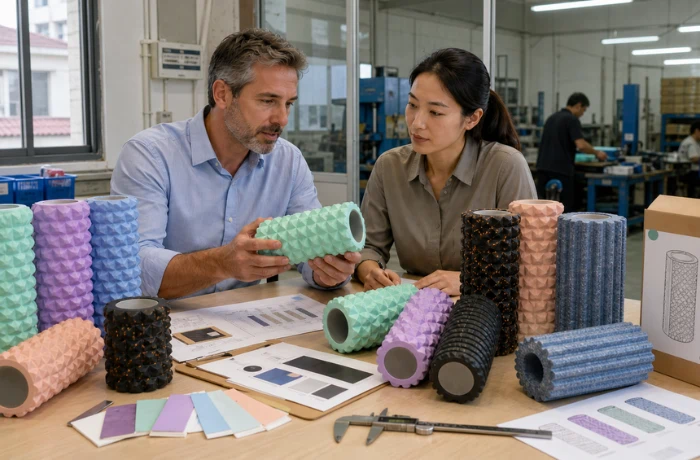
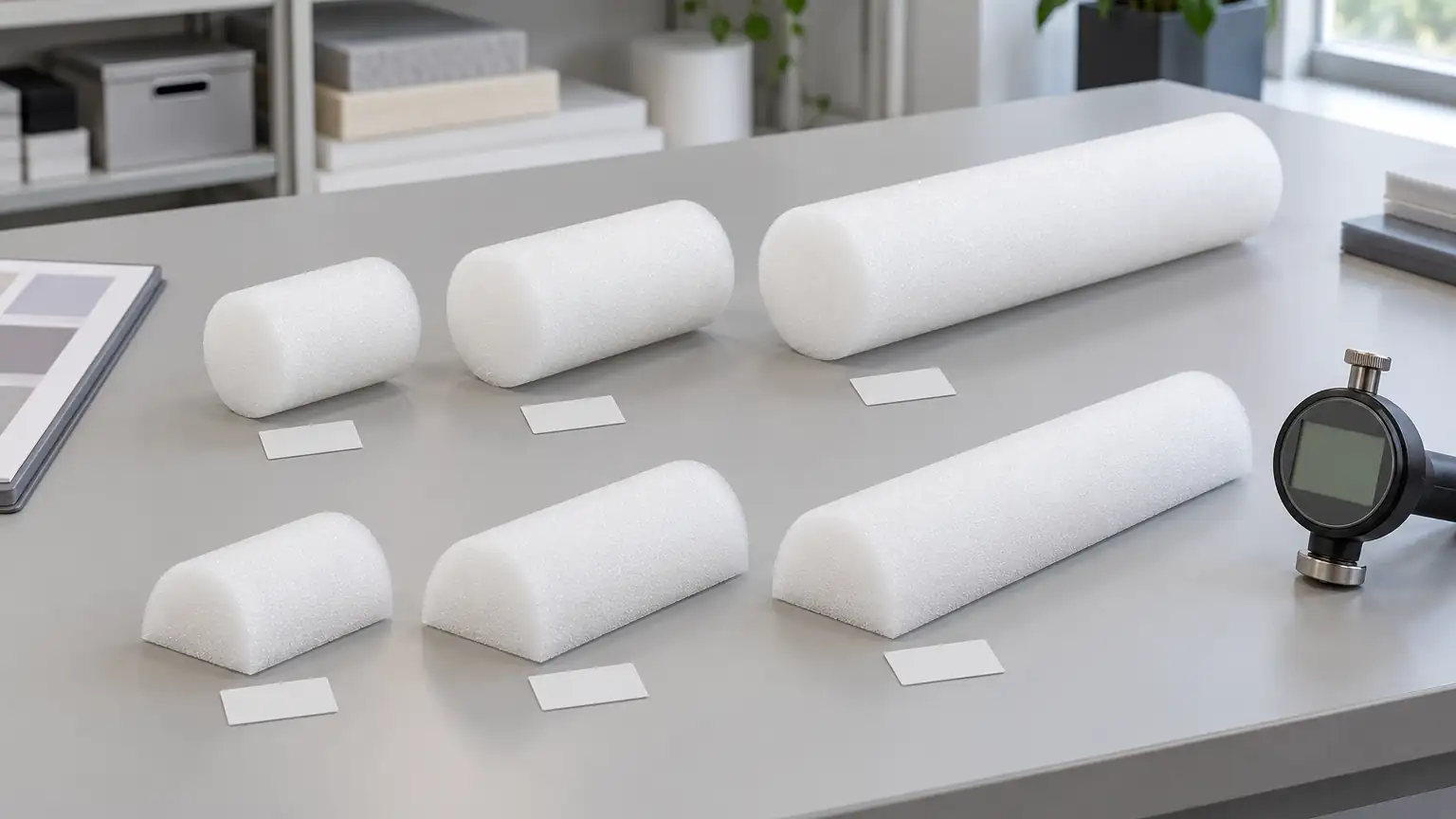
A physical therapy supply distributor moving its own line to a factory. This is common once a distributor’s private label roller sells steadily. This autumn a long-standing US customer of ours, a family-run therapy supply wholesaler, asked whether we could make the white polyethylene rollers they were already selling, in 12, 18 and 36 inches, full round and half round. The sensible first step in a case like that is to sample all six against the current stock and match firmness before talking about volume. Re-sourcing is a factory job; a distributor can’t put your name on someone else’s roller.
A gym, studio or clinic equipping its own floor. Unless you want branded rollers as part of the member experience, a distributor is usually enough. Quantities are small, you want them soon, and you can mix brands and sizes.
A DTC or Amazon brand. A factory, once you have a design you want to own. If you’re still testing whether rollers sell, a small stock order from a marketplace seller can work for the first listing, as long as you plan to move to a factory before the reviews depend on it.
A brand building a recovery kit. A factory that makes, or can coordinate, the other items in the kit. A clinic-backed home recovery brand that contacted us this year asked for one supplier to take responsibility for every component, the packaging and the assembly, and for prices at 50, 100, 250 and 500 kits. A distributor can’t assemble a branded kit, and a marketplace seller rarely will.
An importer or distributor buying across many categories. Often a mix: factories for the high-volume lines, distributors for the long tail. Importers’ requests usually ask for the same data whatever the product: EXW and FOB prices, units per carton, carton dimensions, gross and net weight, and how long the quote is valid. Any supplier type should be able to answer those within a day or two.
Three Things to Fix Before You Ask for a Bulk Quote
Most bulk quotes for foam rollers can’t be compared because each supplier quoted a different roller. Fixing these three things first makes the quotes comparable.
1. Material and density. EVA, EPP and PE behave differently. EVA is the balanced default for retail and private label, EPP is lighter and firmer for gyms and high-use settings, and PE suits entry-level programs. The EVA vs EPP vs PE comparison covers the trade-offs. Within a material, density decides how the roller feels and how long it keeps its shape. Ask each supplier to state density on the quote, and judge the samples side by side. Low-density rollers can feel acceptable on day one and compress flat within weeks of daily use.
2. Length and diameter. Length decides the use (30cm for kits and travel, 45cm as the common retail size, 90cm for studios and full-length back work); diameter changes both the feel and the carton. Write both, each with a tolerance. Our foam roller size guide has the size-by-channel breakdown.
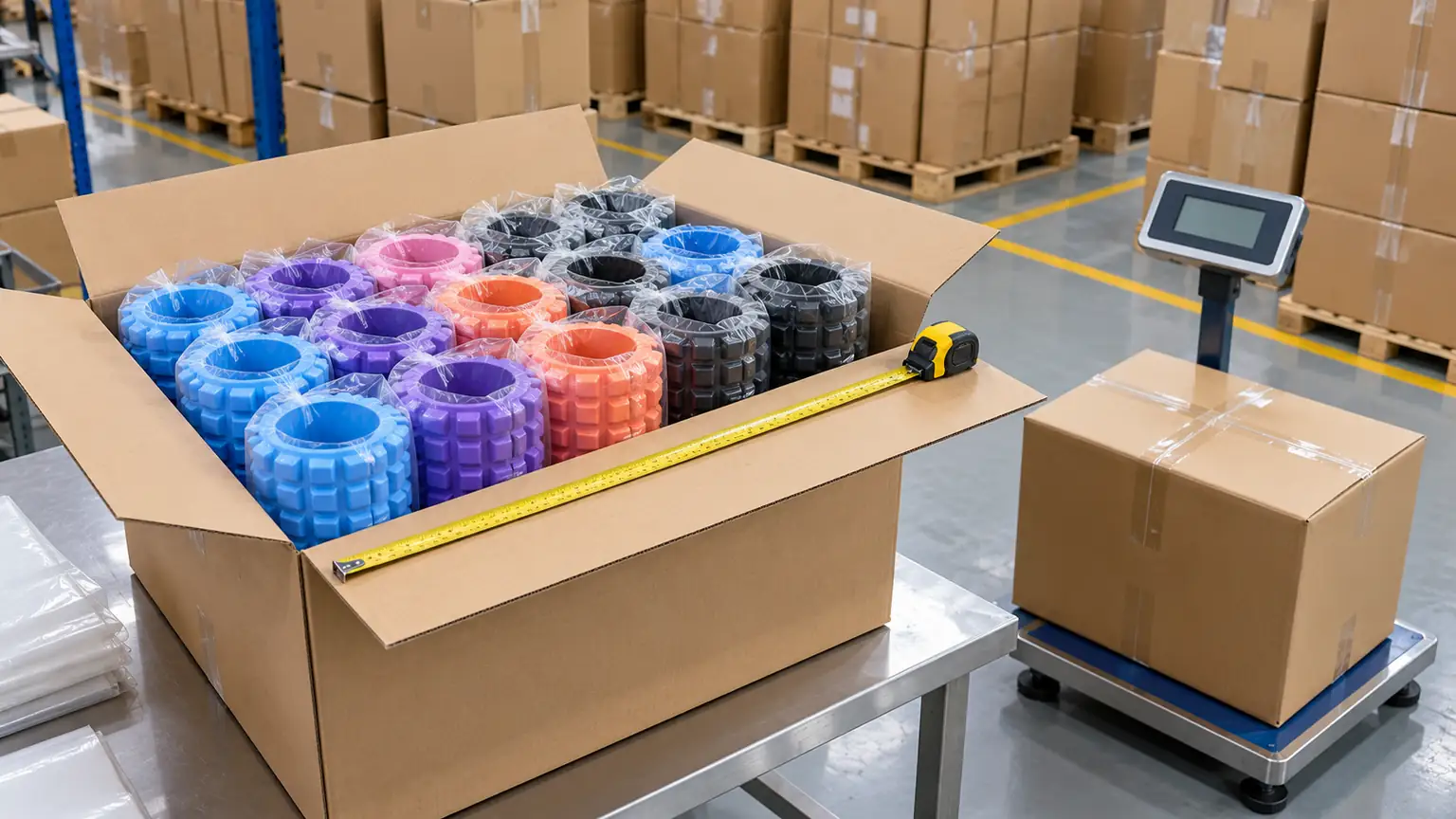
3. Packing and freight. Foam rollers are light and bulky, so freight is charged on volume, not weight. A quote that doesn’t state units per carton and carton dimensions doesn’t tell you what the roller will cost landed. Ask every supplier for the same four numbers: units per master carton, carton dimensions, gross weight and net weight. Then estimate cartons per container from the carton size yourself rather than relying on a headline figure. Hollow rollers and mixed lengths change the count, so work it out for your actual order.
What to Ask Each Supplier Type
| Ask a distributor | Ask a marketplace seller | Ask a factory |
|---|---|---|
| Which brands and densities are in stock now? | Are you the manufacturer or a trading company? | What’s the minimum per style with our logo, and per custom color? |
| What’s the case pack, and can sizes be mixed? | Can you send your business license and a test report issued to your company? | How long for a sample, and for bulk after sample approval? |
| What happens if a size is discontinued? | Is the listing photo your own product? | Which logo methods suit this material? |
| What are the volume price breaks? | What’s the density, stated as a number? | Which test reports do you hold for this material? |
| What’s the lead time for out-of-stock items? | Can I see the production line on a video call? | Units per carton, carton dimensions, gross and net weight? |
On test reports: an ordinary foam roller doesn’t fall under the EU rules that require CE marking, so a “CE certificate” for one tells you little. What buyers usually need are chemical test reports for the market they sell in. We hold REACH and California Proposition 65 test reports for our foam rollers, the two that EU and US retail buyers ask for most. The fitness equipment certifications guide explains which documents apply where.
Red Flags in Foam Roller Quotes
- A price with no trade terms. You can’t compare a number until you know whether it’s EXW, FOB or delivered.
- “High density” with no figure. If the supplier won’t put a density on the quote, the bulk run can be softer than the sample.
- A test report issued to another company. The applicant on the report should be the supplier, or the supplier should explain who it is.
- A sample from stock for a custom order. The sample you approve should be made the way your bulk will be made, in your color and with your logo method.
- No carton data. Units per carton and carton size are part of the price for a product this bulky.
- Very low minimums on custom colors. Compounding a custom color has a real minimum. A much lower figure usually means a near-match stock color, so ask to see it next to your Pantone reference.
Where This Fits in Sourcing
Choosing the supplier type comes first. If a factory is the right route, the next steps are verifying the factory and agreeing on how quality will be checked: our guide to choosing a foam roller manufacturer covers the factory checks, and the seven QC checks before bulk shipment covers inspection. If you already know you want your own branding, the custom foam roller page lists what can be changed.
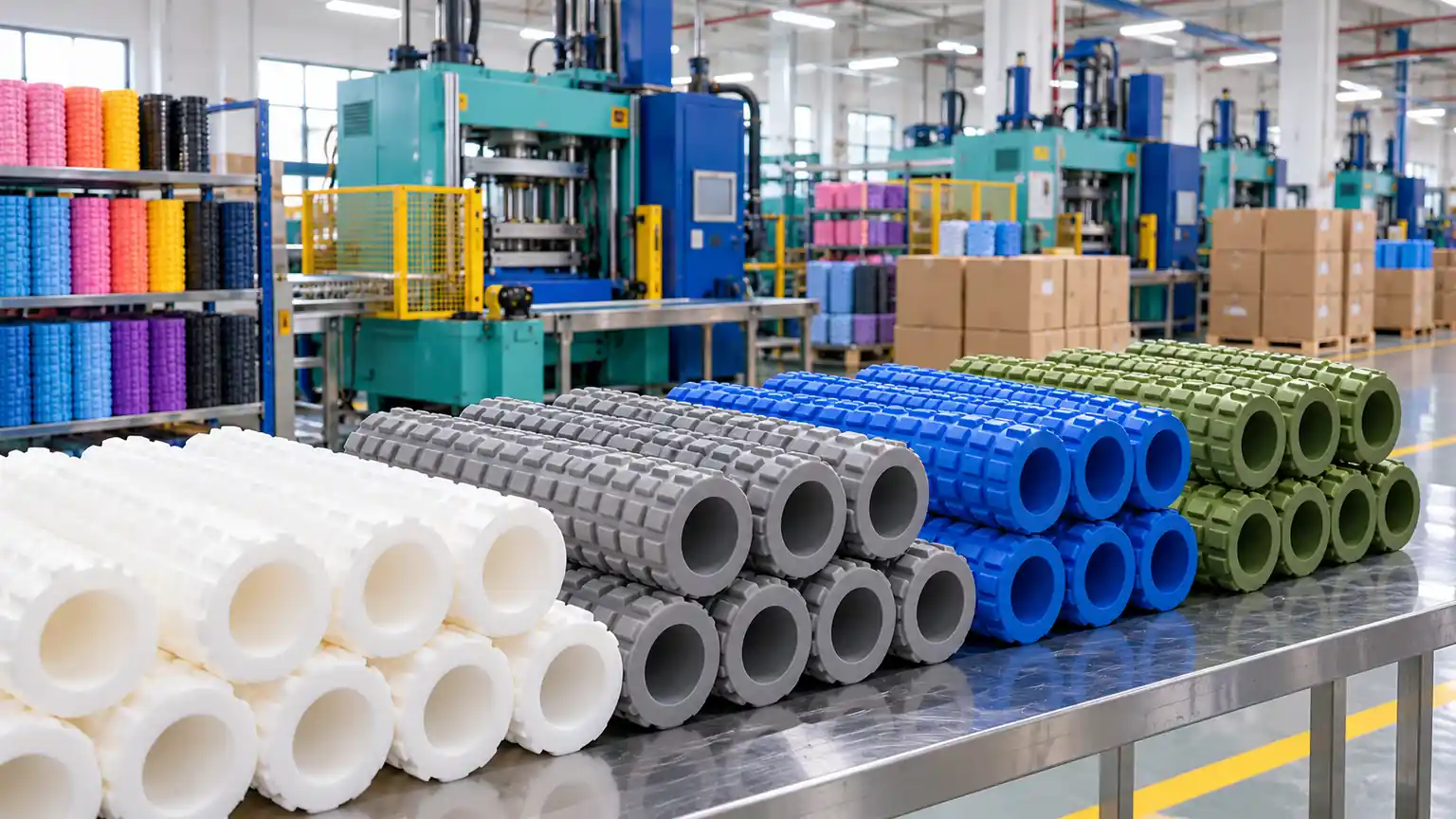
We make EVA, EPP and PE rollers, solid and hollow, full round and half round, at our plant in Yangzhou, Jiangsu, and check density across production lots so the bulk run feels like the sample. We supply bulk foam rollers to distributors, clinics, gyms and private label brands.
If you send the material, sizes, rough quantity and destination, we’ll come back with a quote that includes carton data and trade terms, so you can set it next to the others. Request a foam roller quote →
FAQ
Where can I buy foam rollers wholesale?
From three kinds of supplier: fitness or physical therapy distributors and brand wholesale programs (small quantities from stock, no own branding), B2B marketplaces (wide choice, but you need to check who makes the product), and OEM factories (your own brand at the lowest unit price, with a minimum order and a production lead time).
Is it cheaper to buy foam rollers directly from a factory?
Per unit, yes, once your order meets the factory’s minimum, because there’s no distributor margin. Below the minimum, or if you need rollers this week, a distributor is often cheaper overall because you don’t carry extra stock or wait for production and freight.
What is the MOQ for custom foam rollers?
It depends on what you customize. At our factory a standard roller with your logo starts at 300 units, and standard colors can be mixed within that order. A custom foam color starts at 1,000 units because the foam is compounded in that color.
How long does a foam roller order take?
For a factory order, a logo sample usually takes three to seven days, depending on the logo method. Bulk production takes about 20 days for a simple order and 30 days or more for large or highly customized ones. Add sea freight time to your destination.
How do I know if a foam roller supplier is a real factory?
Ask for the business license and check that its registered scope includes production. Ask which steps are done in-house, ask for a test report issued to the supplier itself, and ask for a live video walk-through of the line making your material.