Author: Wellfitsource Product & Sourcing Team · Published: September 2026 · Updated: September 2026
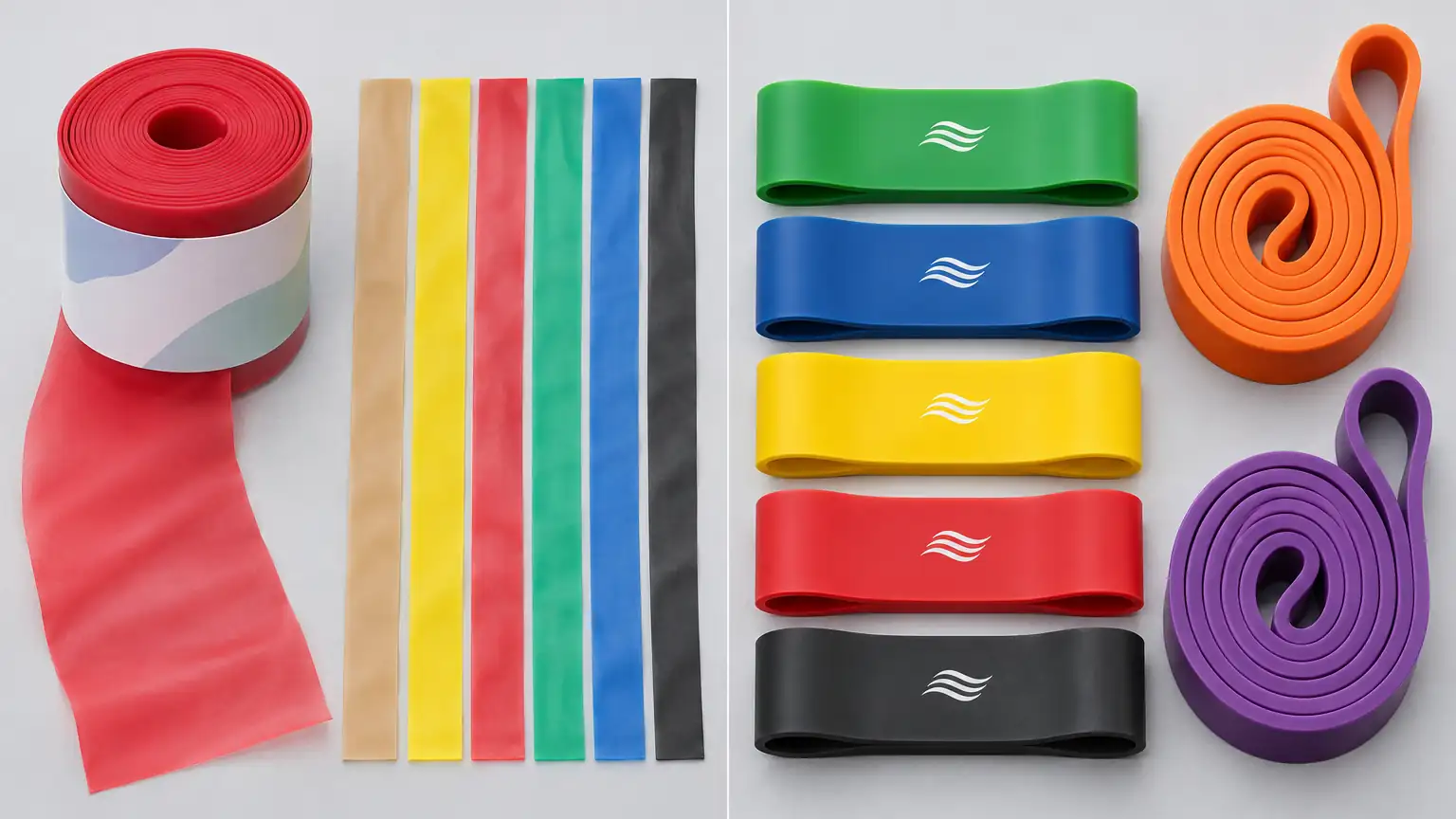
Therapy resistance bands and fitness bands often start life as the same kind of flat elastic sheet, but they are specified for different jobs. A therapy band is light, sold by the roll or as a pre-cut strip, and graded in small, even resistance steps so a clinician can prescribe “one color up” with confidence. A fitness band is usually a closed loop or a long power band, sold in retail sets, with resistance steps several times heavier. For a distributor supplying clinics, five things separate the two: the resistance range, the format, color consistency across reorders, latex policy, and the words on the label.
A request we see regularly from medical supply distributors looks like this: a quote sheet for “latex resistance bands, 5 levels,” copied from a fitness catalog, plus a note that the end customer is a physical therapy practice. The sample set that matches that quote runs from about 10 lb to 50 lb. The therapists will open the carton, pull the lightest band, and find it too heavy for a patient three weeks out of shoulder surgery. Nothing is wrong with the product. It was specified for the wrong room.
Quick Summary
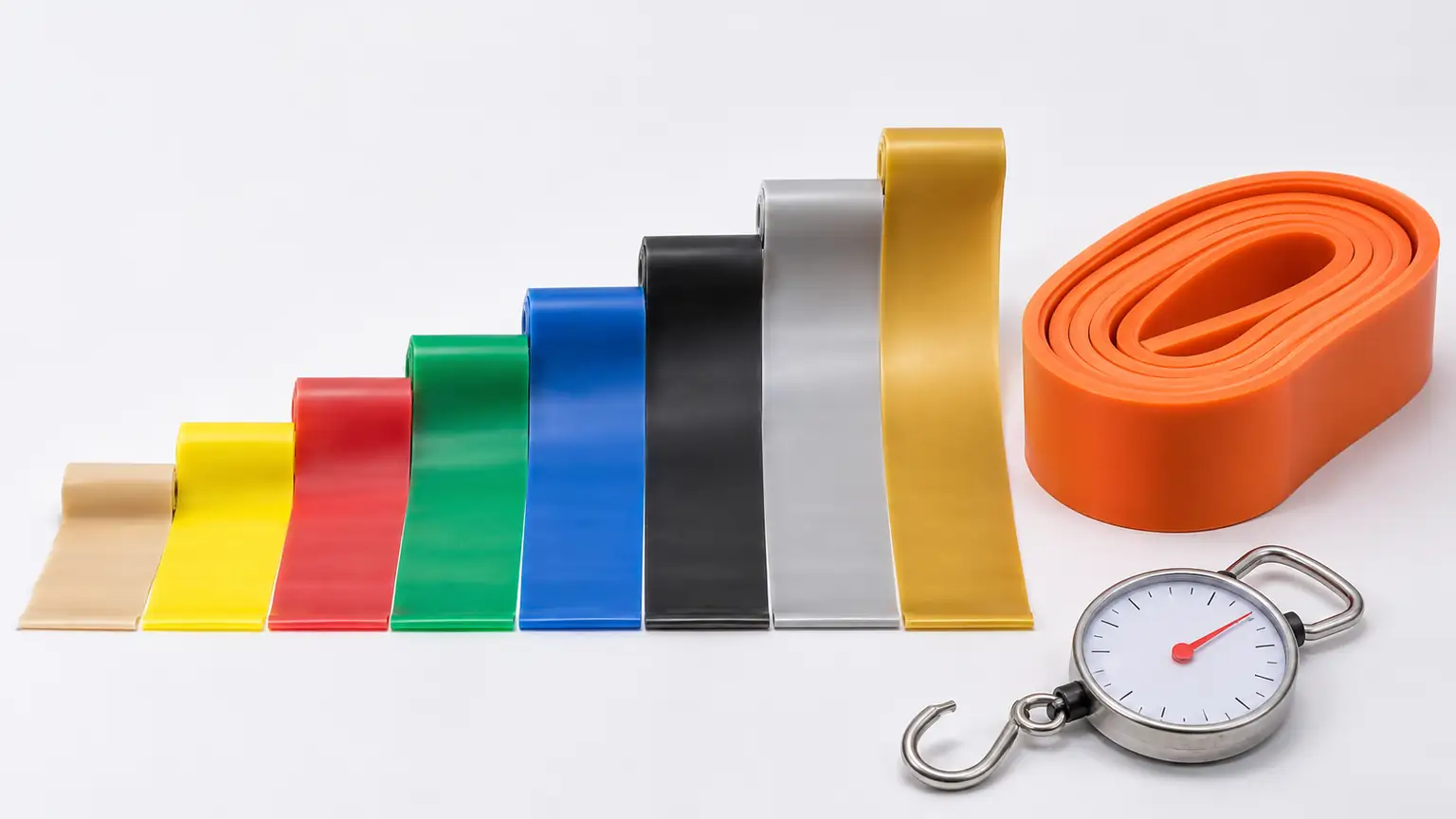
- The resistance scale is different by an order of magnitude. The best-known clinical color line runs from 2.4 lb (tan) to 7.3 lb (black) at 100% elongation. Fitness loop bands typically start around 10 lb and top out at 80–120 lb.
- Therapy steps are small and even — about 25% per color — because rehab is prescribed as a progression. Fitness steps of 15–25 lb would be impossible to prescribe that way.
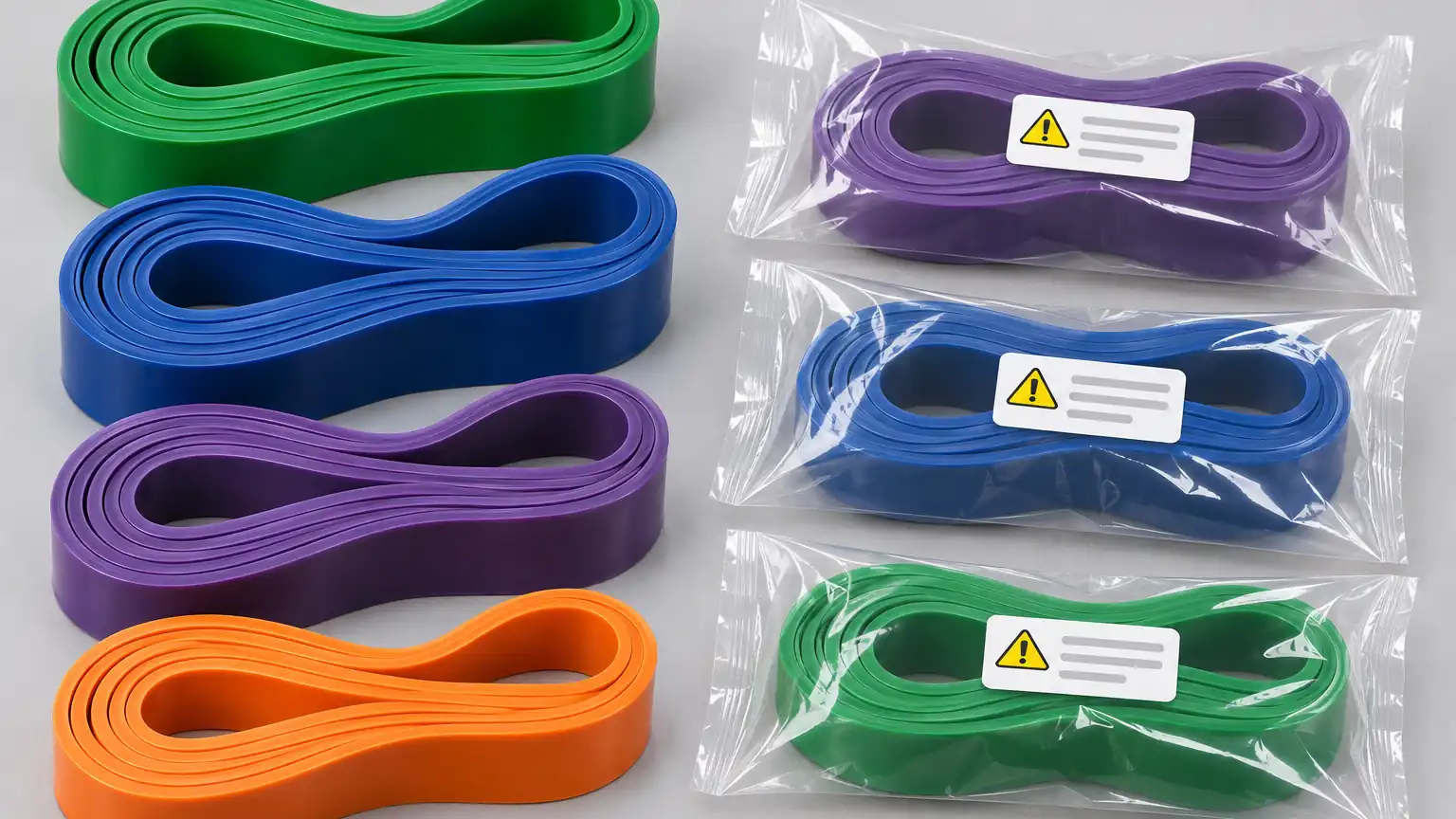
- Clinics buy rolls and strips, not sets. Dispenser rolls of 25 or 50 yards and pre-cut 4–5 ft strips are the core formats; retail loop sets are a different product line.
- Color is a clinical instruction, not a design choice. A therapist’s plan says “move to green.” If a reorder shifts what green feels like, the plan breaks.
- Latex policy and label wording decide who can buy it. Many clinical buyers require latex-free bands, and rehab claims on the label can turn a band into a regulated medical device.
The Resistance Range Is the First Difference
| Color | Force at 100% elongation | Step from previous color |
|---|---|---|
| Tan | 2.4 lb | — |
| Yellow | 3.0 lb | +25% |
| Red | 3.7 lb | +23% |
| Green | 4.6 lb | +24% |
| Blue | 5.8 lb | +26% |
| Black | 7.3 lb | +26% |
| Silver | 10.2 lb | +40% |
| Gold | 14.2 lb | +39% |
Source: Performance Health TheraBand color progression chart; independent tension reference values are published in Uchida et al., Journal of Physical Therapy Science (2016).
Now compare that with a typical flat fitness loop set, which we covered in our resistance band resistance levels guide: X-Light around 10–20 lb, Medium 35–55 lb, X-Heavy 80–120 lb at the same 100% elongation. The lightest band in a common fitness set is heavier than the heaviest band in the clinical tan-to-black range.
The reason is the patient. Rehab often starts close to zero — an older adult rebuilding grip strength, a runner restoring ankle stability, a post-operative shoulder that can barely lift the arm. What the therapist needs is a staircase with shallow, even steps, so each color change is a predictable 25% more load. In a fitness set, going from Light (20–35 lb) to Medium (35–55 lb) can mean a 60% jump. A healthy gym-goer shrugs that off. A rehab patient can’t.
Format: Rolls and Strips, Not Sets
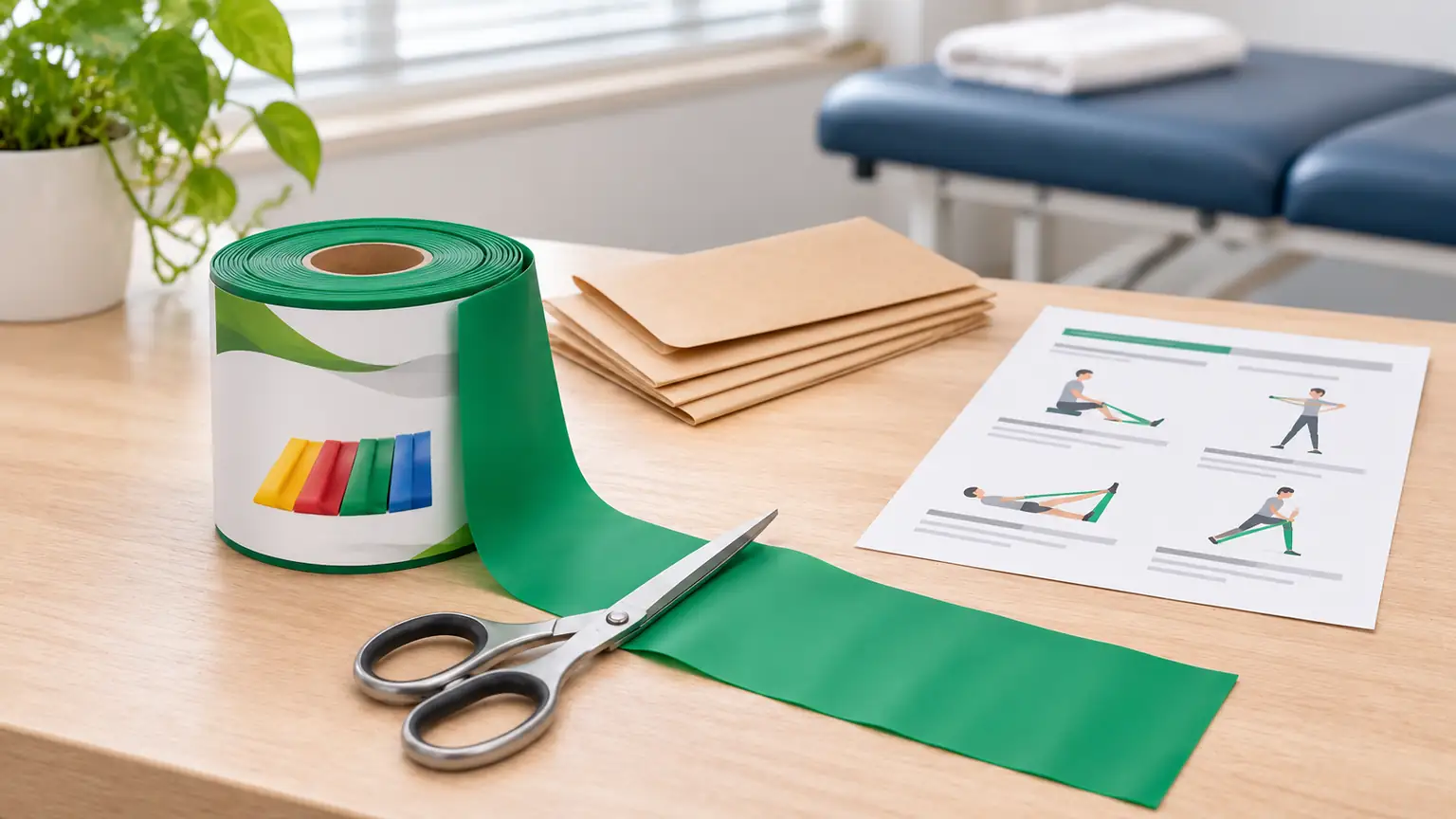
Fitness bands are sold as finished objects: a set of five loops in a pouch, a long power band, a tube with handles. Therapy bands are closer to a raw material that the clinic finishes itself.
| Therapy bands | Fitness bands | |
|---|---|---|
| Typical form | Flat sheet, open-ended | Closed loop, long power loop, or tube with handles |
| How clinics buy it | Dispenser rolls of 25 or 50 yards (about 23 m or 46 m), plus pre-cut strips of 4–5 ft (1.2–1.5 m) | Retail sets of 3–5 levels |
| Who cuts it to length | The clinic, per patient and per exercise | Nobody — length is fixed |
| Resistance range | ~2–14 lb at 100% elongation | ~10–120 lb at 100% elongation |
| Unit of sale in a catalog | One color, one roll | One set |
| Where it ends up | Patient’s home exercise program | Gym bag, living room, studio |
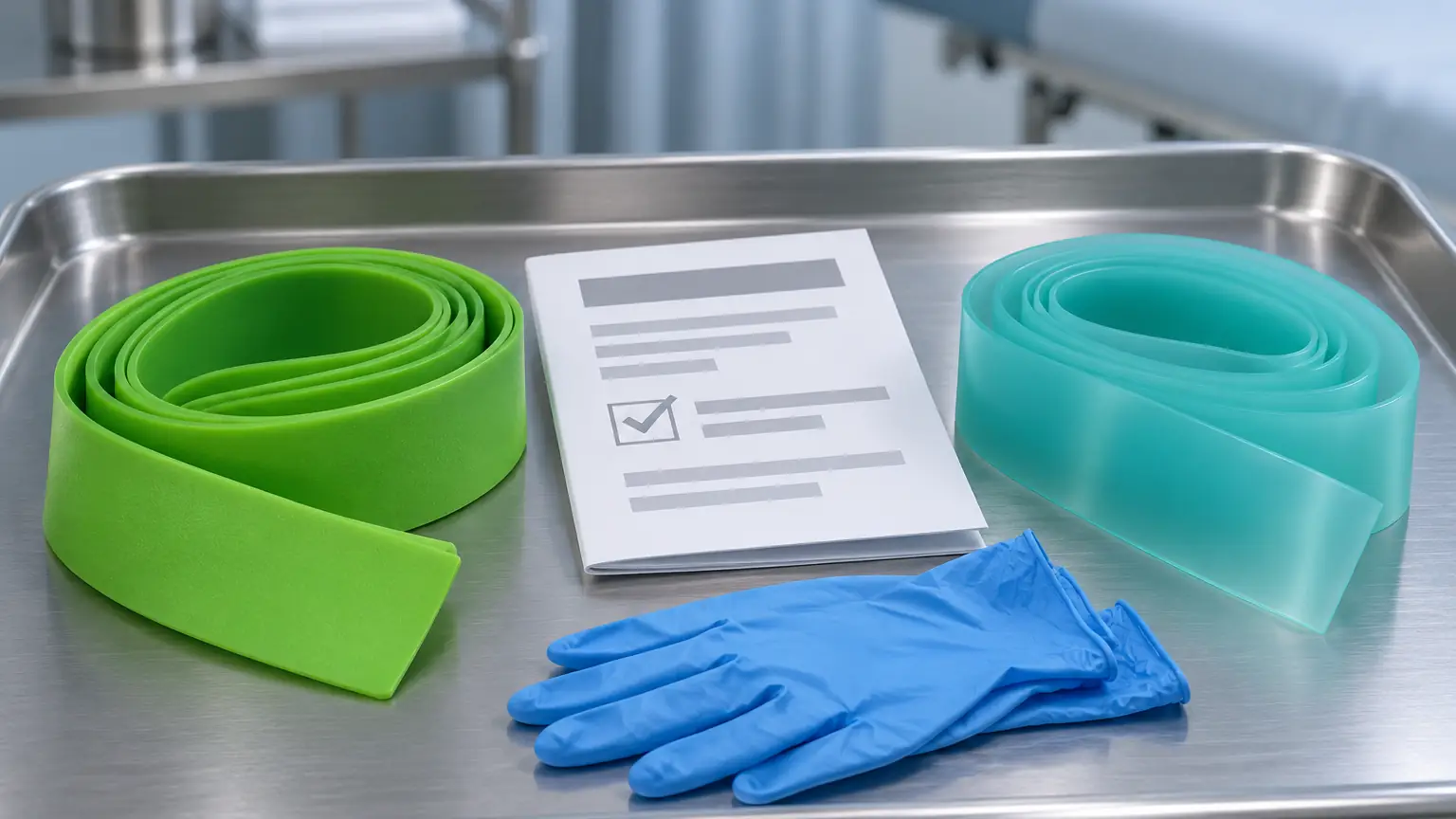
For a distributor, the format difference changes the catalog math. A clinic line in six colors, each offered as a 50-yard roll and a pre-cut strip, is twelve SKUs — each one produced and ordered by color. That shifts how you plan minimum order quantities, which we break down in our resistance band MOQ and lead time guide. Rolls also ship heavier and denser than retail sets, which usually works in your favor on freight per unit. Roll length is not fixed by the factory either. Our ready-to-ship clinic rolls are 15 m long, 150 mm wide and 0.5 mm thick in six colors, which is enough to sample a line or start small; once an order meets the minimum, we cut rolls to the 25- or 50-yard lengths your catalog already lists, adjust thickness and compound to match the force step you need for each color, and pack them in a custom dispenser box.
Color Is a Clinical Instruction
In a fitness line, color is branding. Brands change palettes between seasons, launch a pastel edition, or reassign colors to match their packaging. We’ve covered those choices in our resistance band color coding guide.
In a clinic line, color is part of the prescription. A home exercise sheet says “two sets of 15 with red, move to green next week.” Patients remember the color, not the pound value. Therapists who have used the same sequence for years know by feel what each color should do.
That puts two hard requirements on a distributor’s private label line:
- The sequence cannot change. Once your catalog says red sits between yellow and green, it stays there on every reorder and every format — roll, strip, and loop.
- What each color feels like cannot drift. This is the one place where consistency needs a number. With steps of roughly 25% between adjacent colors, a batch that runs 15% heavy and a neighboring batch that runs 15% light end up almost on top of each other. The therapist notices before anyone measures anything.
The practical fix is not complicated: ask for force readings per color on the approved pre-production sample, keep those readings as your reference, and ask for the same readings on each production lot. If a factory can’t produce them, that tells you how the next reorder will go.
Material and Latex Policy
Classic therapy bands were natural rubber latex, and latex still dominates heavy fitness power bands because of its stretch and snap. The clinic channel has been moving away from it for a simple reason: allergy. A 2016 meta-analysis in the Journal of Occupational Health put the average prevalence of latex allergy at 4.3% of the general population, 7.2% of susceptible patients, and 9.7% of healthcare workers. Therapists handle bands all day. Patients take them home and use them against bare skin.
As a result, many hospital and clinic buyers write “latex-free” into their procurement requirements for bands — even when a latex band would be fine for most individual patients. For a distributor, the useful question is not whether to offer latex-free but which latex-free material, and how to label it correctly. We compare the two main options in TPE vs silicone latex-free bands for clinical settings.
The Words on the Label
A fitness band box says “build strength and tone.” A therapy band box often says something like “for rehabilitation exercises.” That second sentence has consequences.
In the US, FDA’s regulation for exercise components (21 CFR 890.5350) covers devices “intended for medical purposes, such as to redevelop muscles or restore motion to joints” — and classifies them as Class I medical devices. The EU takes a similar view under the Medical Device Regulation: the intended purpose stated on the label decides whether a band is a consumer product or a medical device.
The band itself is the same either way. What changes is who has to register it, what the label must say, and who is legally the manufacturer when a distributor sells it under their own brand. We walk through both routes in are therapy bands a medical device?
Packaging Follows the Channel
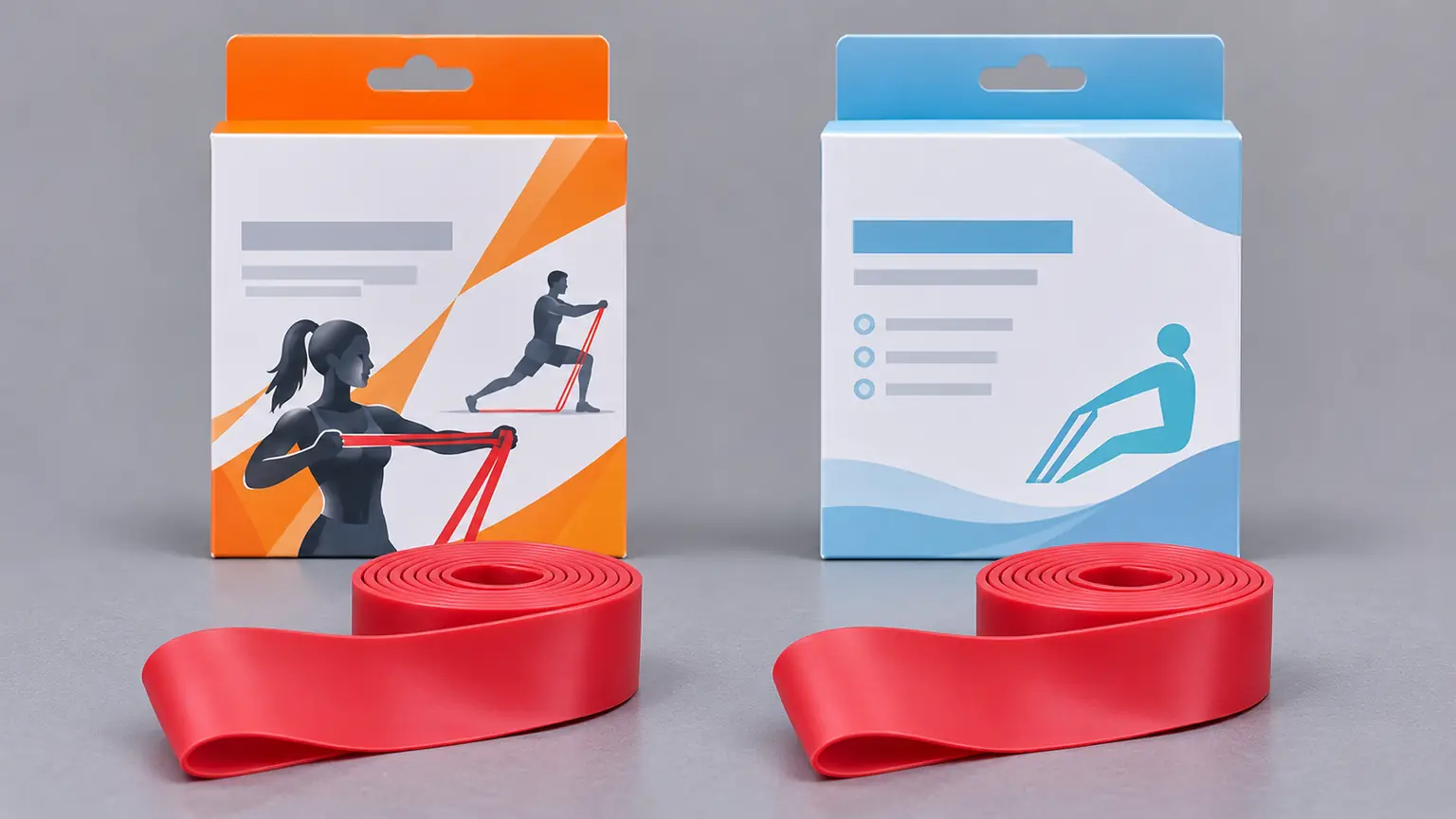
Retail fitness packaging is built to sell from a hook or a listing image: pouches, header cards, printed boxes, all the formats in our resistance band packaging guide. Clinic packaging is built to be opened and used:
- Dispenser boxes for rolls, with a slot so the band pulls out cleanly and the rest stays protected from light and dust
- Bulk boxes of pre-cut strips, one color per box, clearly marked on the outside so a busy clinic can grab the right one
- Patient envelopes or small bags so a strip can go home with an exercise sheet
What clinic packaging usually drops is the marketing: no lifestyle photography, no hang holes, no “total body transformation.” What it adds is information — the color’s position in the sequence, the length, the material statement, and care instructions.
Building a Clinic Line: What to Specify
When a distributor asks us to quote a clinic line, we ask three questions before anything else: which colors, which formats, and does it need to be latex-free. Those three decide the compound, the tooling, and the minimum order. The full specification then looks like this:
- ☐ Color sequence, written out in order, with a physical color reference for each
- ☐ Resistance per color as a force value at a defined elongation (100% is the common reference), not just “light / medium / heavy”
- ☐ Formats: roll length (25 yd, 50 yd, or a custom length), strip length, and any loop versions
- ☐ Material: natural latex or latex-free, with the matching documentation
- ☐ Label wording reviewed for intended use before the artwork is printed
- ☐ Packaging per channel: dispenser box, bulk strip box, patient envelope
- ☐ Lot records: force readings per color on the approved sample and on every production lot
A distributor who arrives with this list gets an accurate quote on the first round. One who arrives with a fitness catalog page usually gets three rounds of samples before anyone realizes the problem was the brief.
If you’re building or re-sourcing a clinic band line, send us the color sequence and formats and we’ll come back with a matched specification and sample plan. Our full resistance band range shows the materials and formats we produce.
FAQ
What resistance bands do physical therapists use?
Physical therapists mostly use flat, open-ended bands cut from dispenser rolls or supplied as pre-cut strips, in a color progression where each step adds roughly 25% resistance. The widely used clinical range runs from about 2.4 lb to 7.3 lb at 100% elongation (tan through black), with heavier silver and gold levels for later-stage strengthening. Many clinics now specify latex-free versions.
Are therapy bands and fitness bands made from the same material?
Often, yes. Both are commonly made from natural rubber latex or TPE, and both usually start as a flat elastic sheet. The difference is in the specification — thickness, resistance steps, format, and labeling — not in the base material. Fitness power bands are thicker and layered; therapy bands are thin sheets with small resistance increments.
What do the colors of therapy bands mean?
The colors mark resistance levels in a fixed order. In the most widely recognized clinical sequence, tan is the lightest, followed by yellow, red, green, blue, black, silver, and gold, with each step adding about 25% resistance in the tan-to-black range. Color sequences are a convention rather than a legal standard, so a distributor’s line should state its sequence clearly and keep it identical across reorders.
Can fitness loop bands be used for physical therapy?
For some later-stage strengthening, yes, but they are usually too heavy for early rehab. The lightest band in a typical fitness loop set starts around 10 lb at 100% elongation, while early rehabilitation exercises often need 2–5 lb. Fitness sets also come in fixed loop lengths, while clinics cut therapy bands to the length each exercise requires.
How long is a therapy band dispenser roll?
The standard clinic formats are 25-yard (about 23 m) and 50-yard (about 46 m) dispenser rolls, plus pre-cut strips of about 4–5 ft (1.2–1.5 m) for patients to take home. Clinics cut rolls to length per patient and per exercise, so one roll typically serves many patients. Roll length is set at production, so a factory can match whatever length your catalog uses once the order meets its minimum.