Prepared by the WellfitSource team based on OEM sourcing and production control work across EU retail and e-commerce supply programs.
This guide is intended as a practical buyer-side checklist for evaluating batch traceability, odor control, recovery stability, and proof-pack discipline during factory audits or remote review. It’s not a substitute for chemical compliance testing or legal advice.
A balance pad factory audit for EU retail should focus first on three failure points that most often trigger returns and bad reviews: strong odor at unboxing, inconsistent feel between batches, and recovery instability after repeated use. This guide gives buyers a Tier 1–3 audit model: Tier 1 for trial orders, Tier 2 for Amazon, DTC, and retail launches, and Tier 3 add-ons for scaled replenishment across markets.
When balance pads arrive with a sharp smell, uneven edges, or a soft, unstable feel after a few weeks, the damage is rarely limited to one shipment. Reviews can quickly turn into “the new batch feels worse,” which is much harder to recover from than a single defective unit. That’s why buyers should audit for retail-visible failure first, then for records and traceability second.
If you’re placing a trial order, Tier 1 is usually enough. If you’re launching on Amazon, DTC, or in retail stores, Tier 2 should be your minimum. If you’re managing replenishment across multiple countries or channels, add Tier 3 controls for exception handling, retention, and review cadence.
Who this guide is for:
EU importers, Amazon/DTC buyers, and retail sourcing teams evaluating OEM balance pad suppliers.
Who this guide is not for:
Teams looking for laboratory compliance testing, product certification advice, or legal interpretation.
The checklist is built around audit evidence buyers can actually verify on site or by video: labeled retention samples, sealed-sample odor checks, short recovery demos, and code matching across COA, packing list, and carton labels.
The right factory is not the biggest factory—it’s the factory that matches your retail risk level. For background on OEM options in this niche, see the resource hub: OEM balance pad factory for European retail brands.
Micro-summary: Retail risk usually shows up as odor at unboxing, inconsistent feel on replenishment, and softening after repeated use. Audit those visible risks first, then layer documentation and traceability.
Why “Best Factory” Is the Wrong Goal
Trial orders, EU retail rollouts, and multi‑market replenishment carry very different retail risks. The goal isn’t the biggest factory—it’s the factory that fits your channel’s risk. Use the tiers to match audit depth to consequences.
Quick map for buyers:
- Low‑risk launch → Tier 1 Baseline
- Retail launch → Tier 2 Retail‑Ready
- Brand scale → Tier 3 Add‑ons
In short, the “best” balance pad factory audit checklist aligns to your channel risk, not to general prestige. Pick the tier that protects reviews and replenishment.
Micro‑summary: Fit beats fame. Tie your audit depth to where returns and ratings can fail in your channel.
The 3‑Tier Audit Model
Tier 1: Baseline essentials most factories should meet
- Prove the visible basics: batch labels, document alignment, and simple demos you can repeat.
- Best for trial orders where you need minimum viable confidence fast.
Tier 2: Retail‑ready controls for Amazon and DTC
- Make the method repeatable: retention samples, fixed comparison method, and a consistent Proof Pack.
- Minimum level for Amazon/DTC and retail launches.
Tier 3: Brand‑protection add‑ons for scale
- Add exception and replenishment control: basic exception notes, longer retention, and review cadence.
- Use as add‑ons for scale, not a first gate for capable SMEs.
Quick comparison: which audit tier fits your channel and risk level?
| Audit Tier | Best For | Must Verify | Minimum Evidence | Main Red Flag | Buyer Decision |
|---|---|---|---|---|---|
| Tier 1 Baseline | Trial orders, first sampling | Batch labels, sealed‑sample odor check, stepping/recovery demo, COA‑carton match | Photos + 2–3 short videos | No retention samples, no carton batch label | Proceed only for low‑risk trial |
| Tier 2 Retail‑Ready | Amazon, DTC, shelf launch | Retention sample comparison, fixed demo method, QC screenshots, packaging odor control | Proof Pack B | Inconsistent side‑by‑side feel, vague process answers | Minimum level for retail launch |
| Tier 3 Brand‑Protection | Multi‑market replenishment, scaled brand programs | Exception log, quarantine/rework evidence, extended retention timeline | Batch dossier + review cadence | No corrective‑action loop | Add‑on for scale, not first gate |
For an example hub on OEM context, see: OEM balance pad factory.
Micro‑summary: Tier 1 proves basics, Tier 2 makes them repeatable, Tier 3 adds governance. Most EU retail launches live in Tier 2.
Audit Checklist by Tier
Tier 1 Checklist — Baseline proof pack
What to check on site or video
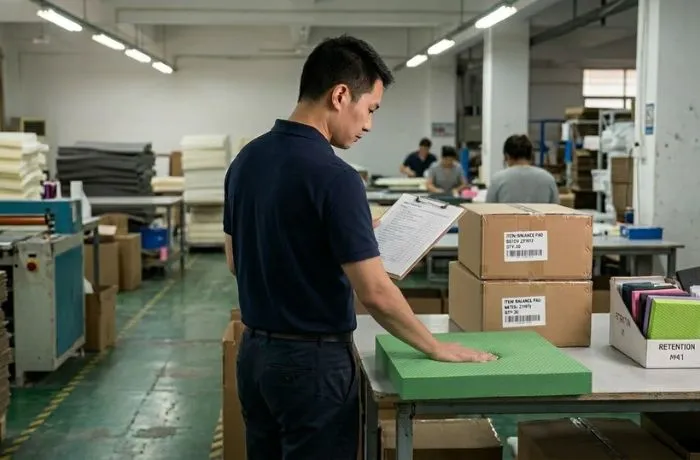
- Warehouse and staging: look for ventilated or curing area before sealing to lower sharp smell risk.
- Packaging table: confirm they can prepare a 7‑day sealed sample and label it.
- Cartons and samples: readable batch or run labels; simple retention sample box or wall.
Questions to ask using “Show me …”
- Show me your batch label and how it links to a production run.
- Show me a sealed sample prepared at least 7 days ago that you can open on camera. How does it smell—sharp, mild, or none?
- Show me a 30‑second stepping and recovery demo on a real pad.
- Show me who signs the packing list and how they match codes to the COA.
- Show me how you would mark a non‑conforming lot.
Evidence to collect
- Photos: product with batch label, carton label, packing list; COA screenshot (redacted OK).
- Videos up to 30 seconds: unsealing and sniff check; stepping and recovery demo; quick daylight versus LED stills if possible.
Red flags
- “We don’t keep samples.”
- “No batch labels on cartons.”
- Hesitation to provide sealed‑sample or demo videos.
Tier 2 Checklist — Retail‑ready proof pack
What to check
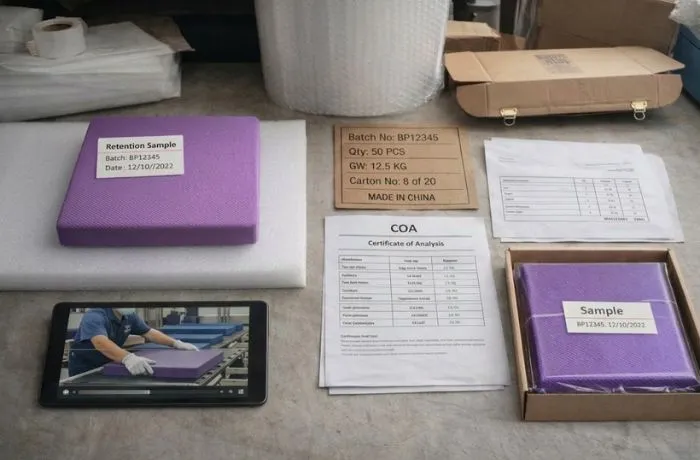
- QC station logs or screenshots with sampling points and rejects. Retention wall or labeled bags. Packaging choices that avoid odor trapping such as vents, liners, or delayed final sealing.
- Method lock‑in: daylight plus LED side‑by‑side with last shipment’s retention sample; same camera angle for demos.
Questions to ask
- Show me how you isolate, rework, and re‑inspect a failed batch.
- Show me last shipment’s retention sample next to this batch under daylight and LED.
- Show me packaging options that reduce odor trapping.
- Show me a recent inspection record—what did you reject and why?
- What happens if a batch smells strong after sealing—quarantine or rework?
- Which two process steps most affect long‑term feel stability?
- Who signs first‑article approval and what evidence do they check?
Evidence to collect — Proof Pack B minimum
- Photos: finished product with batch label; carton label; packing list; COA alignment screenshot.
- Videos: 7‑day sealed‑sample sniff; stepping and recovery before‑after; daylight plus LED side‑by‑side comparison.
Red flags
- Vague answers with no records or samples.
- Inability to reproduce demos consistently.
- Side‑by‑side feels uneven underfoot or edges look rough compared with retention.
Tier 3 Checklist — Brand‑protection add‑ons
Add‑on checks
- Exception loop with brief root‑cause notes and corrective actions; evidence of quarantine, rework, and clearance.
- Extended retention timeline aligned to replenishment cadence; documented review rhythm.
Add‑on evidence
- Batch dossier: labeled retention samples, discrepancy log, and reconciliation notes.
Micro‑summary: Tier 1 equals basic proof, Tier 2 equals a repeatable proof pack, Tier 3 adds tracking and review muscle without turning it into a lab.
Copy-Paste Audit Questions for Your Supplier
Please show the following during the audit call or factory visit:
- Batch labels and how they link to the production run
- A recent COA and the matching carton label
- A sealed sample prepared at least 7 days ago for an odor check
- A 30-second stepping and recovery demo on a real pad
- The previous shipment’s retention sample stored with date and batch ID
- A side-by-side comparison under daylight and LED
- What happens to failed lots: quarantine, rework, and re-inspection
- Packaging options that reduce odor trapping
- A recent inspection record showing rejects and reasons
- Who signs first-article approval and what evidence they review
Pass / Review / Reject: How to Make the Audit Decision
Pass
- Batch labels are visible and traceable to the production run
- A 7-day sealed sample opens with mild odor or no sharp odor
- Retention samples are available and clearly dated
- The current batch feels consistent with the previous retained batch under the same comparison method
- COA, packing list, and carton labels align
Review
- Odor is acceptable, but sample holding or labeling is inconsistent
- Retention samples exist, but storage or dating is weak
- Demo methods vary between calls or batches
- QC records are available, but not easy to link to one lot
Reject
- No batch labels on cartons or products
- No retention samples
- No sealed-sample odor proof
- No clear failed-lot handling process
- Side-by-side comparison shows obvious inconsistency in feel, edge quality, or recovery
What Evidence Works Without Lab Equipment
Professional doesn’t have to mean expensive. Ask for evidence you can replicate every time:
- Sealed‑sample sniff check: prepare a labeled sample, hold for 7 days, unbox on video, and describe the odor as sharp, mild, or none. Align language to EU expectations around substance communication under REACH (and Annex XVII restriction terminology when substances are relevant).
- Stepping or cyclic‑load demo: same camera angle; 30‑second before and after comparison. Watch for recovery lag or visible sag that feels soft and unstable underfoot.
- Before and after wipe photos: reveals surface pickup or weak print adhesion. If you need shared language for discussing print durability with a vendor, you can reference ASTM D3359 or ISO cross‑cut adhesion terminology without prescribing grades.
- Labeled retention samples: shelf or wall photo showing dated samples with batch IDs.
- COA, packing, and carton alignment: screenshots or photos proving code match. For customs and labeling language alignment, EU CN/TARIC (Combined Nomenclature) references can help keep terminology consistent.
Micro‑summary: Repeatable demos beat lab talk for day‑to‑day control. Use REACH and TARIC only as shared language when needed.
Remote Audit Option — A video walkthrough SMEs can support
A structured live video call can cover most Tier 1–2 checks:
- Start at warehouse or staging: show ventilation and curing area and the packing line. Capture a sealed sample labeled with date and batch ID prepared at least 7 days prior; open it live and note odor as sharp, mild, or none.
- Do the demos: a 30‑second stepping and recovery video at a fixed angle; side‑by‑side daylight plus LED comparison of new batch versus retention sample.
- Screen‑share documents: reconcile COA, packing list, and carton labels; show how discrepancies are handled.
Precedent: guided remote inspections are a recognized practice in quality control. If you need a reference point for how third‑party inspection firms structure this, look at any standard pre‑shipment inspection walkthrough and adapt the same checkpoints to your Tier 1–2 proof pack.
Micro‑summary: Remote doesn’t mean blind. Ask for live proofs and labeled samples; most SMEs can deliver this in under an hour.
Decision: Match Your Channel to the Right Tier
- Trial SKU → Tier 1
- Amazon/DTC → Tier 2
- Multi‑market replenishment → Tier 3 add‑ons
Lock in your method now—define the sealed‑sample sniff, the stepping and recovery demo, and the daylight plus LED comparison—so every replenishment is judged the same way. For structured next steps, use this retail production control guide and do one of the following: get the printable Tier 1–3 checklist, send your target channel so we can map the right audit tier, or request a sample Proof Pack (sealed‑sample odor check, recovery demo, and batch traceability photos) before you commit to a larger order.
FAQs
Q1: What should I focus on in a balance pad factory audit?
Batch traceability, retention samples, odor and packaging control, and proof of recovery stability—matched to your tier.
Q2: Can I audit a balance pad factory remotely?
Yes. A live video walkthrough plus a proof pack with labels, records, demos, and a sealed‑sample check covers most Tier 1–2 checks.
Q3: What’s the biggest red flag during supplier evaluation?
Vague answers without showing records or samples—especially around batch control, retention samples, and what happens when a batch fails.