Most “market trends” posts won’t help you make a decision.
They’ll tell you the market is growing, then leave you with the same problem you started with: Which SKU will survive Amazon reviews—and which one will get returned until your margin feels flat?
The US is not just a bigger market. It’s a faster review-driven retail machine. A launch can be “decided” by the first 10–30 reviews, and the failure mode is usually not a missing feature. It’s something the buyer felt.
If you’ve been comparing US balance pad trends 2026 posts or trying to forecast balance pad demand USA on Amazon, this is the mechanism underneath the numbers: reviews decide velocity, returns decide profitability. You’ll see the same pattern show up later when we talk about Amazon fitness accessories—and again in the rehab/home wellness segment.
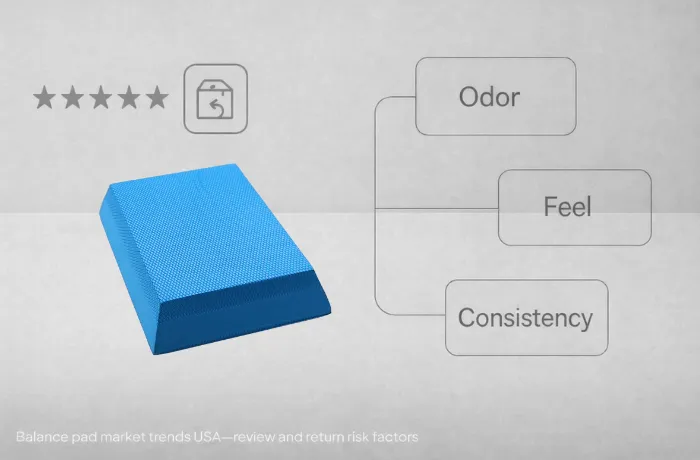
Here are the three ways balance pads most often “blow up” in the US:
- Unboxing odor: the first second of trust. If it hits as a sharp smell, the return impulse is immediate.
- Feel fatigue after a few weeks: the pad starts springy, then goes flat and buyers call it “cheap.”
- Batch-to-batch feel inconsistency: one batch feels stable; the next is shaky underfoot. Reviews punish you twice—once for the product, once for the “brand.”
If you want the manufacturing-side view of how to prevent retail failures before they reach customers, start with this retail production control guide. Then use the trends below as a buyer checklist.
Micro-summary: In the US, “trend” doesn’t mean growth. It means the review and return triggers are evolving—and they’re brutally public.
Trend #1: Balance Pad Market Trends USA Are Now Review-Driven
Quick Trend Map (USA market trends → reviews & returns)
- Fastest return trigger: Unboxing odor
- Slow-burn return trigger: Feel fatigue (goes flat)
- Reorder killer: Batch-to-batch feel inconsistency
- US premium = predictable comfort, not plush
- New spec = Proof pack, not promises
Why Amazon/DTC changes everything
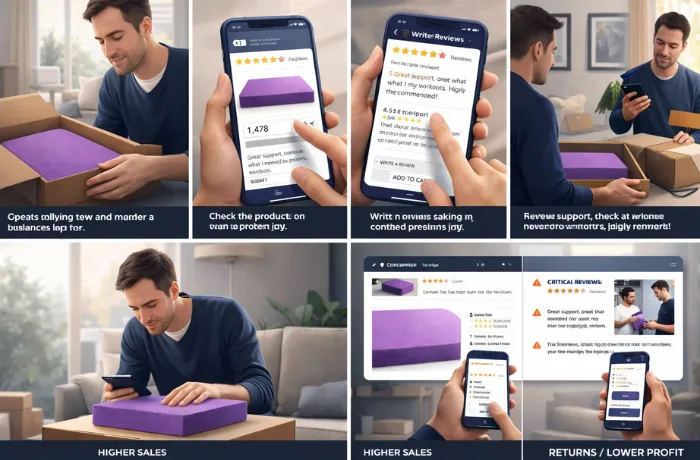
In traditional wholesale, product issues show up slowly. A few customers complain to a store manager. A buyer hears about it months later. The damage is contained.
Amazon/DTC flips that timeline. This is why this category behaves like other fitness accessories trends Amazon buyers chase: the public feedback loop is the spec.
Amazon/DTC flips that timeline:
- The first buyer writes a review the same day the box arrives.
- The review becomes your permanent sales copy.
- The next buyer doesn’t read your spec sheet—they read the 1-star story.
That is why US demand increasingly follows reviews, not brochures. When the category is review-driven, product specs drift toward the safest “won’t get me returned” middle ground.
What this trend changes in real launches
You’ll see fewer “extreme” spec bets and more conservative choices:
- Fewer ultra-soft pads that feel great for 30 seconds but go unstable fast.
- More focus on feel consistency across units instead of one impressive sample.
- Packaging and unboxing becoming part of the product spec (because it affects the first review).
So what should a buyer do next? (Proof Pack / RFQ questions)
Ask your supplier for evidence that the mass-production feel matches the sample feel:
- “How do you control batch density/firmness so the underfoot feel doesn’t shift?”
- “Will you keep a retention sample from the exact shipped batch (not just a showroom sample) so we can verify reorder consistency later?”
- “Can you provide a labeled retention sample photo per batch (kept for X months)?”
- “What’s your plan for ‘sample vs bulk’ variance—how do you catch it before shipping?”
Micro-summary: US specs are getting more conservative because the penalty for being “off” is instant, public, and expensive.
Trend #2: Unboxing Odor Is Now a First-Order Risk
What buyers notice in the first 30 seconds
This isn’t a regulatory debate for your customer. It’s a moment of sensory judgment.
If the pad smells sharp, heavy, or “chemical,” the buyer doesn’t wait to see if it fades. They think:
- “I don’t want this in my home.”
- “Is this safe around kids?”
- “If it smells like this now, what happens after I sweat on it?”
That’s why unboxing odor is one of the fastest paths to returns. It’s not just a negative review. It’s a trust collapse.
What winning brands now require from suppliers (without lab talk)
You don’t need to ask for a lab lecture. Ask for process controls and simple, repeatable checks.
Minimum requirements that reduce odor-triggered returns:
- Sealed sample check (7 days): a sample packed the way you’ll ship it, kept sealed, then opened and assessed.
- Ventilation staging: a defined “rest/airing” window before packing so odor doesn’t get trapped.
- Packaging options that don’t trap odor: e.g., sealed vs vented packaging photos and rationale.
If you want a clean way to operationalize this, don’t ask “Is there odor?” Ask:
- “Show me your sealed-pack odor check process.”
- “Show me your ventilation staging step (time + storage conditions).”
- “Show me packaging variants and what you recommend for Amazon FBA.”
Micro-summary: In 2026 US DTC, odor is not a minor complaint. It’s a first-impression return trigger.
Trend #3: “Feel” Has Become a Differentiator (Not Features)
The rise of “underfoot feel” language in US marketing
The market is shifting toward feel words because that’s what customers can verify.
The copy that converts now sounds like:
- “Soft but stable.”
- “Cushioned but not bouncy.”
- “Doesn’t flatten.”
And the negative reviews mirror that same language:
- “Feels flat.”
- “Shaky underfoot.”
- “Uneven.”
The point: customers don’t care that your foam has a fancy name. They care whether it stays supportive—or turns into a wobble board they didn’t ask for.
Why low-density fatigue becomes returns in weeks
This is the sneakiest failure mode because the first step can feel great.
A too-soft pad often feels springy on day one. Then, after repeated loading (home use, studio sessions, or heavier users), the feel changes:
- the surface response gets dull
- the support starts feeling uneven
- buyers describe it as going flat
That’s when you see delayed negative reviews and “used for a few weeks, then…” returns.
So what should a buyer do next? (Proof Pack / RFQ questions)
Instead of only approving a single “perfect” pre-production sample, validate feel retention:
- “Can you record a stepping + recovery demo video now, and repeat it after a defined conditioning period?”
- “What’s your internal pass/fail for ‘flattening’ or loss of support?”
- “If we reorder in 60–90 days, how do you keep the feel consistent?”
Micro-summary: In the US, ‘feel’ is the spec customers enforce. If the feel drifts, the reviews drift with it.
Trend #4: Rehab & Home Wellness Is Pulling the Category Upmarket
US demand isn’t only gyms and sports. If you’ve been watching rehab balance pad trends, you’ll notice rehab and home wellness buyers are raising expectations in a specific way:
- comfort plus stability
- hygiene and cleanability
- consistent rebound that doesn’t turn unstable
This is not “softer is better.” In rehab/home, “too soft” reads as unsafe. People want supportive comfort—stable enough that a first-time user doesn’t feel shaky.
If you’re building a US line, this trend matters because it changes what “premium” means:
- not just nicer packaging
- not just thicker foam
- but fewer surprise sensations (odor, wobble, flattening)
Micro-summary: Upmarket in the US doesn’t mean plush. It means predictable comfort that stays consistent.
Trend #5: Buyers Are Asking for Proof Packs, Not Promises
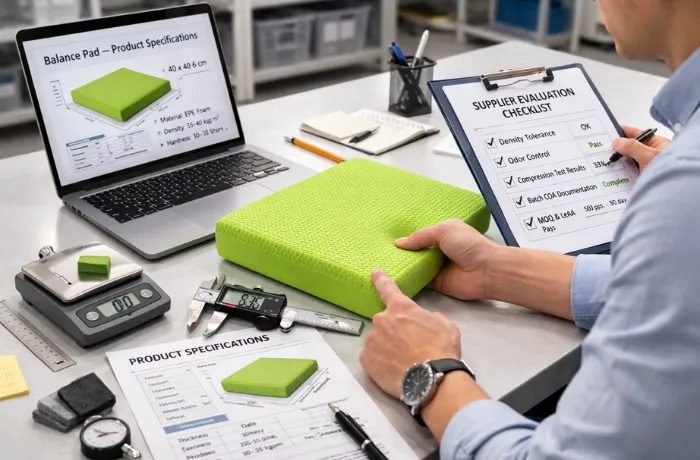
This is the trend that separates sellers who scale from sellers who keep paying for returns.
US buyers are done with “we have good quality.” They want a proof pack that shows you can ship consistent product, not just a good sample.
Minimum proof pack US buyers now expect (copy/paste module)
Use this as a ready-to-send module in your next RFQ:
- Sealed odor sample (7 days)
- Packed the way you’ll ship it (same bag/box)
- Kept sealed for 7 days
- Opened and documented (photo + short note: mild/clean vs sharp/heavy)
- Stepping/recovery demo video
- A simple, repeatable stepping pattern
- Show recovery after the step
- Record under consistent conditions so you can compare sample vs batch later
- Batch label + retention sample photo
- Batch code on carton/unit
- Photo proof of a retention sample kept per batch (your “receipt” for consistency)
- Packaging photos (sealed vs vented options)
- Show the real packaging options
- Explain which you recommend for Amazon/DTC and why
If a supplier can’t show this, the trend doesn’t matter—because you can’t validate the risk before you buy it.
Micro-summary: The new spec is proof. A promise doesn’t protect your star rating.
Trend #6: What This Means for Your 2026 US Product Line
You don’t need 12 variants. You need a small line where each SKU has a clear “return risk strategy.”
Here’s a practical 3-SKU mix that matches how US demand and review language work.
1) One stability-first SKU (studio/gym)
Positioning: stable under load; doesn’t feel shaky.
What to validate before PO:
- feel consistency across units (not just one sample)
- repeatable stepping/recovery demo before and after conditioning
2) One comfort-first SKU (home/rehab)
Positioning: cushioned but supportive; doesn’t go flat.
What to validate before PO:
- delayed feel fatigue (flattening / loss of support)
- cleanability and surface response after routine wiping
3) One retail-ready SKU (Amazon/DTC packaging + low-odor focus)
Positioning: clean unboxing; mild smell; premium feel on first step.
What to validate before PO:
- sealed odor sample protocol
- packaging that doesn’t trap odor + arrives looking premium
- batch labeling plan so you can isolate issues fast if reviews turn
Next step (practical CTA)
Send a structured RFQ with your channel (Amazon/DTC vs wholesale) and we’ll recommend the safest MOQ + proof pack for your launch and reorder rhythm.
If you’re sourcing a pad specifically for DTC packaging and retail readiness, start with the foam balance pad collection page and then build your proof pack around your target positioning.
Micro-summary: A US-ready line is not about more variants. It’s about fewer surprises—odor, flattening, and inconsistency.
FAQ
What drives balance pad demand in the USA right now?
Demand is increasingly review-driven. Amazon and DTC visibility shape what sells—and what gets returned—so “market demand” follows what reviews reward.
What trend causes the fastest returns?
Unboxing odor and early feel fatigue. If the first impression is a sharp smell, or the pad turns flat/less supportive within weeks, returns spike.
How can buyers validate trends without buying a market report?
Request proof packs: sealed odor samples, stepping recovery demos, and batch consistency evidence before placing a PO. That’s how you turn “trend talk” into a safer launch.