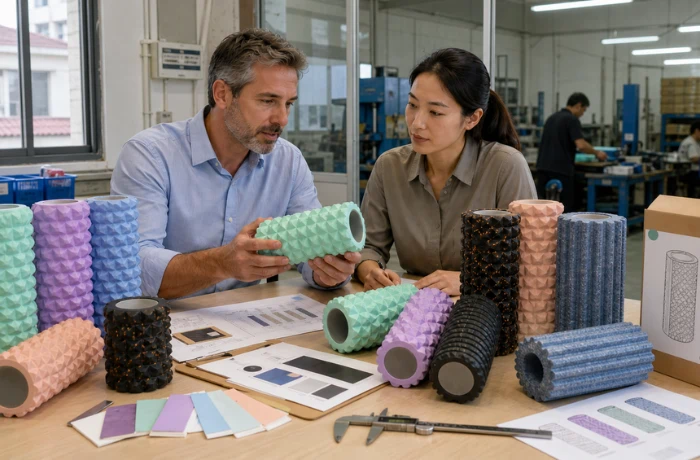
If you’re buying foam rollers as SKUs (not as a one-off personal recovery tool), the “best size” question changes fast. You’re really choosing what you can ship without surprises, what fits your channel, and what customers will not complain about.
This guide is written for B2B buyers building retail lines, wholesale assortments, or private label recovery kits—especially when you’re deciding whether mini rollers deserve a spot next to full-size rollers.
Mini vs Full-Size Foam Rollers: Quick Answer for Buyers
If you need a compact, bundle-friendly item that keeps packaging flexible and reduces shipping friction, a mini foam roller is usually the safer bet—especially for recovery kits, DTC bundles, and add-on SKUs.
If you need a core SKU with “real product” presence and better full-body support (back, glutes, hamstrings), a full-size foam roller is usually the better anchor—especially for studios/gyms, rehab-oriented lines, and premium positioning.
For the broader sizing landscape (30cm/45cm/60cm/90cm), start with our foam roller size guide.
Key Takeaway: Mini sells on convenience. Full-size sells on confidence. Your channel decides which one is “less risky.”
What Is the Main Difference Between Mini and Full-Size Foam Rollers?
In practice, the difference isn’t just length—it’s support, stability, and how much of the body the roller can realistically handle.
A shorter roller often feels more targeted and can create more concentrated pressure on a small area. A longer roller feels more stable and “forgiving,” especially for back work where alignment matters.
In bulk orders, what matters isn’t the “perfect” length—it’s what most end users will recognize as a normal roller, and what your packaging and returns process can support. That’s why, for sourcing teams, the first practical decision is usually short vs standard/full-length (then you fine-tune diameter, texture, and firmness based on your positioning).
Mini Foam Rollers: Compact, Easy to Bundle, but Limited in Support
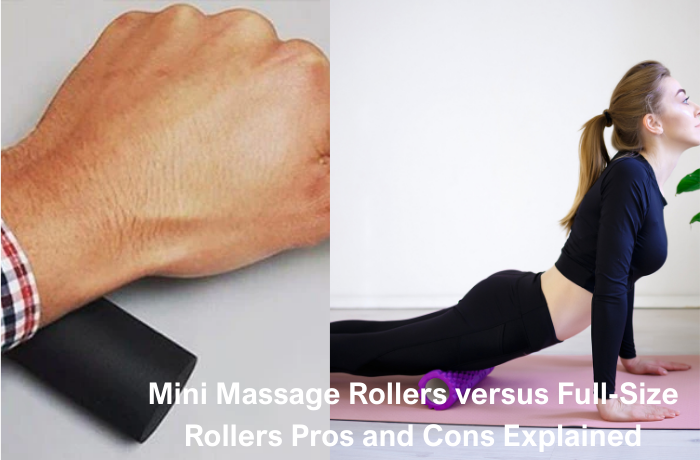
Mini/short rollers work best when the end user is doing spot work—calves, forearms, feet, or quick glute touch-ups. They can feel tight and direct in a good way.
Where they can fail is the moment a user expects “full-back foam rolling.” A mini roller can feel wobbly under the spine, and some customers read that as “this is too small” even if the product is exactly as specified.
What this means for buyers:
- Mini rollers are great as add-on SKUs and kit components, but they’re riskier as a single hero product unless your positioning is clear.
- The biggest complaint risk is expectation mismatch (“I thought it would be bigger”).
Full-Size Foam Rollers: More Support, More Presence, but Larger to Ship
Full-size rollers are easier for users to trust because they feel stable under the torso. They support longer strokes across legs and back and tend to match what people remember seeing in gyms.
The downside is simple: once carton size increases, you’re in a more fragile cost structure. That can show up as higher dimensional shipping costs, more storage space, and more edge/crush damage risk if packaging isn’t reinforced.
What this means for buyers:
- Full-size rollers work well as core SKUs and premium/professional positioning.
- Your logistics plan matters as much as the product itself.
Mini vs Full-Size Foam Roller Comparison for B2B Buyers
Use this table as a quick “channel + risk” filter before you talk price.
| Criteria | Mini foam roller | Full-size foam roller |
|---|---|---|
| Best role in product line | Add-on SKU, kit component, travel SKU | Core SKU, premium SKU, studio/gym SKU |
| End-user feel | More targeted; can feel “not enough” for full-back support | More stable/supportive; feels more “complete” |
| Packaging flexibility | High (easier to fit in multiple box styles) | Lower (carton sizing becomes a constraint) |
| Shipping cost sensitivity | Lower risk (less dimensional weight pressure) | Higher risk (dimensional weight + surcharge thresholds) |
| Retail presence | Small footprint; can feel lightweight/entry-level | Strong presence; easier to justify higher price band |
| Bundle potential | Excellent (pairs well with other recovery tools) | Moderate (bundles get bulky fast) |
| Complaint / review risk | “Too small” / expectation mismatch | “Too big to store” / shipping damage concerns |
| Best channels | Recovery kits, DTC bundles, Amazon add-ons, gift sets | Studios/gyms, rehab lines, premium retail, core assortment |
Micro-summary: Mini reduces shipping and bundling risk. Full-size reduces “is this legit?” risk.
When Should Retailers Choose Mini Foam Rollers?
Recovery Kits and Bundle Sets
Mini rollers are easiest to justify when they’re part of a recovery kit where the value is the system, not one hero item.
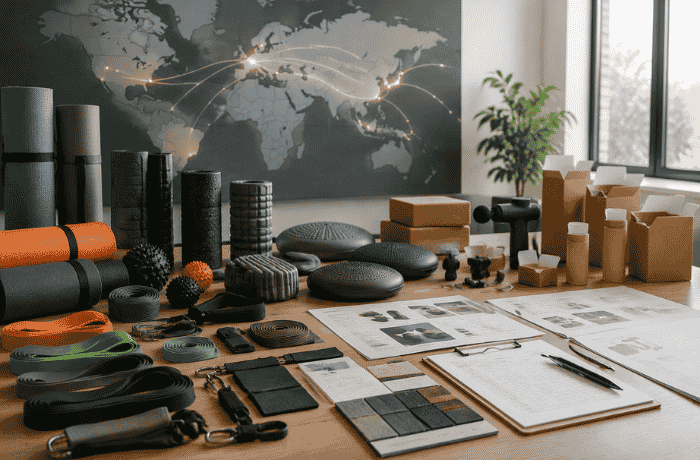
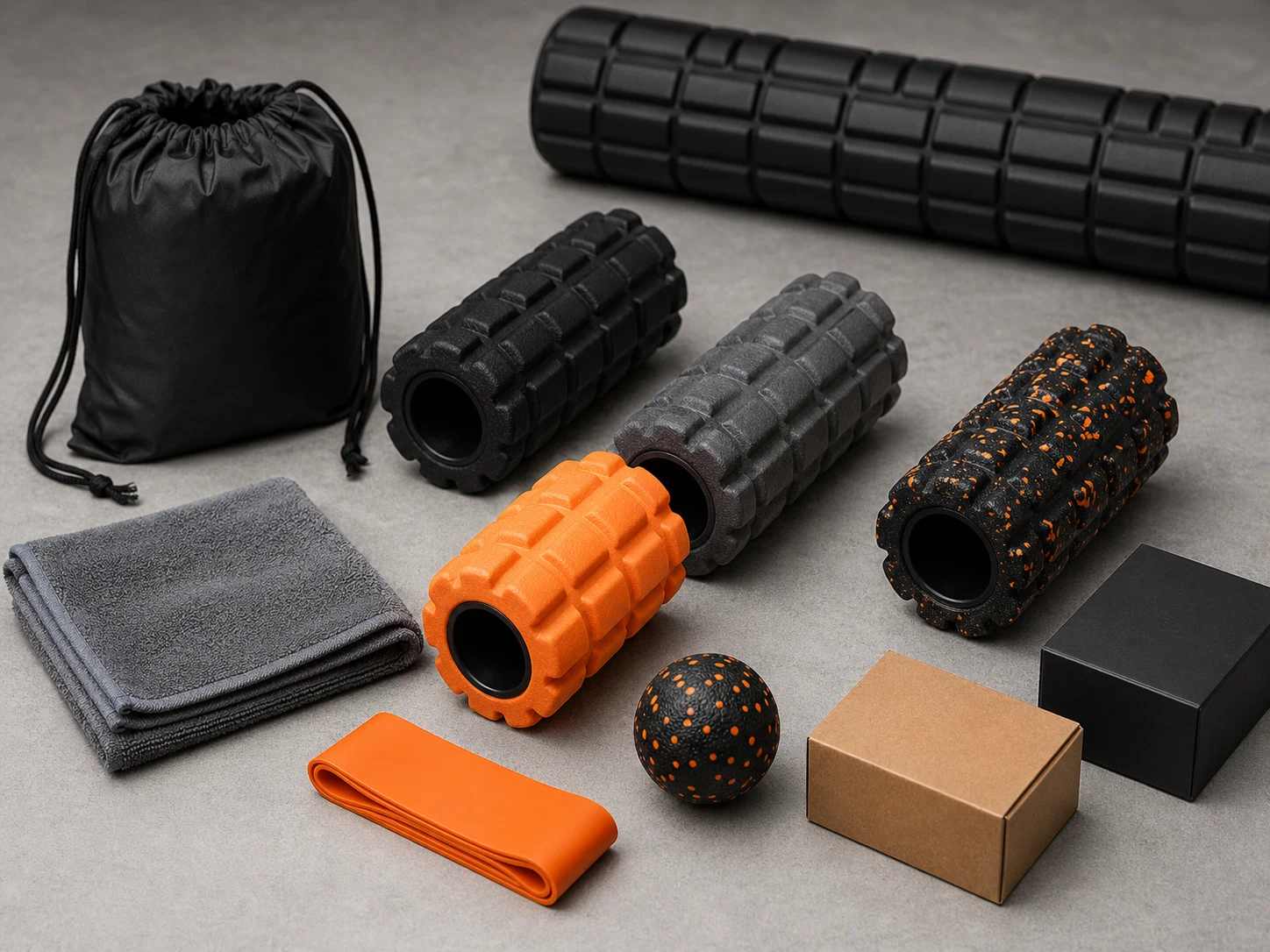
Good pairings include massage balls, resistance bands, stretch straps, and an instruction card that shows a simple routine (so the customer doesn’t feel lost on day one).
If you sell other kit components, you can also cross-sell compact accessories to increase perceived value without blowing up carton size.
E-commerce and DTC Channels
For DTC, mini rollers help you keep options open:
- You can run bundles without turning every order into an oversized parcel.
- You can test multiple variants (smooth vs textured, different densities) without overcommitting to storage.
The trade-off: you must be honest in positioning. If your product page makes it sound like a full-body solution, you’re inviting returns.
Promotional or Entry-Level Product Lines
Mini rollers can work as an entry product—especially if you frame them as targeted recovery or travel recovery, not as “everything you need.”
A common product-line mistake is over-indexing on small, cheap SKUs and then wondering why customers don’t come back. Mini rollers are strongest when they act as a bridge into your main recovery line.
When Should Buyers Choose Full-Size Foam Rollers?
Gyms, Studios, and Pilates Programs
In studios and group programs, full-size rollers feel more “standard.” They’re easier to cue in class because they support stable positions and longer body contact.
If you’re building a studio-facing assortment, full-size can signal professionalism—provided your packaging and replenishment plan is ready for the added volume.
Premium or Core SKU Positioning
If you need one SKU that represents the category on your shelf, full-size is usually the safer anchor. It looks like a complete product and supports more use cases.
Micro-summary: Full-size earns trust faster, but you pay for that trust in space, shipping, and packaging discipline.
Rehab and Mobility Product Lines
For rehab-oriented buyers, the headline is not “bigger is better.” It’s “what feels safe and controllable.”
Full-size can feel more stable for beginners. But firmness and material choices can still cause complaints (too hard, sharp pressure, smell, or surface feel). If you’re selecting materials, use the EVA vs EPP vs PE foam roller guide to align “feel” expectations with your positioning.
How Packaging and Shipping Change the Decision
In B2B, size decisions often get decided by the carton, not the catalog.
In bulk projects, full-size rollers often look light on the product sheet but become expensive in shipping because carton volume drives the real freight calculation. Before confirming a full-size SKU, buyers should check carton dimensions, units per carton, and shipping method together—not separately.
In bulk orders, a practical starting point is to right-size cartons and avoid excess void space—because foam rollers are light, but they can become expensive the moment the box gets bulky.
For sourcing teams, longer cartons also increase the odds of hitting oversized handling and surcharge thresholds. Before approving the SKU, it’s worth checking your carrier rules (especially length + girth) and modeling the landed cost with the actual master carton dimensions—not just product weight.
Buyer-oriented packaging implications:
- Mini rollers let you use more packaging formats (poly bag + shipper, sleeve + shipper, compact kit box).
- Full-size rollers often require more protective structure to prevent corner/edge damage in transit.
- If your channel is retail, you may need a display-friendly box and a shipping-friendly outer carton—two packaging problems, not one.
⚠️ Warning: Most “bad reviews about size” are actually bad reviews about expectations and bad packaging execution. Fix both.
Private Label Considerations: MOQ, Logo, Color, and Packaging
Private label questions are usually where size selection stops being theoretical.
In general, your MOQ pressure comes from what you customize:
- Custom color (especially if you require exact Pantone matching)
- Logo method (printing vs debossing/embossing, placement, durability expectations)
- Retail packaging (custom sleeve vs custom color box vs kit box)
- Multiple SKUs at once (mini + full-size + variants)
How size changes private label risk:
- Mini rollers are easier to prototype into kits, but they can be more sensitive to “value perception.” Packaging and instruction inserts matter.
- Full-size rollers feel more premium by default, but packaging costs and shipping damage risk are harder to hide.
Sample approval is where buyers protect themselves. For either size, align on:
- final size tolerance (what variance is acceptable)
- density/firmness expectation (how it should feel under body weight)
- packaging drop-test expectations for your channel
- label and warning language (especially for retail)
Micro-summary: Customization is not the risk. Misaligned expectations are.
How to Build a Product Line with Both Mini and Full-Size Rollers
Carrying both sizes can be smart—if each size has a clear job.
Starter line (lowest SKU complexity)
- Start with one “mainstream” size (often the middle size buyers expect) and add a mini later as an accessory.
E-commerce line (bundle-first)
- Mini as the kit component + one full-size as the core upsell.
Gym/studio line (professional signaling)
- Full-size as the default + mini for spot work (calves/forearms) or travel packs.
Recovery kit line (giftable and shippable)
- Mini as the anchor + other compact tools; avoid turning the kit into a dimensional-weight penalty.
The goal is not more SKUs. The goal is fewer “wrong orders.”
Supplier Note: How We Evaluate Mini vs Full-Size Foam Roller Projects
When buyers ask us, “Should this project start with a mini roller, a full-size roller, or both?” we usually confirm three points first. Getting these right reduces returns, packaging surprises, and the classic “this isn’t what I expected” complaint.
- Channel + use case: Where will the first 100 orders be used—DTC bundles, retail shelf, studios, or rehab? Mini rollers win when portability and bundling matter. Full-size wins when full-back support and stability are non-negotiable.
- Packaging + shipping model: Are you shipping single units by parcel, building kits, or moving cartons via LTL? Mini sizes tolerate more box formats and lower dimensional-weight risk. Full-size needs more protection and carton discipline.
- Value perception + positioning: What’s your price band and what will the customer think they’re buying? If you sell mini, we recommend labeling it clearly as targeted recovery / travel-friendly. If you sell full-size, set expectations on storage and firmness.
If you can share these three details, we can usually recommend a starting size (and packaging approach) quickly—then move to samples and firmness/material alignment.
Common Sourcing Mistakes When Choosing Mini or Full-Size Foam Rollers
Even experienced buyers run into avoidable issues with foam roller sizing because the problems usually show up after you’ve listed the product—through returns, reviews, and landed-cost surprises. Here are the most common mistakes we see in bulk projects:
- Treating mini rollers as full-body tools: If the listing or packaging implies “full-back rolling,” you’re setting up an expectation mismatch. Mini is strongest when it’s positioned as targeted or travel-friendly.
- Ignoring carton dimensions for full-size rollers: Full-size units can be light but still expensive to ship. If you don’t validate master carton dimensions early, dimensional-weight charges can wipe out margin.
- Approving product samples without packaging samples: The product can pass, but the packaging fails (crushed edges, scuffs, barcode placement issues). Approve the product and the retail pack/shipper together.
- Splitting MOQ across too many SKUs: Too many sizes/textures/colors at once increases inconsistency risk and makes it harder to hit stable pricing. Start with fewer “must-win” SKUs, then expand.
- Using product photos that hide the real size: Cropped lifestyle shots look great, but they can trigger “smaller than expected” complaints. Include at least one clear scale reference (human leg/back, gym bag, or dimension callouts).
If you avoid these five mistakes, your sizing choice (mini vs full-size) becomes a much simpler, lower-risk procurement decision.
Procurement Checklist Before Ordering
Use this checklist before RFQs and sampling so you don’t discover the real problems after you’ve placed a PO—especially for a bulk foam roller order where carton dimensions, packaging, and SKU count drive most of the risk.
- Channel fit: Where will this SKU sell first—DTC, retail shelf, distributor, studio?
- Role in your line: Core SKU or add-on/bundle component?
- End-user expectation: Are you clearly describing what the size can and can’t do?
- Packaging decision: Sleeve, poly bag + shipper, color box, kit box—what’s required for your channel?
- Shipping model: Parcel vs LTL; any oversized thresholds you’re likely to hit?
- Damage control: What protection is needed to prevent crushed edges or scuffed surfaces?
- Material/feel: Confirm density/firmness expectations and odor sensitivity for your audience.
- Private label scope: Logo method, colors, packaging artwork—what’s truly required vs “nice to have”?
- MOQ and risk: What’s your minimum viable order that still protects consistency and landed cost?
- Sample sign-off: Approve product + packaging together, not separately.
FAQ
Is a mini foam roller good for wholesale and private label orders?
Yes. A mini foam roller wholesale program works well when buyers position it as targeted recovery or a travel accessory, and when the retail packaging makes the size clear. For mini foam roller private label projects, we recommend confirming packaging format, firmness, and how it fits into a kit or bundle before you split MOQ into multiple variants.
Can you support custom mini foam roller projects?
Yes—custom mini foam roller projects typically start with confirming your target use case (spot work vs travel), preferred surface (smooth vs textured), and the packaging format you need for your channel. Once those are clear, sampling and artwork approval move faster and review risk drops.
What’s the best way to source a foam roller recovery kit supplier?
If you’re building a kit, treat it as a system: confirm the roller size first, then finalize the other components and packaging together. A good foam roller recovery kit supplier will help you validate carton efficiency, protection, and how the kit will be photographed so buyers don’t misread the size.
Are mini foam rollers suitable for private label recovery kits?
Yes—mini rollers are often a strong fit for private label kits because they’re compact and easy to bundle. The main risk is perceived value: avoid positioning a mini roller as a full-body solution, and use packaging/inserts to set expectations.
Should retailers stock mini or full-size foam rollers first?
If you need one SKU to represent the category on-shelf, start with a full-size (or mainstream) roller because it feels more “complete” to most shoppers. If your retail strategy leans heavily on giftable bundles or tight shelf space, start with mini as an add-on or kit item.
Do mini and full-size foam rollers require different packaging or MOQ?
Packaging needs usually diverge more than MOQ. Full-size rollers tend to require larger cartons and more protection to reduce transit damage and dimensional-weight surprises. MOQ depends on what you customize (color, logo method, retail packaging) rather than size alone.
Next step: request a quote with the right details
Before requesting a quote for a private label recovery kit or a retail bundle, share:
- Target channel (DTC, retail, studio/gym, distributor)
- Product role (core SKU, add-on, kit component)
- Preferred size range (mini, full-size, or mixed)
- Material and firmness (EVA/EPP/PE, smooth vs textured, target feel)
- Packaging format (poly bag + shipper, sleeve, color box, kit box—especially if you’re building a foam roller bundle for retail)
- Customization needs (color, logo method, artwork/labels)
- Estimated order quantity (and any MOQ constraints)
We’ll help you sanity-check whether a mini roller, full-size roller, or mixed SKU plan fits your recovery product line—then align samples, carton efficiency, and packaging protection before you place a PO.
When you’re ready, contact WellfitSource with your project details.