If you’re searching for top US balance pad manufacturers, you’re usually trying to do one of three things:
- Qualify a US-made or US-supplied option (government procurement, faster replenishment, or brand narrative).
- Stop living through tight replenishment windows where one late PO turns your week into a spreadsheet of panic.
- Protect yourself from the stuff that doesn’t show up in a sample: sharp smell at unboxing, a pad that feels flat after a few weeks, and the return/review spiral that makes margins feel… heavy.
This guide won’t give you a fake “Top 10” ranking. Instead, it shows how experienced buyers define “top” as lowest risk for their channel—and how to verify who can actually deliver consistent reorders.
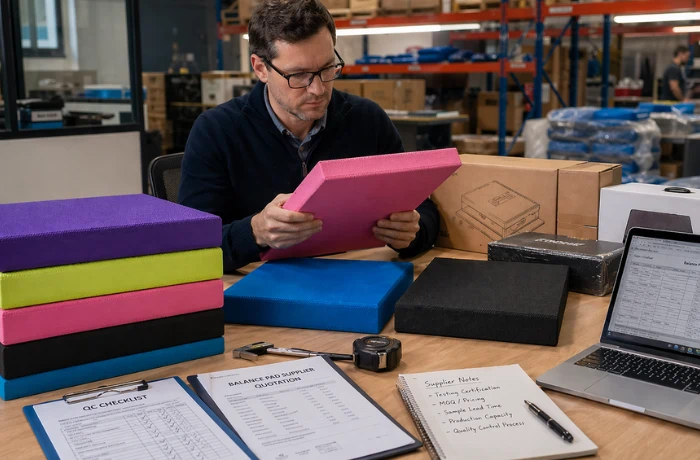
If you also want a reference point for product specs and private-label options (without confusing “brand” with “factory”), start with our foam balance pad collection page.
1) What “Top Manufacturer” Means in the US (It Depends on Your Channel)
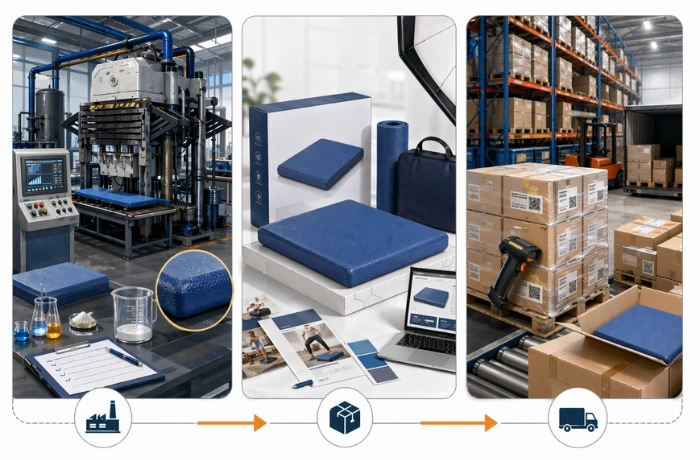
A supplier can be “top” in one channel and a liability in another. The difference is rarely the first shipment—it’s the reorder.
For Amazon / DTC sellers
Your real KPI isn’t “unit cost.” It’s return reasons and review language.
The three patterns that quietly wreck listings:
- Odor complaints (“chemical smell,” “sharp smell,” “arrived stinky”) → immediate returns.
- Feel drift after repeated use (“lost firmness,” “feels flat,” “doesn’t rebound”) → slow-burn negative reviews.
- Batch inconsistency (same SKU, different feel) → customers think you bait-and-switched.
If you sell on review-driven channels, the best manufacturer is the one who can prove they can repeat the same feel across runs—not the one with the prettiest brochure.
For wholesalers, distributors, and institutional procurement
You’re buying stability:
- predictable lead times
- packout consistency (same cartons, labels, units-per-case)
- fewer surprises during replenishment
- traceability when something goes wrong
Your biggest fear isn’t a single defect. It’s a reorder where the new batch feels slightly different—enough that your downstream customers start questioning every shipment.
For “Made in USA” requirements
If you truly need “Made in USA,” treat it like a substantiated origin claim, not a marketing badge.
The U.S. Federal Trade Commission explains that an unqualified claim generally means the product is “all or virtually all” made in the U.S. (with only negligible foreign content). If “Made in USA” is a requirement for you, ask suppliers to show how they substantiate the claim (origin documentation, material sourcing, and a clear definition of what they mean by the claim).
Micro-summary: “Top” doesn’t mean biggest. It means lowest channel risk—especially on reorders.
2) The US Supply Landscape: Manufacturer vs Brand vs Distributor
Most “top manufacturers” lists fail because they don’t separate these three roles. But as a buyer, you need to know what you’re actually buying.
Many “top” names are brands, not factories
In balance pads, it’s common for:
- Brands to own the product story, warranty language, and channel strategy.
- Factories to control foam formulation, curing, process controls, and batch-to-batch consistency.
- Distributors to control availability, short lead times, and reorder convenience.
A “top brand” can still be a poor fit if:
- they can’t support your packaging/labeling requirements,
- they won’t share batch-level traceability,
- or they treat you like a small side account (slow response when you’re already feeling tight on inventory).
What to ask to confirm who actually manufactures
Use these questions early. They’re simple, but they flush out ambiguity fast:
- Where is this product produced? (Ask for facility location, not “we’re US-based.”)
- Who owns the tooling, foam formulation, and process spec?
- What’s your batch traceability?
- lot code format
- how long you retain production records
- How do you keep reorders consistent?
- Do you keep retention samples?
- Is there any change-control process for material or process shifts?
- What happens when there’s an issue?
- response time
- replacement policy
- how root-cause is documented
If a supplier can’t answer these clearly, they may still be a fine reseller—but they’re not who you lean on for long-term consistency.
Micro-summary: The fastest way to avoid a shaky shortlist is to separate who sells from who controls the process.
3) How to Build a Shortlist (A Buyer Checklist)
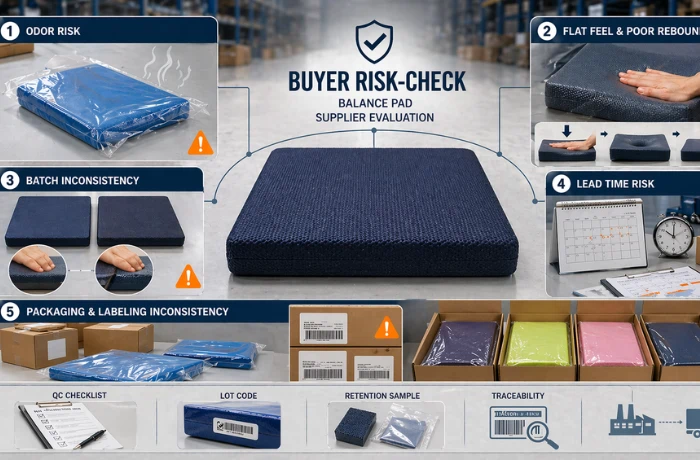
Below is a checklist you can copy into an email or RFQ. It’s designed around the failure modes buyers actually complain about: odor, “feels flat,” and reorder drift.
A) Lead time realism (and why “fast” can be fake)
Ask:
- What is the standard lead time for first PO vs reorder?
- What is the realistic lead time during peak season?
- What’s the supplier’s definition of “in stock”? (Raw material only? Finished goods? Packaged-ready?)
If you’re building a US-supplied narrative, “fast” matters—but “fast sometimes” creates the tight, anxious weeks you’re trying to avoid.
B) Batch consistency controls (reorder stability)
Ask for proof of a repeatable system:
- retention samples (kept per lot)
- measurable spec checks tied to lot codes
- documented handling of nonconformities
For buyers running institutional programs, this is where after-sales becomes real: you need a supplier who can trace, explain, and correct.
C) Odor control workflow (screen it before it ships)
Odor issues aren’t just annoying—they create immediate returns.
Screening questions:
- Is the foam designed to resist moisture absorption (e.g., closed-cell style construction)?
- How is the product packaged right after production?
- Can you perform a sealed-sample check and approve that before mass packout?
Many rehab-grade balance pads are marketed as closed-cell foam for moisture resistance and easier hygiene. Treat claims like these as a starting point—then verify your supplier’s actual materials and process controls (including how the foam is cured, aired out, and packaged) before you commit to a larger PO.
If your brand uses logo printing, odor isn’t your only sensory risk. Print inks and surface prep can also create complaints if durability or cure isn’t controlled. Use this logo printing durability guide to screen suppliers with the right tests.
D) “Feels flat” over time (material and recovery)
Most balance pads feel fine in a quick squeeze test. The difference shows up after repeated compression.
You don’t need a lab report to start screening; you need consistent language and a spec conversation:
- What material family is it (e.g., EVA-based foam vs TPE-based approaches)?
- What does the supplier consider a “pass” for rebound / recovery?
- What changes between sample and production lots?
If you want a practical comparison of trade-offs buyers see in retail returns (odor risk, feel stability, and long-term recovery), use this TPE vs EVA balance pad guide.
E) MOQ flexibility (test vs scale)
MOQ isn’t just a negotiation point—it’s a risk-control tool.
- Pilot order: validate odor + feel + packaging with real customers.
- Scale order: lock specs and change-control.
Use this MOQ guide for custom balance pads to structure a test-to-scale plan that doesn’t trap you in heavy inventory.
F) Packaging, labeling, and packout capability
For distributors and institutional buyers, packout drift creates downstream chaos.
Ask:
- can cartons, labels, inserts, and barcodes be standardized?
- do they photograph packout per lot?
- can they support multi-pack or kit configurations?
G) Warranty/returns handling (after-sales responsiveness)
You’re not buying a pad. You’re buying how problems get handled.
A simple way to qualify maturity:
- Who is your escalation contact?
- What’s the typical response time?
- How do you document root-cause and corrective actions?
If you want a factory-side checklist (what to verify on site or via video audit), use this balance pad factory audit checklist.
Micro-summary: A shortlist is a risk model. Screen for odor, “flat feel,” and reorder drift—not just quote price.
4) “Top” US Options: How to Categorize and Compare (No Fake Rankings)
Shortlist starter list (US): where buyers usually source
These are common sourcing routes—not endorsements. Use them as a starting point for building a shortlist, then use the checklist in Section 3 to validate who actually controls production.
- Domestic manufacturers (Category A): Companies that produce balance pads in the US and can support substantiated origin needs.
- US brands with domestic or nearshore partners (Category B): Brands that sell in the US and manage specs/support, while production may be domestic or nearshore.
- US distributors and private label programs (Category C): US-based inventory programs optimized for fast replenishment and smaller reorders, often with more standardized SKUs.
Instead of ranking brands, categorize your options by what they actually control.
Category A: US-based manufacturers with domestic production
Best for: buyers with strict origin requirements, rapid replenishment needs, or government/institutional procurement.
Typical strengths:
- shorter logistics chain
- clearer local support
- easier site visits
Typical constraints:
- higher unit costs
- fewer customization options
- tighter MOQs or limited capacity during peak cycles
What to verify:
- manufacturing location (facility details)
- lot traceability and record retention
- reorder consistency controls
Category B: US brands using domestic or nearshore partners
Best for: buyers who value a known product story and established specs, and want a US-facing support layer.
Typical strengths:
- mature product documentation
- stable channel packaging
- consistent customer service processes
Typical constraints:
- less transparency into the actual factory
- limited flexibility on private label packaging
- longer lead times if production is not truly domestic
What to verify:
- where the product is produced vs where it ships from
- how the brand enforces batch consistency with their manufacturing partner
Category C: US distributors and private label programs
Best for: buyers who prioritize speed and availability (especially for replenishment) and can accept standard SKUs.
Typical strengths:
- fast shipment from US stock
- easier small reorders
- fewer import/logistics tasks on your side
Typical constraints:
- less control over material/process specs
- harder to investigate batch drift root-cause
- private label options may be limited or templated
What to verify:
- whether lot codes are preserved through distribution
- how substitutions are handled when stock runs tight
Micro-summary: “Top US balance pad manufacturers” aren’t a single list. They’re categories—pick the one that matches your origin needs and your reorder risk.
5) When a China OEM Makes Sense (Without Fighting the US Intent)
If your goal is US supply stability, a China OEM isn’t a replacement. It’s a common second leg—especially when you’re scaling and don’t want every peak season to feel tight.
Many buyers use a dual-sourcing model: US supply for speed, and a China OEM for scale and customization.
Use case 1: Dual-sourcing for replenishment stability
A practical model for many buyers:
- Primary: US-based supply for speed and “US-supplied” continuity.
- Secondary: China OEM for scale, customization, and cost control.
This reduces the “either/or” stress:
- US supply keeps you from going out of stock.
- OEM scale keeps inventory from feeling heavy and cash from getting trapped.
Use case 2: Private label customization and packaging flexibility
When you need:
- custom colors
- logo methods and durability control
- bundles/kits with consistent packout
…an OEM program often gives you more levers to control how the product shows up in customer hands.
Use case 3: MOQ strategy for testing vs scaling
The cleanest way to avoid supplier lock-in is to structure your program:
- small pilot PO for real-market validation
- then scale with locked specs, change-control expectations, and retention samples
For buyers building a dual-sourcing plan, WellfitSource can support private-label foam balance pad programs as a China-based OEM/ODM backup line. Start here: WellfitSource foam balance pad.
FAQ
1) Are the “top” US balance pad manufacturers always the best choice?
Not always. The best choice depends on your channel, MOQ needs, and how tightly you must control odor, feel stability, and batch consistency.
2) How can I verify if a company is a manufacturer or just a brand?
Ask where production happens, request batch traceability details, and confirm whether they can provide retention samples and consistent replenishment runs.
3) When should buyers consider a China OEM like WellfitSource?
When you need private label customization, better cost at scale, or a backup supply line to protect replenishment speed—especially for review-driven channels.
Next step: get a US + China dual-sourcing plan (built for your channel)
Tell us three things and we’ll suggest a shortlist + backup plan that reduces stockouts and return risk:
- Channel: Amazon/DTC or wholesale/distribution?
- Lead time target: What is your realistic replenishment window (weeks)?
- Made in USA: Is it a requirement, a preference, or not needed?
We’ll reply with a recommended sourcing split (US-supplied for speed + China OEM for scale/customization), plus what proof to request before each PO.