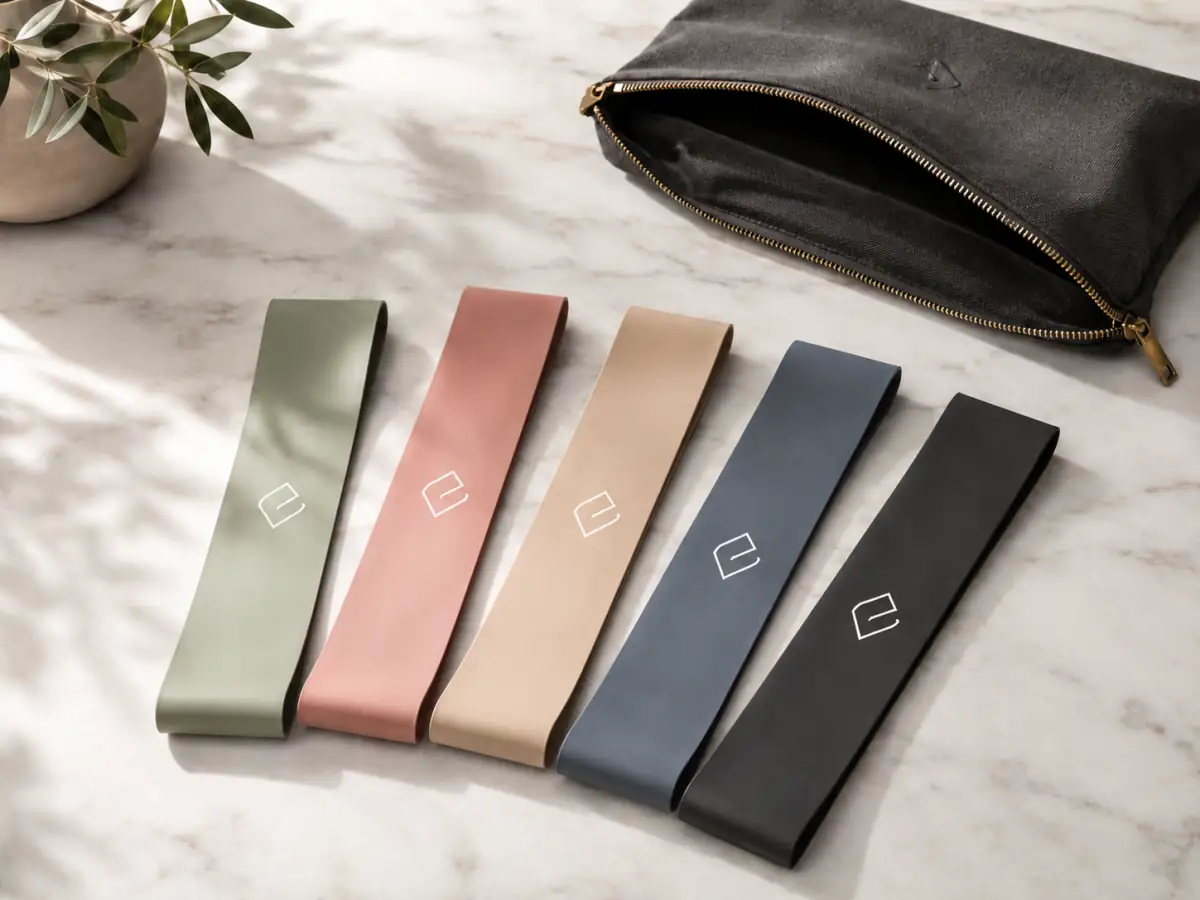
The listing goes live on a Tuesday. By Thursday, it is suppressed. The reason in Seller Central reads: “This item may be subject to dangerous goods regulations.” The product is a set of five TPE resistance bands in a zip pouch. Nothing about it is dangerous. But the word “latex” appeared in a backend keyword — added because the algorithm rewards it — and Amazon’s automated compliance review flagged it.
Getting the listing reinstated takes a test report, a GHS safety data sheet, and three weeks of back-and-forth with Amazon Seller Support. The inventory has been sitting in a fulfillment center since it arrived.
This is the failure mode that catches first-time resistance band sellers on Amazon. The product is fine. The sourcing is fine. The compliance gap is in how the product was described, classified, and documented at listing creation — before a single unit sold.
This guide covers the Amazon-specific decisions that determine whether a resistance band listing launches cleanly or spends its first month in compliance review.
Quick Summary
- Resistance bands are classified under Sports & Outdoors on Amazon — typically as Exercise Bands or Resistance Bands — and their fee tier is determined by product dimensions and weight, not category alone. A mis-classified ASIN can sit in the wrong fee tier for its entire lifetime.
- Natural latex resistance bands trigger Amazon’s dangerous goods review if the product listing or backend keywords include “latex.” Clearing the review requires a GHS safety data sheet and, often, a third-party chemical test report. TPE bands avoid this pathway entirely.
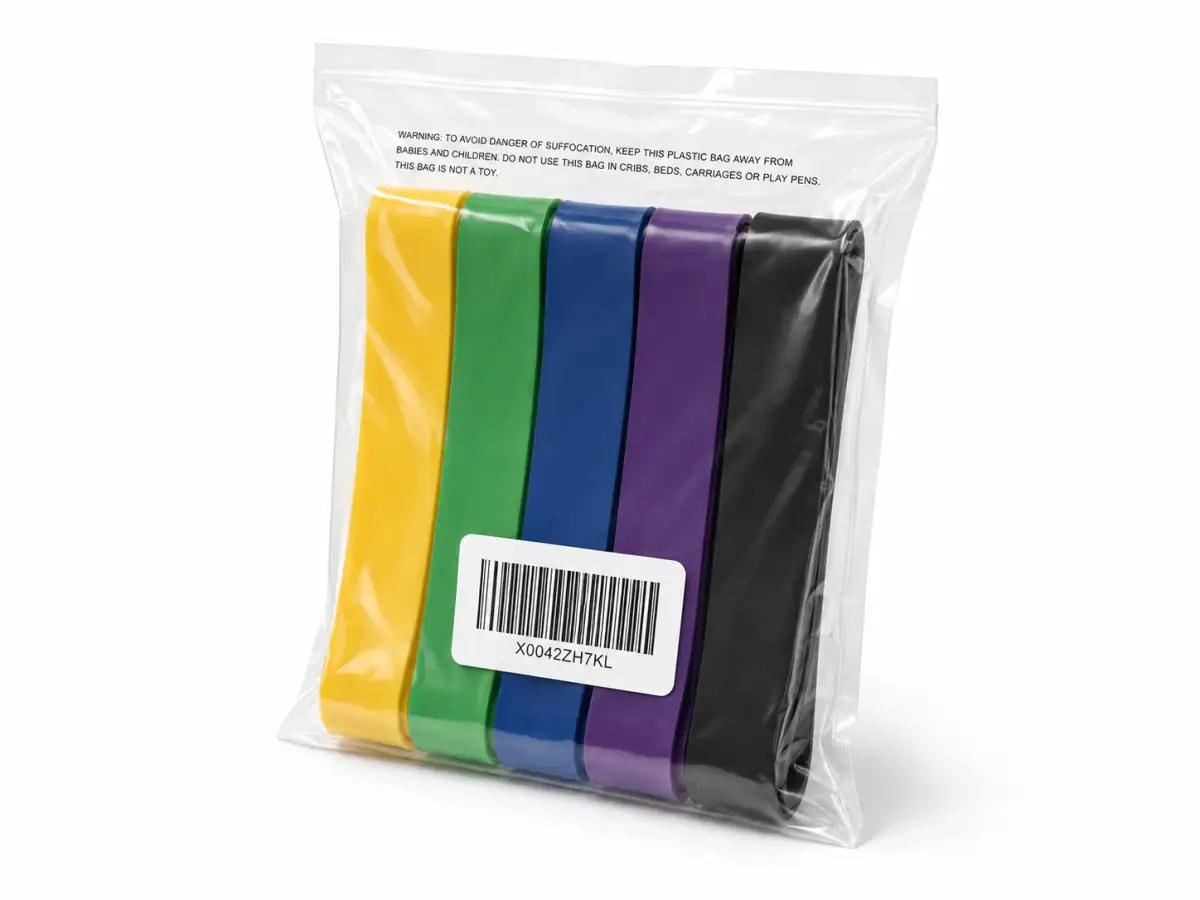
- FBA packaging for resistance bands must meet Amazon’s poly bag requirements: suffocation warning if the bag opening exceeds 5 inches, FNSKU barcode scannable through the packaging, and the product sufficiently contained that individual bands don’t tangle or migrate during fulfillment center handling.
- Brand Registry (requiring a registered trademark) is the primary protection against listing hijackers on a private label ASIN. Without it, a competing seller can add themselves to your listing and undercut your price with an inferior product.
- The most common return reason for resistance bands on Amazon is resistance level mismatch — the customer expected “medium” to feel different from what arrived. Listing copy that sets accurate expectations by describing the resistance range in pounds or kilograms, not just color names, reduces return rates measurably.
Product Classification: Getting the ASIN Right from the Start
Amazon’s product classification determines the fee structure, the browse node where the product appears, and the compliance requirements that apply. Resistance bands are not a single classification — the right category depends on the product format.
Exercise Bands / Resistance Bands (flat loop or flat strip): The correct category for standard flat TPE or latex loop bands and flat resistance strips. Browse path: Sports & Outdoors → Exercise & Fitness → Strength Training Equipment → Resistance Bands. FBA fulfillment fees are calculated by actual weight and dimensional weight — a 5-band set in a zip pouch typically falls in the Small Standard or Large Standard size tier depending on the pouch dimensions.
Resistance Tubes (cylindrical with handles): A separate classification from flat bands. If your product has plastic or rubber handle grips, it classifies differently from a loop band — confirm the correct browse node before listing. Misclassifying a tube product in the flat band node creates a category mismatch that can generate customer service issues and A9 algorithm disadvantages.
Fitness Accessory Bundles: If you are selling a set that includes both bands and other accessories (foam roller, carrying bag, exercise guide), the listing classification may shift to a bundle category with different requirements. Amazon requires that bundles be packaged as a single unit and labeled as a “bundle” on the outer packaging — items cannot be individually priced within the bundle ASIN.
Dimensional Weight vs Actual Weight
Resistance bands are light products that can be bulky in packaging. Amazon charges FBA fees based on the greater of actual weight and dimensional weight (L × W × H ÷ 139 for standard size). A 5-band set in a rigid gift box with dimensions 25cm × 18cm × 6cm calculates to a dimensional weight that may exceed its actual weight — shifting the product into a higher fee tier.
Check dimensional weight before finalizing packaging dimensions. A pouch that is 2cm shorter may save $0.25–$0.40 per unit in fulfillment fees — meaningful at scale. Conversely, packaging that is unnecessarily large because the buyer didn’t calculate dimensional weight is a cost that repeats on every single unit sold.
FBA Packaging Requirements: What Must Be True Before Goods Ship
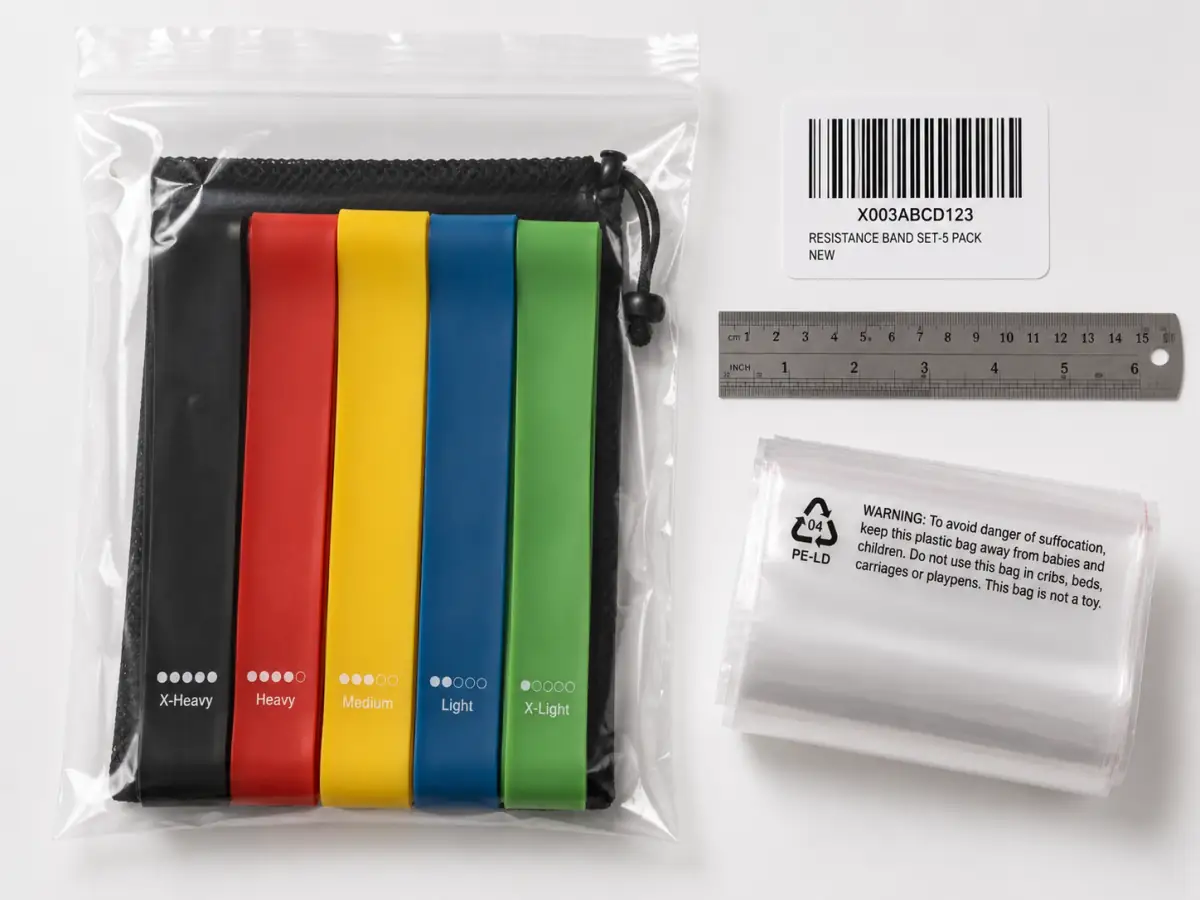
Amazon’s FBA packaging requirements for resistance bands have specific details that are not obvious from the general seller guidelines.
Poly Bag Requirements
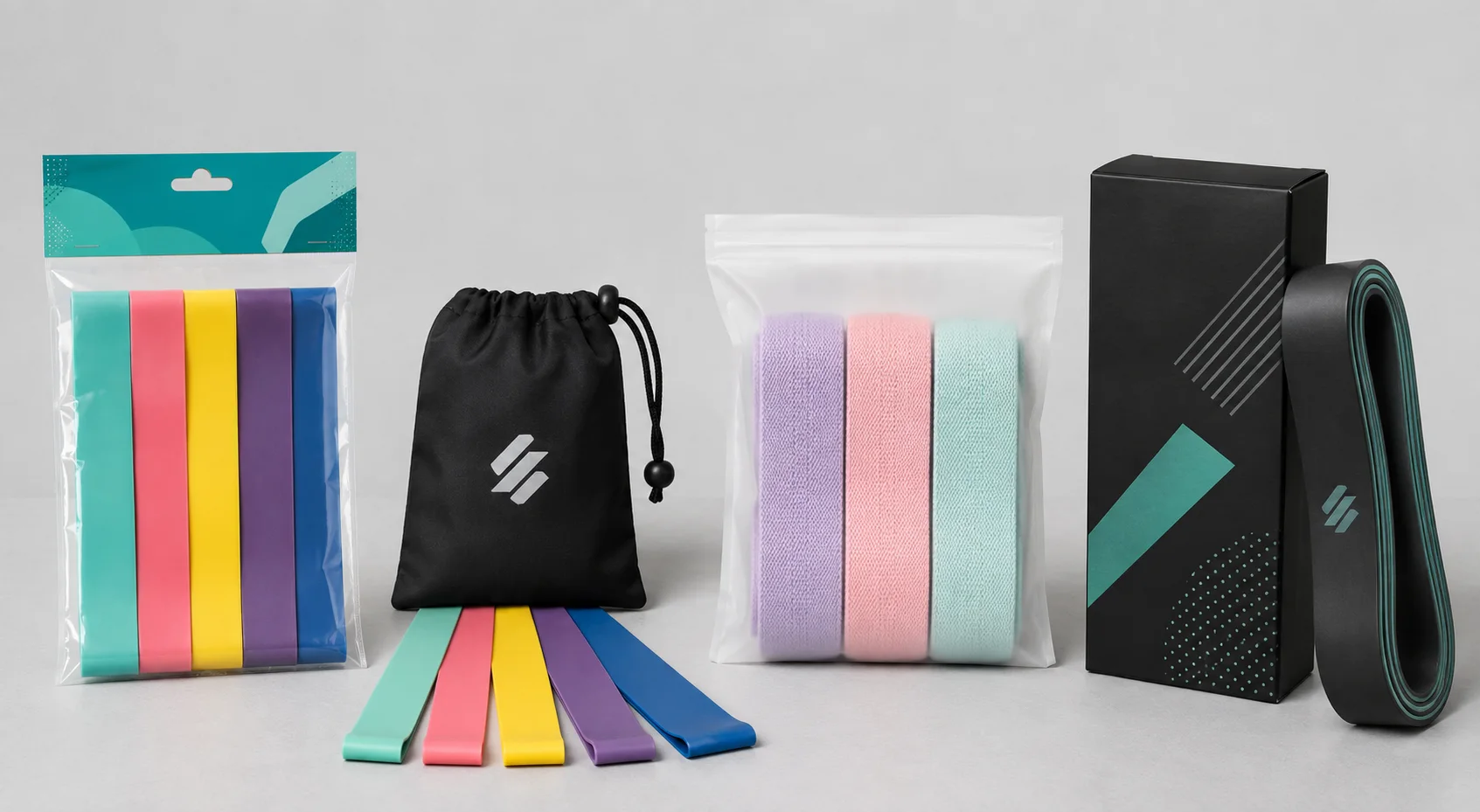
If your resistance band set ships in a poly bag (OPP bag, PE bag, or similar clear packaging), the bag must:
- Be transparent (Amazon staff must be able to identify the product without opening it)
- Have a suffocation warning if the bag’s opening exceeds 5 inches (12.7cm) — the warning must be printed on the bag itself, in a font size proportional to the bag size per Amazon’s guidelines (minimum 10-point font for bags under 500cm², larger for bigger bags)
- Be sealed — not just folded. A heat seal, adhesive seal, or zip-lock closure counts; a simple fold-over does not
- Have the FNSKU barcode applied in a location where it can be scanned without opening the packaging
The suffocation warning is the most commonly missed requirement for first-time FBA sellers of resistance band sets. A poly bag with a 20cm × 15cm opening is over the 5-inch threshold. Many factories produce the bags without this warning unless explicitly specified. Include the suffocation warning in your packaging specification document and confirm it appears on the pre-production packaging sample before approving production.
Boxed Sets (Rigid Packaging)
If your resistance band set ships in a rigid gift box:
- The box must be able to withstand a 3-foot drop test without opening (Amazon tests this during receiving)
- All contents must be secured inside so they don’t rattle or migrate (tissue paper, a fitted insert tray, or a rubber band securing the bands to the insert card)
- The outer box must have only one barcode visible: the FNSKU. If the manufacturer’s own barcode appears on the box, it must be obscured with an opaque FNSKU label before sending to FBA
FNSKU Barcode Placement
The FNSKU (Fulfillment Network SKU) is the Amazon-specific barcode that links the physical product to your ASIN. It must:
- Be applied before goods arrive at the fulfillment center (either by the factory or by a prep center)
- Be scannable without unpackaging the product
- Not be placed behind a colored background, foil surface, or overlapping another barcode
- Be at least 1 inch × 0.5 inch in size
The simplest approach: have the factory apply FNSKU labels at the factory (requires sending the FNSKUs to the factory before production completion), or use an Amazon-approved prep center to label goods after arrival in the US. Factory labeling is less expensive; prep center labeling is more flexible and avoids reprinting if the FNSKU needs to change.
Product Set Labeling
If your product is sold as a set (5 bands in one ASIN), the outer packaging must be labeled as a “set” or “bundle” — either printed directly on the packaging or on a label applied before FBA shipment. Individual items within the set should not have separate barcodes visible from the outside, as this creates confusion during FBA receiving and can cause individual items to be received as separate units.
Latex and Chemical Compliance: Navigating Amazon’s Dangerous Goods Review
Amazon’s dangerous goods (hazmat) program applies to products that may be subject to transportation regulations due to their chemical composition. Most resistance bands are not genuinely dangerous — but Amazon’s automated screening catches products that resemble dangerous goods based on listing content, keywords, and product type.
Natural Latex: The Flag That Triggers Review
Any listing or backend keyword that includes the word “latex” may trigger an automated dangerous goods review. Amazon’s system is conservative — it would rather review a set of harmless rubber exercise bands than miss a genuinely hazardous product.
To clear a latex-triggered dangerous goods review, Amazon typically requests:
- SDS (Safety Data Sheet) / GHS Sheet: A document formatted to Globally Harmonized System (GHS) standards identifying the product’s composition, allergen information, and safety data. Your factory can provide this — it should be a standard document in their compliance library for any latex product they produce for international markets.
- Third-party chemical test report: For many latex product reviews, Amazon also requests a test report from an accredited laboratory confirming the product meets applicable chemical safety standards (CA65, REACH, or ASTM-equivalent). This report typically takes 2–3 weeks and costs $300–$600 from accredited labs.
- Exemption confirmation: If the product is exempt from transportation dangerous goods regulations (most exercise resistance bands are), the SDS should explicitly state the exemption basis. A document that merely describes the product’s composition without addressing the dangerous goods classification question will not clear the review.
The practical implication for listing strategy: If your product is made from TPE (not latex), do not include “latex” or “latex-free” in your backend keywords. The “latex-free” claim is meant to reassure buyers but often triggers the same automated review as “latex” itself. Let the product type speak for itself; buyers who need latex-free will filter by material in the product details.
CA65 for California Sales
If your product will be sold to California customers through Amazon — and unless you restrict your listing to non-California ship-to addresses (which limits your market significantly), it will be — CA65 compliance applies. Products above the CA65 thresholds for listed chemicals require a warning on the product or its packaging:
“WARNING: This product can expose you to chemicals including [X], which is known to the State of California to cause [cancer / birth defects / reproductive harm]. For more information, go to www.P65Warnings.ca.gov.”
For most TPE resistance bands using standard compound formulations, CA65 compliance testing returns a clean result — no warning required. For products with surface coatings, adhesives, or colorants outside standard compound formulations, the result may differ.
Having a CA65 test report from an accredited laboratory before listing — not after you receive a compliance complaint — is the right sequence. The cost ($200–$400 for a resistance band-specific panel) is fixed; the cost of a compliance complaint or retailer action is not.
For the complete compliance framework covering REACH (EU), EN 13568, and CA65 together, the resistance band compliance guide covers all three in detail.
Listing Setup: The Three Elements That Determine Performance
Title Structure
Amazon’s A9 algorithm weights the product title heavily. The title must: – Lead with the most specific product category term: “Resistance Bands” or “Exercise Bands” – Include the primary differentiator: material (if relevant), set composition, resistance range – Stay under 200 characters (Amazon displays approximately 100–120 in search results before truncating) – Not include promotional language (“best,” “top,” “#1”) — Amazon will suppress listings with prohibited terms
A clean, algorithm-friendly title structure for a 5-band set:
Resistance Bands Set — 5 TPE Exercise Bands for Women and Men, Light to Extra Heavy, with Carry Bag, for Yoga, Pilates, Physical Therapy
This title covers: product type, material, composition, gender targeting (broad), resistance range, accessories included, and use cases. Each element adds a keyword surface without padding.
Avoid: putting the brand name first (Amazon already shows it separately), repeating the product type twice, or including a resistance level like “30–150 lbs” without confirming it’s accurate — resistance level claims that don’t match the product generate returns and negative reviews.
Main Image Compliance
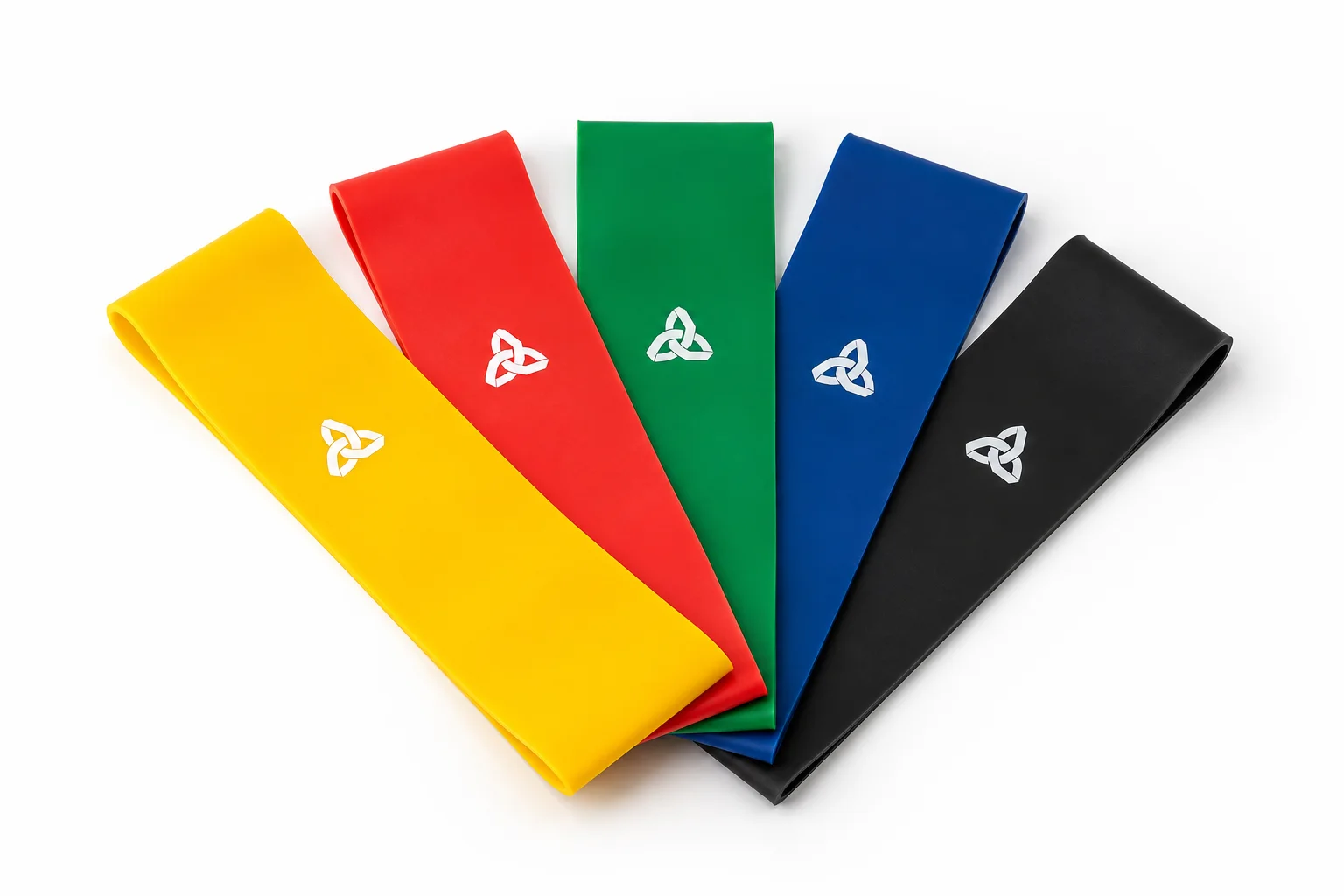
Amazon’s main image must: – Show only the product(s) being sold, on a pure white background (RGB 255, 255, 255) – Have the product occupy at least 85% of the image area – Not include props, models, additional text, or watermarks
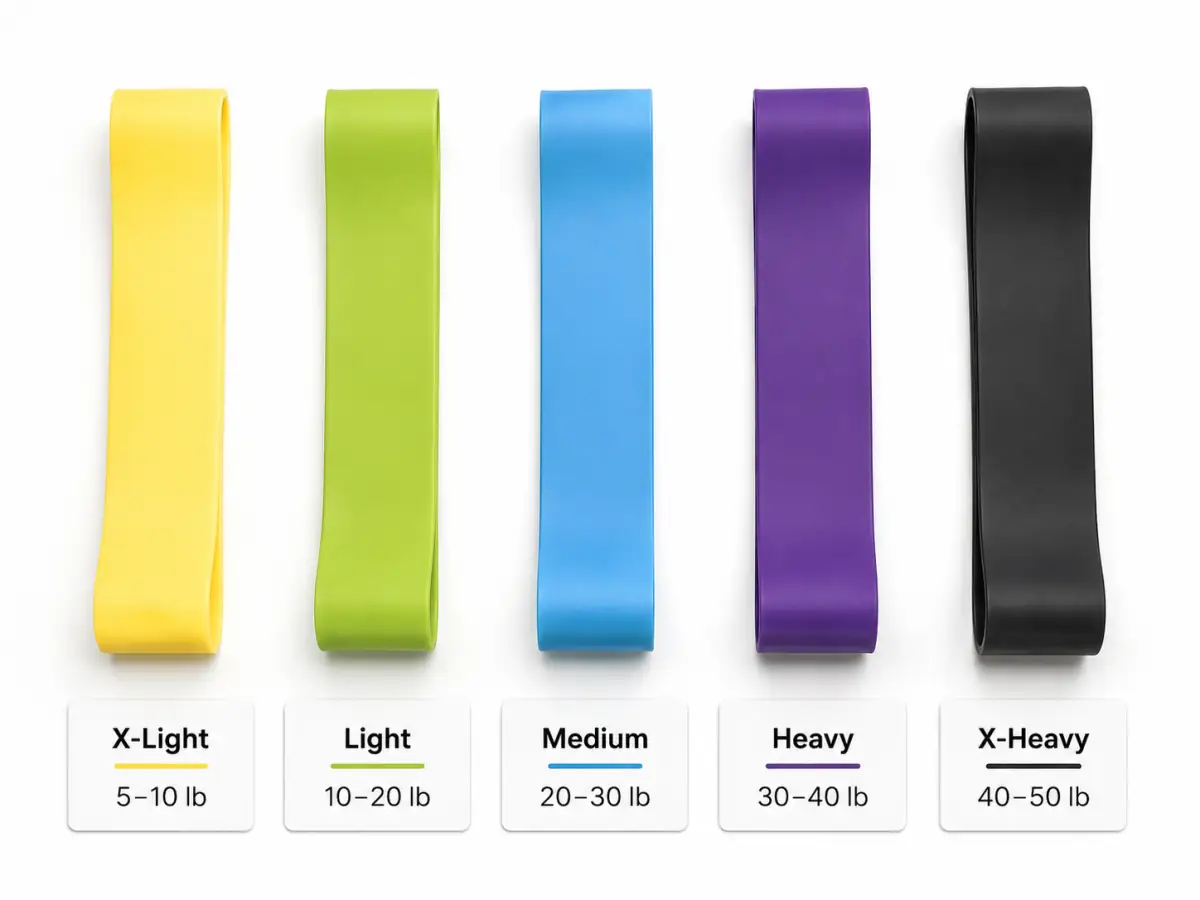
Secondary images can include lifestyle shots, infographics, and size comparison images. The infographic that shows the resistance range by color (light → extra heavy, with approximate force ranges in pounds or kilograms) is the single highest-converting secondary image in the resistance band category — it directly addresses the question that drives the most returns.
Backend Keywords
Amazon’s backend keyword field (250 bytes per field) captures search terms that don’t fit naturally in the title, bullet points, or description. For resistance bands:
- Include resistance level synonyms: “exercise band,” “workout band,” “stretch band,” “loop band,” “pull band”
- Include use case terms: “home gym,” “physical therapy,” “glute band,” “booty band,” “pilates”
- Include body area terms: “leg,” “hip,” “glute,” “arm,” “back”
- Do NOT include: “latex” if your product is TPE, competitor brand names, or prohibited terms
Do not repeat terms already in the title — Amazon ignores redundant backend keywords.
Brand Registry: Why It Matters More Than the Product
Amazon Brand Registry links your registered trademark to your ASIN and provides three protections that significantly change the economics of selling a private label resistance band:
Hijacker prevention. Without Brand Registry, any seller can list on your ASIN. A competitor who sources an inferior resistance band from a lower-cost supplier can appear on your listing — below your price — and buyers who select “used” or the lower-price offer receive the competitor’s product with your branding. Brand Registry gives you the tools to remove unauthorized sellers from your listing.
A+ Content. Brand Registry enables enhanced product description pages with image-text modules, comparison charts, and brand story sections. In the resistance band category, the A+ comparison chart showing resistance level by color against approximate force ranges is a standard conversion tool. Listings without A+ content consistently underperform listings with it in this category.
Sponsored Brands access. Brand Registry enables Sponsored Brands ads — the banner-format advertising that appears above search results. For competitive keywords in the resistance band category (“resistance bands for women,” “booty bands,” “pull-up assist bands”), Sponsored Brands placements have higher click-through rates than Sponsored Products for brand-building campaigns.
The trademark required for Brand Registry must be registered with the relevant government body: USPTO for the US, EUIPO for the EU, or the equivalent for other markets. Filing to registration takes 8–12 months in most markets. If you are launching a private label resistance band brand on Amazon and don’t yet have a trademark application filed, file now — the timeline means Brand Registry may not be available until your second production run.
Set vs Individual ASIN Strategy
A resistance band line can be structured as individual ASINs per resistance level, a single ASIN for the full set, or both. Each has different economics:
Set ASIN only. One listing, one FBA inventory stream, one set of sponsored ads. Simpler to manage. The set price point ($18–$35 for a standard 5-band set) positions the product above the entry-level single-band price point and is the most common format in the top-selling resistance band ASINs on Amazon.
Individual ASINs per level. Allows entry-level pricing ($6–$12 per band) and targeting buyers who want a single specific resistance level. More complex inventory management — five separate ASINs, five FBA shipment streams. Useful for brands with both a set product and a professional line where individual band specification matters.
Both. Set ASIN as the primary product; individual ASINs for specialty sizes (extra-heavy, extra-light) that don’t move in set format. The individual specialty ASINs serve a different search intent (“heavy resistance band only”) and don’t cannibalize the set.
For most brands launching their first resistance band line, the set ASIN is the correct starting point. Expand to individual ASINs once the set has established reviews, ranking, and a return rate baseline.
The Most Common Return Reason — and How to Prevent It
Across the resistance band category on Amazon, the most common negative review and return reason is a variant of the same complaint: “The bands are not as strong as I expected” or “The light band feels too easy / the heavy band is too hard.”
This is not a product defect. It is an expectation gap. The customer’s mental model of “medium resistance” does not match the actual force range of the product they received.
The fix is in the listing copy: instead of (or in addition to) color-coded resistance level names, specify the actual resistance range in pounds or kilograms at a standard elongation percentage. “Medium: 20–35 lbs resistance at 100% elongation” sets a measurable expectation. “Medium (green band)” does not.
Adding a resistance level infographic in the secondary images — showing each band color with its resistance range in a visual force scale — is the single most effective A+ content element for reducing resistance band returns. It answers the question before the customer asks it.
FAQ
Do we need a separate ASIN for each country we sell in?
Amazon operates separate marketplaces (Amazon.com, Amazon.co.uk, Amazon.de, Amazon.ca, etc.), each with its own ASIN. Products listed in one marketplace are not automatically available in others. Amazon’s Build International Listings tool can synchronize listings across marketplaces, but compliance requirements differ by market — what passes CA65 review on Amazon.com may still require REACH documentation for Amazon.de. Plan compliance by market, not by product.
Can we use Amazon FBA if our goods are shipped directly from China?
Amazon does not allow direct factory-to-FBA shipments in most cases — goods must arrive with proper FBA labeling, packaging, and documentation prepared before reaching the fulfillment center. This requires either a US-based prep center (a third-party service that receives goods, labels them, and ships to FBA) or factory labeling (factory applies FNSKU labels before export). Factory labeling is generally more cost-efficient for regular shipments; prep center services are useful for first shipments or when packaging changes are required after factory inspection.
What causes an Amazon listing to go inactive or be suppressed?
Common suppression causes for resistance band listings: missing or non-compliant main image (not on white background, product not filling 85% of frame), prohibited keywords in the title or backend, dangerous goods review triggered by latex-related terms, a missing safety warning for CA65-required products, or a category mismatch between the selected browse node and the product type. Suppression notices appear in Seller Central’s listing quality dashboard and include a reason code — address the specific reason rather than making broad changes to the listing.
How long does the dangerous goods review process take?
Amazon’s dangerous goods review timeline varies significantly. A submission with complete documentation (SDS + test report + exemption confirmation) typically clears in 3–10 business days. Incomplete submissions that require follow-up from Amazon can take 4–8 weeks. Submitting complete documentation the first time is significantly faster than iterating through a series of incomplete submissions.
Should we enroll in Amazon’s Transparency program?
Amazon Transparency applies unit-level authentication codes to individual products, allowing Amazon and buyers to verify product authenticity. It is primarily useful for brands with demonstrated counterfeit problems — where a competitor is selling a counterfeit version of your branded product. For first-time resistance band brands without an established counterfeit history, Transparency adds labeling cost and logistics complexity without a proportionate benefit. Brand Registry handles hijacker prevention more efficiently at the launch stage.
Related reading:
– OEM Resistance Band Sourcing: Complete B2B Guide — material selection, MOQ, lead times, and supplier qualification
– Resistance Band Compliance: REACH, CA65 & Safety Standards — the complete compliance documentation framework for US and EU markets
– Resistance Band Set Packaging: Bulk, Retail-Ready & Gift Box Formats — FBA-compatible packaging specifications and dimensional weight optimization
– Private Label Resistance Bands: MOQ, Branding & Packaging — customization options and spec protection for Amazon private label products