Amazon Vendor Central, REI, and Target each have a compliance document package they require before issuing a purchase order. Most fitness brands discover this for the first time when a buyer sends them the compliance questionnaire — after months of relationship-building, after sample approval, sometimes after a verbal commitment on quantities. The brands that move through onboarding in weeks are the ones who assembled the package before the conversation started.
Quick Summary
- All three major retail channels require: product safety test reports (CA65/Prop 65, CPSC/ASTM where applicable), a factory social compliance audit (BSCI or equivalent), GS1-registered UPC/EAN barcodes, product liability insurance, and a documented Declaration of Conformity.
- Amazon Vendor Central adds EDI capability requirements and a chargeback system that automatically deducts for packaging and labeling non-compliance — without warning, without a call.
- REI’s Restricted Substance List (RSL) is stricter than REACH. A product that passes REACH can still fail REI’s RSL screen. Test against REI’s RSL specifically before submitting a compliance package.
- Target’s packaging sustainability requirements — recyclable materials, minimal single-use plastic, clear recycling instructions — are increasingly a first-filter in vendor onboarding, not an afterthought.
- The right sequencing: assemble your compliance package before you approach a retail buyer, not after they express interest. The brands that stall in onboarding are the ones who showed up to the compliance conversation without the folder.
The Email You Weren’t Ready For
It arrives on a Tuesday. Your buyer contact at the retail chain — the one you’ve been cultivating for six months, the one who liked your samples, the one who said “let’s make this work” at the trade show — sends you a link.
The link goes to their vendor compliance portal. There’s a welcome message. Then there are tabs.
Product Safety. Factory Compliance. Insurance & Legal. Packaging Standards. Labeling Requirements. Data & EDI. There’s a tab you don’t recognize: RSL Declaration.
You scroll down looking for the part that says “if you have most of this, that’s probably fine.” You don’t find it. Each tab has a checklist, a file upload field, and a status indicator: Not Started, In Review, Approved.
Every status indicator says Not Started.
The email from your buyer says the compliance review team needs the complete package before they can issue a purchase order. The next buying cycle closes in nine weeks.
You close the browser, open it again, and start reading. The product liability insurance alone requires a certificate with specific language, naming the retailer as an additional insured, with a minimum coverage amount you’ve never had to think about before. The EDI requirement references a standard — 850/856/810 — that you understand conceptually and have never actually implemented.
Nine weeks suddenly feels like a different number than it did before you opened that link.
Why Retail Compliance Is a Different Problem Than DTC Compliance
When you sell direct-to-consumer or through Amazon Seller Central (third-party), you are responsible for your product’s safety and labeling. But the enforcement mechanism is reactive: compliance becomes a problem when a customer complains, when a platform flags a listing, or when a regulator acts.
When you enter a first-party retail relationship — Amazon Vendor Central (1P), REI direct vendor, Target direct vendor — the enforcement mechanism is proactive. The retailer is buying your product, putting it on their shelves, and absorbing the liability that comes with it. They require documentation before the first unit ships, not after the first customer complains.
This is a different category of compliance work. It requires:
- Upfront investment in testing, auditing, and documentation that does not generate revenue until the first purchase order clears
- Systems you may not have: EDI capability, a GS1 account, a product liability insurance policy with retailer-specific endorsements
- Factory cooperation on social compliance audits that take 4–8 weeks to schedule and complete
- Material-level specificity in test reports — not “this product is compliant” but “this specific compound, from this specific factory, tested at this specific ILAC-accredited lab, against this specific standard, on this date, produced these specific results”
The brands that underestimate this are the ones you hear about at trade shows: “we had a buyer at REI interested but we couldn’t get through their compliance process in time.” What that usually means is: they had a buyer interested and they started the compliance process after the buyer expressed interest. By the time the documentation was ready, the buying window had closed.
The brands that move fast are the ones who treated retail compliance as infrastructure — built before it was needed, maintained as the business grew.
Amazon Vendor Central: What It Actually Requires
Most fitness equipment brands know Amazon as Seller Central — the marketplace model where you list products, manage your own inventory, and receive payouts after Amazon’s fees. Vendor Central is the inverse: Amazon buys your product wholesale, takes ownership, manages inventory in their own fulfillment centers, and sells under Amazon’s retail brand. Your listing says “Sold by Amazon.” You get a purchase order instead of individual sales.
The commercial terms are better in some ways (you don’t absorb individual sale variability) and more demanding in others (Amazon owns your price, controls your inventory placement, and has a chargeback culture that will cost you money if your operations aren’t tight).
What Amazon Vendor Central Requires
GS1-registered UPC or EAN barcodes. Not third-party barcodes. Not resold barcodes. Barcodes registered directly through GS1, the global standards body. Amazon has been tightening this requirement progressively and will reject vendor submissions with non-GS1-registered codes. The GS1 US annual license starts at approximately $250/year for a basic prefix. Budget time: 1–2 weeks to register and receive your prefix.
FNSKU labeling. Each unit in an Amazon fulfillment center must carry an FNSKU (Fulfillment Network Stock Keeping Unit) label in addition to the UPC. FNSKU labels are Amazon-generated and must be applied to each unit before shipment — either at the factory, at a prep center, or at your warehouse. The placement specifications (label size, placement zone, barcode orientation) are defined in the vendor manual and are enforced by automated scanning at receiving. A label that is 2mm outside the specified zone creates a receiving exception.
Product safety documentation. Fitness equipment sold on Amazon Vendor is subject to CPSC (Consumer Product Safety Commission) regulations for the US market and California Proposition 65 requirements for sales in California. Amazon requires test reports from CPSC-approved labs for products that fall under mandatory standards. For yoga mats, foam rollers, and resistance bands — which are general-use adult fitness products rather than children’s products — the documentation requirement centers on CA65 test reports and supplier’s Declarations of Conformity. Amazon’s Children’s Product requirements are a separate and more demanding track; if any of your products could be construed as appropriate for children under 12, treat them differently.
Amazon’s Supplier Code of Conduct. Amazon requires vendors to agree to their Responsible Sourcing standards, which include factory working conditions, environmental practices, and prohibition of forced labor. This is not currently enforced through a mandatory audit on initial onboarding for most fitness accessories categories, but it is a documented agreement that creates exposure if your supply chain is later audited.
EDI (Electronic Data Interchange). Amazon Vendor Central operates on EDI for purchase orders, advance ship notices, and invoices. The relevant transaction sets are 850 (purchase order), 856 (advance ship notice / ASN), and 810 (invoice). You need either a direct EDI integration with your ERP/WMS, a third-party EDI provider (SPS Commerce, TrueCommerce, and others offer managed EDI services for around $300–$700/month depending on volume), or a manual web-EDI portal access that Amazon makes available for lower-volume vendors.
The Chargeback Reality
Amazon’s chargeback system is automated, non-negotiable, and operates without a phone call.
If your carton dimensions are outside the specified tolerances: deduction. If your pallet configuration doesn’t match the vendor manual: deduction. If your ASN is submitted after the shipment arrives rather than before: deduction. If your label placement is outside spec: deduction.
These deductions appear in your vendor account as a line item. The deduction rate for labeling non-compliance is typically 3% of the invoice value. On a $20,000 purchase order, that’s $600 — gone automatically, discovered when you’re reconciling your vendor statement.
Experienced Amazon Vendor brands build a compliance review step into every shipment specifically to catch these deductions before they happen. New Amazon Vendor brands usually learn this after the first two or three statements.
REI: The Sustainability Filter First
REI is a consumer cooperative — it answers to its members as much as to commercial metrics. This shapes its vendor requirements in a way that is meaningfully different from pure-commercial retail. Sustainability, supply chain transparency, and material responsibility are not marketing add-ons at REI. They are first-filter criteria in the vendor onboarding process.
What REI Requires
BSCI, Sedex/SMETA, or equivalent social compliance audit. REI requires documented evidence of social compliance at the factory level before onboarding any new vendor. BSCI (via SGS, TÜV, Bureau Veritas, or amfori-member auditors) is widely accepted. Sedex SMETA (Supplier Ethical Data Exchange) is increasingly preferred because REI can access the audit report directly through the Sedex platform, reducing documentation back-and-forth. Factory audits take 4–8 weeks to schedule and complete from initial contact. If your factory doesn’t have a current audit, add that timeline to your compliance window.
Product liability insurance. REI requires a certificate of insurance naming REI Co-op as an additional insured, with minimum coverage typically of $2 million per occurrence and $5 million aggregate for general liability and product liability. Your existing business insurance policy may not include these limits or the specific additional-insured endorsement language REI requires. Budget 2–4 weeks to work with your insurance broker and confirm the certificate format matches REI’s specification exactly — they will reject certificates with incorrect language.
REI’s Restricted Substance List (RSL). This is the compliance trap that catches the most fitness brands.
REI’s RSL is not the same as REACH. REACH is a European regulation with defined Annex XVII restrictions and SVHC candidate list limits. REI’s RSL is a proprietary standard that is more restrictive than REACH in certain substance categories — including phthalates, heavy metals in surface coatings, and certain flame retardants. A yoga mat that passes REACH SVHC screening can still fail REI’s RSL if the plasticizer compound exceeds REI’s internal threshold for DEHP or DBP.
The test that clears you for EU retail will not tell you whether you pass REI’s RSL. You need to test against REI’s RSL specifically, using an ILAC-accredited lab, and submit the results with your compliance package. REI publishes their RSL; download the current version before testing so your lab knows what to screen for.
Discover this after months of relationship-building and your product is already at sample approval stage. The reformulation conversation with your factory — explaining that the product passed all government standards but fails a retailer’s proprietary list — is one of the more uncomfortable conversations in B2B sourcing.
GS1 UPC codes and product data submission. REI uses the GS1 Global Data Synchronization Network (GDSN) for product data onboarding. New vendors need to either maintain their own product data in the GDSN (through 1WorldSync or a similar data pool) or work with REI’s preferred data submission portal. Dimensions, weight, images, ingredient/material disclosures, and sustainability certifications all go into the product data record.
The Trial Order Reality
REI’s first purchase order to a new vendor is almost always a trial: a small quantity distributed to a limited number of stores for a defined evaluation period. The evaluation criteria include sell-through rate, return rate, customer feedback, and — increasingly — product return compliance (the ability to restock or responsibly recycle returned units).
You will not make money on the trial order. The compliance costs, the insurance setup, the packaging redesign for REI’s sustainability requirements, and the EDI or data submission work will likely exceed the margin on a 48-unit initial order to 6 stores. But your barcode is in REI’s system. Your factory audit is in their database. Your RSL test results are on file. The next purchase order is issued against existing documentation, not a new compliance review.
The brands that get frustrated with REI’s onboarding process and walk away are often the ones who went in expecting the first order to be profitable. The ones who complete it and wait for the second order understand that retail channel development is a capital investment, not a revenue transaction.
Target: Packaging First, Then Everything Else
Target’s vendor requirements are broadly similar to REI’s in structure — social compliance audit, product safety documentation, GS1 barcodes, EDI — but Target’s specific emphasis has shifted substantially in recent years toward packaging sustainability.
What Target Requires
Packaging sustainability standards. Target has committed to making all of its owned-brand packaging 100% recyclable, compostable, or reusable by 2025, and they are pushing this expectation through their vendor supply chain. For branded fitness equipment, this translates to: no expanded polystyrene (Styrofoam) in packaging, clear recycling instructions on outer packaging using How2Recycle labels, minimized plastic film, and documentation of the recyclability of each packaging component.
If your current packaging for Amazon FBA — designed for scan-ability, drop-test survival, and FNSKU label placement — includes a polybag, a foam insert, or any component that isn’t recyclable, it needs to be redesigned for Target. This is a real cost: new dielines, new packaging artwork, new samples, revised packaging spec sheets for your factory.
Product safety testing and documentation. Target requires test reports from CPSC-recognized labs for applicable product categories. For fitness equipment sold to adult consumers, the key requirements are: CA65/Prop 65 test report, CPSC section 14(a) General Certificate of Conformity (GCC), and country of origin documentation. If your product contains regulated materials (latex, natural rubber, certain dyes), additional disclosure and testing may be required.
Target’s Responsible Sourcing Program. Target requires factories to be audited under a recognized social compliance standard — BSCI, Sedex SMETA, Social Fingerprint, or equivalent — with audit results submitted through Target’s Partner Online (TPO) portal. New factories must complete an audit before the first purchase order is issued. Existing audit reports from shared platforms (Sedex) can be accepted if they are current (typically within 2 years for audit category B or above).
EDI capability. Target operates on EDI for purchase orders (850), advance ship notices (856), and invoices (810). The same managed EDI providers that serve Amazon Vendor also support Target’s EDI requirements. If you’re building EDI capability for one retailer, build it to handle both — the marginal cost of adding a second trading partner once the infrastructure is in place is low.
Target Plus (Marketplace). Target’s marketplace program — Target Plus — has a lighter compliance onboarding than direct vendor and is invitation-only. It operates more like Amazon Seller Central: you fulfill orders (either directly or through Target’s fulfillment program), and you retain more pricing control. The compliance requirements are less extensive, but you’re also trading away the retail placement and the “Sold by Target” brand signal. For brands that want Target shelf placement rather than just Target.com listings, direct vendor is the path.
The Compliance Package You Need Before Any Retail Conversation
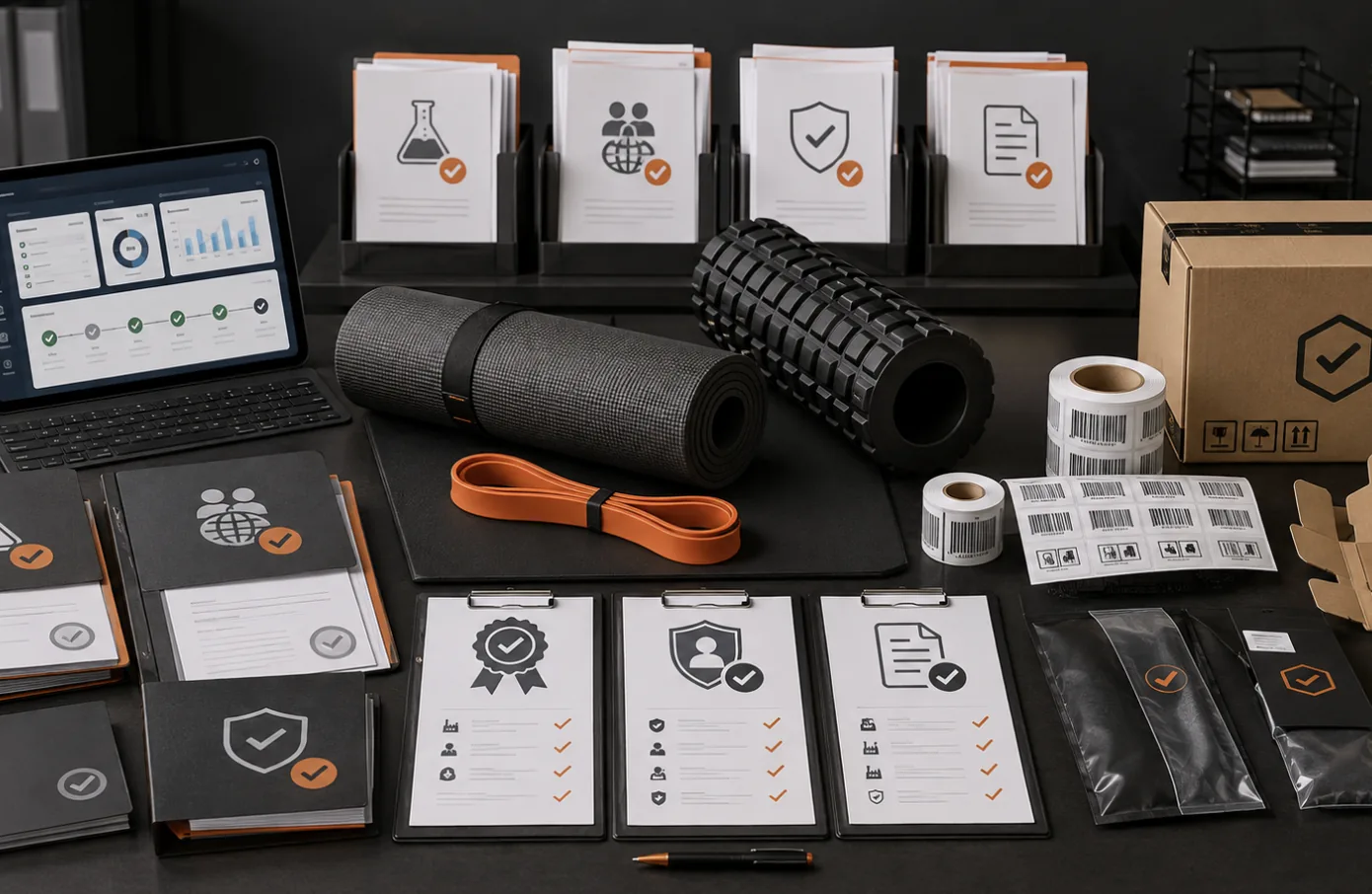
Across all three channels — and any other specialty retailer you’ll encounter at scale — the core document set is the same. Assemble this before you approach a buyer, and every onboarding conversation moves faster.
Tier 1: Always Required
| Document | What It Is | Lead Time to Obtain |
|---|---|---|
| CA65 / Prop 65 test report | Product-specific, from ILAC-accredited lab | 2–3 weeks + $400–$700 per SKU |
| CPSC General Certificate of Conformity | Manufacturer self-declaration with lab support | 1 week (once test reports are in hand) |
| REACH SVHC screening report | Material-level chemical screen from EU-recognized lab | 2–3 weeks + €300–€600 per SKU |
| Factory social compliance audit | BSCI or Sedex SMETA, from accredited auditor | 4–8 weeks from first contact |
| Product liability insurance certificate | With retailer named as additional insured | 2–4 weeks via insurance broker |
| GS1-registered UPC/EAN barcodes | Direct GS1 registration | 1–2 weeks |
Tier 2: Channel-Specific
| Document | Required by |
|---|---|
| REI RSL test report | REI |
| How2Recycle packaging certification | Target (strongly preferred) |
| Sedex SMETA audit (shareable via platform) | REI, Target (preferred format) |
| EDI capability confirmation | Amazon Vendor, Target, most large retailers |
| GS1 GDSN product data record | REI, Target |
The sequencing rule: Start with Tier 1. The factory audit and the product testing take the longest and are required by everyone. While those are running, set up your GS1 account and start the insurance certificate conversation. Tier 2 documents can be added once you know which retailer you’re targeting.
How Wellfitsource Supports Retail-Track Brands
Brands entering retail channels need a factory that can support the compliance process, not just the production process. We’ve built our documentation infrastructure to match what major retailers actually ask for.
Social compliance: Our Yangzhou, Jiangsu facility holds a current SGS-certified BSCI audit and operates under ISO 9001 quality management certification. Both are available for review — and shareable in retailer compliance portals — before a sample order is placed.
Test reports on file: We maintain current CA65 Prop 65 test reports, REACH SVHC screening reports, and CE Declarations of Conformity for our standard material specifications across yoga mats, foam rollers, resistance bands, and yoga accessories. Brands entering retail channels can access our existing documentation for standard materials rather than commissioning fresh testing from zero — reducing both cost and timeline.
RSL-ready compounds: For brands targeting REI or other retailers with proprietary RSLs, we can specify compounds against the RSL prior to production, and arrange RSL-specific testing through our lab network before a production commitment is made.
Packaging redesign support: If your current packaging needs to meet Target’s recyclability standards or REI’s minimal-plastic requirements, we can work with you on packaging specification changes at the sampling stage. Changing packaging after production creates waste and cost; building the retailer’s requirements into the packaging brief from the start doesn’t.
Factory audit access: We support third-party pre-shipment inspections, factory audits, and retailer-commissioned facility reviews. If your buyer’s compliance team wants to conduct a direct factory audit, we facilitate access.
Discuss retail channel compliance requirements →
FAQ
We already sell on Amazon Seller Central. What changes when we move to Vendor Central?
The product itself doesn’t change. The operational requirements do. You go from managing individual listings to managing purchase orders. You go from receiving payouts to issuing invoices. You gain EDI requirements, carton-level labeling specifications, and Amazon’s chargeback system. You lose price control — Amazon sets the retail price on Vendor listings. The commercial terms are often better for high-volume SKUs because Amazon manages the demand variability for you, but the operational compliance cost is real and ongoing. Evaluate the transition when your SKU has consistent velocity at scale and you can absorb the compliance infrastructure cost.
Can the same BSCI audit satisfy REI, Target, and Amazon’s requirements simultaneously?
Yes — a single current BSCI audit at your factory satisfies the social compliance requirement for all three channels. REI prefers Sedex SMETA because it’s shareable through the Sedex platform without a separate documentation transfer; if your factory is also Sedex-registered, that covers REI’s preferred format. If not, REI will accept BSCI. The audit is the asset; the format and platform through which it’s shared is a secondary consideration.
How much does it cost to build a retail compliance package from scratch?
Budget $5,000–$15,000 in one-time compliance costs for a single SKU entering US retail channels: $400–$700 for CA65 testing, €300–€600 for REACH screening, $500–$1,500 for REI RSL testing if applicable, $300–$800 for BSCI audit (if your factory doesn’t already have one), $1,500–$3,000 annually for product liability insurance, $250+ for GS1 registration, and $300–$700/month for managed EDI if you don’t have in-house EDI capability. These costs are not per-order — they’re infrastructure costs that apply across all orders once established. The first purchase order rarely recovers these costs on its own. The second and third do.
What happens if a product passes CA65 but fails REI’s RSL?
You go back to your factory and reformulate. REI’s RSL threshold for some substances (certain phthalates, specific heavy metals in printing inks) is lower than Prop 65’s NSRL. Failing REI’s RSL on a Prop 65-compliant product doesn’t mean your product is unsafe or illegal — it means it doesn’t meet REI’s proprietary standard. The fix is a compound change at the factory, followed by retesting. Depending on the substance and the reformulation, this adds 4–10 weeks. The only way to avoid this situation is to test against REI’s RSL specifically, before you enter the onboarding conversation.
Should we approach REI, Target, or Amazon Vendor first?
Amazon Vendor first, if you’re getting an invitation — it has the highest volume potential and the most predictable compliance requirements. REI if your brand has strong sustainability positioning and can absorb the RSL testing requirement — REI’s brand alignment with premium outdoor and wellness is the strongest of the three for fitness equipment. Target if you have broad market appeal and your product can sit in a mass-market context without losing its brand narrative. The compliance infrastructure built for any one of these channels transfers to the others, so the sequencing is a commercial strategy question more than a compliance one.
Related reading:
– Scaling Fitness Equipment Sourcing: A Supplier Risk and Channel Compliance Guide for Growing Brands — covering all five risk categories at scale
– OEM Fitness Product Tooling Ownership in China — IP protection and mold contracts before the retail compliance conversation starts
– The Complete OEM Fitness Equipment Manufacturing Guide — factory evaluation, certifications, and OEM production process