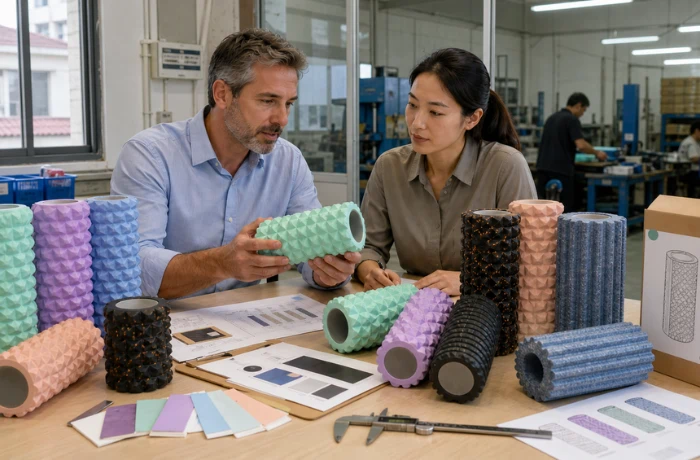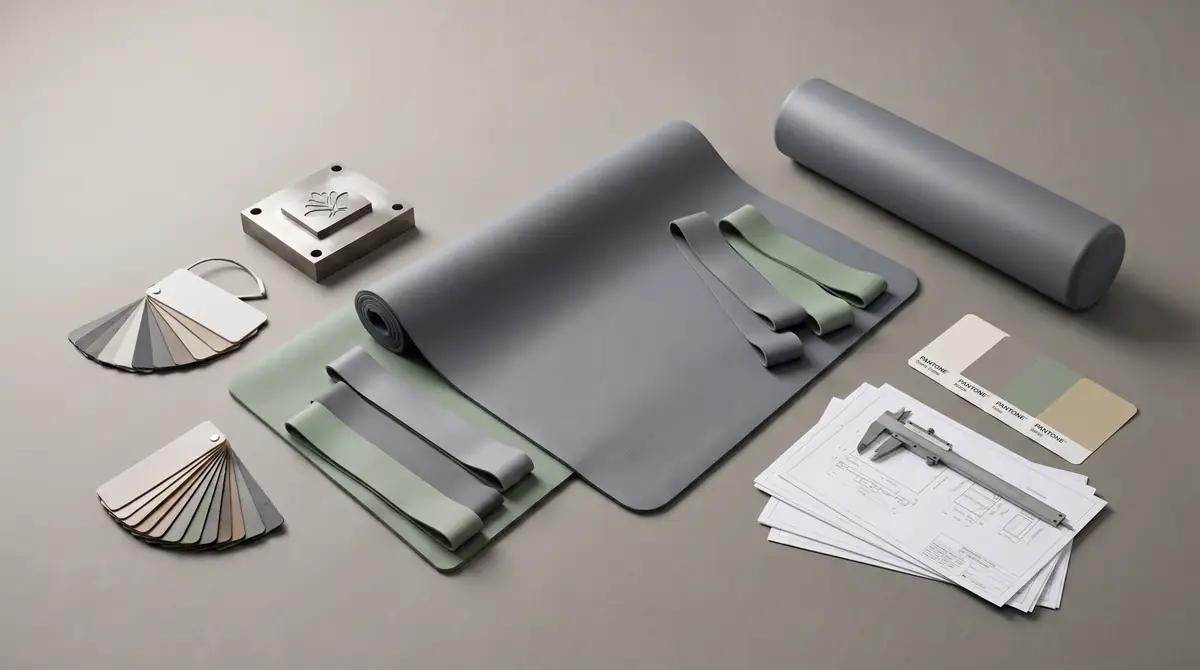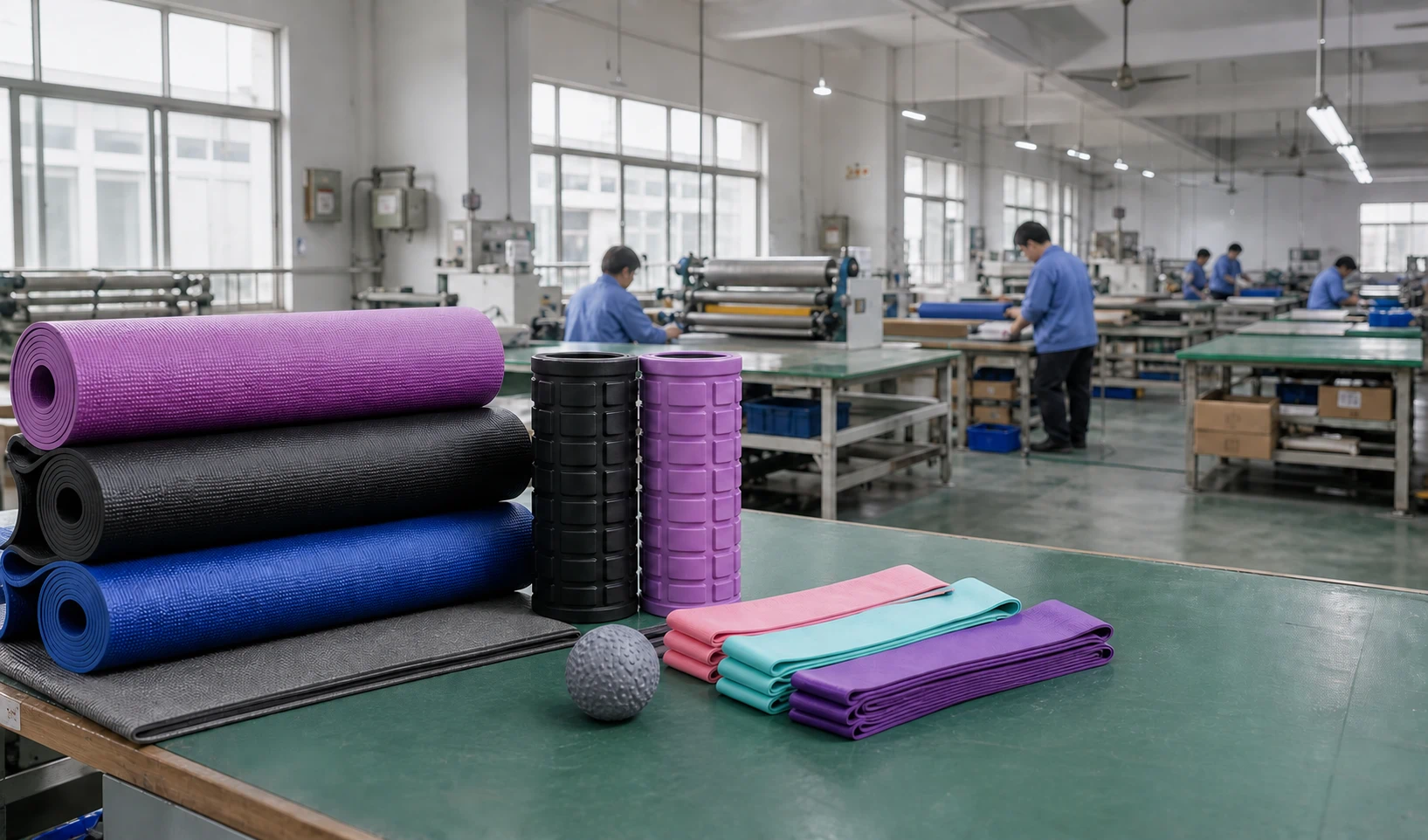
OEM fitness equipment manufacturing means contracting a factory to produce Yogamatten, Schaumstoffrollen, Widerstandsbänder, or gym accessories under your brand name — the factory builds it, you sell it. This guide covers every decision point a fitness brand faces when sourcing OEM products: factory evaluation, certifications, MOQ benchmarks, lead times, and the red flags that derail first-time buyers.
Quick Summary: 5 Things to Know Before You Start
- OEM (you provide specs) and ODM (factory provides designs) have different MOQ floors, lead times, and IP implications — choose the right model before contacting factories.
- Certifications aren’t optional: CE + REACH + RoHS for EU; UKCA for UK (post-Brexit); California Prop 65 (CA65) is the primary compliance signal US buyers and retailers request for foam and rubber fitness products.
- Typical yoga mat MOQs run 500–1,000 units; foam rollers 300–1,000 units; resistance bands 500–3,000 units depending on SKU count.
- Sample-to-production lead time is typically 6–10 weeks for new OEM products with custom tooling.
- The cheapest quote is rarely the best choice — factories pricing 30–40% below market average frequently cut corners on materials or fail audits.
Inhaltsübersicht
- What Is OEM Fitness Equipment Manufacturing?
- OEM vs. ODM: Which Model Fits Your Brand?
- 6-Point Framework for Evaluating Manufacturers
- Certification Requirements by Market
- The 6-Step OEM Production Process
- MOQ, Pricing, and Lead Time Benchmarks
- 5 Red Flags That Signal an Unreliable Factory
- What to Look for in a Qualified OEM Partner
- FAQ
- How to Request an OEM Quote
- Wichtigste Erkenntnisse
1. What Is OEM Fitness Equipment Manufacturing?
OEM (Original Equipment Manufacturing) in the fitness industry means a brand provides product specifications — materials, dimensions, logo, colorways, packaging requirements — and a contract factory produces the goods. The brand owns the IP; the factory provides the production capability.
This model powers nearly every private label fitness product sold on Amazon, in specialty retailers, or through DTC channels. According to the Sporting Goods Manufacturers Association, China accounts for over 70% of global sporting goods production volume, making Asian OEM partnerships the default path for brands building product lines without owned manufacturing facilities.
The alternative is buying off-the-shelf from a distributor, which offers lower MOQs but zero brand differentiation. OEM is the step brands take when they want their logo on a product built to their standard — not a generic SKU from a catalog.
Why OEM Manufacturing Is the Standard for Fitness Brands
Four factors make OEM the dominant sourcing model for emerging fitness brands:
Cost structure. Factory-direct OEM pricing removes two to three layers of margin compared to buying from a distributor. For yoga mats, the delta between OEM-direct and distributor pricing typically runs 30–50% on a per-unit basis, depending on material grade and volume.
Brand control. Every detail — durometer of the foam, thickness tolerance, texture pattern, custom packaging with your retail barcode — is specified in writing before production begins. You get exactly what you brief, with no compromise to accommodate a standard SKU.
Scalability. OEM relationships grow with order volume. Factories prioritize accounts that reliably reorder. Brands that build a multi-year supplier relationship gain access to production slots during peak seasons when new buyers struggle to get confirmed lead times.
IP protection. With a signed OEM agreement, your design files, mold tooling, and packaging artwork are contractually yours. Reputable manufacturers will sign Non-Disclosure Agreements (NDAs) before design review and production begins.
2. OEM vs. ODM: Which Model Fits Your Brand?
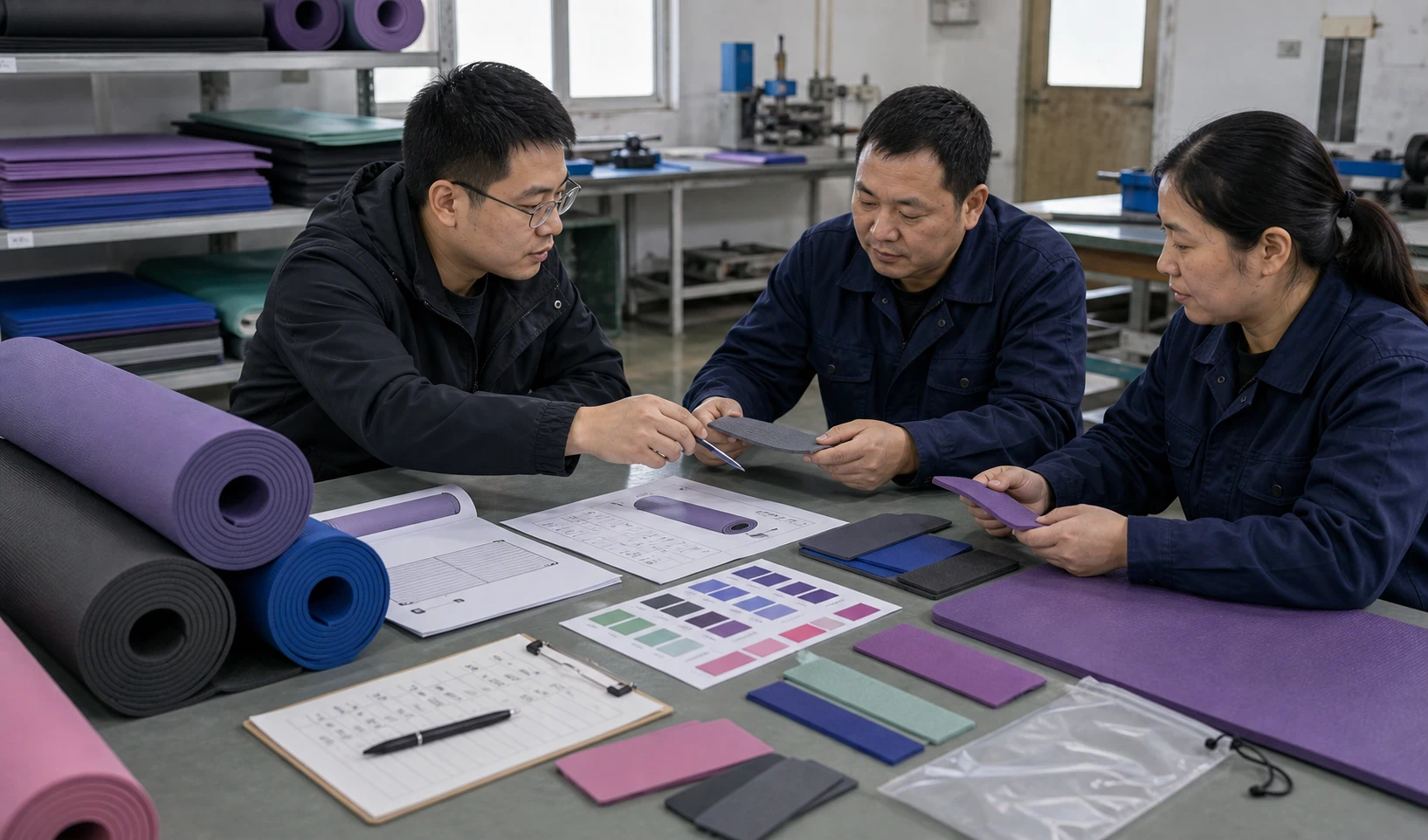
OEM and ODM are often used interchangeably in sourcing conversations, but they represent meaningfully different arrangements with different cost, speed, and IP implications.
| Faktor | OEM (Original Equipment Manufacturing) | ODM (Original Design Manufacturing) |
|---|---|---|
| Who owns the design | You (the brand) | The factory |
| Who provides specs | You submit detailed specs | Factory provides ready designs |
| Customization level | Full (materials, thickness, texture, dimensions) | Limited (logo, colorway, packaging) |
| MOQ | Higher — custom tooling requires volume to amortize | Lower — tooling already exists |
| Lead time (first order) | Longer — 8–12 weeks with tooling | Shorter — 4–6 weeks |
| Unit cost at scale | Lower long-term | Higher (factory carries design overhead) |
| IP risk | Low — you own the mold and design files | Medium — factory may sell similar designs to others |
| Am besten für | Established brands with clear product vision | New brands testing a category before committing |
When to Choose OEM
OEM is the right model when your brand’s product differentiation is the product itself — not just the logo. If your yoga mat is built around a proprietary texture, a specific dual-density foam formula, or a patented alignment system, OEM is the only model that protects that advantage. You pay for custom mold tooling upfront (typically $800–$3,000 per SKU depending on complexity), but that investment means the factory cannot sell the same product to a competitor.
When to Choose ODM
ODM makes sense when you’re entering a new category and want to validate demand before making a tooling investment. The factory’s standard foam roller, resistance band set, or balance pad ships quickly and at lower minimums. Once you’ve validated the market, you migrate to OEM for the next iteration with differentiated specs and your own tooling.
Many brands run both models simultaneously — ODM for new SKU testing, OEM for proven core products.
3. 6-Point Framework for Evaluating Manufacturers
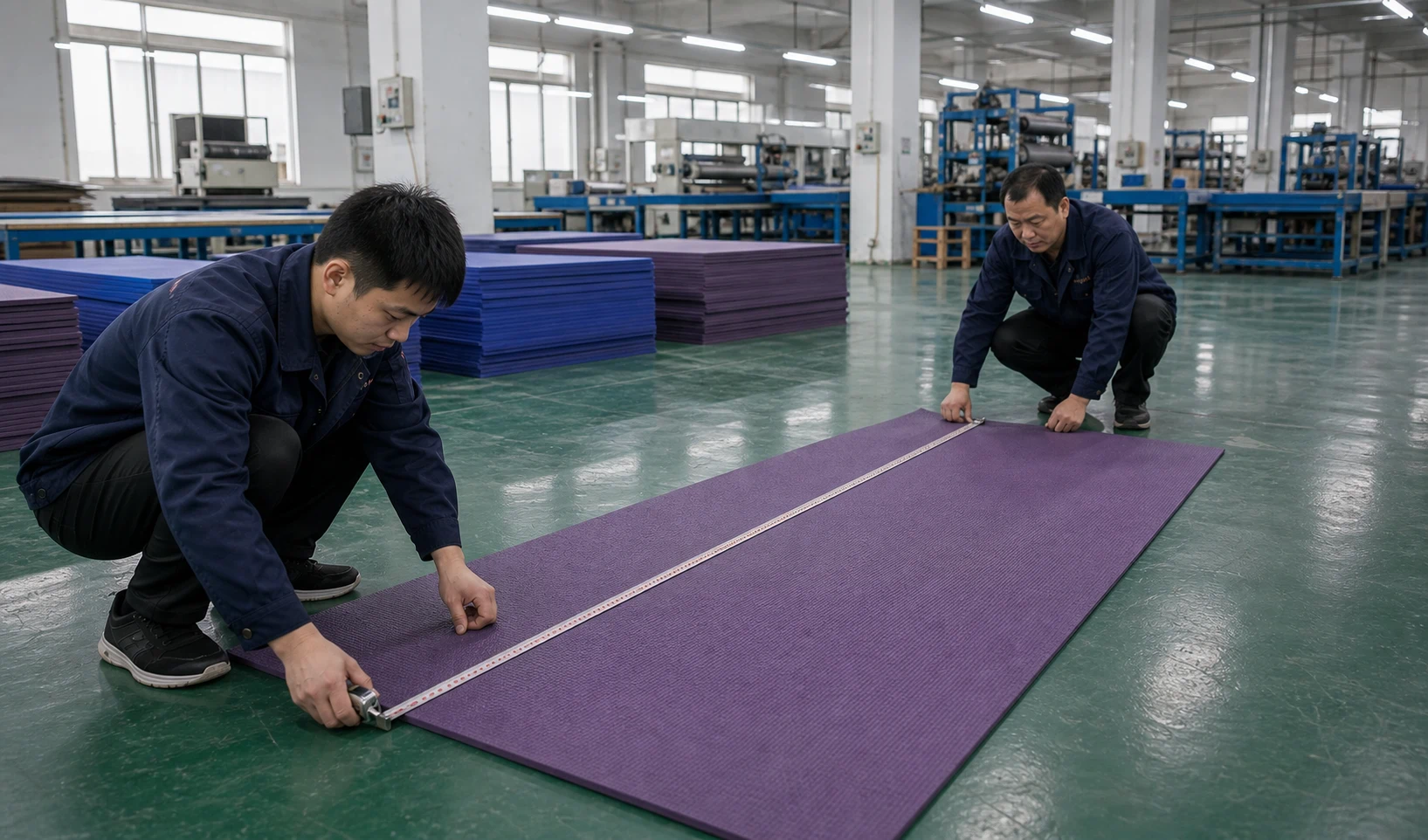
Choosing an OEM partner is a two-to-five year relationship. These six criteria separate reliable long-term partners from factories that look good on paper but fail on the first order.
1. Verified Certifications
Certifications are the minimum threshold. Any manufacturer targeting export to the US, EU, or UK must hold relevant third-party certifications — not self-declared compliance. Request the original certificate with issuing body and expiry date, then verify independently. (See Section 4 for a full breakdown by market.)
2. Factory Audit History
Ask for the most recent BSCI audit report — issued by a recognized auditing body such as SGS or TÜV. A credible manufacturer will provide it without hesitation. BSCI audits cover labor practices, working hours, wages, health and safety, environmental management, and anti-corruption — the same categories that expose brands to ESG liability if a supplier fails. Factories audited within the last 12 months with no critical non-conformances are meaningfully lower risk. If a factory presents a BSCI report from an unfamiliar body, ask for the auditor’s accreditation certificate; legitimate BSCI audits are conducted exclusively by amfori-approved organizations, of which SGS and TÜV are among the most widely recognized.
3. Export Track Record to Your Target Market
A factory that has exported 50 containers to the US knows FDA import requirements, HTS codes, and the documentation importers need. A factory exporting to your market for the first time introduces risk around shipping documentation, labeling compliance, and customs classification. Ask for references from existing buyers in your region — then call them.
4. Sample Quality and Revision Tolerance
Before committing to a production order, evaluate how the factory handles sampling. Send detailed specs and evaluate the sample against every parameter: weight, hardness, dimension tolerance, color accuracy, logo print quality, packaging finish. Then request one revision. How the factory responds to correction tells you more than the sample itself. A factory that pushes back on reasonable revision requests or charges excessive fees for minor changes is showing you how they’ll handle production QC disputes.
5. Communication and Lead Time Reliability
Response time during the quoting phase is a proxy for production communication quality. If you’re waiting three days for a response to a basic inquiry, expect the same delay when you need to resolve a production issue mid-order. Establish a dedicated account manager, confirm their preferred communication channel, and document all approvals in writing.
6. Production Capacity and Scheduling Transparency
Request the factory’s monthly production capacity and their current booking rate. A factory running at 95% capacity through the next quarter cannot reliably take your order without compromising either your timeline or an existing customer’s. Ask specifically: “What is your current lead time for new OEM orders?” and “What production window would you assign our order?” Factories that can answer these questions with specifics are running organized operations.
4. Certification Requirements by Market
Certification requirements vary by destination market. Shipping non-compliant product to a regulated market results in customs holds, product recalls, or retailer delisting. Map your target market’s requirements before finalizing material specs with your manufacturer.
| Zertifizierung | Markt | Covers | Who Issues / Verifies |
|---|---|---|---|
| CE Marking | EU / EEA | Safety, health, and environmental protection — required before products can be sold in the EU | Manufacturer self-declaration (low-risk) + Notified Body assessment (regulated categories) |
| REACH | EU | Chemical substance compliance — restricts 200+ SVHCs including phthalates in foam, rubber, and surface coatings | European Chemicals Agency (ECHA); tested by accredited labs (SGS, TÜV, Intertek) |
| RoHS | EU | Restriction of hazardous substances — primarily relevant for fitness products that contain electronic components (heart rate monitors, smart trackers embedded in equipment) | CE Notified Body / third-party lab |
| UKCA Marking | Vereinigtes Königreich | UK equivalent of CE marking post-Brexit — required for products placed on the Great Britain market (England, Scotland, Wales) from 2023 onward | UK Approved Body; tested by UKAS-accredited lab |
| CA65 (Prop 65) | USA (California + de facto national) | California Safe Drinking Water and Toxic Enforcement Act — requires warning labels or compliance testing for 900+ listed chemicals; foam, rubber, and latex products commonly trigger this | California OEHHA; verified by third-party lab testing (SGS, TÜV, Intertek) |
| BSCI Audit | Global (retailer & platform requirement) | Social compliance: labor rights, working hours, wages, health & safety, environmental management, anti-corruption | amfori-approved auditors only — SGS and TÜV are among the most recognized; self-declared BSCI is not accepted |
| ISO 9001:2015 | Global | Factory quality management system — process controls, documentation, defect tracking, continual improvement | Third-party certification body (SGS, TÜV, Bureau Veritas, Intertek) |
| OEKO-TEX STANDARD 100 | EU / Global | Harmful substance testing for textiles and foam materials — increasingly required by EU yoga and wellness retailers | OEKO-TEX member institutes |
Key Notes by Product Category
Yoga mats: REACH compliance is the baseline for EU sales — PVC mats must be tested for phthalates (SVHC list), and TPE and natural rubber mats face overlapping restrictions on chemical coatings and dyes. For the UK market, ensure CE documentation is mirrored with UKCA. For the US, CA65 (Prop 65) testing for rubber mats is the standard request from US retailers and Amazon — it addresses phthalates, lead, cadmium, and other listed substances in a single test panel. OEKO-TEX STANDARD 100 is increasingly a prerequisite for EU yoga brands sourcing from Chinese factories.
Foam rollers: EU buyers require REACH SVHC screening reports — self-declaration is no longer accepted by most European retailers. For US buyers, CA65 compliance documentation is the primary request, covering phthalates and other chemicals that commonly occur in EPE, EVA, and PE foam. UK buyers require UKCA + REACH-equivalent documentation.
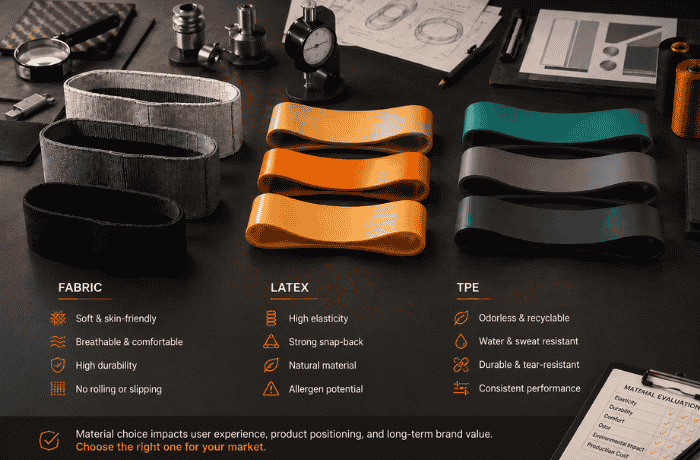
Resistance bands: Latex bands must be tested for safe latex protein levels under EN ISO 10282 or equivalent. Latex allergy warning labeling is required in several EU markets. TPE and fabric bands face lighter regulatory friction but still require REACH chemical screening for colorants and surface coatings when sold into the EU.
Balance pads / foam stability equipment: CA65 testing covers the US market. EN71 (European toy safety standard) applies if the product is positioned for children’s rehabilitation use. REACH chemical screening applies across all foam balance products sold into the EU or UK.
5. The 6-Step OEM Production Process
Understanding the production workflow helps brands set realistic timelines and know when to escalate concerns.
Step 1: Inquiry and Specification Submission (Week 1–2)
Submit a detailed product brief covering: target material and grade, dimensions with tolerances, density/hardness specs (for foam products: specify ILD rating or Shore A hardness), colorway with Pantone references, logo placement and print method, retail packaging requirements, and target unit cost range.
The more specific your brief, the more accurate the factory’s quote and the faster sampling begins. Vague briefs produce generic samples that require expensive revision cycles.
Step 2: Quotation and Contract Negotiation (Week 2–3)
The factory returns a unit price quote with an itemized breakdown of material costs, labor, tooling, and packaging. At this stage, negotiate:
- MOQ — most factories have flexibility of 10–20% on minimums for reliable accounts
- Payment terms — standard is 30% deposit on order confirmation, 70% before shipment; experienced buyers negotiate 30/70 on first orders, moving to Net 30 or Net 45 after establishing history
- Tooling ownership — explicitly state in the contract that molds and tools remain your property after the tooling fee is paid
- NDA scope — ensure your design files, specifications, and client information are covered
Step 3: Sample Development (Week 3–6)
The factory produces a pre-production sample to your specifications. For products requiring custom molds (embossed yoga mat surfaces, shaped foam rollers), tooling development adds 2–3 weeks to this stage. Budget for two to three sample rounds on complex products — a single sample round is common for straightforward products like flat resistance bands but rare for multi-component kits.
Step 4: Sample Approval and Production Confirmation (Week 6–7)
Upon approving the final sample, sign the Production Approval Form (PAF) documenting the approved sample as the quality standard. This document is your contractual reference if production goods deviate from the approved sample. Retain a physical sample for comparison on goods receipt.
Step 5: Mass Production (Week 7–12)
The factory runs production against the approved PAF. Brands with volume ($50,000+ per order) should arrange a mid-production QC inspection through a third-party service (QIMA, Bureau Veritas, Intertek offer per-inspection rates starting around $250–$350). This catches material substitutions, print errors, or packaging defects before 100% of goods are packed.
Step 6: Pre-Shipment Inspection and Logistics (Week 12–14)
A pre-shipment inspection (PSI) samples 5–10% of packed cartons against the AQL (Acceptable Quality Level) standard — typically AQL 2.5 for major defects, AQL 4.0 for minor defects. Upon passing inspection, the factory issues a Bill of Lading, Commercial Invoice, and Packing List. Sea freight from Yangzhou, China to US West Coast ports runs 18–22 days; East Coast 25–30 days.
6. MOQ, Pricing, and Lead Time Benchmarks
These benchmarks are based on standard B2B OEM orders for yoga and fitness accessories from established Chinese manufacturers. Actual quotes vary by specification, factory tier, and order history.
| Produkt | Typical MOQ | Unit Cost Range (OEM) | Sample Lead Time | Production Lead Time |
|---|---|---|---|---|
| Yoga mat (6mm PVC, printed) | 500–1,000 units | $3.50–$8.00 | 5–10 working days | 35–45 days |
| Yoga mat (6mm TPE, printed) | 500–1,000 units | $6.00–$14.00 | 5–10 working days | 40–50 days |
| Yoga mat (PU natural rubber, premium) | 200–500 units | $12.00–$20.00 | 5–10 working days | 45–60 days |
| Foam roller (standard EPE, 33cm) | 300–1,000 units | $2.50–$5.50 | 5–10 working days | 25–35 days |
| Foam roller (EVA grid, 45cm) | 300–500 units | $5.00–$9.00 | 5–10 working days | 30–40 days |
| Resistance bands (latex, set of 5) | 500–2,000 sets | $1.50–$4.00/set | 5–10 working days | 20–30 days |
| Resistance bands (fabric glute bands, set of 3) | 500–1,000 sets | $3.00–$7.00/set | 5–10 working days | 25–35 days |
| Foam balance pad | 300–500 units | $4.00–$9.00 | 5–10 working days | 30–40 days |
| Full OEM kit (mat + roller + bands) | 300–500 sets | $12.00–$28.00/set | 5–10 working days | 45–60 days |
Notes on this data:
- Unit costs above are FOB (Free on Board, Chinese port) and exclude shipping, import duties, and inspection fees.
- US import duties on yoga mats run 6.5–14% depending on HTS classification; foam rollers 5.3%; resistance bands 4.9–14%.
- MOQs can sometimes be negotiated 20–30% lower for brands with existing supplier relationships or multi-SKU orders.
- Lead times increase 30–50% during Chinese New Year (January–February) and the peak pre-holiday production period (August–October).
Total Landed Cost: A Worked Example
For 1,000 units of a 6mm TPE yoga mat at $8.00 FOB:
- Factory cost: $8,000
- Sea freight (LCL, China to Los Angeles): ~$400–$600
- US import duty (6.5%): $520
- Third-party inspection: $300
- Customs brokerage: $150–$250
Total landed cost: approximately $9,370–$9,670, or $9.37–$9.67 per unit.
At a $24.99 retail price, that’s a 61% gross margin before Amazon/retailer fees. At a $39.99 premium price, gross margin before fees is 76%.
7. 5 Red Flags That Signal an Unreliable Factory
Every experienced sourcing manager has a story about a factory that looked credible until the first order arrived. These warning signs appear during the quoting and sampling phase — before you’ve committed capital.
Red Flag 1: Pricing 30–40% Below Market Average
Factories do not consistently produce fitness equipment at a 35% discount to market rates without doing something differently — usually materials substitution (lower-grade foam, thinner mat rubber), shorter curing times, skipped QC steps, or labor violations that would fail a BSCI audit. A price that seems too good to be true in fitness OEM manufacturing almost always is.
Red Flag 2: Reluctance to Share Audit Reports or Certifications
Any established export-focused factory will have completed at least one third-party audit in the past two years. Reluctance to share reports, providing PDFs with no verifiable issuing body, or stating that “certifications are in process” for a factory claiming five years of export history are serious concerns. Verify CE certificates through the EU’s NANDO database; verify UKCA certificates through the UK OPSS register; verify BSCI audit reports by confirming the auditor (SGS, TÜV, or another amfori-approved body) and checking that the audit date falls within the last 12 months. ISO 9001 certificates can be verified directly through the issuing registrar’s online certificate lookup.
Red Flag 3: No Verifiable References in Your Target Market
Request three contact references from brands in your country who have completed at least two production orders. A legitimate factory will have them. If a factory says their clients all request confidentiality, that is not a satisfactory answer — ask to be connected anonymously or ask for shipment records from a freight forwarder as an alternative.
Red Flag 4: Pressure to Skip Sample Approval
“The production will be exactly like the sample, we don’t need your written approval.” This sentence has preceded more disputes than any other in contract manufacturing. Sample approval is not bureaucracy — it is the contractual standard by which production quality is measured. A factory that discourages written approval is a factory that wants flexibility to deviate from agreed specs.
Red Flag 5: Communication Gaps Beyond 48 Hours Without Explanation
Slow email response during the quoting phase is often rationalized as a one-time issue. In reality, a factory that takes four days to respond to a specification question will take four days to respond when you discover a packaging error mid-production. Set a clear communication expectation during onboarding and evaluate whether the factory meets it.
8. What to Look for in a Qualified OEM Partner
A qualified OEM supplier combines manufacturing capability with the operational systems that protect your brand and your supply chain. Beyond certifications and pricing, look for these signals of a mature production operation:
Multi-product range. A supplier manufacturing yoga mats, foam rollers, resistance bands, and balance pads in the same facility has production processes that overlap meaningfully — foam handling, rubber compounding, textile printing. This reduces the coordination overhead compared to managing three separate factories and creates opportunities for consolidated shipments that cut freight costs.
Dedicated account management. Your point of contact should remain consistent across sampling, production, and after-shipment. Factories that reassign accounts to junior staff after order confirmation create information loss that delays problem resolution.
Transparent QC process. Ask to see the factory’s internal inspection checklist for your product category. A factory with formalized inspection procedures (in-process QC, pre-shipment AQL inspection) has built quality control into the workflow rather than treating it as an afterthought.
Flexible customization depth. A strong OEM partner can accommodate: custom die-cut logos, embossed surface textures, multi-layer foam construction (dual density), personalized packaging with retail-ready barcoding and hangtags, and bundle kit assembly. If a factory can only change logo placement and color, they are operating closer to a catalog supplier than a true OEM partner.
Export documentation competence. Your factory must be able to produce: Commercial Invoice, Packing List, Bill of Lading, Certificate of Origin (for duty preference programs), and product-specific compliance test reports. Factories experienced with EU and US markets handle this documentation routinely; less experienced exporters treat it as an obstacle.
At Wellfitsource, we work with fitness brands, DTC sellers, and wellness distributors across North America, Europe, and Australia. Our product range — yoga mats (PVC, TPE, PU rubber, cork), foam rollers (EPE, EVA, PEF), resistance bands (latex and fabric), and foam balance pads — is manufactured in Jiangsu Province, China. We maintain SGS-certified BSCI audit compliance, CE and REACH certification for EU-bound products, UKCA documentation for UK market shipments, and CA65 Prop 65 compliance test reports for US buyers. We support orders from initial sampling through bulk production with dedicated account management for each client.
9. FAQ
What is the minimum order quantity for OEM yoga mats?
Standard OEM yoga mats typically require a minimum order of 500–1,000 units depending on material and print complexity. Custom-embossed surfaces or PU rubber construction may have higher minimums of 200–500 units due to tooling requirements, but the per-unit cost is higher. ODM options (using existing mold designs with logo customization) can start at 200–300 units.
How long does it take to go from design to first shipment?
For a new OEM product with custom tooling, expect 8–12 weeks from specification submission to ex-factory shipment. This breaks down as: 2–3 weeks for quotation and contract, 3–4 weeks for tooling and sampling, 1 week for sample approval, and 4–5 weeks for mass production. Add 3–4 weeks for sea freight to North America or Europe. Rush orders are possible but carry a 10–20% premium and require production capacity availability.
What certifications do I need for selling fitness equipment in the USA?
For the US market, California Proposition 65 (CA65) compliance is the primary certification request from US retailers, Amazon, and B2B buyers. CA65 requires that products not expose consumers to listed chemicals above threshold levels — for yoga mats, foam rollers, and resistance bands, this covers phthalates, lead, cadmium, and several rubber processing chemicals. CA65 testing is conducted by accredited third-party labs such as SGS, TÜV, or Intertek and results in a test report (not a “certificate”) that you provide on request. Federal-level CPSIA requirements apply to products marketed specifically to children under 12; for general adult fitness products, CA65 is the practical compliance standard most buyers care about. ISO 9001 factory certification is not a legal requirement but is increasingly expected by major US retailers during vendor onboarding.
What is the difference between BSCI and ISO 9001 audits?
ISO 9001:2015 audits the factory’s quality management system — processes, documentation, defect tracking, and continuous improvement procedures. A factory can pass ISO 9001 with poor labor practices. BSCI (operating under the amfori framework) audits social compliance — worker rights, wages, working hours, health and safety, environmental management, and anti-corruption measures. BSCI audits must be conducted by amfori-approved auditing organizations; SGS and TÜV are the most widely recognized bodies for this. Both certifications are often required together: retailers expect ISO 9001 as a production quality signal and BSCI as a social responsibility signal. Neither replaces product-level testing — CE, REACH, UKCA, or CA65 depending on your target market.
Can I source multiple product categories from one OEM manufacturer?
Yes, and there are meaningful advantages to consolidating product categories with a single manufacturer: one account manager, consolidated shipments, simplified QC oversight, and a vendor relationship that grows with your total volume rather than being diluted across suppliers. Manufacturers specializing in soft fitness goods (yoga mats, foam products, resistance bands, balance accessories) can typically handle a full yoga/fitness/wellness line from a single facility. The key question to ask any prospective supplier: “Do you manufacture all these products in-house, or do you subcontract any categories?” Subcontracting without disclosure is a quality-control risk.
10. How to Request an OEM Quote: What Your RFQ Must Include
A Request for Quotation (RFQ) is the document you send a factory to receive an accurate price. Vague RFQs produce vague quotes — and vague quotes become disputes when the production sample looks nothing like what you imagined. A complete RFQ for fitness equipment should include:
Product Specifications
- Product name and category (e.g., “6mm TPE yoga mat, anti-slip texture top surface, smooth backing”)
- Dimensions with tolerances (e.g., 183cm × 61cm × 6mm ±0.5mm)
- Material grade and density (for foam products: ILD rating or Shore A hardness; for rubber: natural rubber percentage vs. synthetic; for fabric bands: weight GSM)
- Color specification with Pantone references — do not describe colors in words only
- Surface texture — if custom: include a reference image or sketch; if standard: specify from the factory’s available options
- Logo placement — dimensions, position, print method (screen print / heat transfer / deboss / emboss)
- Packaging type — poly bag only, hangtag, retail box, custom printed packaging, carton configuration
Order Parameters
- Target order quantity (state your OEM order volume, not your aspirational scale)
- Desired unit cost range — including this helps the factory understand whether your budget is aligned with your specifications; mismatches surface early
- Target ship date or required in-warehouse date (work backwards from this)
- Delivery destination — FOB port of origin, CIF destination port, or DDP warehouse
Documentation and Compliance Requirements
- Destination market (US, EU, AU, etc.) — triggers the factory’s awareness of applicable certifications
- Required test reports — list specific standards by market: CE + REACH + RoHS for EU; UKCA for UK; CA65 Prop 65 for US. Never write “all applicable certifications” — the factory will interpret this as narrowly as possible
- Retailer compliance requirements — if selling into Target, REI, or similar, attach their vendor compliance manual or reference their requirements explicitly
Questions to Include in Every RFQ
Beyond specifications, embed these questions directly in your RFQ document:
- What is your current OEM MOQ for this product?
- What is the lead time for first-order sample and for mass production?
- Do you hold current ISO 9001 and/or BSCI certification? Please attach the most recent certificates.
- Can you provide two to three client references in our target market?
- Who holds ownership of mold tooling once the tooling fee is paid?
- What is your AQL standard for pre-shipment inspection?
A factory that responds to a complete RFQ with answers to all six questions — not just a price — is a factory that understands B2B export requirements. Factories that return only a price and ask you to “confirm the order to proceed” are signaling that they’re optimizing for signed contracts, not successful partnerships.
Wichtigste Erkenntnisse
OEM fitness equipment manufacturing gives brands a direct path to differentiated products, factory-direct cost structure, and the supply chain control required to scale. The critical decisions happen before production begins: choosing OEM vs. ODM based on your IP needs and volume readiness, vetting manufacturers against a structured evaluation framework, and mapping certification requirements to your target markets before finalizing materials.
The brands that build durable OEM partnerships treat the factory relationship like any high-value vendor relationship — with clear written specifications, documented approvals at every production milestone, and a willingness to invest in audits and inspections that protect quality at scale.
If you’re evaluating OEM manufacturing for yoga mats, foam rollers, resistance bands, or wellness accessories, we’d be glad to walk through your product specifications and provide a detailed quote.
Sources and references:
- Sporting Goods Manufacturers Association (SGMA) — Global Sporting Goods Production Data
- European Chemicals Agency (ECHA) — REACH Substance of Very High Concern (SVHC) Candidate List
- California Office of Environmental Health Hazard Assessment (OEHHA) — Proposition 65 Chemical List and Compliance Guidance
- UK Office for Product Safety and Standards (OPSS) — UKCA Marking Requirements
- amfori — BSCI Audit Framework and Approved Auditor List
- OEKO-TEX Association — STANDARD 100 Certification Requirements