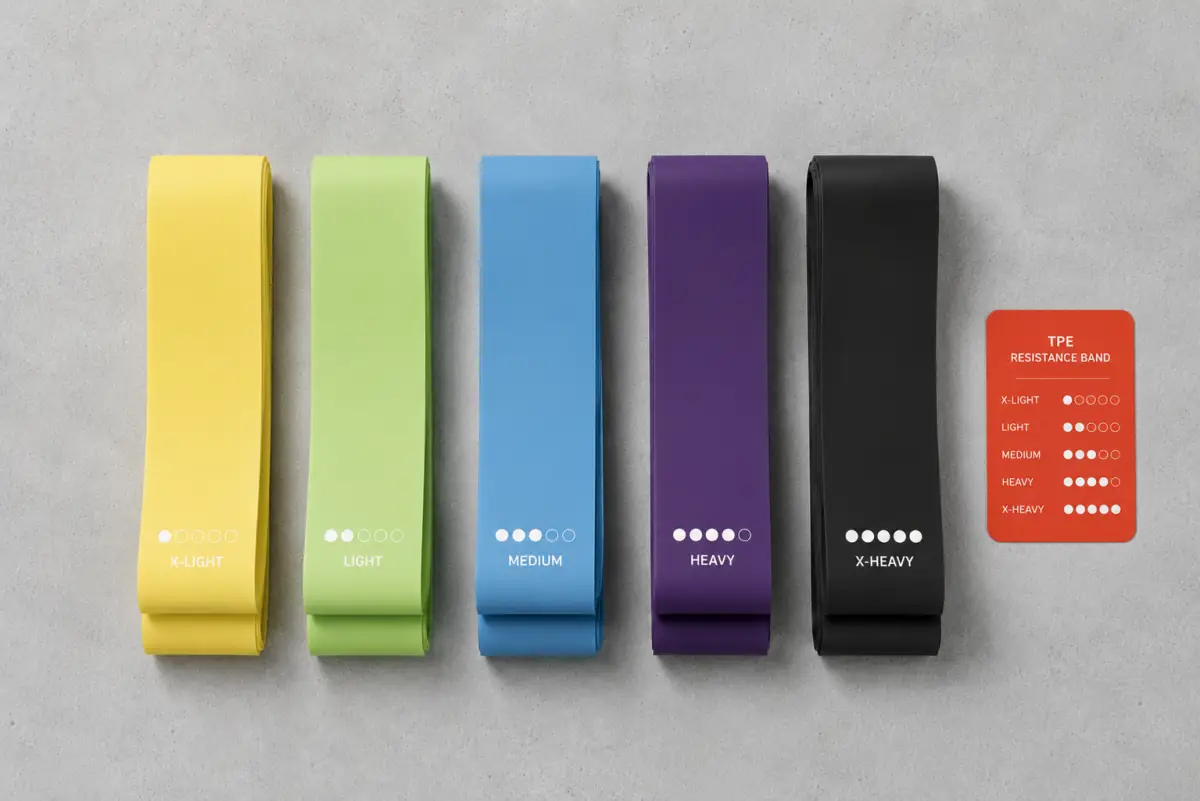
Sourcing resistance bands from a Chinese OEM manufacturer starts at around $0.80–$2.40 per unit FOB depending on material, width, and customization level, with standard MOQ at 300–500 units per color. Lead time from order confirmation to goods ready is 25–35 days for standard TPE or latex bands, with sea freight adding 18–25 days to US destinations.
That’s the answer to the first question most buyers have. Everything after it — which material, which supplier structure, which channel requirements, what compliance documentation — is the decision work that determines whether a sourcing program runs profitably or generates problems on the second order.
This guide is the starting point for B2B buyers building or expanding a resistance band product line: private label brands, Amazon FBA sellers, fitness studio chains, corporate wellness program buyers, and distributors sourcing at scale. Each section links to a deeper guide for the decisions that need more than a paragraph.
Quick Summary
- Resistance bands are produced in three primary materials for B2B: natural latex (highest elasticity, highest allergen risk), TPE compound (latex-free, best for retail and corporate channels), and fabric-covered elastic (premium feel, studio and gift set positioning). Each has different MOQ thresholds, compliance profiles, and channel fit.
- Standard MOQ for branded resistance bands is 300 units per color for latex and TPE bands; 100 units for fabric-covered bands in some configurations. Custom compound colors or proprietary texture patterns start at 500 units.
- Private label customization — logo printing, custom colors, packaging design — is available from most mid-size factories at the 300-unit MOQ tier. Full sublimation printing on fabric bands starts at 100 units.
- Amazon FBA is the highest-volume channel for resistance bands and carries specific compliance requirements: chemical testing (CA65, REACH), packaging dimensions compatible with Amazon’s poly bag and labeling standards, and ASIN setup that correctly classifies the product to avoid dangerous goods review.
- Total landed cost for a standard TPE resistance band set (5-band, zip pouch, logo print) from China to a US warehouse runs $2.20–$4.80 per set depending on order size and shipping terms — the factory’s quoted price is typically $1.20–$2.80 FOB.
Why Resistance Bands Are a Strong B2B Sourcing Category
Resistance bands occupy an unusual position in the fitness equipment market: they are among the lowest unit-cost products in the category, ship flat, have no battery or motor components to fail, and generate repeat purchase cycles because buyers replace them as bands wear, lose, or want to upgrade.
For B2B buyers, these characteristics translate to specific sourcing advantages. A 500-unit order of resistance band sets ships in two to three cartons — a container that would hold 500 yoga mats holds tens of thousands of resistance band sets. The freight cost per unit is low. The customs duty on most resistance band classifications runs 2.4–4.9% of FOB value, below the rate for many gym equipment categories. And the product has enough SKU flexibility — material, width, resistance level, color, packaging — to support product differentiation without custom tooling.
The challenge is that this same accessibility makes the category crowded at the generic end. A resistance band with a printed logo and a poly bag is indistinguishable from a hundred competitors at retail. The B2B sourcing decisions that actually produce a defensible product — material selection, resistance level calibration, packaging that positions the product correctly for the intended channel — are where margins are made or lost.
Material Selection: The First and Most Consequential Decision
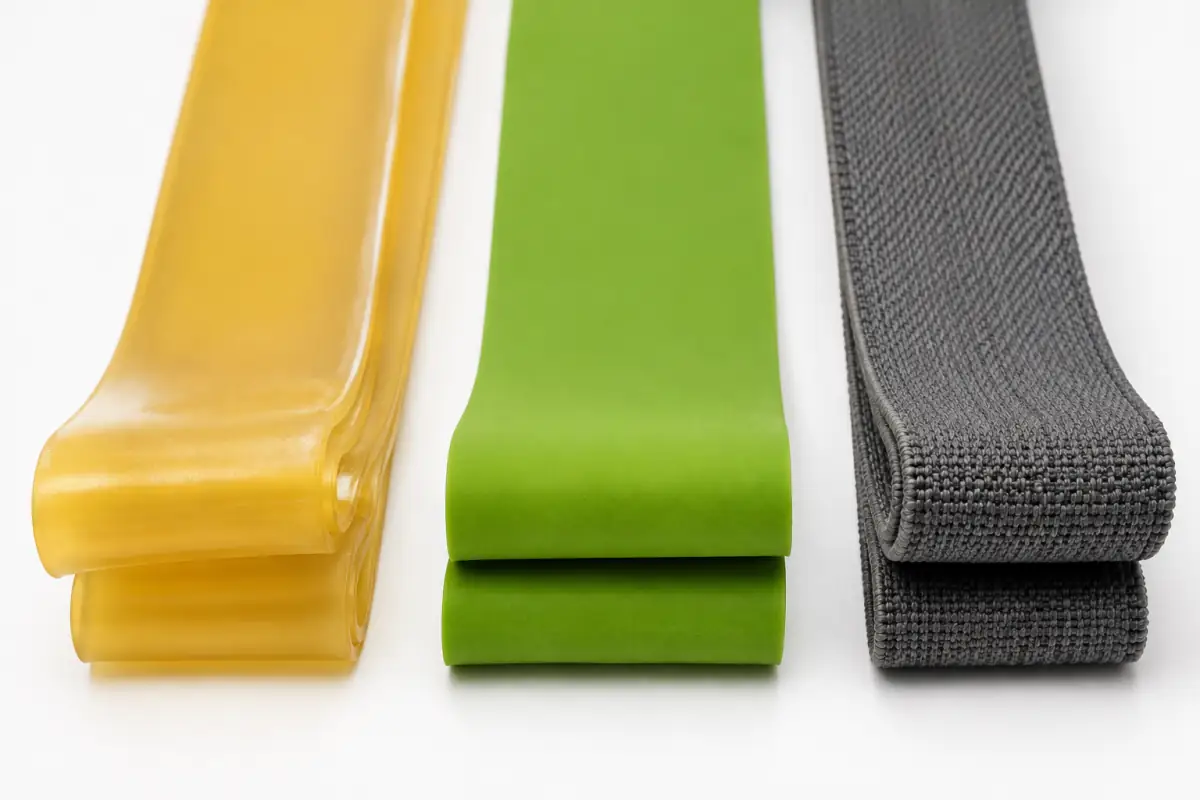
The material of a resistance band determines its performance, its allergen risk, its compliance requirements, and its MOQ threshold. Getting this decision right at the beginning prevents a costly switch mid-program.
Natural Latex
Natural latex resistance bands have the highest elasticity return — the snap-back force per unit stretch is greater than synthetic alternatives — and the most established track record in professional sports and physical therapy settings. The material is biodegradable and often positioned as eco-conscious in marketing.
The trade-off is the allergen risk. Latex allergy affects approximately 1–6% of the general population, with higher rates among healthcare workers and people with multiple prior latex exposures. Products containing natural latex require allergy warning labeling in most major markets, and some corporate procurement policies specifically restrict latex products in office environments.
Production parameters: latex bands are produced in continuous tube or flat sheet form and cut to length. Standard widths (1.3cm, 2.5cm, 4.5cm, 7.5cm, 10cm) cover the full resistance range from light to extra-heavy. MOQ for standard latex bands in existing colors is typically 300–500 units per color.
TPE (Thermoplastisches Elastomer)
TPE compound bands are latex-free, making them the correct specification for retail channels, corporate programs, and any context where latex allergy is a liability. The material is produced in compound form and can be mixed to precise Shore A hardness values, giving OEM buyers control over the resistance feel that natural latex cannot match.
TPE bands feel slightly different than latex under load — less “live,” with a different spring-back character. For most fitness applications this difference is imperceptible. For physical therapists and high-level athletes who have worked with latex for years, it registers. Channel positioning matters here: fitness retail, corporate wellness, and studio beginner programs don’t require the latex feel; specialty PT supply and performance markets may prefer it.
TPE compound colors are controllable via dye mixing, which supports custom brand colorways and the industry-standard resistance-level color coding systems (light/medium/heavy/extra-heavy corresponding to specific colors by convention).
Fabric-Covered Elastic
Fabric resistance bands — typically a woven polyester or nylon sleeve over an elastic core — are the premium positioning option in the category. They don’t roll, don’t pinch skin, don’t leave the rubber smell that some users associate with latex or TPE, and photograph with a quality aesthetic that reads as premium in retail and social content.
The trade-off is production complexity and cost. Fabric bands are 40–80% more expensive per unit than equivalent-resistance TPE bands. MOQ is lower for some configurations (100 units for standard fabric-over-elastic in stock colors) but customization options are more limited than compound-mixed TPE.
Channel fit for fabric bands: premium DTC brands, studio gift sets, corporate wellness programs where the unboxing experience matters, and high-ticket resistance band kit products ($40–$80 retail).
For a full material comparison with channel fit matrix and compliance profile by material, the resistance band materials guide covers all three in detail.
MOQ, Pricing, and Lead Time: The B2B Order Structure
MOQ by Material and Configuration
| Configuration | MOQ per Color | Anmerkungen |
|---|---|---|
| Standard latex, stock width | 300–500 units | Existing colors only; no compound changes |
| Custom latex color | 500+ units | Compound dye mixing requires larger batch |
| Standard TPE, stock color | 300 units | Most common entry point |
| Custom TPE color (Pantone ref) | 300–500 units | Compound chip approval required first |
| Fabric-covered, stock color | 100–200 units | Lower MOQ; limited customization |
| Fabric-covered, custom print | 200–500 units | Sublimation print; MOQ varies by factory |
| Resistance band set (5-band + pouch) | 300 sets | Set MOQ includes all components |
Unit Price by Order Scale
| Order Scale | Standard TPE (per band) | Latex (per band) | Fabric (per band) |
|---|---|---|---|
| 300–499 units | $0.90–$1.40 | $1.00–$1.60 | $1.80–$2.60 |
| 500–999 units | $0.80–$1.20 | $0.90–$1.40 | $1.60–$2.20 |
| 1,000+ units | $0.65–$0.95 | $0.75–$1.10 | $1.30–$1.80 |
Prices quoted EXW Yangzhou (factory gate) or FOB Shanghai depending on agreed trade terms. EXW Yangzhou gives buyers full control over inland trucking to port; FOB Shanghai includes Yangzhou–Shanghai freight and export clearance. Custom compound colors, custom mold textures, or non-standard packaging add to these ranges.
Lead Time from Order to Warehouse
| Stage | Duration |
|---|---|
| Sample production (if needed) | 7–10 days |
| Sample approval | 3–5 days |
| Production (standard) | 25–35 days |
| Pre-shipment inspection | 2 days |
| Sea freight: China → US West Coast | 18–22 days |
| Sea freight: China → US East Coast / EU | 25–32 days |
| Customs clearance + inland delivery | 5–8 days |
| Total (first order, US West Coast) | 60–82 days |
| Total (repeat order, approved spec) | 48–65 days |
For full detail on MOQ thresholds, payment structure, and lead time planning by order type, the resistance band MOQ and lead times guide covers the complete order structure.
Private Label and Customization: What’s Actually Available
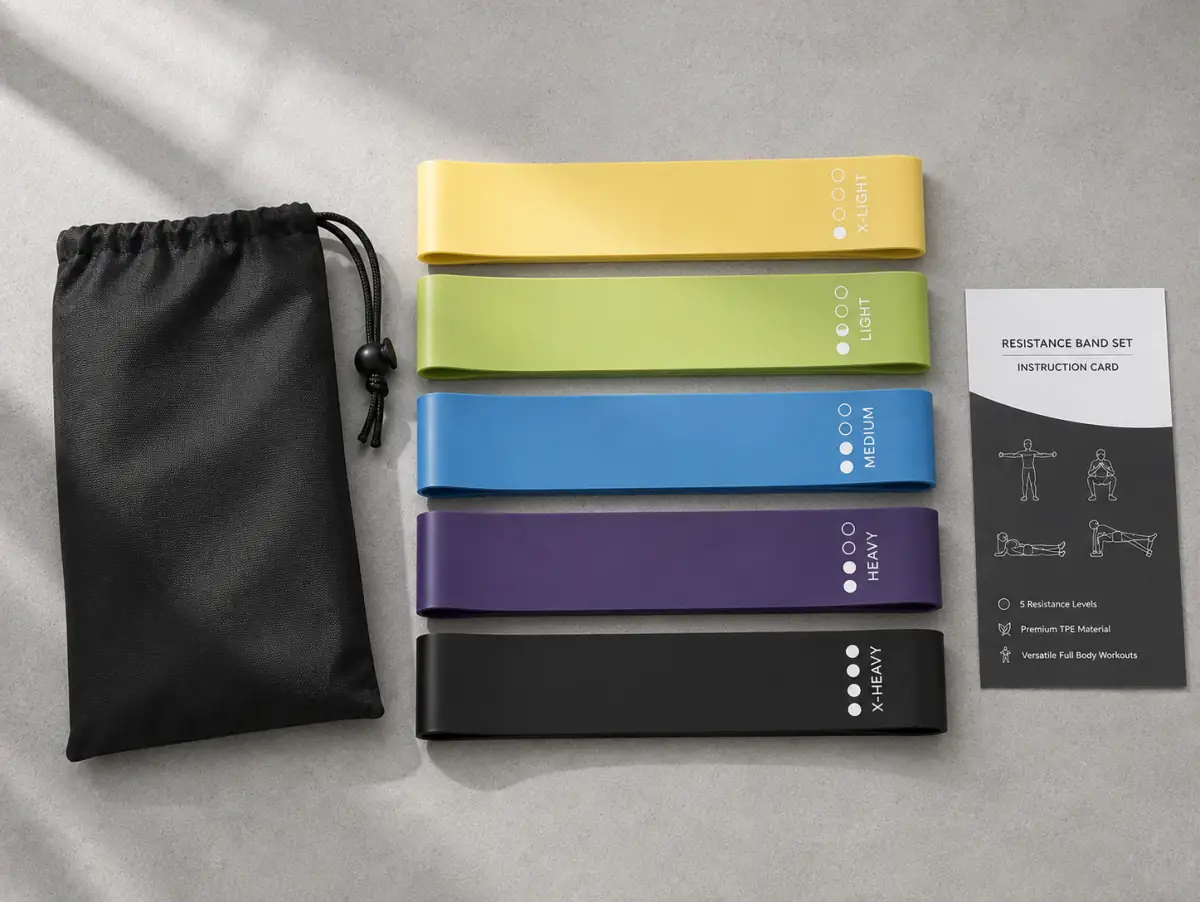
Resistance bands are among the most customizable products in the fitness equipment category because customization doesn’t require expensive tooling. The main options:
Logo placement. Screen print, heat transfer, or embossed deboss on the band surface. Logo placement on a 10cm-wide flat band is straightforward; on a narrow 1.3cm band, text-heavy logos reduce to a simple mark or name. Specify the logo in vector format (AI, EPS); the factory’s art team will confirm maximum resolution at the specified band width.
Custom resistance level color coding. Industry convention assigns colors to resistance levels (light/medium/heavy/x-heavy), but the specific color assignments vary by brand. Some brands use the industry-standard color sequence; others define their own system that reflects their visual identity. Custom compound colors require a Pantone reference and a compound chip approval before production.
Packaging. Options range from simple OPP poly bag with a printed header card, to a branded zip pouch (common for 5-band sets), to a rigid gift box (premium set positioning), to a custom tube or cylinder container. Packaging MOQ is typically matched to the band MOQ, though pouches and header cards can sometimes be pre-ordered in larger quantities for future reorders.
Fabric print (fabric bands only). Full-surface sublimation printing on fabric band surfaces allows photographic-quality patterns, brand-color designs, or custom artwork at the set level. Sublimation ink bonds uniformly to polyester fabric; the result is wash-fast and abrasion-resistant at the surface.
The private label guide — covering logo options, packaging formats, MOQ by customization type, and the approval workflow from artwork to production — is at private-label-resistance-bands.
Channel Requirements: What Changes by Distribution
The specifications and documentation that a resistance band order needs depend almost entirely on the channel it’s going into. Selling into Amazon FBA, supplying a studio chain, and running a corporate wellness program all require the same product but in different configurations with different compliance documentation.
Amazon FBA
Amazon is the largest single channel for resistance bands in the US market, and it’s also the most compliance-intensive. Resistance bands are not a dangerous goods category by default, but:
- Latex bands trigger Amazon’s allergen documentation review if the listing mentions latex
- Some resistance band formulations contain rubber compounds that flag Amazon’s chemical review process
- Packaging must meet FBA poly bag requirements: sealed, with a suffocation warning if the bag opening exceeds 5 inches, barcode scannable through the bag
- ASIN classification errors (wrong product type) can trigger a listing suppression that takes weeks to resolve
The full Amazon FBA specification guide for resistance bands — what to list, how to label, how to navigate the chemical compliance review — is at selling-resistance-bands-amazon.
Studio Chains and Gym Supply
Studio supply buyers prioritize durability and consistency over unit cost. A studio that replaces resistance bands frequently because they snap or lose resistance within 90 days of use will switch suppliers quickly. The specification requirements for studio supply:
- Resistance band elasticity tested to a specific number of stretch cycles (typically 10,000–50,000 cycles depending on the use case)
- Surface that doesn’t collect the skin oils and cleaning product residue that generates grip complaints over time
- Color consistency across reorders (for studios that use color-coded class kits, a new reorder with a slightly different color breaks the system)
Corporate Wellness
Corporate programs want products that photograph well for internal communications, ship cleanly, and don’t generate allergen complaints. TPE compound or fabric bands (never latex) are the correct specification for corporate programs. Packaging for direct-to-employee delivery — individual mailing-ready packaging rather than bulk cartons — adds logistics complexity that needs to be scoped before the order is placed.
The full corporate wellness sourcing context, including MOQ for gifting quantities and multi-location delivery logistics, is covered in the corporate wellness equipment sourcing guide.
Supplier Qualification: What to Look for Before the First Order
A resistance band factory that can produce 300 units of a standard TPE band is not necessarily a factory that can produce 5,000 units of a custom-color, multi-width set with consistent quality across the production run. The qualification criteria that matter:
Production capability. Does the factory mix their own compound or purchase pre-mixed compound from a third-party supplier? A factory that controls their own compound mixing has better control over color consistency and Shore A variation between production runs. A factory using purchased compound is dependent on their supplier’s batch-to-batch consistency.
Quality documentation. Can the factory provide Shore A hardness test reports, dimensional tolerance records, and elasticity cycle test data from recent production runs? A factory that cannot produce documented test results from their existing quality process is a factory whose quality control exists informally — which means it varies by the individual on the line.
Compliance testing history. Has the factory produced CA65 or REACH test reports for products going to the US and EU markets? A factory with no prior compliance testing history will need to be walked through the process, which adds cost and lead time to the first order.
Minimum run size vs claimed capability. A factory that claims capability to produce 50-unit trial runs is typically either using a contracted external production facility (not their own lines) or is significantly below the scale where quality control systems are consistently applied. For branded resistance bands, 300 units is the practical minimum for a production run worth the quality management overhead.
The full factory evaluation framework — including an audit checklist, the questions to ask during factory visits, and how to interpret audit report results — is at resistance-band-manufacturer-evaluation.
Compliance Basics: What’s Non-Negotiable by Market
Resistance bands entering the US and EU markets are subject to chemical regulations that the factory must document before the goods ship. The key requirements:
California Proposition 65 (CA65). Products containing listed substances above established thresholds require warning labeling. For natural latex bands, the relevant listing is N-Nitrosamines, which can be present in the vulcanization process. For TPE bands, phthalate plasticizers are the primary concern if the formulation includes softening agents. A factory using a CA65-compliant compound can provide a third-party test report as evidence; the cost is $200–$400 and the turnaround is 2–3 weeks.
REACH (EU). The EU’s chemical restriction framework limits dozens of substances in consumer products, including certain rubber processing agents and colorants. EU-bound resistance band shipments need a REACH compliance test report from an accredited laboratory. Factories with existing EU export history typically have recent REACH reports on file for their standard compound formulations.
EN 13568 (EU rubber bands standard). Applies to latex rubber bands used in professional and commercial contexts. Most fitness-application resistance bands are tested against this standard for stretch and recovery properties even when not strictly required, because it provides a documented performance baseline.
Requesting compliance documents before ordering — not after goods arrive at the border — is the protection that keeps a compliance failure from becoming an import detention or market withdrawal.
The Full Resistance Band Product Range
For buyers at the specification stage, the resistance band product range provides a reference for available materials, widths, resistance levels, and standard customization options — the starting point for a sourcing inquiry that produces an accurate quote rather than a range estimate.
A complete sourcing inquiry covers: target quantity, material preference, resistance level range (light through extra-heavy, or specific resistance values in pounds or kilograms), preferred packaging format, destination market, delivery deadline, and compliance documentation requirements. With these inputs, a factory can return a full quote — FOB price, tooling cost if applicable, lead time, and compliance documentation availability — within 24–48 hours.
FAQ
What is the difference between resistance bands and resistance tubes?
Resistance bands are flat strips of elastic material (latex, TPE, or fabric-covered). Resistance tubes are cylindrical tubes with handles at each end, typically used in cable-based exercise movements. They serve overlapping but distinct exercise applications. B2B buyers often source both categories but from different production processes — flat band production and tube production use different equipment and may be at different factories. Confirm which format you need before requesting quotes; factories often specialize in one or the other.
Can we order multiple resistance levels in the same production run?
Yes, and this is the standard structure for resistance band sets. A factory running 300 units of a 5-band set produces 1,500 individual bands — 300 each at light, medium, heavy, extra-heavy, and x-heavy resistance. The production run is the set quantity (300 sets), not the individual band quantity. Confirm whether the factory’s MOQ refers to sets or individual bands before comparing quotes from different suppliers.
How do we test resistance level consistency between production runs?
Resistance level consistency is tested by measuring the force required to stretch a band to a specified extension percentage — typically 100% elongation (double the resting length) and 200% elongation. A resistance band at “medium” resistance should produce a force within ±10% of the established reference at the same elongation. Require the factory to provide force-extension test data from each production run, compared to the approved reference. This is testable with a standard force gauge and prevents the common problem of “medium” bands that feel noticeably different from the original specification on a reorder.
Is there a minimum order for a custom resistance band color?
For standard compound TPE bands, minimum order for a custom Pantone-matched color is typically 300–500 units per color. The compound mixing requires a batch that justifies the dye-mixing setup. For fabric-covered bands, custom print color is applied at the print stage and doesn’t require a compound change — custom-color fabric bands can sometimes be ordered in quantities as low as 100 units if the factory accommodates small print runs.
What is the shelf life of resistance bands in storage?
Latex bands in unpackaged storage have a shelf life of 12–18 months before the natural rubber begins to oxidize and crack. Bands stored in sealed packaging (individual poly bags, away from direct light and ozone-generating equipment) can maintain performance for 24–36 months. TPE bands are more stable than latex in storage — 36–48 months in sealed packaging is typical. Fabric-covered elastic bands have the longest storage stability, as the fabric layer protects the elastic core from UV and ozone degradation.
Related reading by topic:
– Material selection: Latex vs TPE vs Fabric Resistance Bands — B2B Comparison Guide
– Product range: Full resistance band range and specifications