A corporate wellness manager at a 400-person company wants to distribute branded resistance bands to employees for a home fitness initiative. The brief sounds straightforward. It isn’t. The product needs to be latex-free (the company’s general counsel flagged allergen liability). It needs to arrive individually packaged, because the bands are shipping to home addresses in three countries. It needs the company logo on the band and on the packaging. And the HR team wants it done in six weeks, which is when the Q4 wellness initiative launches.
Resistance bands for corporate wellness programs are a distinct sourcing context from retail or Amazon FBA. The volume is typically 200–1,000 units for a single program. The packaging requirement is individual-unit mailer-ready rather than shelf-ready. The compliance requirement is stricter on allergens than a typical retail buyer would specify. And the timeline is often driven by an internal launch date rather than a product development roadmap.
This guide covers how to source resistance bands for corporate wellness programs: material specification, MOQ structure, packaging requirements for direct-to-employee distribution, compliance considerations, and how to structure the inquiry to get an accurate quote quickly.
Quick Summary
- Corporate wellness resistance bands should always be specified as TPE (latex-free). Natural latex allergy affects 1–6% of the general population; distributing latex products in an employee context creates allergen liability that most corporate legal teams will not approve. TPE specification eliminates this risk entirely.
- Standard MOQ for a branded TPE resistance band set for corporate use is 300 sets — which is the same as retail private label. The corporate context does not lower MOQ, but it does affect packaging requirements: individual-unit mailer-compatible packaging is a different specification from retail shelf packaging.
- Direct-to-employee distribution (bands shipped to home addresses) requires individual-unit packaging that can survive postal or courier handling: a sealed pouch or box that protects the product, carries the FNSKU or address label surface, and doesn’t require assembly at the company’s facility.
- Lead time for a branded corporate wellness order is 35–55 days from order confirmation to delivered units — including sample approval, production, and shipping. A six-week internal launch deadline with no existing approved samples is not achievable without a pre-approved specification or a stock-color, pre-production approval shortcut.
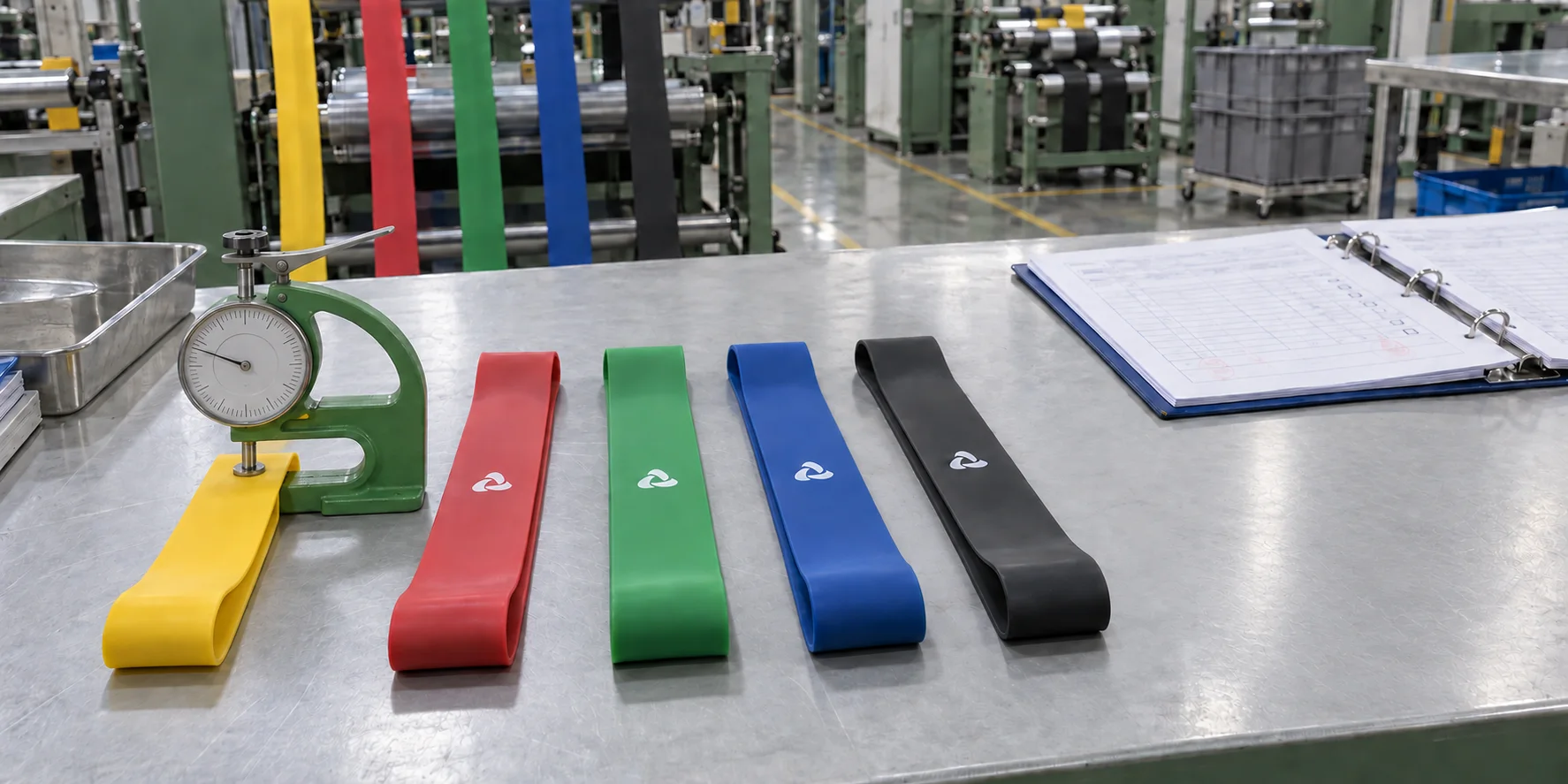
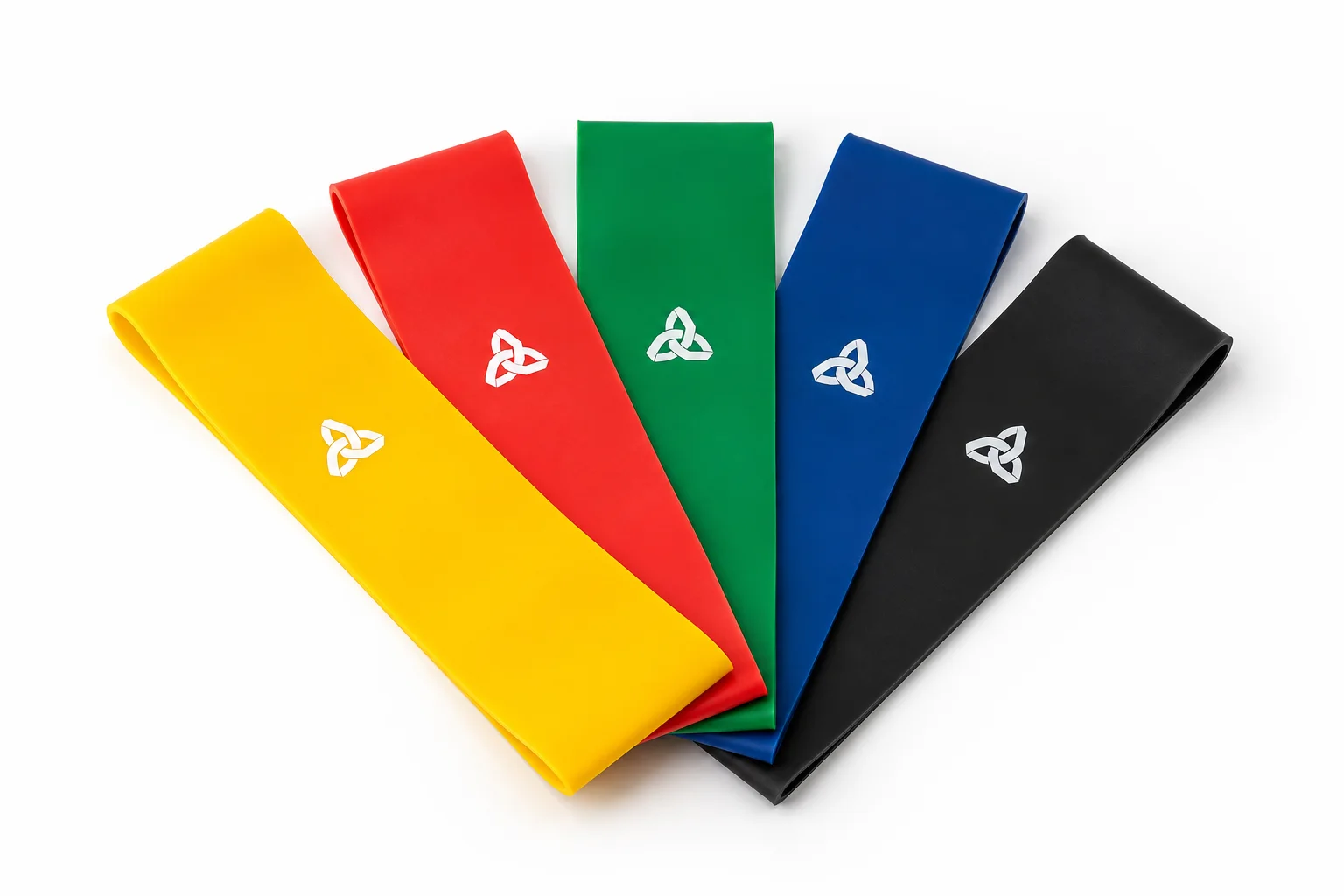
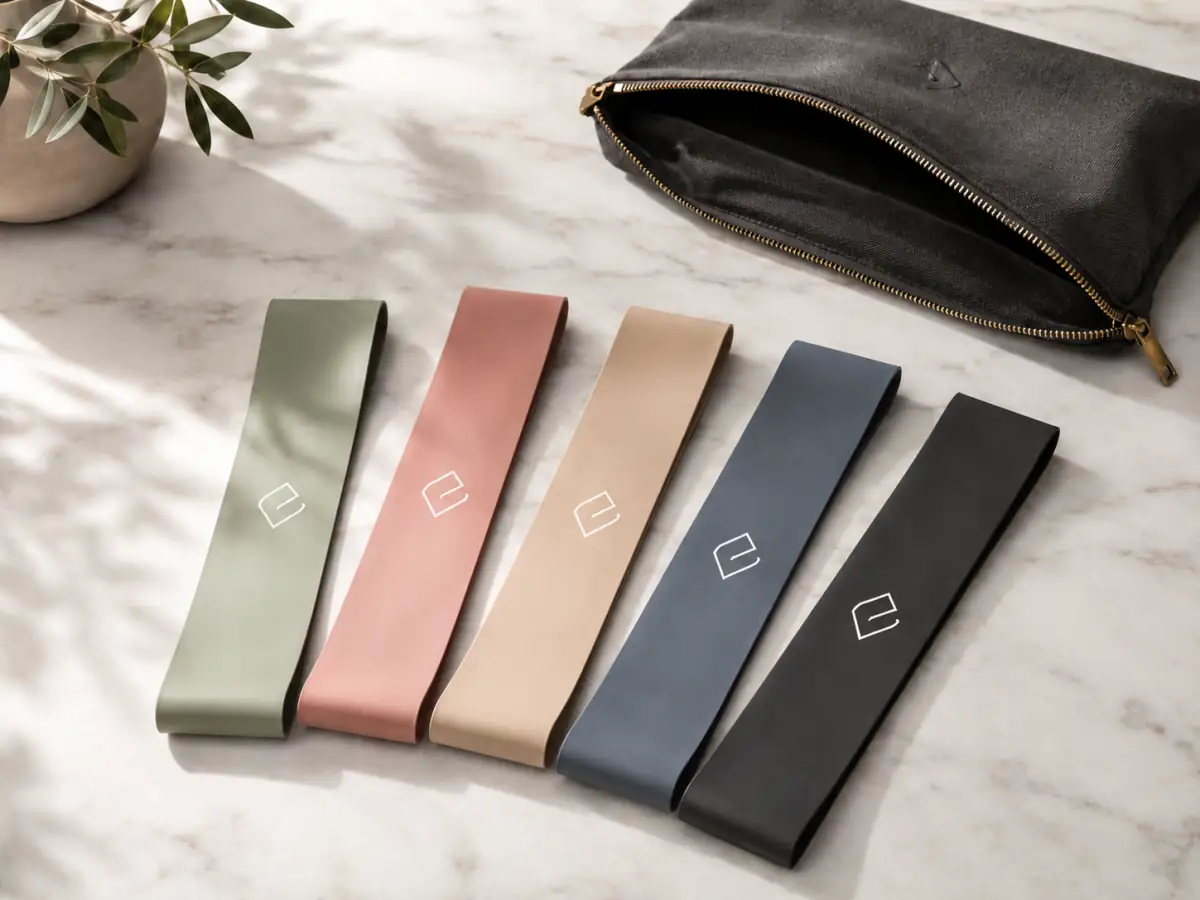
- Unit quantities of 200–500 are common for corporate wellness programs. At these quantities, a 5-band set is typically the right format — it provides a complete resistance range for home workouts and photographs well for internal communications. Single-band orders at corporate quantities are usually for PT-adjacent programs (post-injury recovery, physical therapy at-home programs).
Material Specification: Why TPE Is Non-Negotiable

The corporate environment introduces allergen risk management in a way that retail does not. A retail customer who is allergic to latex reads the product label and doesn’t buy the band. An employee who receives a company-distributed wellness kit may not read the small print — or may not know they have a latex sensitivity until the reaction occurs.
Natural latex allergy (Type I, IgE-mediated) can cause anaphylaxis in sensitized individuals. Distributing natural latex products to 400 employees without individual health screening creates liability that most corporate legal teams will identify and prohibit as a general policy — not as a case-by-case product review.
TPE resistance bands produce the same functional performance across the resistance range relevant for corporate wellness programs (light to heavy is typically sufficient; extra-heavy resistance levels are rarely needed for the home fitness use cases these programs address). The feel is slightly different from latex, but for users who are not comparing them side-by-side against a latex band, the difference is imperceptible.
Specify TPE explicitly in the inquiry. Do not leave material unspecified and assume the factory will default to TPE — some factories still use natural latex as a default for certain resistance level configurations, particularly in the heavy and extra-heavy tiers where latex’s higher elasticity is a selling point.
MOQ and Volume Structure for Corporate Programs
Corporate wellness bands typically fall into three volume categories:
Small program (200–500 units): A department, a site, or a pilot wellness initiative. At this scale, 300-unit set MOQ is the starting point. Most factories will not go below 300 sets for a custom branded product. If the program requires 200 sets, the buyer orders 300 and holds 100 for the next program cycle or for employee onboarding kits.
Mid-size program (500–2,000 units): A company-wide initiative or multi-site distribution. At this scale, pricing moves into the next tier, lead time remains standard, and the factory may be willing to negotiate on packaging customization (custom pouch color, additional insert card content). This is also the scale at which exclusive compound color specification becomes practical without the per-unit cost premium being prohibitive.
Large program (2,000+ units): Enterprise-scale wellness programs, benefits administration companies distributing on behalf of employer clients, or insurance wellness programs. At this scale, negotiations include unit price, lead time priority, and potentially a standing order relationship with scheduled production runs.
Single band vs set: Corporate wellness programs distributing to all employees typically use a 3-band set (light, medium, heavy) or a 5-band set. A 3-band set at a lower price point allows a larger program budget to go further; a 5-band set photographs better for internal communications and provides more workout versatility. Single bands are appropriate for PT-adjacent programs where a specific resistance level is being prescribed — not for general wellness distribution.
Packaging for Direct-to-Employee Distribution

The packaging requirements for corporate wellness distribution differ from retail in one critical way: the package must travel via postal or courier directly to a home address, not from a fulfillment center to a retail shelf.
Mailer-Compatible Packaging
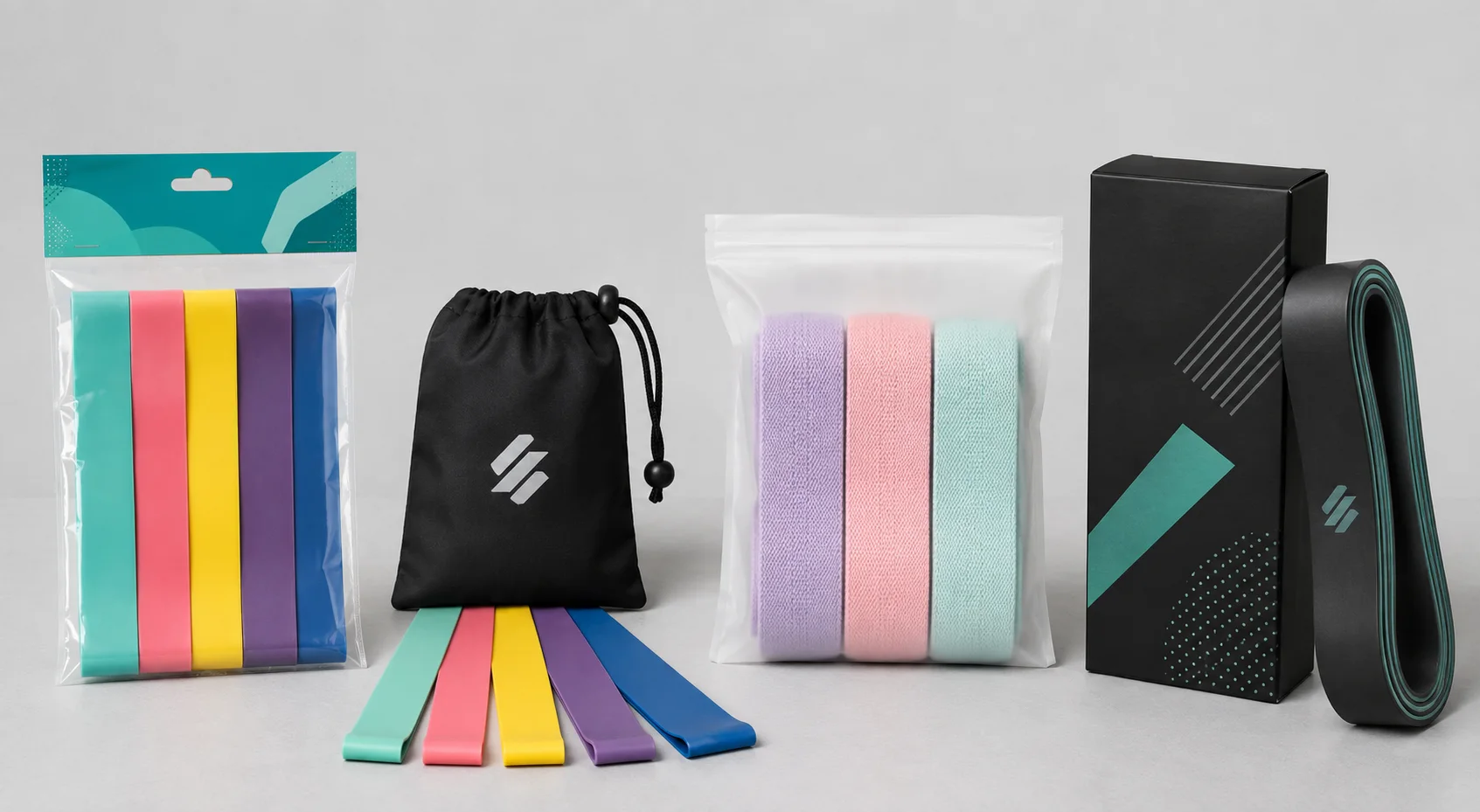
A zip pouch in a poly mailer bag is the most common format for direct-to-employee distribution. The sequence:
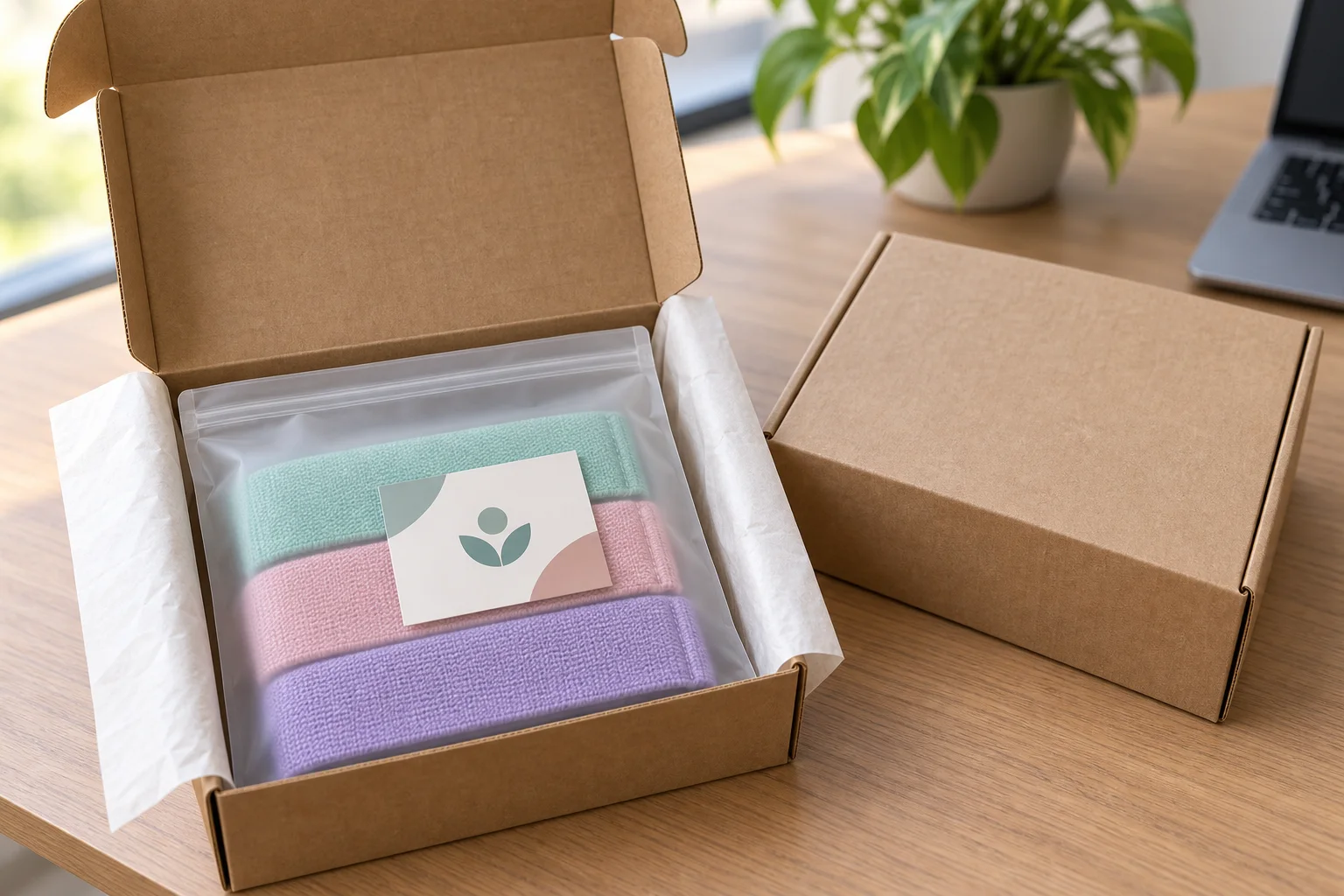
- Resistance bands packed in branded zip pouch with insert card at factory
- Zip pouch sealed in a polybag or placed in a paper poly mailer at a fulfillment center or at the company’s shipping facility
- Mailing label applied to the exterior
- Shipped via USPS, UPS, FedEx, or local courier
The zip pouch must be dimensionally compatible with the chosen mailer size. Standard mailers are available in sizes from 6″ × 9″ to 14″ × 17″; a standard 5-band set zip pouch (approximately 22cm × 16cm) fits in a 10″ × 13″ poly mailer with room for address label placement.
Bubble mailer vs flat poly mailer: For a zip pouch without rigid components, a flat poly mailer is sufficient and less expensive. If the packaging includes a rigid insert card that could bend in transit, a padded bubble mailer adds $0.15–$0.30 per unit but protects the packaging presentation quality — which matters for a branded corporate gift.
Factory-Packed vs Kitting at Destination
Two approaches to final packing for distribution:
Factory-packed: The factory packs the bands into the branded pouch, seals it, and boxes the pouches for shipment to the company’s distribution address or a third-party fulfillment center. The company then mailers individual pouches. This is the most cost-effective approach for high-volume programs and requires that the factory has the pouch specification approved before production begins.
Kitting at destination: The factory ships bands and packaging components separately. The company or its fulfillment partner kits the bands into pouches. This allows late customization (e.g., adding a name tag or specific insert content per employee) but adds kitting labor cost — typically $0.50–$1.50 per unit for third-party fulfillment kitting.
Corporate Branding on Packaging
The packaging insert card is the most cost-effective place to add corporate-specific content — the company’s wellness program name, a QR code linking to workout resources, or a personalized message from the CEO. If the insert card content varies by department or location, this requires separate print runs for each variant (or variable-data digital printing, which is available from some packaging suppliers at larger quantities).
Logo on the band itself (screen print or heat transfer) requires the standard minimum of 300 units per design. Logo on the pouch via screen print also requires 300 units minimum. If the corporate wellness program involves multiple company logos (for a benefits administrator sourcing on behalf of several employer clients), each logo is a separate production run.
Compliance and Documentation for Corporate Distribution
Corporate wellness programs have compliance requirements that individual retail purchases do not:
Insurance and benefits vendor requirements: Companies that administer wellness programs as part of employee benefits may be required to use products that meet specific safety standards. Request documentation from the factory confirming: CA65 test report (for programs distributed in California), TPE material declaration (latex-free confirmation), and country of origin.
International distribution: Programs distributing across multiple countries need packaging compliant with each destination market. A program distributing in the US, UK, and Germany simultaneously needs: US-compliant packaging (CA65 warning if applicable, English labeling), UK post-Brexit import documentation, and EU REACH-compliant product (German or bilingual labeling). Multi-country distribution should be flagged in the sourcing inquiry so the factory can quote compliance documentation costs.
Employee safety records: Some corporate buyers maintain a record of product specifications for employee wellness items in case of product liability claims. Request the factory’s product specification sheet (material, dimensions, test reports) in a format that can be retained in the company’s vendor documentation system.
Structuring the Inquiry
A corporate wellness band inquiry that produces an accurate quote in 24–48 hours includes:
- Quantity: Total number of sets, and the band count per set (3-band or 5-band)
- Material: TPE, latex-free (confirm explicitly)
- Resistance levels: Light / Medium / Heavy is the standard for corporate wellness; specify if a different configuration is needed
- Branding: Company logo on band (Y/N), logo on pouch (Y/N), custom insert card (Y/N)
- Packaging: Zip pouch (standard recommendation), individual mailer-compatible
- Delivery: Destination country, delivery deadline
- Compliance: CA65 test report required (Y/N), REACH required (Y/N)
With this information, a factory can return a full quote — unit price, tooling cost if applicable, lead time, and compliance documentation status — without follow-up questions that delay the timeline.
FAQ
Can we get a sample before committing to 300 units?
Some factories offer paid pre-production samples — 10–20 units in the exact specification — for internal review or HR presentation before the full order is placed. This is not universally available and is charged at a higher per-unit rate (typically 3–5× the production unit price). For programs with internal approval requirements before budget commitment, this option is worth asking about explicitly during the inquiry stage.
What if we want the bands in our brand’s specific color?
Custom compound colors for TPE bands follow the standard process: Pantone reference → compound chip approval → production. The chip approval cycle adds 8–14 days to the sampling phase. For a corporate program with a fixed launch date, allow time for this cycle or build flexibility into the launch by specifying a stock compound color closest to the brand color and accepting a close match rather than an exact match.
Can a factory ship directly to employee home addresses?
Factories in China do not typically fulfill direct-to-consumer shipments. They ship in bulk to a destination address — the company’s warehouse, a third-party fulfillment center, or a freight forwarder. Individual employee distribution from there requires a fulfillment partner or the company’s own logistics operation. For small programs (under 200 units), some US-based private label fulfillment services can handle individual mailer dispatch for $1.50–$3.00 per unit including the mailer.
How do we handle programs that run across multiple quarters?
A standing order structure — where the factory holds the approved specification and can run production with a 2-week notice — is available to corporate buyers with regular repeat volume (500+ units per year). This requires an upfront agreement with the factory and typically involves the buyer paying for packaging component pre-production (pouches, insert cards) in quantity. The advantage is zero sample cycle on reorders and shorter lead time (25–30 days instead of 35–55 days).
Related reading:
– OEM Resistance Band Sourcing: Complete B2B Guide — full sourcing framework including channel requirements by distribution type
– Resistance Band Set Packaging: Bulk, Retail-Ready & Gift Box — packaging format comparison including direct-to-consumer mailer-compatible options
– Private Label Resistance Bands: MOQ, Branding & Packaging — logo options and spec documentation for custom branded bands
– Resistance Band Compliance: REACH, CA65 & Safety Standards — compliance documentation for US and EU market distribution