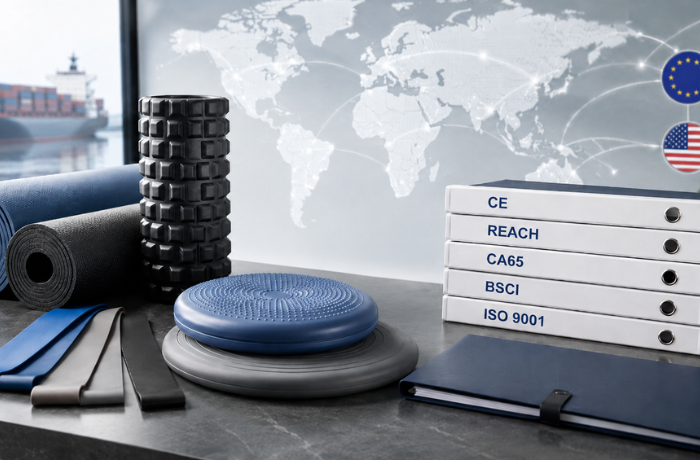
CE, REACH, CA65, BSCI, and ISO 9001 are the five certifications most fitness brands encounter when sourcing OEM products. Each one covers a different dimension — product safety, chemical compliance, social accountability, or quality management — and knowing which applies to your market prevents costly customs holds and retailer rejections.
Quick Summary
- CE is a legal requirement to sell fitness products in the EU/EEA — it’s your product’s passport to the European market.
- REACH governs chemical safety in EU-bound products; yoga mats, foam rollers, and resistance bands all have substances on the SVHC list.
- CA65 (Prop 65) is the practical US compliance standard most retailers and Amazon buyers actually request — broader and stricter than federal CPSIA for adult fitness products.
- BSCI is a factory-level social audit, not a product certification — it covers labor conditions, and must be issued by an amfori-approved body like SGS or TÜV.
- ISO 9001 audits the factory’s quality management system, not the product — retailers use it as a proxy for production reliability.
Why Certifications Matter More Than You Think
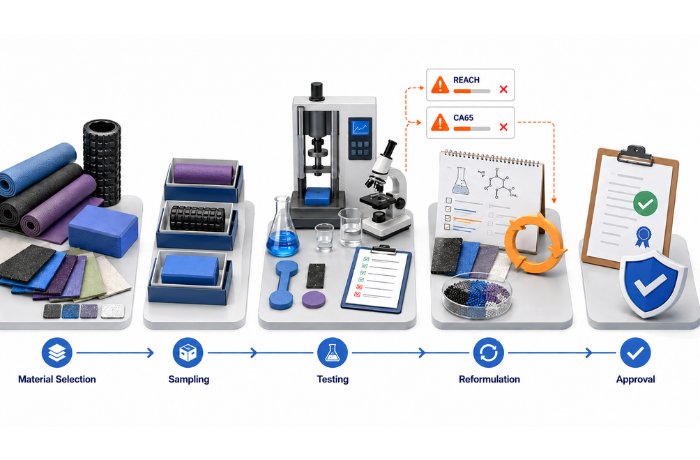
Most first-time OEM buyers think certifications are a formality — something you sort out after the product is designed. In practice, certification requirements should shape material selection before sampling begins. A yoga mat built from a specific PVC compound may clear CE but fail REACH phthalate limits. A foam roller foam density that passes CA65 testing may be incompatible with OEKO-TEX requirements for EU textile retailers.
Getting this sequence wrong means reformulating the product, resampling, and re-testing — adding 6–10 weeks and $1,500–$4,000 in additional costs to an order that was already committed.
For a full picture of how certifications fit into the OEM sourcing process — from sampling through pre-shipment inspection — see our complete OEM fitness equipment manufacturing guide.
CE Marking
What It Is
CE (Conformité Européenne) is not a quality badge — it is a legal declaration that a product meets EU health, safety, and environmental requirements. Without it, a fitness product cannot legally be placed on the market in any EU or EEA member state. Customs authorities can hold or destroy non-compliant shipments at the importer’s expense.
What It Covers for Fitness Products
For yoga mats, foam rollers, resistance bands, and balance pads, CE compliance typically falls under the General Product Safety Directive (GPSD) and relevant harmonized standards. Products are assessed against parameters including: mechanical hazards, material safety, packaging labeling, and instructions for use in the local language of the destination market.
Fitness equipment that incorporates electronic components (smart trainers, resistance machines with displays) must also comply with the Low Voltage Directive (LVD) and Electromagnetic Compatibility (EMC) Directive, which require a Notified Body to conduct the conformity assessment.
How to Get It
For most soft fitness goods (mats, rollers, bands), CE marking follows a manufacturer self-declaration route:
- Identify applicable EU Directives and harmonized standards
- Conduct or commission technical testing against those standards
- Compile a Technical File (product specs, test reports, risk assessment, instructions for use)
- Issue a Declaration of Conformity (DoC) and affix the CE mark
Cost: Third-party lab testing for a yoga mat or foam roller: €400–€900 per product. Technical file preparation: €500–€1,500 if outsourced.
Timeline: 3–6 weeks for testing and documentation, assuming no reformulation is required.
After Brexit: UKCA for the UK Market
Since January 2023, CE marking is no longer sufficient for products placed on the Great Britain market. UKCA (UK Conformity Assessed) marking is required. The process mirrors CE marking, but requires UKAS-accredited testing. If you’re shipping to both EU and UK, you need both marks — they are not interchangeable.
How to Verify a Factory’s CE Claim
Ask for the Declaration of Conformity document, which lists the specific EU Directives claimed and the standards tested against. CE marking has no central registry — there is no database to check it against. What you verify is the technical substance of the Declaration: does it reference actual harmonized standards, is it signed by a responsible person, does it match your product?
REACH Compliance
What It Is
REACH (Registration, Evaluation, Authorisation and Restriction of Chemicals) is an EU regulation managed by the European Chemicals Agency (ECHA). It restricts over 200 Substances of Very High Concern (SVHCs) in products sold in the EU. Unlike CE, REACH is not about declaring safety — it is about proving that specific chemical substances are either absent or present below threshold concentrations.
Why Fitness Products Are High-Risk Under REACH
Yoga mats, foam rollers, and resistance bands all use materials that commonly contain REACH-restricted substances:
- PVC yoga mats: phthalate plasticizers (DEHP, DBP, BBP) are on the SVHC list and have strict concentration limits
- Foam products (EPE, EVA, PE): certain flame retardants and colorant compounds are restricted
- Natural rubber: processing chemicals and vulcanization agents may contain restricted substances
- Surface printing inks and dyes: azo colorants and heavy metals in pigments are subject to REACH restrictions
- Adhesives used in multi-layer construction: solvent residues can trigger REACH scrutiny
How REACH Compliance Works in Practice
Your manufacturer must provide REACH SVHC screening reports from an EU-recognized laboratory (SGS, TÜV, Bureau Veritas, Intertek). These reports test the product against the current SVHC candidate list — updated by ECHA twice yearly.
What to ask for: A full REACH SVHC screening report specific to your product and material. Not a self-declaration from the factory. Not a general factory certificate. A product-specific lab report dated within the last 12 months.
Cost: €200–€600 per product depending on material complexity and number of components tested.
Timeline: 2–3 weeks from sample submission to lab report.
A critical point for buyers: reformulation may be necessary. If your initial PVC mat compound fails phthalate testing, the factory needs to switch to a compliant plasticizer, which changes the material feel and may require another sample round.
CA65 — California Proposition 65
What It Is
California Proposition 65, officially the Safe Drinking Water and Toxic Enforcement Act (1986), requires businesses to warn Californians about significant exposures to chemicals that cause cancer, birth defects, or other reproductive harm. The California OEHHA maintains a list of 900+ chemicals with no-significant-risk levels (NSRL) and maximum allowable dose levels (MADL).
Why CA65 Is the De Facto US Standard
Although Prop 65 is California law, it has become the practical national compliance standard for fitness products sold in the US for two reasons:
First, California represents roughly 14% of US consumer spending. No brand selling through national retail channels or Amazon can realistically exclude California and maintain meaningful revenue.
Second, Prop 65 enforcement is driven by private citizen lawsuits, not regulators. Thousands of enforcement actions are filed annually by private law firms. The settlement cost of a Prop 65 lawsuit — even a frivolous one — typically runs $25,000–$100,000 in legal fees alone, making prevention far cheaper than defense.
What CA65 Tests Cover for Fitness Equipment
For yoga mats, foam rollers, and resistance bands, the primary substances of concern are:
| Substance | Common Source in Fitness Products | CA65 NSRL/MADL |
|---|---|---|
| DEHP (phthalate) | PVC plasticizer | 8.7 μg/day |
| Lead | Pigments, stabilizers | 0.5 μg/day |
| Cadmium | Colorants, stabilizers | 4.1 μg/day |
| Benzene | Rubber processing solvent residue | 6.4 μg/day |
| 1,3-Butadiene | Synthetic rubber raw material | 28 μg/day |
| DINP (phthalate) | PVC foam | 67 μg/day (reproductive) |
How to Get a CA65-Compliant Product
Commission CA65 testing through an ILAC-accredited laboratory. The test report quantifies the migration or content levels of listed substances and compares them to Prop 65 thresholds. Products below thresholds require no warning label. Products above thresholds either require reformulation or must carry the Prop 65 warning label on packaging.
Cost: $300–$700 per product depending on number of substances tested.
Timeline: 2–3 weeks.
Practical note: CA65 compliance documentation is a test report, not a certificate. There is no CA65 mark. What you provide to retailers and Amazon is the lab test report showing substance levels below thresholds.
BSCI — Business Social Compliance Initiative
What It Is
BSCI is a social compliance auditing framework operated by amfori (formerly the Foreign Trade Association). Unlike product certifications, BSCI audits the factory, not the product. It evaluates: working hours and wages, freedom of association, child labor prohibition, health and safety conditions, environmental management, and anti-corruption practices.
Why Retailers Require It
Major retailers — sporting goods chains, wellness brands, e-commerce platforms — face mounting ESG disclosure requirements and investor scrutiny of supply chain labor practices. BSCI audit reports give them documented evidence of supplier social compliance without conducting factory audits themselves.
The Audit Process
BSCI audits must be conducted by an amfori-approved auditing organization. SGS and TÜV are among the most widely recognized. The audit involves a factory visit, document review (payroll records, contracts, safety certifications, environmental permits), and worker interviews. Results are rated on a scale from A (Outstanding) to E (Unacceptable).
Audit validity: 1–2 years depending on rating. A-rated factories can go 2 years; lower ratings may require follow-up audits within 12 months.
Cost: $600–$1,500 per audit depending on factory size and location.
How to Verify a Factory’s BSCI Status
Ask for the full audit report — not just the rating page. The report should include: the auditing body name and accreditation, audit date, factory name and address, and scores by category. Verify that the auditing body appears on amfori’s approved auditor list at amfori.org. Self-declared BSCI compliance without an approved auditor is not accepted by any serious retailer.
ISO 9001:2015
What It Is
ISO 9001 is an international standard for quality management systems (QMS), published by the International Organization for Standardization. It specifies requirements for a QMS that helps organizations consistently meet customer and regulatory requirements and continually improve. For fitness equipment factories, it covers: production process control, document management, non-conformance tracking, supplier management, and customer feedback loops.
What ISO 9001 Does NOT Cover
ISO 9001 is process-focused, not product-focused. A factory with ISO 9001 certification has documented quality processes — but that documentation does not guarantee a specific product meets your quality specification. A factory can hold ISO 9001 and still ship defective goods if your spec was poorly communicated or their processes weren’t applied to your order.
Use ISO 9001 as a proxy for organizational maturity, not as a substitute for product-specific QC inspection.
How to Verify
ISO 9001 certificates are issued by third-party certification bodies (SGS, TÜV, Bureau Veritas, Intertek, BSI). Each certificate has a unique certificate number and an expiry date — typically 3 years with annual surveillance audits. Verify directly on the certification body’s online certificate lookup or request the certificate with the registration number and check it yourself.
All Five Certifications at a Glance
| Certification | What It Covers | Required vs. Requested | Who Issues | Typical Cost | Timeline |
|---|---|---|---|---|---|
| CE Marking | Product safety for EU/EEA market | Required (legal) | Self-declaration + Notified Body | €400–€2,500 | 3–6 weeks |
| REACH | Chemical substances in EU products | Required (legal) | Accredited lab (SGS, TÜV, Intertek) | €200–€600 | 2–3 weeks |
| CA65 (Prop 65) | Chemical exposure thresholds for US market | Requested (de facto standard) | ILAC-accredited lab | $300–$700 | 2–3 weeks |
| BSCI | Factory social compliance | Requested (retailer requirement) | amfori-approved auditor (SGS, TÜV) | $600–$1,500 | 1–2 days on-site + 2 weeks report |
| ISO 9001:2015 | Factory quality management system | Requested (retailer expectation) | Certification body (SGS, TÜV, BV) | $2,000–$5,000 | 3–6 months (initial) |
What to Ask Your Factory Before Sampling
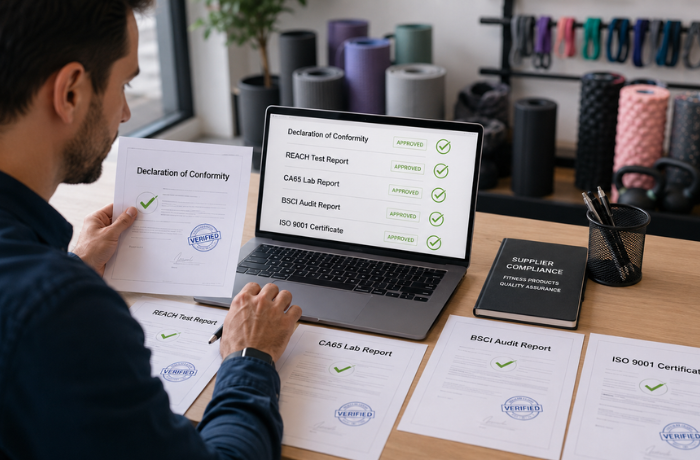
These questions should be in every RFQ before you commit to a sample order:
- “Can you provide CE Declaration of Conformity and REACH SVHC test reports for this product?” — If the factory hesitates, they have not exported to the EU market seriously before.
- “Do you have CA65 Prop 65 test reports for yoga mats / foam rollers / resistance bands?” — A factory regularly exporting to the US will have these on file.
- “Please send your current BSCI audit report including the auditor name and audit date.” — Verify the auditor against amfori’s approved list.
- “What is your ISO 9001 certificate number and which certification body issued it?” — Verify it online in 60 seconds.
- “If I need a product reformulation to pass REACH or CA65 testing, what is the lead time and cost impact?” — Know this before sampling, not after a failed test.
FAQ
Do I need CE marking if I’m only selling on Amazon EU?
Yes. Products sold on Amazon EU marketplaces (amazon.de, amazon.fr, amazon.it, etc.) must comply with EU product safety requirements, including CE marking where applicable. Amazon’s European seller policies require product compliance documentation and can delist non-compliant listings. The legal obligation rests on whoever places the product on the EU market — that is the seller or importer, not Amazon.
Can my factory’s existing CE certificate cover my OEM product?
No. CE marking is product-specific, not factory-specific. A factory may hold CE certificates for their own catalog products, but those certificates do not transfer to your OEM-specified product. Your product requires its own Declaration of Conformity based on testing of your specific material formulation, construction, and design.
How often do REACH and CA65 test reports expire?
Neither REACH nor CA65 has a legally mandated expiry period for test reports. However, ECHA updates the SVHC candidate list twice per year, meaning substances not on the list when your product was tested may be added later. Best practice is to refresh REACH screening annually. For CA65, Prop 65’s chemical list is also updated periodically — annual retesting is increasingly standard practice among brands selling into US retail.
Is BSCI the same as SMETA?
No. BSCI (amfori) and SMETA (Sedex Members Ethical Trade Audit) are both social compliance audit frameworks but are run by different organizations with different audit protocols. Many global retailers accept either; some specify one over the other in their vendor requirements. Ask your target retailer which framework they accept before commissioning an audit — commissioning the wrong one means paying twice.
Related: The Complete OEM Fitness Equipment Manufacturing Guide — MOQ benchmarks, production process, and manufacturer evaluation framework.