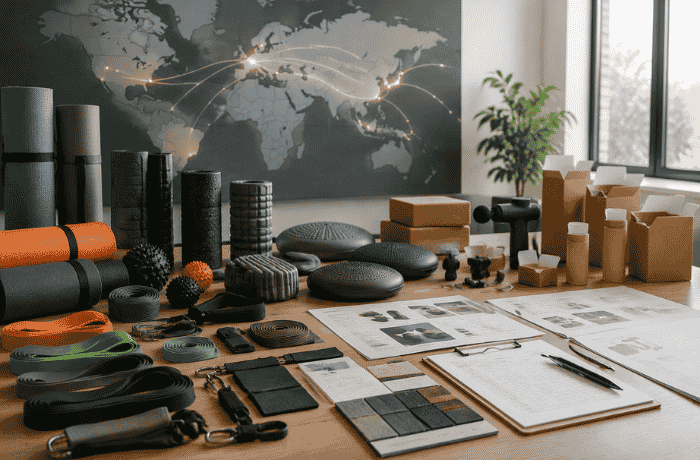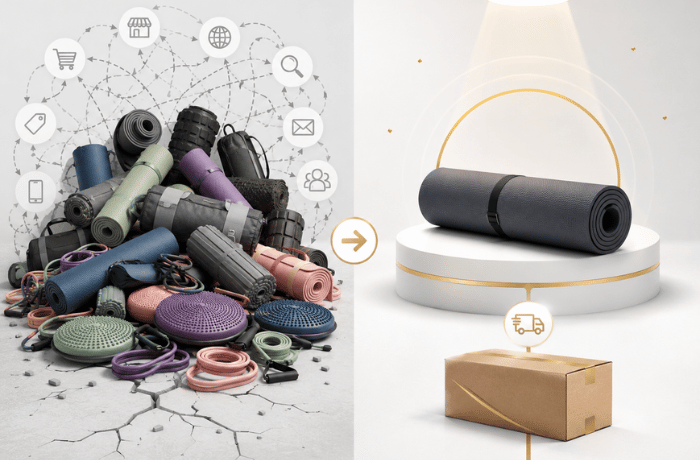
A full product line looks impressive.
More SKUs. More category coverage. More chances to sell.
But in private label fitness product expansion, “more” often comes with weight: more inventory decisions, more packaging variants, more QC points, more supplier coordination, and more opportunities for operational drag.
If you’re already feeling stretched—or your growth curve is starting to flatten—this decision matters more than the product ideas themselves.
You don’t need a bigger catalog.
You need a repeatable system that can carry a bigger catalog without getting heavy.
Schnelle Antwort
Most private label fitness brands should start narrow before they build a full product line.
A focused launch (or focused expansion from 1–3 existing SKUs) helps you validate demand, supplier execution, packaging consistency, and replenishment rhythm before complexity compounds.
A full line tends to work best when:
- customers already buy multiple items in the same “user moment,”
- your operations can absorb more SKUs without breaking reorder discipline, and
- packaging + QC standards are already standardized enough to scale.
Buyer Snapshot
This is most relevant for:
- Amazon fitness sellers expanding beyond 1–3 SKUs
- DTC fitness brands building an expansion roadmap
- Importers and distributors planning assortment coverage
- Sourcing managers making MOQ and supplier-structure calls
Start Narrow vs Full Line at a Glance
| Dimension | Start narrow | Build a full line |
|---|---|---|
| Learning speed | Cleaner signal from one hero SKU | Slower signal; results blur across many launches |
| Inventory exposure | Fewer bets to forecast and reorder | Cash spreads across more SKUs and variants |
| Operational load | Standards are easier to repeat | More places for drift across packaging, QC, and coordination |
| Best used when | When your operating system is still forming | When demand and execution are already consistent |
A full line can scale revenue—but it can also scale the parts that create drag.
At WellfitSource, we often see brands move into a full line one stage too early. The issue is rarely product selection. More often, it’s inventory synchronization and operational readiness.
Why This Decision Feels Bigger Than It Looks
Most buyers think they’re making a product decision.
In reality, they’re making an inventory, packaging, and supplier decision.
The product is usually the easy part. The system behind the product is where expansion becomes heavy—where you feel stretched, where every “small change” creates pressure across approvals, cartons, inspections, and replenishment.
The Pattern We See Most Often: Brands Expand One Stage Too Early
This is the failure mode that shows up again and again.
Not because the next product is wrong.
Because the operating system behind the first product isn’t repeatable yet.
When a Hero SKU Is Still Teaching You Something
A hero SKU is supposed to teach you the boring things that keep you profitable:
What positioning actually converts. What customers complain about (and what they ignore). What your packaging needs to survive shipping. What your reorder cycle really looks like once you’re past the first launch.
If your hero is still teaching those lessons, adding SKUs doesn’t speed you up.
It just adds noise.
Why Growth Slowdown Creates False Urgency
Slower growth often creates the feeling that the catalog is the problem.
In many cases, the real bottleneck is execution.
That’s why adding SKUs can feel like progress—while quietly making everything harder to manage.
What Starting Narrow Actually Gives You
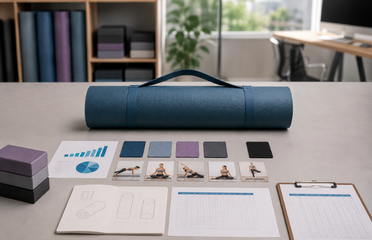
If you want a deeper look at how routines connect categories (yoga → recovery), see our guide on fitness product category expansion.
Starting narrow isn’t a virtue signal. It’s a way to get specific advantages that compound.
Cleaner demand signals
When you have one hero, the signal is clean.
You can see what’s driving conversion, which variant matters, and whether your positioning is working.
Once you launch five products at once, you can still grow—but it becomes harder to tell what’s actually pulling the weight.
Faster packaging learning
Packaging is one of the most underestimated parts of private label fitness products.
A yoga mat that looks perfect in the sample can arrive scuffed, creased, or split at the seams if the carton spec is off. A foam item can compress. A label can peel.
We’ve also seen foam categories like a Schaumstoff-Balancepad behave “adjacent” commercially, but very different operationally once storage footprint and compression tolerance show up.
You don’t “solve packaging” by thinking harder. You solve it by repeating the same system until it holds.
Simpler supplier coordination
Every SKU adds back-and-forth:
spec confirmations, label proofs, test reports, inspection expectations, shipment timing.
If that coordination isn’t already calm with one hero SKU, it won’t get calmer with eight.
Less inventory noise
Inventory noise is when you’re technically “in stock,” but still losing sales.
One color is missing. One size is stuck. One SKU becomes a slow mover that drags cash and attention.
Starting narrow reduces the surface area for that kind of stress.
At WellfitSource, we often see brands discover packaging, replenishment, or QC problems only after adding adjacent products. The issue wasn’t product expansion itself. The issue was expanding before the first system became repeatable.
When a Full Product Line Starts Making Sense
This is the part that gets missed: a full line can work.
But it usually works after the system is already boring and consistent.
Customers already buy the next product naturally
The cleanest expansions follow routines.
Yoga mat buyers often want yoga accessories next.
If you’re building around yoga, it helps to map the step-down from a hero Yogamatte into yoga accessories (blocks, straps, towels) before you jump categories.
Foam roller buyers often add recovery accessories.
For recovery lines, a hero Schaumstoffrolle often pulls through into recovery accessories—but only when packaging and QC feel consistent across the set.
Resistance band buyers often add training accessories.
For training, Widerstandsbänder tend to expand cleanly into training accessories because the “user moment” stays coherent.
If you need to “force” the next product with deep discounting or complicated bundles, that’s not a pull signal.
Reorders feel predictable
When reorders feel predictable, you’re no longer guessing.
You know your lead times, your sell-through, and how much buffer you actually need.
That predictability is what makes multiple SKUs manageable.
Packaging no longer requires reinvention
If every new SKU needs a brand-new packaging template, you’re rebuilding the machine while running it.
A full line becomes realistic when your packaging system is modular: reusable templates, standard label placement rules, consistent carton specs.
Supplier communication is stable
Stable doesn’t mean perfect.
It means you’re not constantly re-explaining expectations. Your QC language is shared. Your approvals don’t turn into fire drills. Your timelines are believable.
The Four Expansion Costs Buyers Underestimate
You don’t feel these costs on the mood board.
You feel them in the week-to-week grind.
MOQ multiplication
A brand adds “just two” new SKUs.
Then each SKU has two colors.
Then each color needs its own packaging.
Suddenly MOQ isn’t a number. It’s a stacking problem that ties cash up across slow movers.
Inventory fragmentation
This is the quiet killer.
Your hero sells, but one variant goes out of stock. Or the new SKU sells slower than forecast and your warehouse starts filling up with the wrong cartons.
The business looks bigger, but the cash feels tighter.
QC variation
One SKU feels premium.
Another feels slightly off.
That’s how brands get reviews like “Love the mat, hated the bands.” Not because the category is wrong—but because standards weren’t normalized before the catalog grew.
Communication fatigue
Every SKU creates a few more approvals, a few more proofs, a few more opportunities for mismatch.
When the team is small, this becomes the real bottleneck—not the product ideas.
Quick expansion rule: If your current SKU still reveals new packaging, inventory, or QC problems every month, you’re probably not ready for a full line yet. If operations feel predictable, adjacent expansion usually becomes safer.
A Smarter Expansion Path for Fitness Brands
The strongest brands usually don’t build a line.
They earn a line.
- Stage 1: Hero SKU — lock positioning, packaging, QC checkpoints, and replenishment rhythm.
- Stage 2: Adjacent product — add the next item in the same routine.
- Stage 3: Category collection — build a coherent set with shared standards.
- Stage 4: Full line — expand coverage only when execution stays consistent.
A Practical Question Before You Add Another SKU
Can your current system support another SKU without creating:
inventory stress, packaging changes, supplier confusion, or QC drift?
If not, the next product is probably arriving too early.
Where WellfitSource Fits
At WellfitSource, we often see buyers focus on the next SKU while underestimating the systems that support it.
The most successful expansions usually happen when packaging, QC, and replenishment standards become repeatable before the catalog becomes larger.
If you want to pressure-test your expansion timing, we can help you map adjacencies, MOQ exposure, packaging templates, and QC checkpoints before you commit to a broader line.
If you’re evaluating whether a category is truly adjacent (commercially und operationally), start with how fitness brands evaluate new product categories.
If you’re planning a move into recovery, don’t skip recovery product sourcing risks—that’s where packaging and material behavior can surprise teams.
And if your growth plan depends on attach rate, fitness product bundles is the cleanest place to start.
If coordination is the bottleneck, here’s our take on fitness supplier structure.
FAQ
Should private label fitness brands start with one product or a full line?
If you’re early, start with a hero SKU. Not because a full line is “bad,” but because your first product is where you learn whether your positioning, packaging, and replenishment can survive the real world.
How many SKUs should a fitness brand launch with?
For most brands, one hero SKU plus one to three adjacent products is enough. If you can’t reorder those calmly, adding five more won’t fix the problem.
What is the biggest mistake in fitness product expansion?
Expanding product count before the operating system becomes repeatable. Most “product failures” are really packaging, inventory, or QC failures showing up late.
When is a full fitness product line justified?
A full line becomes justified when demand feels predictable and expansion no longer requires constant firefighting across packaging, inventory, and supplier coordination.
How can brands expand without increasing inventory risk?
Expand in stages, keep products inside the same user moment, and pressure-test MOQ exposure and packaging standards before you commit to wider coverage.
How can WellfitSource help with private label fitness expansion?
We help buyers evaluate adjacency (what belongs together), MOQ stacking risk, packaging templates, QC checkpoints, and supplier coordination—so you don’t discover the weak spot after the containers land.