Scaling from 200 to 500+ units per order does not mean doing more of the same thing. It means entering a different category of risk — where the relationship with your factory stops carrying you past the gaps in your contracts, and every undocumented assumption becomes a potential production failure, a compliance rejection, or a missed retail window. This guide covers the five risk categories that surface at scale, and what to put in place before the problems arrive.
Quick Summary
- At entry-level quantities, a good factory relationship masks weak contracts. At scale, the contract is all you have when the relationship is under stress.
- The five risk categories that surface when a fitness brand scales past 500 units: IP and tooling ownership, quality and inspection consistency, compliance and channel requirements, capacity and production planning, and financial exposure through payment terms.
- Retail channels (Amazon Vendor, REI, Target) require a compliance document package that most small-brand sourcing operations have never assembled — and they require it before your first purchase order is issued.
- Corporate wellness and fitness studio chains represent the highest-value B2B segments in the fitness accessories market — and the lowest-competition content and sales environment, because most suppliers haven’t bothered to speak their language.
- The goal of scaling your sourcing operation is not to find a better factory. It’s to build a supplier relationship that holds its shape under the pressure of higher volume, stricter channels, and fewer margins for improvisation.
The Moment You Realize the Game Changed
Picture this: your first 500-unit order arrives at the 3PL on a Thursday afternoon. The pallet comes off the truck. The cartons are labeled correctly. The shipping marks look right. You cut open a case and pull out a unit.
Something is slightly off. Not catastrophically wrong — just slightly. The foam density feels a touch softer than your approved sample. The colorway is half a shade warmer than the Pantone reference you signed off on eight weeks ago. The seam closes at 3mm instead of 4mm.
At 200 units, you catch this at the pre-shipment inspection, send a photo to the factory, get a credit on the next order, and move on. The relationship absorbs the gap.
At 500 units, you’ve already sold forward to four wholesale accounts. The shipment is in transit before your inspector even filed the report. The units go to your 3PL. Your accounts receive them. One buyer places the product next to your approved sample from the previous season and takes a photograph. You know what email comes next.
The factory didn’t change what they were doing. You changed what was at stake. And everything your sourcing operation wasn’t doing right — the inspection protocol you kept meaning to formalize, the production specification sheet that was “close enough” on the first few orders, the contract clause about color tolerance that you planned to add “next time” — all of it surfaces at once.
This is not a story about a bad factory. It’s a story about what happens when a sourcing operation that was calibrated for small orders encounters the physics of scale.
What Actually Changes at 500+ Units
The difference between entry-level sourcing and scaled sourcing is not quantity. It’s accountability structure.
At 200 units, the factory’s goodwill fills the gaps in your agreements. They fix problems informally because the relationship is young and they want your future orders. You operate on trust, on WhatsApp, on the assumption that both parties want things to go well.
At 500 units and above, three things happen simultaneously:
Your exposure per order increases. A 5% quality failure rate at 200 units means 10 units. At 1,000 units, it means 50 units — potentially an entire wholesale account’s first season order. The tolerance for informal problem-solving collapses.
Your channels become more demanding. Moving from direct-to-consumer into Amazon Vendor Central, specialty retail, or B2B channels like corporate wellness means compliance requirements that didn’t exist before. These channels require documentation chains, vendor audits, and product compliance files that take months to assemble — and reject you at the door if you show up without them.
Your factory relationship faces different pressure. At higher volumes, factories start having opinions about your production schedule, your payment terms, and your price. The informal goodwill that carried you through early orders doesn’t scale the same way your order volume does. The relationship needs structural support — in contracts, in production agreements, in documented quality standards.
None of this means your factory became a worse partner. It means the sourcing infrastructure that was adequate at entry level is now the weakest link in your operation.
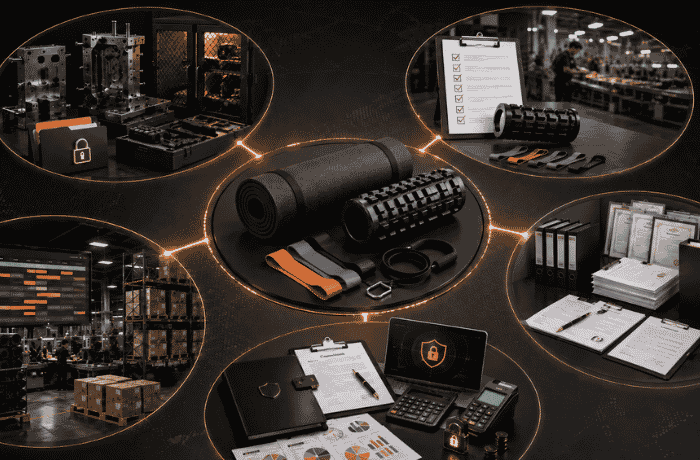
The Five Risk Categories That Surface at Scale
Risk Category 1: IP and Tooling Ownership
If you’ve commissioned custom tooling — a mold for a foam roller end-cap, a cutting die for a resistance band buckle, a custom texture emboss for a yoga mat — you’ve paid a tooling fee. That fee is on your invoice. It feels like a purchase.
In China, a tooling fee receipt is not proof of ownership. Ownership is established by a written clause that names the mold, assigns it a serial number, and specifies the factory’s obligation to release it within a defined timeline on your written request. Without that clause, the mold stays at the factory — physically, legally, and practically — until the relationship is functional enough that nobody raises the question.
The question gets raised the first time you want to move factories. Or the first time a factory uses your tooling for a competitor’s order without telling you. Or the first time you’re trying to recover assets from a factory that closed.
At scale, your tooling represents accumulated design investment, sampling cost, and market validation. It is, in many product categories, the only thing that distinguishes your product from a white-label catalog item. Protecting it is not optional.
The deeper dive: OEM Fitness Product Tooling Ownership in China: Contracts, IP Protection, and What to Insist On
Risk Category 2: Quality and Pre-Shipment Inspection
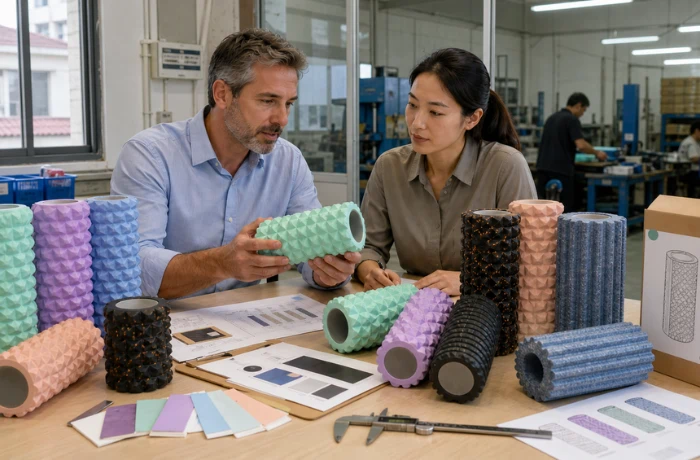
Approval samples are not production samples. This is one of the most widely known facts in B2B product sourcing and one of the most widely ignored at the operational level.
Here is why it gets ignored: at low volumes, the sample approval process and the production process are close enough in time and attention that they effectively merge. The factory is paying close attention because it’s a new relationship. The production run is small enough that variation is visible on the floor. Problems surface before they ship.
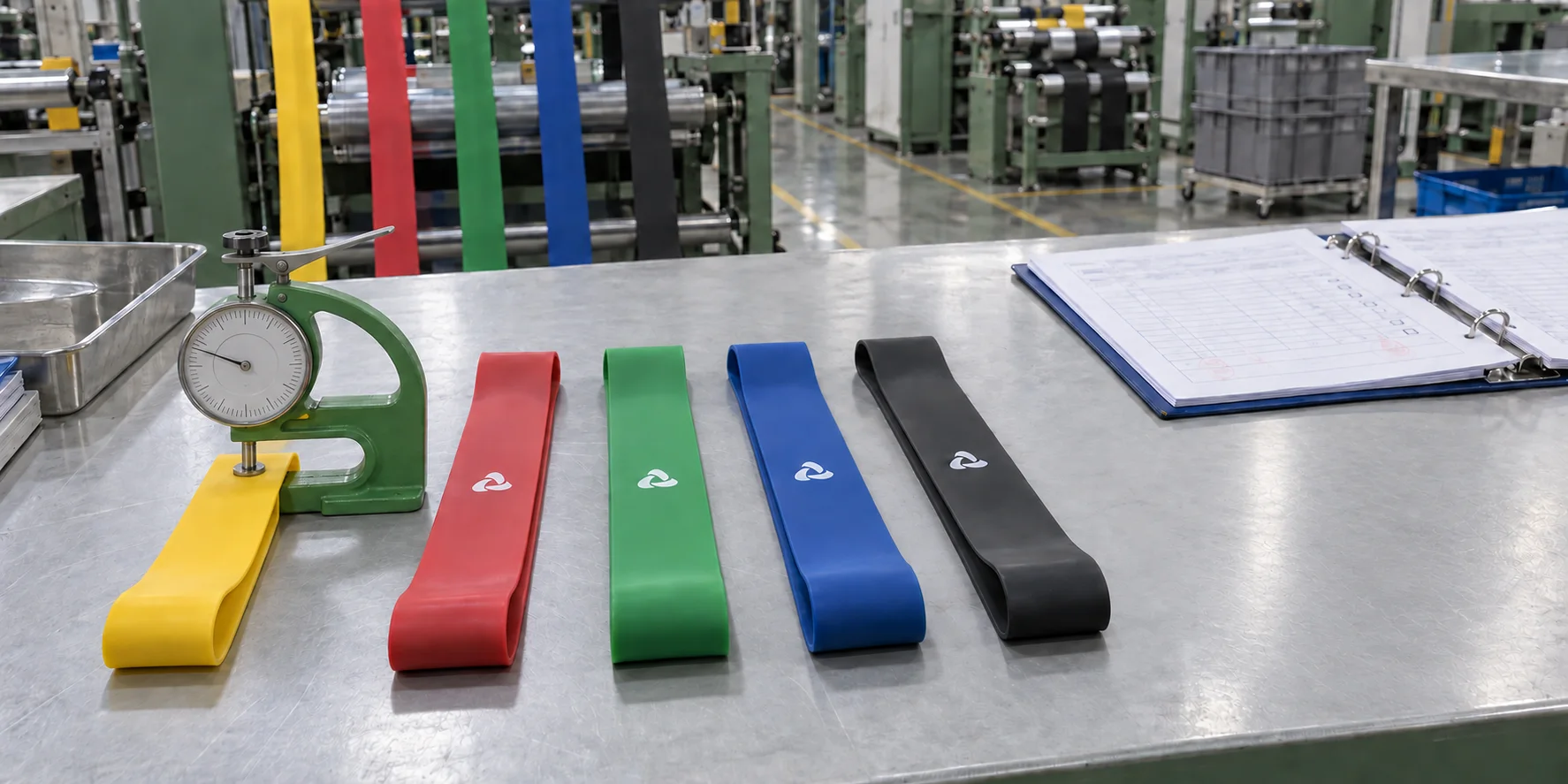
At scale, the production run occupies a different section of the factory floor, runs on a different schedule, and is overseen by floor workers rather than the account manager you communicate with. The gap between what was approved and what was produced is a function of process control — and process control is something you cannot see from a distance. It requires eyes on the floor, at the right moment, with a documented checklist that matches your product specification.
Pre-shipment inspection is the mechanism. But what to test, when to test, who to hire, and what a failed inspection actually costs in downstream consequences — these are the operational details that most scaling brands have not formalized before they need them.
The moment you need them is never the moment you have time to figure them out.
The deeper dive: Pre-Shipment Inspection for Fitness Equipment: What to Test, Who to Hire, and What a Failed Inspection Really Costs (coming soon)
Risk Category 3: Retail Channel Compliance
Amazon Seller Central and Amazon Vendor Central are different programs with different requirements. REI has a vendor compliance manual that runs to dozens of pages. Target’s supplier standards cover product testing, packaging, labeling, and social compliance auditing. Each of these channels has a compliance document package they require before issuing a purchase order — and each of them will hold that purchase order until the package is complete.
Most brands discover this for the first time when a retail buyer sends them the compliance questionnaire. The questionnaire asks for: test reports (REACH, CA65, CPSC as applicable), a Declaration of Conformity, factory audit certification (BSCI or equivalent), labeling compliance specifications, UPC/EAN verification, and insurance certificates. Some retailers add an appointed factory visit, a document review by their own compliance team, and a trial order with defined pass/fail criteria before the main program is activated.
None of this is unreasonable. All of it takes time to assemble if you haven’t started. And most of it cannot be retroactively applied to existing products — the testing must be done on the specific compound, from the specific factory, in the specific configuration being submitted.
The brands that walk into retail conversations unprepared don’t just lose the account. They lose the months it took to get the meeting.
The deeper dive: Retail Vendor Compliance for Fitness Equipment: What Amazon Vendor Central, REI, and Target Actually Require (coming soon)
Risk Category 4: Capacity Planning and the Production Calendar
Q4 does not move. The Christmas gifting window, the Black Friday promotion, the Q4 wholesale replenishment cycle — these dates are fixed. Factory production capacity is not.
Fitness equipment factories in China run at their highest utilization between August and October, as brands across multiple categories rush to clear Q4 production before the pre-Chinese New Year shutdown window. If you haven’t booked production capacity by late spring — secured with a deposit, confirmed with a purchase order, documented in a production schedule — you are competing for whatever capacity remains in August. That competition is expensive and often unsuccessful.
The brands that miss Q4 windows don’t usually miss them because the factory failed. They miss them because the production calendar wasn’t structured to account for factory loading cycles, raw material procurement lead times, and the transit time back-calculation that determines when a production start date is too late.
A 12-month production calendar built with your factory — not handed to the factory, but built with them — is the structural solution. It requires understanding your factory’s capacity constraints, their holiday schedule, and the minimum lead time for your specific product categories. It requires annual planning conversations that most brands don’t have because they’re still operating order-by-order.
The deeper dive: How to Build a 12-Month Production Calendar with Your Fitness Equipment Factory (coming soon)
Risk Category 5: Payment Terms and Financial Exposure
The standard payment terms for a first OEM order are 30% deposit, 70% balance before shipment — often called 30/70 T/T. At 200 units, the total exposure on the 70% balance is typically $3,000 to $8,000. Manageable even if something goes wrong.
At 1,000 units, the 70% balance is $15,000 to $50,000 or more, depending on the product. That amount is sitting in a factory in another country, secured by a verbal description of what “before shipment” means. If the factory’s interpretation of product quality and yours diverge at the inspection stage, you are negotiating your balance payment against product you haven’t accepted yet, with leverage determined almost entirely by how much you need the goods and how fast your alternative options move.
Letter of Credit (L/C) exists specifically to protect against this scenario. It creates a bank-enforced conditional payment mechanism — the factory gets paid when compliant goods are shipped, verified by documents, not by a phone call. L/C adds complexity and bank fees, but at order values above $20,000–$30,000 per shipment, the risk profile of 70% T/T starts to warrant the alternative.
Understanding when T/T terms are acceptable, when L/C is appropriate, and how to negotiate the terms in between — including payment against inspection certificate rather than against shipping documents — is the financial architecture of a scaled sourcing operation.
The deeper dive: How to Negotiate Payment Terms with a Chinese Fitness Equipment Factory: T/T, L/C, and What’s Realistic (coming soon)
The Two Channel Opportunities Most Fitness Brands Leave Untouched
Corporate Wellness: The Invisible High-Value Segment
Corporate wellness equipment purchasing operates entirely outside the consumer-facing fitness market, and almost no fitness equipment suppliers speak directly to it.
The buyer is an HR manager or a procurement officer at a company with 500 to 10,000 employees. Their budget is a line item in the annual benefits plan. They need customized equipment — yoga mats and resistance bands with the company logo, foam rollers in corporate colorways, accessory kits for home gym stipend programs — delivered to multiple office locations or distributed to employees as a benefits package.
Their requirements are different from DTC buyers: they care about consistent quality across a large batch (all 800 mats must be identical, because the CFO and the intern are getting the same kit), they need custom packaging with the company brand, and they need documentation that the product is REACH and CA65 compliant in case an employee raises a health concern. They do not care about retail price positioning. They care about reliability, timeline, and a single point of contact who returns emails.
The order value is high — $15,000 to $150,000 in a single corporate wellness purchase. The repeat rate is high — annual or biannual cycles. And the competition for this segment, at the factory level, is nearly zero. Because most suppliers have never written a sentence addressed to an HR procurement officer.
The deeper dive: Corporate Wellness Equipment Sourcing: Custom Fitness Accessories for Employee Programs (coming soon)
Fitness Studio Chains: One Buyer, 50 Doors
A single fitness studio chain with 50 locations needs 50 sets of equipment. A chain with 200 locations needs 200 sets. This is one purchase order. One account manager relationship. One compliance file. One production run.
The buyer is a procurement director or operations manager, often working with a preferred vendor list that gets reviewed annually. Their requirements: consistent quality across all locations (a mat at the Tokyo location should feel identical to the mat at the Toronto location), branded equipment that reflects the studio’s visual identity, replaceable components that can be ordered in smaller quantities for maintenance, and a supplier relationship stable enough to support the chain’s expansion pipeline.
The onboarding process is more involved than a consumer DTC sale. But once you’re on the preferred vendor list of a 50-location chain, you’re embedded in their operations. Switching costs — re-specifying, re-sampling, re-approving across 50 locations — work in your favor.
For a factory with the capability to produce consistently across large runs, this segment is not more difficult than DTC. It’s simply addressed differently. The conversation starts with the operational requirements, not the product specifications.
The deeper dive: Fitness Studio Chain Equipment Sourcing: Branded Mats and Accessories for 20–500 Locations (coming soon)
How to Structure a Supplier Relationship That Holds at Scale
Most scaling brands don’t need a new factory. They need a different agreement with the same factory — or a different factory with the same products, handled correctly from the start.
The structural elements of a supplier relationship that holds at scale:
A documented product specification. Not a sample and a price. A written spec sheet that covers material compound, dimensions with tolerances, color reference (Pantone number, not “dark green”), print specifications, weight, packaging dimensions, and labeling requirements. This document is the reference for every production run, every inspection, and every dispute.
A quality agreement, separate from the purchase order. The purchase order covers price and quantity. The quality agreement covers what “acceptable” means — and who makes that determination if there’s disagreement. Include acceptable defect rates by category (critical / major / minor), inspection access rights, and the protocol for disputed batches.
Tooling and IP documentation. As covered above — ownership clause, serial number, release obligation, non-reproduction clause. These are written before the tooling fee is paid, not after.
A production schedule you both signed. Not a timeline you sent via email. A schedule with defined milestones — material procurement date, production start, inspection date, ship date — that your factory has agreed to in writing. This becomes the reference document when timelines slip.
An annual planning conversation. Not a quarterly check-in, not a reactive call when you’re placing an order. A dedicated annual planning meeting — or video call — where you share your forecast, they share their capacity constraints, and together you build a production calendar that accounts for both. This conversation is what transforms a factory from a vendor into a supply chain partner.
How Wellfitsource Supports Scaling Brands
We manufacture yoga mats, foam rollers, resistance bands, and fitness accessories for 820+ B2B buyers globally — including brands at early-stage ODM and brands running 10,000+ unit annual production programs. The infrastructure we’ve built is calibrated for exactly the transition this guide describes.
On IP and tooling: Client-commissioned tooling carries a client-specific serial number engraved before first production. Ownership clause, non-reproduction clause, and 7-business-day release obligation are standard in our OEM agreements.
On quality: We operate under ISO 9001 quality management certification, with documented production specifications and pre-shipment inspection access for all client-commissioned orders. Our SGS-certified BSCI audit covers social compliance and is available for review before sampling.
On compliance: We maintain current REACH SVHC screening reports, CA65 Prop 65 test reports, and CE Declarations of Conformity for our standard material specifications across yoga mats, foam rollers, and resistance bands. Brands entering retail channels can review existing documentation before committing to a production order.
On planning: We support annual production planning conversations for brands at 1,000+ unit annual volume. If you’re building toward Q4 and haven’t started your production calendar conversation, that conversation should happen now, not in August.
On account management: Each client account is assigned a dedicated English-speaking account manager who owns the relationship across sampling, production, inspection, and post-shipment. Not a rotating contact. One person who knows your product and your history.
Start a supplier conversation →
FAQ
How do I know when I’m ready to scale my sourcing operation?
The clearest signal is when a single production failure — a quality issue, a missed shipment, a compliance gap — would materially affect your business. At 200 units, a bad batch is an expensive lesson. At 500+ units with forward sales commitments, it’s a potential customer relationship failure. If you’ve reached the point where improvising a fix is no longer an option, your sourcing infrastructure needs to catch up with your business size. The good news: the structural elements described in this guide are not complex. They’re just specific — and they need to be in place before the pressure arrives.
Do I need a different factory as I scale, or can I work with the same one?
Usually the same factory, with a more structured agreement. Mid-size Chinese factories are well-positioned to handle scaling brands — the issue is rarely factory capability, it’s the absence of documented agreements that can hold when volume increases and the informal relationship is under strain. Evaluate your current factory against the five risk categories in this guide. If they’re willing to document tooling ownership, sign a quality agreement, and support a production calendar conversation, you have a foundation to scale with. If they’re not willing to document basic terms, that resistance is itself the answer.
What’s the single most important document to have in order before scaling?
A product specification sheet that both you and the factory have signed. Everything else — inspection protocols, compliance filings, production scheduling — depends on a clear, written definition of what your product is supposed to be. Without a spec sheet, every dispute about quality is a negotiation about interpretation. With one, it’s a measurement against an agreed standard.
Can I run two suppliers simultaneously — China for main products, Vietnam or India for accessories?
Yes, and many scaling brands do. The structural requirements don’t change by country — tooling ownership, quality agreements, and production calendars apply wherever your factory is located. The operational complexity doubles when you add a second factory relationship, so the threshold for adding a second supplier should be tied to a specific risk-reduction or channel-access rationale, not just geographic diversification for its own sake. See our sourcing country comparison for the landed cost and supply chain depth analysis.
Related reading: – The Complete OEM Fitness Equipment Manufacturing Guide — the entry-level guide: factory evaluation, certifications, OEM vs. ODM, and the 6-step production process – OEM Fitness Product Tooling Ownership in China — contracts, IP protection, and what to insist on before paying the tooling fee