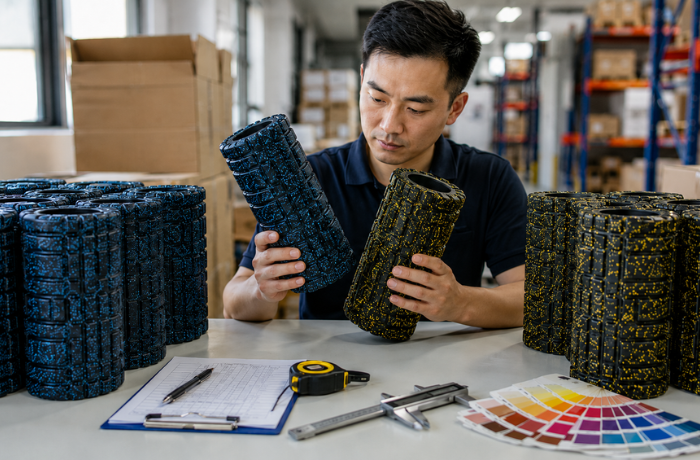
A foam roller order should not be approved for shipment just because the sample looked good. Before bulk shipment, buyers should confirm sample-to-bulk consistency across material, firmness under body weight, size and roundness, surface feel, odor, logo/color accuracy, and packaging strength—using a repeatable foam roller inspection checklist, not just photos. These are the issues that trigger real-world outcomes—customer complaints, returns, bad reviews, retail rejection, and brand trust loss.
A foam roller is approved twice: once as a sample, and again before bulk shipment.
Quick Answer: What Should Buyers Check Before Bulk Shipment?
Before you release a foam roller bulk shipment, run this foam roller QC checklist (a foam roller pre-shipment inspection done side-by-side against your approved sample):
- Material consistency (EVA/EPP/PE matches the spec)
- Density and firmness (the same support and pressure feel under body weight)
- Size and shape stability (length, diameter, roundness—no wobble)
- Surface finish and texture (no rough edges, pits, sticky spots)
- Odor and user feel (carton-opening smell is acceptable for your channel)
- Logo and color consistency (position, clarity, batch color match)
- Packaging and carton strength (no compression dents, no crushed retail presentation)
Why Foam Roller QC Matters Before Bulk Shipment
Foam rollers don’t “fail” in your warehouse.
Bulk variation usually shows up in the places customers notice first: how the roller feels under body weight, what it smells like when the carton opens, and whether packaging arrives crushed or scuffed. Those aren’t “factory terms,” but they’re exactly what drives complaints.
They fail later—when customers feel the difference or open a damaged box. Bulk production introduces batch variation (foam mixing, curing, storage), branding drift (logo alignment, color match), and packaging pressure (carton stacking and handling). That’s why QC can’t be a quick glance at the top layer of cartons.
If the approved sample feels firm and supportive, but the bulk order feels flat or uneven under body weight, customers won’t describe it as a production issue. They’ll say the roller feels cheap.
If you’re still comparing suppliers, start with our foam roller manufacturer selection guide before you lock QC requirements.
Key Takeaway: Photos are not enough. Foam roller QC must include feel, odor when cartons openund packaging resistance to compression.
7 Foam Roller QC Checks Before Bulk Shipment
Below are seven checks buyers can execute fast during a pre-shipment inspection. The rule is simple: compare bulk units to your golden sample, not to product photos.
Every check below is designed to answer one practical question: if a customer compares the product they receive to what you approved, will anything look, feel, or smell “off”?
1. Material Consistency
If the material changes, everything changes: firmness, rebound, surface feel, odor perception, and durability. A bulk shipment can look “close enough” but feel lighter, more brittle, or more plasticky in hand.
What to inspect
- Confirm the material matches the PO/spec and approved sample (e.g., EVA vs EPP vs PE)
- Surface touch and rebound feel compared to the golden sample
- Lot-to-lot consistency across multiple cartons (not just one opened box)
How buyers check it quickly
- Pull units from different cartons and do a direct side-by-side feel check (same pressure, same hand placement)
- Compare “weight feel” in hand: the roller shouldn’t feel noticeably lighter or hollow-feeling versus the approved sample
If you need a refresher on what changes with each material choice, use the foam roller material guide to align expectations before you write the QC spec.
2. Density and Firmness
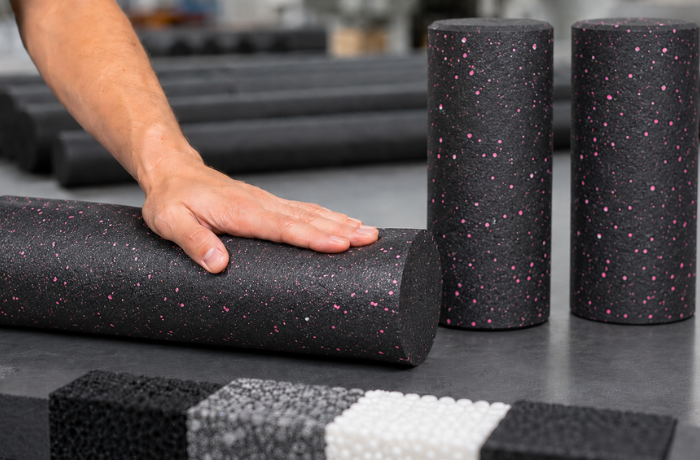
Density and firmness aren’t the same, and buyers get burned when the spec only says “high density.” Your customer doesn’t review density. They review pressure: too hard, too soft, or uneven.
What to inspect
- Support under body weight (does it collapse flat or stay springy?)
- Consistency across cartons (no “one batch is harder” surprises)
- Rebound consistency after pressure (does it recover cleanly?)
How buyers check it quickly
- Use the golden sample and do the same compression test on both (fixed hand position, fixed time)
- Check multiple points around the cylinder—one soft side usually shows up as an uneven roll
⚠️ Warning: “High density” is not automatically “better.” If the bulk roller feels sharp under body weight, you’ll see reviews like “too painful” or “too hard,” especially in yoga/wellness channels.
3. Size and Shape Stability
Size issues are not only about being “off spec.” Even small shape drift can create wobble. If a roller is slightly oval or compressed from packing pressure, users may feel uneven rolling resistance instead of a smooth roll.
What to inspect
- Length and diameter against your spec
- Roundness (no oval shape)
- End-face squareness and visible deformation marks
How buyers check it quickly
- Roll the unit on a flat surface: it should roll smoothly, not hop or wobble
- Measure key points (both ends + center) to catch compression drift
If you’re still finalizing SKUs and carton constraints, reference the foam roller size guide so size decisions match shipping reality.
4. Surface Finish and Texture
Surface defects are one of the fastest ways to trigger “feels cheap” reactions. Smooth rollers should feel clean in hand. Textured rollers should feel intentional—not sharp, scratchy, sticky, or uneven.
What to inspect
- Pitting, bubbles, dents, scratches, contamination, or seam lines
- Rough edges and end surfaces
- Texture depth consistency (for ridged/grid patterns)
How buyers check it quickly
- Inspect under strong, even light and rotate the roller 360°
- Run a gloved hand across the surface to catch rough spots you can’t see
5. Odor and User Feel
Odor is one of the fastest paths to bad reviews—especially in DTC/Amazon and wellness retail. The key is that odor often concentrates in packaging. A product can smell “fine” in open air and still hit you with a sharp chemical smell when the carton opens.
What to inspect
- Carton-opening smell (first 5–10 seconds after opening)
- Polybag odor (if individually bagged)
- Odor consistency across cartons
How buyers check it quickly
- Open cartons from different pallet positions (top vs middle), not only the easiest-to-reach boxes
- Do a quick “sealed time” check: place one unit in a clean bag for a short period, then open and compare to the golden sample
Boundary note: Don’t write medical claims into your QC spec (e.g., “safe for medical use”). Keep it to user experience and channel expectations.
6. Logo and Color Consistency
Private label itself isn’t hard—uncontrolled variation is. A crooked logo, dull color, or inconsistent emboss depth makes the roller feel lower value before a customer even puts it under their body.
What to inspect
- Logo position (drift left/right, rotation, distance from edges)
- Print clarity or emboss/deboss depth consistency
- Color match under the same lighting (batch-to-batch consistency)
- Rub resistance for printed logos (basic durability check)
How buyers check it quickly
- Lay 5–10 bulk units next to the golden sample under the same light and look for drift
- Check cartons from different production points (early vs late packed) to catch gradual drift
If your program involves custom colors, textures, and logo methods, review the custom foam roller options so your inspection checklist matches what you actually ordered.
7. Packaging and Carton Strength
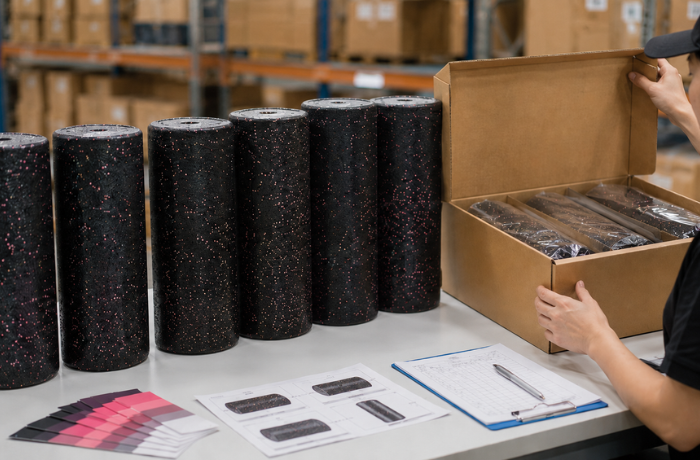
Packaging damage becomes a brand problem, not a factory problem. A roller can feel right in hand, but if it arrives with crushed packaging, scuffed surfaces, or dented edges, the customer sees a damaged product.
What to inspect
- Retail box / sleeve condition (if applicable)
- Inner protection (polybag, wrap, separators) and whether product rubs during transit
- Master carton strength: corners, sidewalls, tape seal, moisture marks
- Compression dents on the roller (especially for softer foams)
How buyers check it quickly
- Carton squeeze test: top panel and side panels shouldn’t buckle easily
- Open sample cartons and check whether product has scuffs or compression marks
- Shake/shift check: nothing should rattle or slide enough to scuff the surface
Common Foam Roller Quality Problems Buyers Miss
Most “surprises” don’t show up when you inspect one perfect unit from the top layer of cartons. Buyers often miss these:
Most misses come from two patterns: batch drift (feel/logo/color slowly changing across production) and pack-out drift (compression dents or scuffs caused by how units are packed and stacked). They’re hard to catch if you only open one “perfect” carton.
- The sample feels supportive, but bulk units feel softer and flatter under the same body-weight pressure
- Rollers smell fine in open air, but a sharp odor hits when cartons or polybags open
- Logo position drifts gradually across cartons, so the first boxes look fine and later ones don’t
- Textured patterns feel smooth in some areas and sharp in others (mold/finish inconsistency)
- The carton looks acceptable outside, but the product inside has compression marks or scuffed surfaces
- Colors look “close” until you line up multiple units under the same lighting—and then the batch mismatch is obvious
Supplier Note: For private label foam roller orders, we usually recommend checking the product and packaging together, not separately. A roller can pass the hand-feel test but still fail the retail channel if the logo drifts, cartons compress, or the product surface gets scuffed during packing.
How to Use This Checklist Before Shipment
A checklist only works if the process is executable. Here’s a simple pre-shipment inspection workflow buyers can actually run:
- Lock a golden sample: keep the approved sample and the signed spec pack (material, size, firmness feel, logo placement, packaging requirements).
- Sample across cartons: inspect units pulled from different cartons and pallet positions—don’t only check the top layer.
- Compare against the sample, not photos: side-by-side feel, odor, and logo position is faster than debating pictures.
- Approve product + packaging together: if packaging fails, the product fails for DTC/retail channels.
- Document deviations before release: record what’s off (firmness drift, odor, logo drift, carton weakness) and stop shipment release until corrective actions are confirmed.
Profi-Tipp: If you can only do a short inspection, prioritize firmness, odor (carton-open)und packaging strength. Those three drive the most visible complaints.
Foam Roller QC Checklist Table for Buyers
| QC Check | What to Inspect | Buyer Risk if Missed |
|---|---|---|
| Material | EVA/EPP/PE matches approved sample | Wrong feel, durability complaints, “cheap” perception |
| Festigkeit | Support under body weight, rebound, batch consistency | “Too hard/too soft,” higher return and review risk |
| Size/Shape | Length, diameter, roundness, wobble | Product mismatch, unstable rolling feel |
| Oberfläche | Texture uniformity, rough edges, sticky spots, dents | Poor hand feel, discomfort, negative first impression |
| Geruch | Carton-opening smell, polybag smell, lot consistency | Bad unboxing, complaints, returns |
| Logo/Color | Position drift, clarity, color match under same light | Private label brand damage, retail rejection |
| Verpackung | Retail box condition, inner protection, carton strength | Damage in transit, deformation, support-ticket explosion |
FAQ
What should buyers check before foam roller bulk shipment?
Buyers should check material consistency, density and firmness, size tolerance and roundness, surface finish, odor when cartons open, logo/color accuracy, and packaging/carton strength. The key is to compare bulk units against the approved sample—not against order photos.
Why does a foam roller sample feel different from bulk production?
Bulk production can drift due to material batch differences, density control, curing/storage conditions, surface finishing, and packing pressure during carton stacking. That’s why a golden sample matters: it gives you a physical reference for sample-to-bulk consistency before you release shipment.
How do private label buyers inspect logo and color quality?
Check logo position, clarity, emboss/deboss depth, and color under the same lighting across multiple cartons. Small drift makes the product look lower value in retail and e-commerce—even if the foam itself is fine.
Is packaging part of foam roller quality control?
Yes. For foam rollers, packaging affects product condition, retail presentation, and complaint risk. If cartons crush, or product picks up compression dents and scuffs in transit, customers treat it as a quality failure—not a shipping story.
Next Step for Wholesale Buyers
Before you release a foam roller bulk shipment, prepare your golden sample, PO/spec sheet, packaging requirements, and inspection checklist—and approve product and packaging as one system.
If you’re running a private label order, send your foam roller QC requirements before shipment release—ideally in this exact “inspection-ready” format:
- Approved sample standard (your golden sample + any signed spec sheet)
- Material spec (EVA/EPP/PE + density/firmness target)
- Size spec (length, diameter, allowable tolerance)
- Firmness feel reference (what “pass” feels like under body weight)
- Logo tolerance (position range, clarity/emboss depth standard)
- Color reference (Pantone/physical swatch + lighting condition for matching)
- Packaging standard (retail box/sleeve, inner protection, master carton strength)
- Shipment timeline + inspection window
That makes it easy for the supplier to confirm sample-to-bulk consistency and flag issues early—especially on private label programs where logo drift and pack-out damage create the fastest returns.