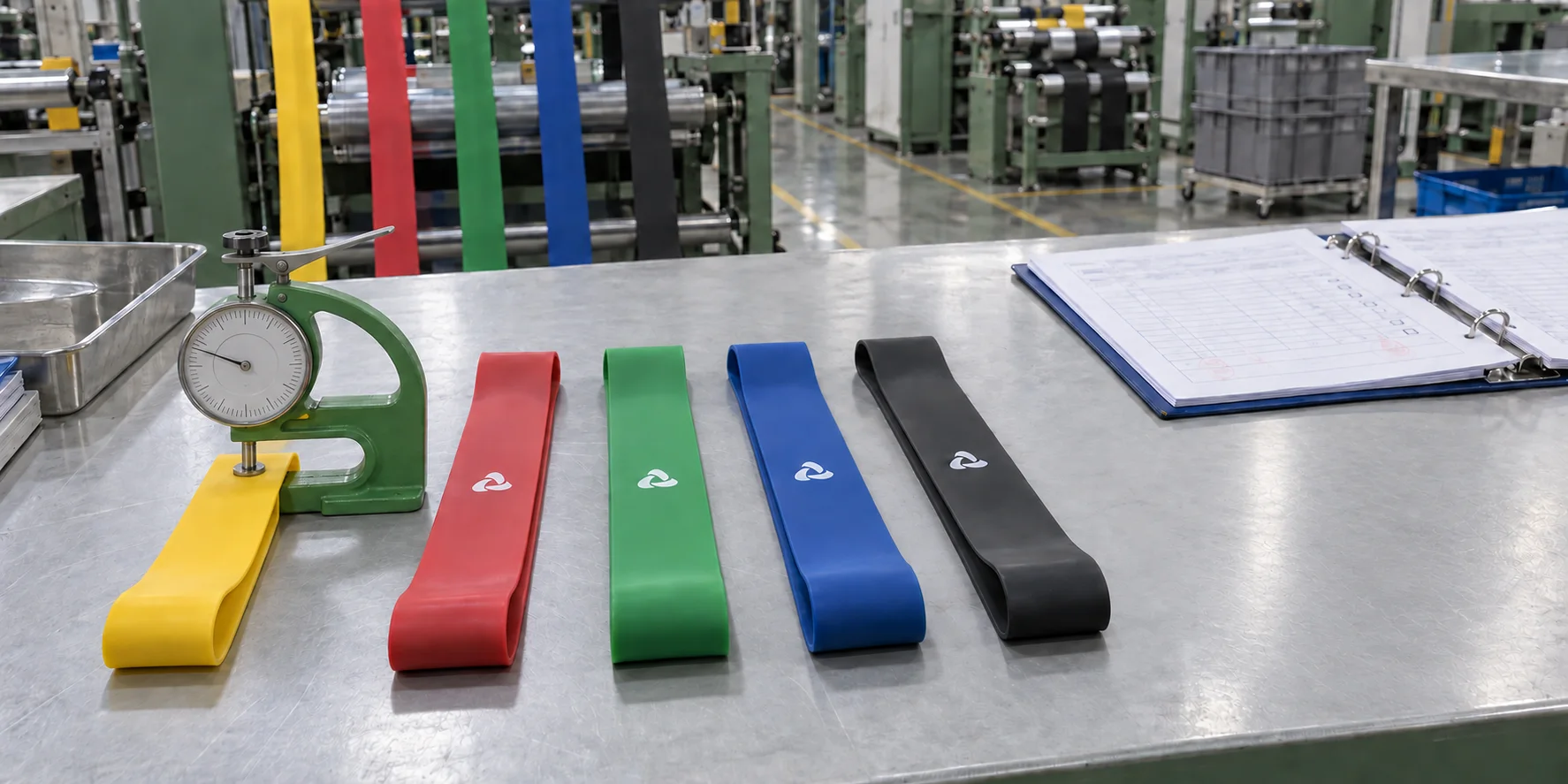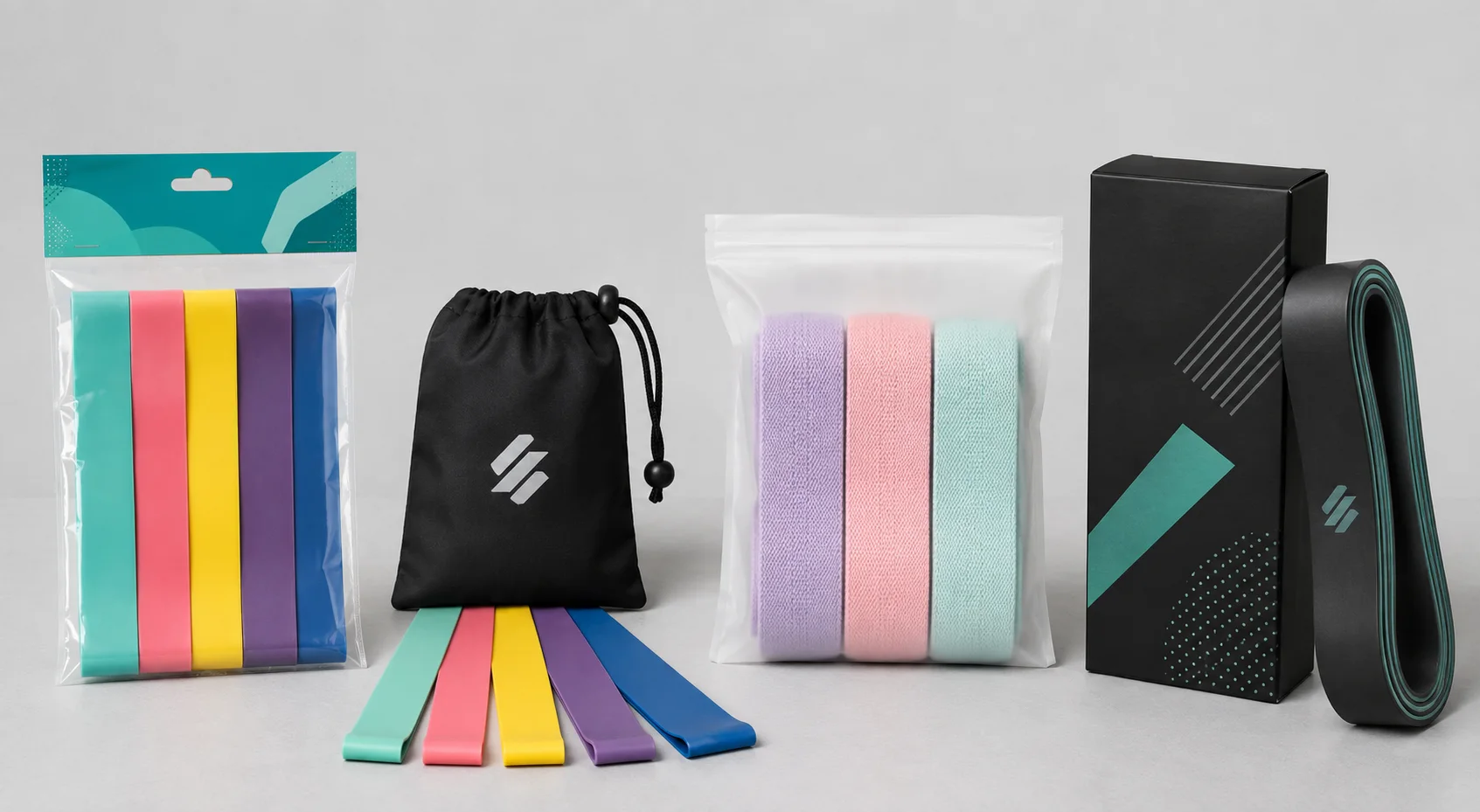
The most common mistake in resistance band sourcing timelines is working backward from a delivery deadline without accounting for what has to happen first. A buyer who needs product in a US warehouse by October 1 and places an order on August 15 — assuming a 6-week lead time — arrives at September 30 if everything goes perfectly. Everything does not always go perfectly. The sample gets rejected. The compound color takes two rounds of chip approval. The pre-shipment inspection finds a width tolerance issue that requires a partial re-run. Suddenly it’s October 20 and the product isn’t there.
Understanding MOQ structure and lead time composition — not just the headline numbers, but what each stage requires and where delays concentrate — is what separates a sourcing plan that has margin for problems from one that doesn’t.
Quick Summary
- Standard MOQ for branded TPE resistance bands is 300 units per color for individual bands, or 300 sets for a multi-band set (300 sets × 5 bands = 1,500 individual bands). Custom compound colors may require 500 units per color minimum. Fabric-covered bands have lower MOQ starting at 100 units for stock elastic in stock colors.
- Total lead time from inquiry to goods delivered at a US warehouse is 55–85 days for a first order (including sampling, approval, production, inspection, sea freight, and customs clearance). Repeat orders with an approved specification run 45–65 days.
- The sampling phase — producing and approving pre-production samples — is the most variable and most frequently underestimated stage. A single sample rejection adds 7–14 days. A custom compound color requiring two rounds of chip approval adds 10–20 days before production can begin.
- Production itself is 25–35 days for standard configurations. This stage is less variable than sampling but can be affected by factory capacity during peak season (Q3, pre-Chinese New Year in January/February).
- Payment terms affect the timeline in one specific way: production does not begin until the deposit is received and confirmed. Wire transfer processing (1–3 business days) plus any deposit negotiation delay is added to the effective production start date.
MOQ Structure by Product Configuration
Standard TPE Flat Loop Bands
| Configuration | MOQ | Notas |
|---|---|---|
| Stock color, stock width | 300 units per color | Most common entry point |
| Custom Pantone color | 300–500 units per color | Compound chip approval required |
| 5-band set (3–5 resistance levels) | 300 sets | Set MOQ includes all resistance levels |
| Logo print added | 300 units (same as base) | Screen print setup fee: $30–$60 |
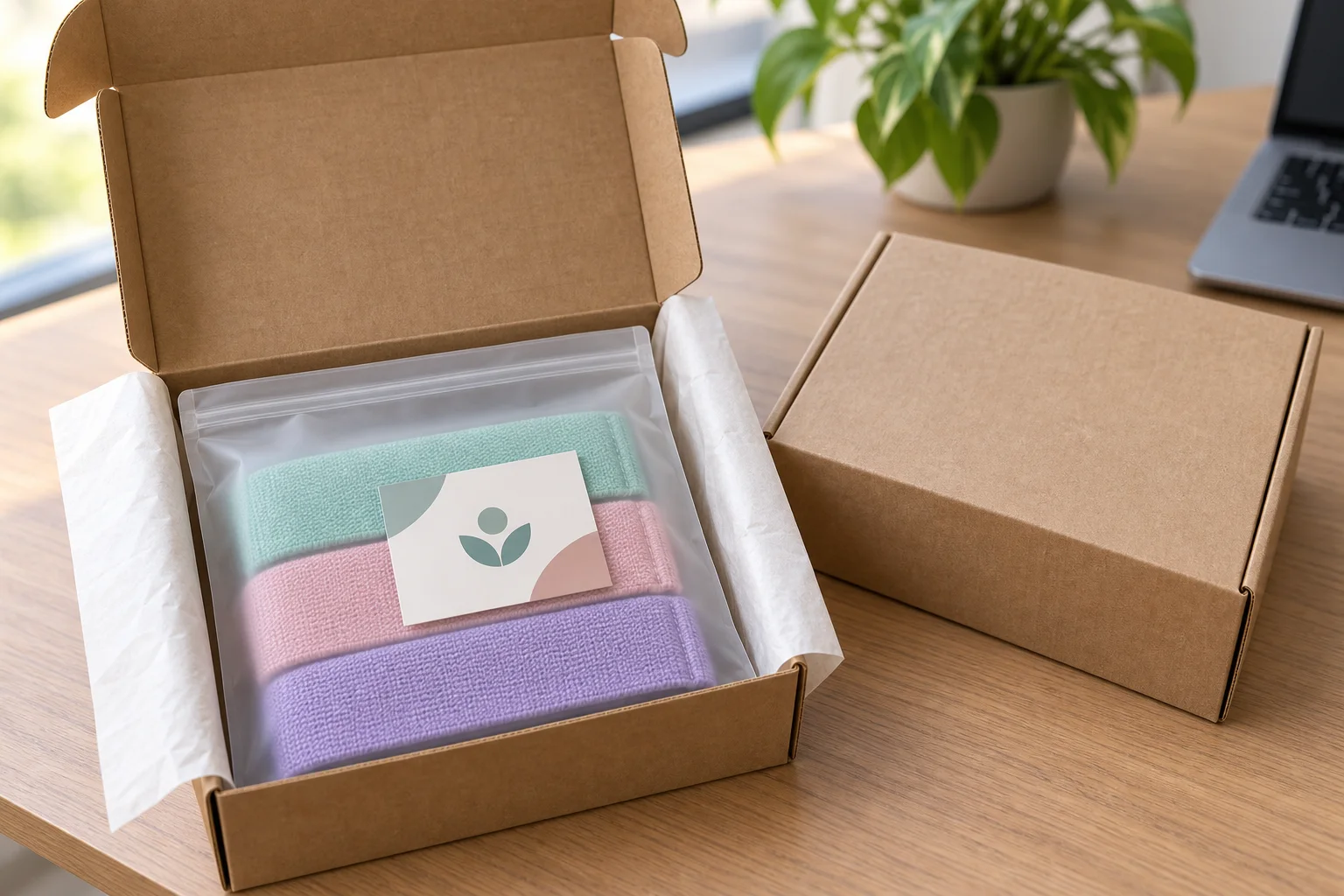
| Custom packaging (zip pouch, insert card) | 300 sets minimum | Packaging MOQ may be separate |
Natural Latex Flat Loop Bands
| Configuration | MOQ | Notas |
|---|---|---|
| Stock color, standard widths | 300–500 units per color | Slightly higher than TPE due to batch size |
| Custom color | 500+ units per color | Latex compound color mixing is less precise than TPE |
Fabric-Covered Elastic Bands
| Configuration | MOQ | Notas |
|---|---|---|
| Stock elastic, stock fabric color | 100–200 units | Lowest MOQ in the category |
| Custom sublimation print on fabric | 200–300 units | Print setup fee applies |
| Custom fabric color (woven yarn) | 500+ units | Yarn color MOQ drives the minimum |
Lead Time Composition: First Order
Stage 1 — Sampling (7–25 days)
Sampling is the phase that determines whether a first order finishes on time or runs late. The variables:
If samples already exist (factory’s existing spec): The factory sends existing samples for review. No new production required. Review and approve in 3–5 days. Add 5–7 days for DHL/FedEx international shipping if physical samples are requested. Total: 8–12 days.
If new samples are required (new color, new width, new logo): The factory produces pre-production samples — typically 2–5 pieces per resistance level. Production of new samples takes 7–10 days. Shipping: 5–7 days. Review and approval: 3–5 days. Total: 15–22 days minimum.
If a custom compound color is required: Add the chip approval cycle before samples begin. Chip production: 5–8 days. Chip shipping and review: 5–7 days. If the chip requires revision: add another 8–14 days. After chip approval, samples proceed as above. Total for chip + samples: 20–35 days.
If samples are rejected: Identify the specific issues (color off, logo placement wrong, resistance level inconsistent), communicate corrections to the factory, and request revised samples. Another 7–14 days minimum.
The simplest way to control sampling duration: provide the most complete specification possible at inquiry stage — vector logo files, Pantone references with chip comparison photos, reference samples from a comparable product, and force measurements for each resistance level. The more specific the input, the fewer revision rounds the sample requires.
Stage 2 — Order Confirmation and Deposit (1–5 days)
After sample approval, the buyer issues a purchase order and wires the production deposit (typically 30% of the total order value). Wire transfer processing time: 1–3 business days. Some factories require the deposit to clear their account before scheduling production; others schedule upon PO receipt and verify payment before releasing to the production floor. Clarify the factory’s process to avoid a 3-day gap appearing unexpectedly in the timeline.
Stage 3 — Production (25–35 days)
Production for standard resistance band configurations runs 25–35 days. What happens in this phase:
- Compound mixing and quality check (1–3 days)
- Band extrusion or compression molding (3–7 days per resistance level, running in sequence or parallel depending on factory capacity)
- Trimming and width cutting
- Logo application (screen print or heat transfer)
- Quality inspection by the factory’s QC team
- Packaging assembly (bands into pouches, insert cards added, sealed)
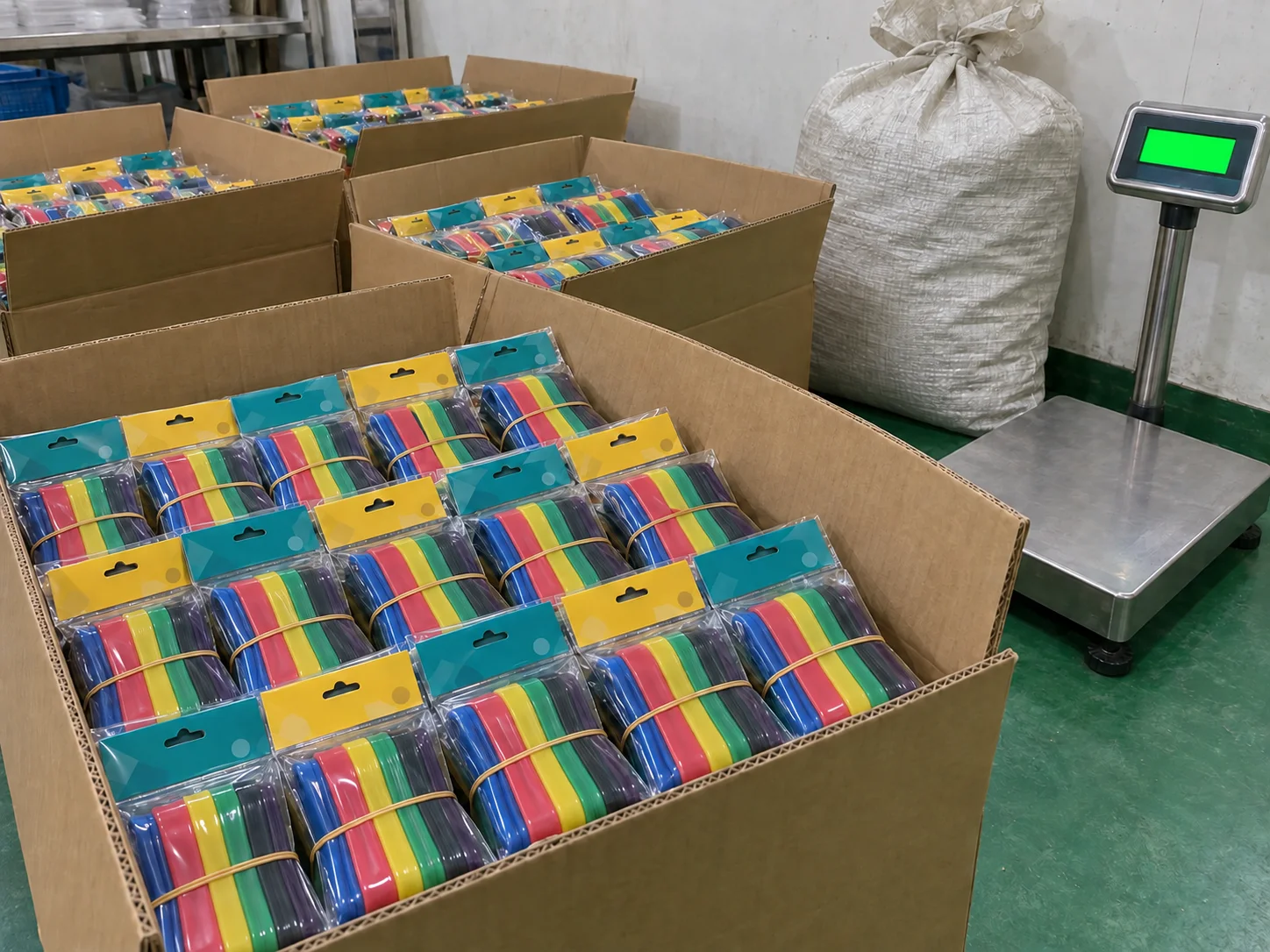
- Carton packing and labeling
Production time extends when: – The order volume is large relative to the factory’s daily output capacity – Multiple custom compound colors require sequential compound mixing and cleaning between batches – The order coincides with peak season (August–October for Q4 product, when factories are running at capacity for holiday inventory)
Stage 4 — Pre-Shipment Inspection (1–3 days)
A third-party pre-shipment inspection (PSI) by an accredited firm (SGS, Intertek, Bureau Veritas, or similar) is recommended for first orders and any order above approximately $5,000 value. The inspection covers:
- Quantity count (carton count and unit count)
- Packaging compliance (sealing, labeling, barcode scan test)
- Product QC sample (resistance level force test, visual inspection, dimensional check)
- Carton drop test (for rigid gift box configurations)
Inspection scheduling takes 1–3 days lead time; the inspection itself takes 1 day on-site. Report delivery: same day or next business day. If the inspection fails, the factory addresses the finding and schedules a re-inspection — add 3–7 days.
Stage 5 — Freight and Customs (23–35 days)
Sea freight (FCL or LCL): – Port loading and departure: 3–5 days after goods cleared by inspection – Transit: China → US West Coast ports (Los Angeles, Long Beach): 18–22 days – Transit: China → US East Coast ports (New York, Savannah): 25–30 days – Transit: China → major EU ports (Rotterdam, Hamburg): 25–35 days
Customs clearance and inland delivery: – Customs clearance: 2–5 days (standard; longer if random examination is selected) – Inland trucking to warehouse: 2–4 days
Air freight (when timeline requires it): – Transit: 3–5 days China → US or EU – Cost: 4–8× sea freight rate per kg – Appropriate when: the production phase finished on time but the sea freight window was missed, or when the order value is high enough to justify the premium to protect a launch date
Lead Time Composition: Repeat Orders
A repeat order with an approved specification is significantly faster than a first order:
| Stage | First Order | Repeat Order |
|---|---|---|
| Sampling | 15–35 days | 0 (spec already approved) |
| Confirmation and deposit | 1–5 days | 1–3 days |
| Producción | 25–35 days | 25–35 days |
| Pre-shipment inspection | 1–3 days | 1–3 days |
| Sea freight + customs | 23–35 days | 23–35 days |
| Total (US West Coast) | 65–113 days | 50–76 days |
The most important variable between first and repeat orders is the sampling phase — eliminating it saves 15–35 days. This is why maintaining a current approved specification document (with reference samples held at the factory and at the buyer’s location) is not just a quality protection measure — it’s a timeline asset.
Seasonal Timing Considerations

Chinese New Year (January/February)
Factories close for 1–2 weeks around Chinese New Year (date varies by year; typically late January to mid-February). The 2–4 weeks before closure are peak pre-holiday production, when factories are at capacity and may deprioritize new orders or small orders in favor of existing clients’ large orders. Orders confirmed before mid-December and completed before the CNY closure ship without disruption. Orders confirmed in December for delivery after CNY should be planned around the factory’s closure date and post-holiday ramp-up period (1–2 weeks after reopening for production to return to normal pace).
Q3 Peak Season (July–October)
Factories producing for the US Q4 retail cycle are at peak capacity from July through October. New orders placed in August or September for delivery before November require either a factory relationship that provides priority scheduling, or accepting a longer production lead time (30–40 days instead of 25–35 days).
PREGUNTAS FRECUENTES
Can we get a faster turnaround by paying a rush premium?
Some factories offer expedited production for a premium — typically 15–25% additional cost — which prioritizes the order on the production schedule. This can reduce production time from 30 days to 20–25 days. Rush premiums do not speed up sampling (which requires physical time for compound curing and shipping) or freight (which is determined by vessel schedules). The most time that can be compressed through a rush premium is the production stage — a maximum of 10 days in most cases.
What is the minimum order if we just want to test one resistance level?
For a single resistance level (one color, one width) in a stock color without custom packaging, some factories will accept 200 units. At 200 units, the per-unit cost is higher than at 300, and packaging customization options are more limited. If the goal is market testing, a 300-unit order of a single resistance level with minimal packaging (poly bag, stock colors, simple logo) is typically more practical than pushing for a lower MOQ at higher unit cost.
How do we calculate when to place a reorder to avoid stockouts?
Work backward from the desired in-stock date: add 50–76 days (repeat order lead time to US warehouse). Then add your safety stock buffer — typically 30–45 days of average daily sales. If you sell 15 sets per day and want 45 days of safety stock, reorder when you have 45 + 63 (mid-range lead time) = 108 days of stock remaining. At 15 sets/day, that’s when you have 1,620 sets in stock. Adjust the buffer based on how variable your sales rate is and how willing you are to run a stockout.
Does the factory hold our tooling and dies between orders?
Logo embossing dies, custom packaging tooling, and compound chip formulations are typically held at the factory between orders. A factory with a 12–18 month gap since the last order may have reorganized storage and lost track of smaller tooling items. Confirm at the start of each reorder inquiry: “Can you confirm you still have the emboss die for [logo reference]?” and “Can you confirm the approved compound chip for [color name] is still on file?” A factory that cannot confirm within 48 hours may need to remake the tooling or compound chip.
Related reading:
– OEM Resistance Band Sourcing: Complete B2B Guide — full sourcing framework with MOQ, pricing, and channel requirements
– Private Label Resistance Bands: MOQ, Branding & Packaging — private label customization options and their effect on MOQ and lead time
– How to Evaluate a Resistance Band Manufacturer — factory qualification criteria including capacity, QC process, and compliance history