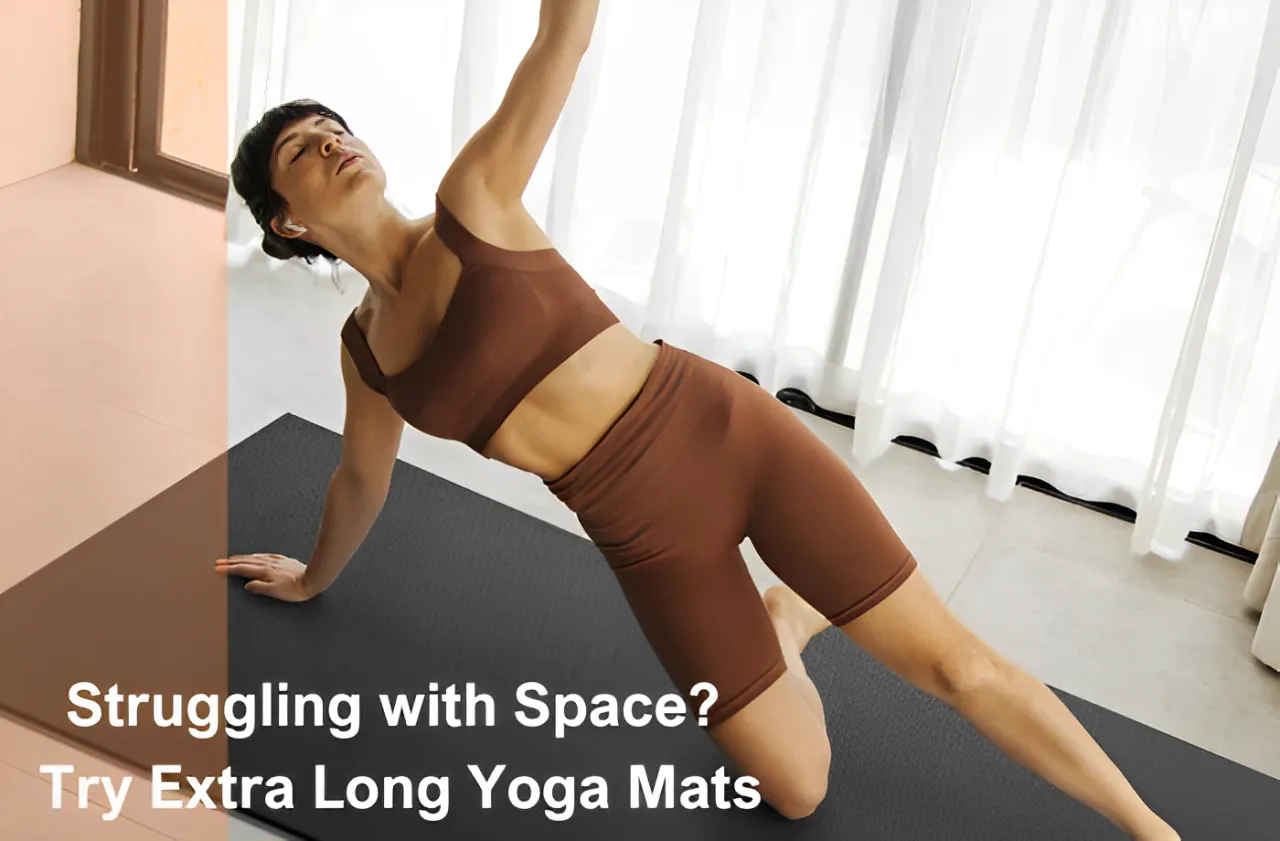
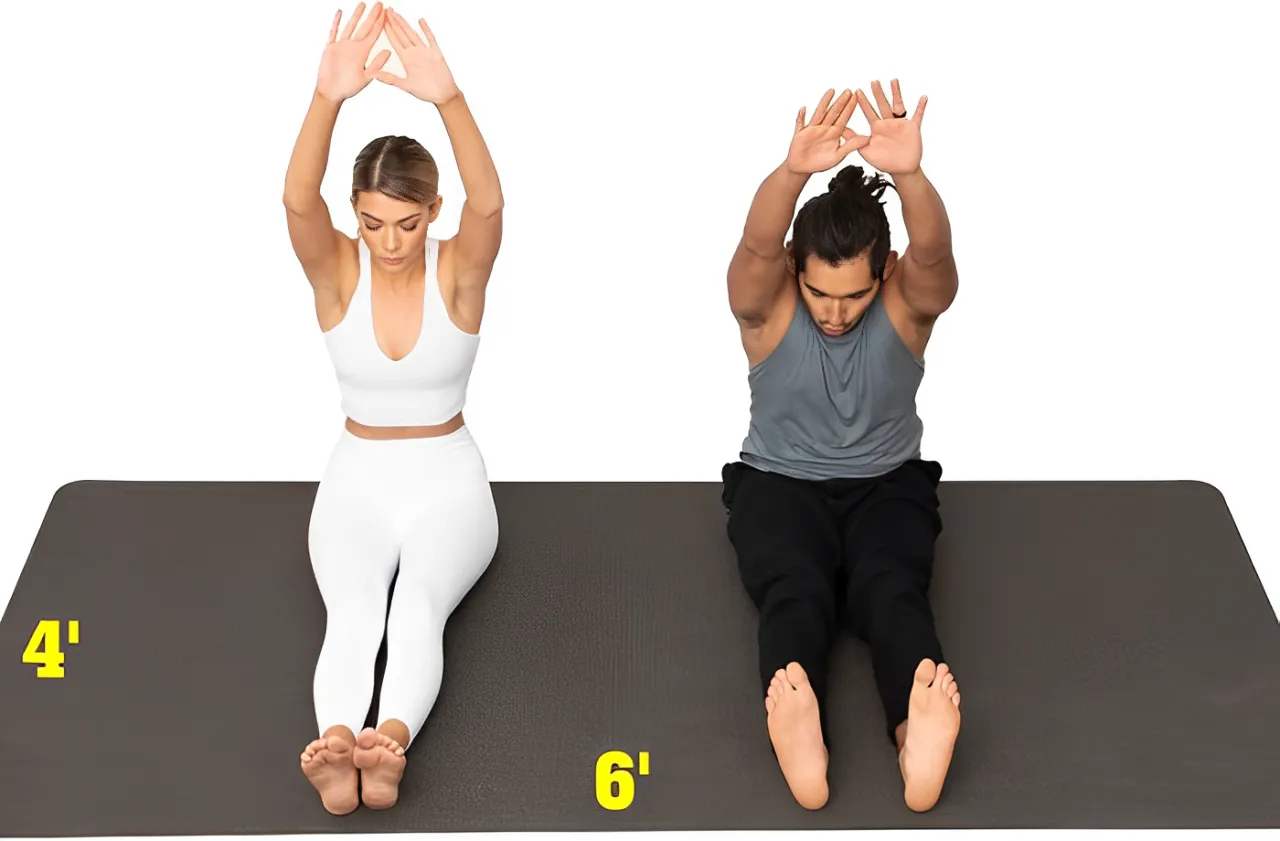
A 6’3″ practitioner setting up for downward dog on a standard 183cm mat has about four inches of mat behind their heels. When they walk their feet back to lengthen the pose, their heels hit the floor. Not a catastrophic problem — but noticeable every single class, on every single vinyasa transition. Over a year of daily practice, that four-inch gap is something they think about every time they unroll their mat.
That practitioner is also a B2B opportunity. Approximately 12–15% of adult yoga practitioners in Western markets are over 6 feet tall. The mainstream market has served them with a product designed for a body that isn’t theirs. A brand that builds a non-standard size option into its line is not just solving a product problem — it is capturing a segment that has historically had to compromise.
For B2B buyers sourcing yoga mats, the custom sizing question has two dimensions: the market opportunity in non-standard lengths and widths, and the OEM production reality of what custom sizing actually costs, requires, and constrains. Both are more accessible than most first-time buyers expect.
Quick Summary
- Standard yoga mat dimensions (183cm × 61cm) leave approximately 12–15% of practitioners — those over 6 feet tall — with insufficient mat length for full-body practice. This is a documented gap that specialty brands, studio chains, and premium private labels can address with non-standard sizing.
- Extended length mats (200cm, 213cm) and extended width mats (68cm, 76cm) are both producible within standard factory capabilities. Extended length does not require custom tooling; extended width may require verification of equipment capability.
- MOQ for non-standard dimensions typically starts at 300 units — the same threshold as standard sizing — because the production process adjusts cut dimensions rather than mold tooling. The per-unit premium for non-standard sizing is usually $0.40–$1.20 depending on the dimension delta.
- Weight and packaging implications of non-standard sizing directly affect freight cost per unit and carry bag specifications. A 213cm × 68cm mat weighs approximately 35–45% more than a standard format — a variable that needs to be in the landed cost model.
- Studio chains with non-standard room configurations are an underserved B2B buyer segment for custom-width mats. A studio designed for a specific row-spacing format may find that 66cm or 68cm mats fit their layout better than 61cm standard — and will pay a premium for mats that solve that operational problem.
The Market Gap That Custom Sizing Addresses
The 183cm × 61cm standard was not designed for anyone specifically — it emerged from manufacturing economies and has persisted because most buyers have accommodated it. For practitioners who fit the standard body profile, it works. For those who don’t, it is a product specification that makes their practice slightly less functional every day.
The three body types that standard sizing underserves:
Tall practitioners (over 6 feet / 183cm). In seated forward fold, a standard-length mat covers the full torso but may not extend past the feet. In savasana, heels rest on the mat edge. In downward dog, a practitioner who walks their feet wide to accommodate tight hamstrings finds their heels at the mat edge before they’ve achieved a working position. The fix — a 200cm or 213cm mat — is not dramatic, but for someone who practices daily, the 17–30cm of additional mat behind their feet changes the quality of every standing and supine sequence.
Wide-shouldered practitioners and those who work in wide-stance formats. A 61cm standard width is adequate for most forward-facing poses but constrains wide-leg seated poses, flying pigeon, and lateral balance work. A 68cm or 76cm mat provides the lateral margin that allows full expression of these poses without the practitioner having to monitor their hand placement relative to the mat edge.
Studio operators with non-standard room configurations. This is a B2B-specific segment that the consumer framing of “extra long mats” usually misses entirely. A studio designed with 18-inch center-to-center mat spacing in a room that is 22 feet wide accommodates a specific number of 61cm mats per row. Change the mat width to 66cm and the calculation changes — sometimes fitting more mats in the same space, sometimes creating more comfortable spacing between practitioners. Studio operators who have built rooms around a specific mat format will source non-standard widths specifically to match their floor plan.
Standard vs Non-Standard: The OEM Dimension Options
Most yoga mat factories operate from a set of standard dimension options — the formats they produce regularly, with existing cutting jigs and packaging specifications in place. Non-standard dimensions are available but require the factory to adjust production parameters. Understanding this distinction matters for MOQ, lead time, and cost.
Standard Dimensions (Factory Stock Options)
| Format | Dimensiones | Typical Weight (6mm TPE) | Notas |
|---|---|---|---|
| Estándar | 183cm × 61cm | 1.4–1.6kg | Most common; lowest MOQ |
| Wide standard | 183cm × 68cm | 1.6–1.8kg | Common upgrade; most factories stock |
| Short travel | 150cm × 61cm | 1.1–1.3kg | Folding/travel category |
These formats are produced regularly enough that factories maintain cutting jigs and packaging specifications. Ordering within these dimensions means the factory does not need to adjust production setup — lower risk of dimensional variation, faster production confirmation.
Extended Dimensions (Non-Standard, OEM Adjustment Required)
| Format | Dimensiones | Typical Weight (6mm TPE) | MOQ Consideration |
|---|---|---|---|
| Extra long | 200cm × 61cm | 1.6–1.9kg | 300 units; minor setup adjustment |
| Extra long wide | 200cm × 68cm | 1.9–2.2kg | 300 units |
| Professional long | 213cm × 61cm | 1.7–2.0kg | 300–500 units |
| Professional long wide | 213cm × 68cm | 2.1–2.5kg | 300–500 units |
| Studio custom width | 183cm × 66cm | 1.5–1.7kg | 300 units; common for studio chains |
| Full custom | Any dimension | Variable | 500+ units; engineering review required |
Extended length adjustments — from 183cm to 200cm or 213cm — are primarily a cutting adjustment, not a tooling change. The foam is produced on a continuous line and cut to length. Adding length adds material cost proportionally and requires a cutting jig adjustment, but does not require new mold tooling or a production line change. This is why the MOQ premium for extended length is lower than many buyers expect.
Extended width adjustments are more variable. Foam production equipment has a fixed maximum width output. Factories operating equipment sized for 70cm maximum width can produce 68cm mats without difficulty; factories with 62cm maximum width equipment cannot. Confirming equipment capability is the first conversation when specifying a non-standard width.
The Real Cost of Non-Standard Sizing
Custom dimension mats carry a cost premium over standard format. The premium comes from two sources: material cost (more foam per unit) and production setup adjustment (reconfiguring cutting parameters, updating packaging specifications). Understanding both helps buyers determine which non-standard dimension delivers the best margin-to-differentiation ratio.
Material cost premium. The cost of a yoga mat is approximately proportional to its material volume. A 200cm × 61cm mat has 9.3% more material than a 183cm × 61cm mat at the same thickness. At a $5.80 FOB base for standard, the material cost premium is approximately $0.45–$0.55 per unit — before any setup adjustment.
Production setup adjustment. For extended length mats within 30cm of standard, most factories charge no setup fee and absorb the adjustment within standard MOQ pricing. For extended width beyond 68cm, or for any dimension requiring equipment modification, a one-time setup fee of $150–$400 may apply.
Packaging adjustment. Non-standard dimensions require adjusted packaging — carry bag dimensions, retail box sizing, or rolled diameter specifications. If you are specifying a carry bag with your order, the bag specification must match the mat dimensions exactly. A 183cm carry bag does not fit a 200cm mat. This sounds obvious but is a specification detail that is sometimes missed in the initial order discussion and becomes a problem at quality check.
Freight cost implication. Longer and wider mats occupy more carton volume and weigh more. At sea freight rates calculated by the greater of weight and dimensional weight, a 213cm × 68cm mat may generate 35–45% higher freight cost per unit than a 183cm × 61cm mat. This needs to be in the landed cost model before the retail price is set.
Practical cost example — 300 units, 200cm × 61cm TPE (6mm), standard texture:
| Cost component | Standard 183cm | Extended 200cm | Delta |
|---|---|---|---|
| FOB unit price | $5.80 | $6.30 | +$0.50 |
| Ocean freight per unit | $0.90 | $1.05 | +$0.15 |
| Import duty (3.4% FOB) | $0.20 | $0.21 | +$0.01 |
| Landed per unit | $6.90 | $7.56 | +$0.66 |
A retail price of $55 on the standard format versus $68–$72 on the extended format produces comparable or better gross margin despite the higher landed cost — because the non-standard sizing commands a real price premium in the market. That is the economic case for offering a non-standard size: the market will pay for a product that fits, and the production cost premium is substantially lower than the retail price premium.
Which Channels Buy Custom-Sized Yoga Mats
Not every distribution channel has demand for non-standard sizing. Understanding where the demand is concentrated helps B2B buyers decide whether to add a non-standard SKU and which format to prioritize.
Specialty yoga retail and premium DTC. The segment most willing to pay a premium for extended sizing. Specialty yoga retailers actively merchandise to serious practitioners — a customer profile with higher body size diversity and higher willingness to pay for specification-correct products. A 200cm or 213cm format at a $65–$85 retail price point moves in this channel.
Studio retail shelves. Studios that sell mats to members typically stock their house mat specification — whatever format they use in the studio. Adding an extended-length option to the retail shelf serves the tall members who have been quietly unhappy with standard sizing. Studios already have the manufacturer relationship; adding a second SKU is a reorder conversation rather than a new sourcing project.
Studio chain supply (non-standard width). Studio chains with specific room configurations represent a B2B segment that specifically wants custom width, not necessarily extra length. A studio designed for 18-inch center-to-center mat spacing with their existing 61cm mat may find that moving to 64cm allows them to keep the same row count while giving members noticeably more lateral space. This is a procurement conversation about operational fit, not consumer preference — the studio operator is the buyer, not the end practitioner.
Corporate wellness programs. Less common for extended sizing — corporate wellness programs tend to prioritize logo placement and cost over dimensional specification. Extended sizing in this channel is relevant only for programs specifically targeting a tall-employee demographic (professional sports teams, executive wellness programs).
For buyers assessing where to start, the full yoga mat product range provides a reference for standard and available extended formats — useful context before entering a sizing conversation with a factory.
How to Specify Non-Standard Dimensions in an OEM Order
When specifying non-standard yoga mat dimensions, the specification document needs to cover four dimension references to avoid misproduction:
1. Finished mat dimensions (length × width × thickness). The dimensions of the final product after production and any edge finishing. This is the specification the factory produces to: e.g., “200cm (±1cm) × 61cm (±0.5cm) × 6mm (±0.5mm).”
2. Roll diameter (for rolled delivery). Non-standard lengths produce larger roll diameters when the mat is packaged rolled. A 200cm mat rolled at standard tightness has a larger diameter than a 183cm mat. The carry bag inner diameter must accommodate this. Specify: “maximum roll diameter not to exceed [X]cm” based on your carry bag specification.
3. Carry bag or packaging dimensions. If ordering with carry bags or retail packaging, the bag length and inner diameter must be specified to match the mat dimensions. Do not rely on the factory to infer bag specifications from mat specifications — these are separate documents.
4. Shipping carton configuration. How many units per carton and how cartons are stacked for freight. Longer mats change the carton count per pallet and may affect container utilization. Confirm with your freight forwarder that the carton configuration you’ve specified produces efficient container loading — a detail that can reduce freight cost by 5–8% if optimized.
PREGUNTAS FRECUENTES
Does extended length require a different mold?
For TPE and PVC foam mats, extended length is a cutting adjustment, not a mold change. The foam is produced in continuous sheets or logs and cut to the specified length. Going from 183cm to 200cm means adjusting the cutter, not the mold. For extended width beyond the factory’s standard equipment output, a different production setup may be required — confirm equipment capability before specifying.
What is the minimum order for a non-standard size?
For extended length within 30cm of standard (e.g., 200cm or 210cm), MOQ is typically the same as standard sizing — 300 units for standard TPE. For extended width or custom dimensions that require equipment adjustment, MOQ may start at 500 units to justify the setup investment. For dimensions significantly outside standard capability (e.g., 250cm × 90cm), engineering review and higher MOQ are required.
Can we order both standard and extended sizes in the same production run?
Yes, and this is common. A brand running 300 units of standard format and 100 units of extended format in the same production cycle can often produce both from the same material batch, with the extended units cut separately. Confirm with your factory whether mixed-dimension runs are accommodated at their facility — most mid-size factories handle this routinely.
How do we handle carry bag specifications for multiple sizes?
The simplest approach is to specify a carry bag sized for the longest mat in your line. A bag that accommodates a 213cm mat will also fit a 183cm mat — the standard mat simply has more bag above the roll. This avoids sourcing two different bag specifications and allows you to use one bag SKU across your line. The trade-off is slightly more excess bag material for the shorter mat; the trade-off for most brands is worth the SKU simplification.
Does non-standard sizing affect compliance testing?
Compliance testing (CA65, REACH) is performed on the material and compound, not on the dimensional format. A 200cm mat made from the same compound as a tested 183cm mat does not require a separate compound test. However, if extended sizing changes the product’s packaging (retail box, carry bag, hang tag), those packaging materials may have their own compliance considerations — particularly for packaging with plastic components entering the California market.
Related reading:
– What Are the Standard Yoga Mat Sizes? A B2B Specification Guide — standard dimensions, tolerances, and how size specification affects MOQ and pricing
– The Problem with Standard Yoga Mat Dimensions — and Custom Sizing Solutions — deeper analysis of where standard sizing underserves specific market segments
– Yoga Mat Sourcing 101: A Guide for First-Time B2B Buyers — the complete OEM sourcing process from specification to production
– Yoga Mat Materials Compared: TPE vs PU vs Cork vs PVC — material selection and how compound choice affects custom sizing economics