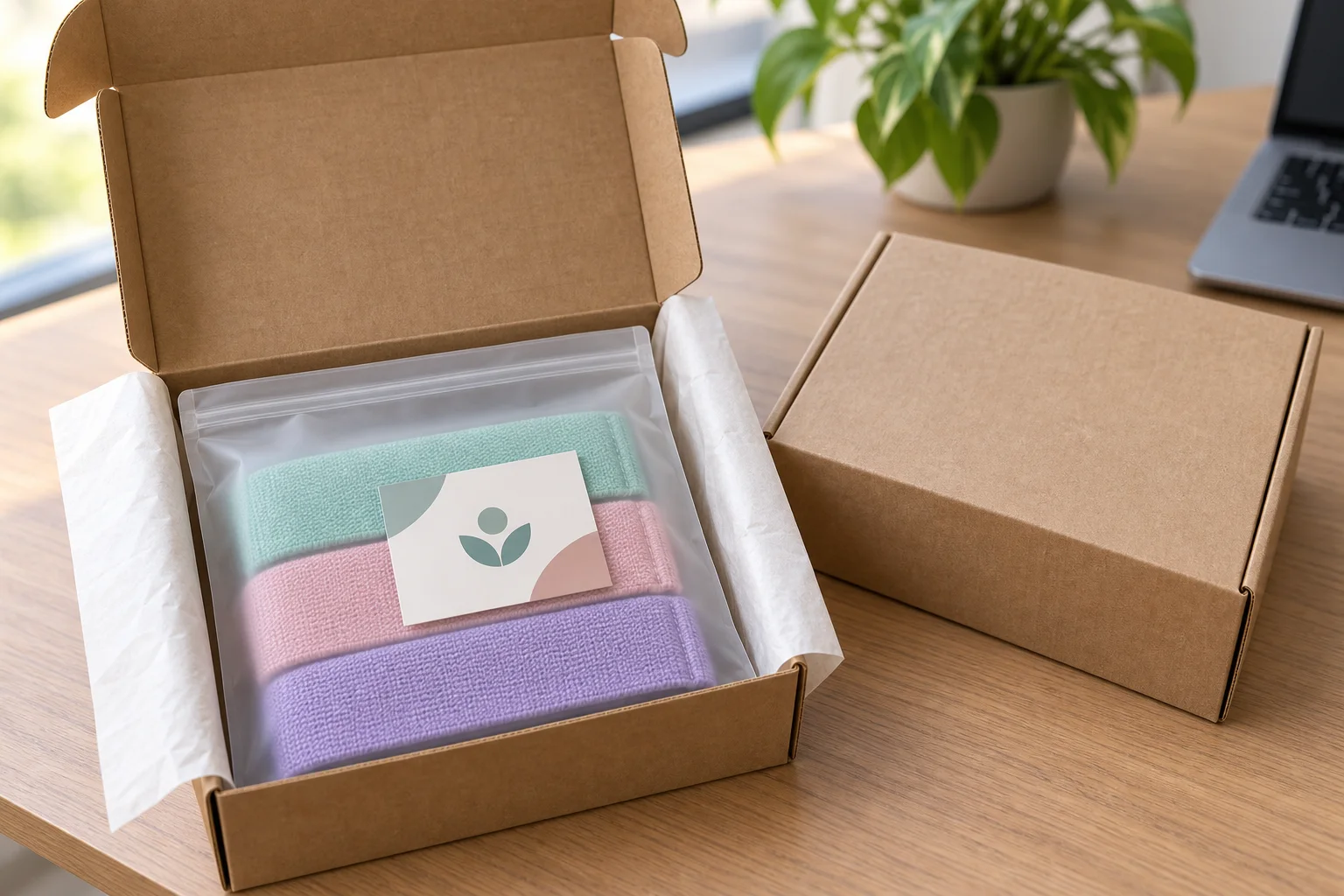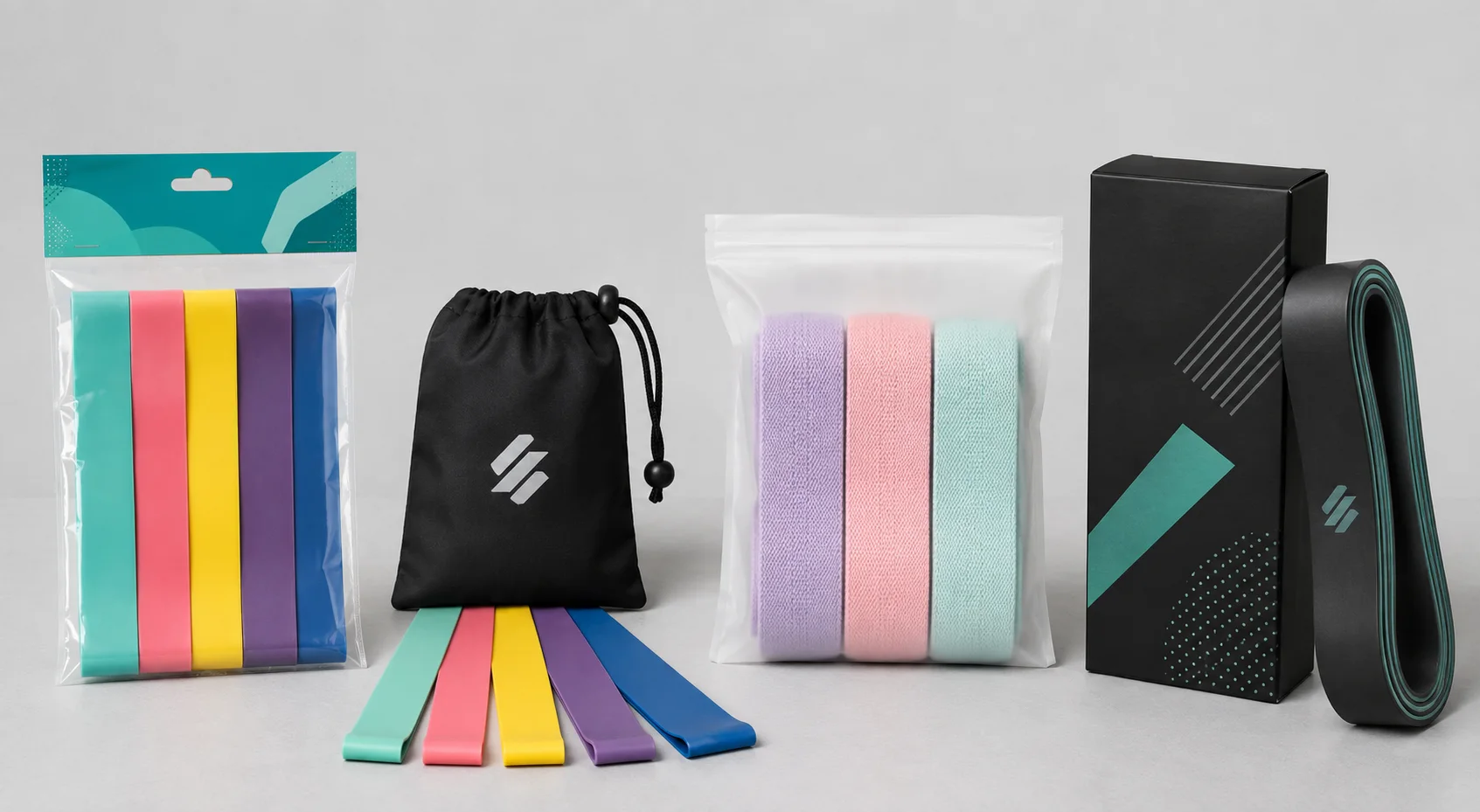
The resistance bands inside two competing products can be identical — same material, same dimensions, same resistance levels. The packaging is where the buying decision gets made. A branded carry bag with a printed insert card on a retail hook feels like a considered product. The same bands in a sealed poly bag with a laser-printed label feel like a commodity. The unit cost difference between those two formats is often under $0.80. The retail price difference can be $8–$15.
Packaging specification is the most consistently underinvested part of the OEM resistance band sourcing process. Buyers spend three rounds of sample approval on band color and logo placement, then accept the first packaging sample without close review. The result is a product that performs well and photographs poorly — which, in a category driven by Amazon listing images and DTC social content, is a competitive disadvantage from day one.
This guide covers the packaging formats available for OEM resistance band sets, what each format communicates at retail, the specification details that determine quality within each format, and how to match packaging to channel.
Quick Summary
- OEM resistance band packaging is available in four primary formats: sealed poly bag with header card (entry-level), portable carry bag — drawstring or zippered (standard branded set), rigid gift box (premium retail and corporate gifting), and custom cylinder or tube (niche retail differentiation). Each format has distinct cost, lead time, and channel positioning implications.
- The portable carry bag is the most common format for branded 3–5 band sets at $15–$40 retail. It functions as both product packaging and a reusable gym bag accessory the buyer keeps, which keeps the brand visible every time the bands are used. Bag material, closure type (drawstring vs zipper), and insert card finish are the three specification variables that most affect perceived quality.
- Amazon FBA packaging must meet specific dimensional requirements: sealed packaging, suffocation warning if the bag opening exceeds 5 inches (12.7cm), FNSKU barcode scannable through the packaging without opening. Rigid boxes must withstand a 3-foot drop test.
- Gift box format adds 60–120% to packaging unit cost compared to a carry bag, increases dimensional weight (affecting FBA fees), and extends lead time by 5–10 days for box production. It is appropriate for products positioned above $40 retail or for corporate wellness gifting programs where unboxing experience is part of the value proposition.
- Packaging MOQ typically aligns with band MOQ (300 sets minimum for custom-printed carry bags or boxes), but insert cards and header cards often have separate minimum print runs of 500–1,000 units. Confirm the packaging MOQ structure before comparing quotes from different suppliers.
The Four OEM Packaging Formats
Format 1: Sealed Poly Bag with Header Card
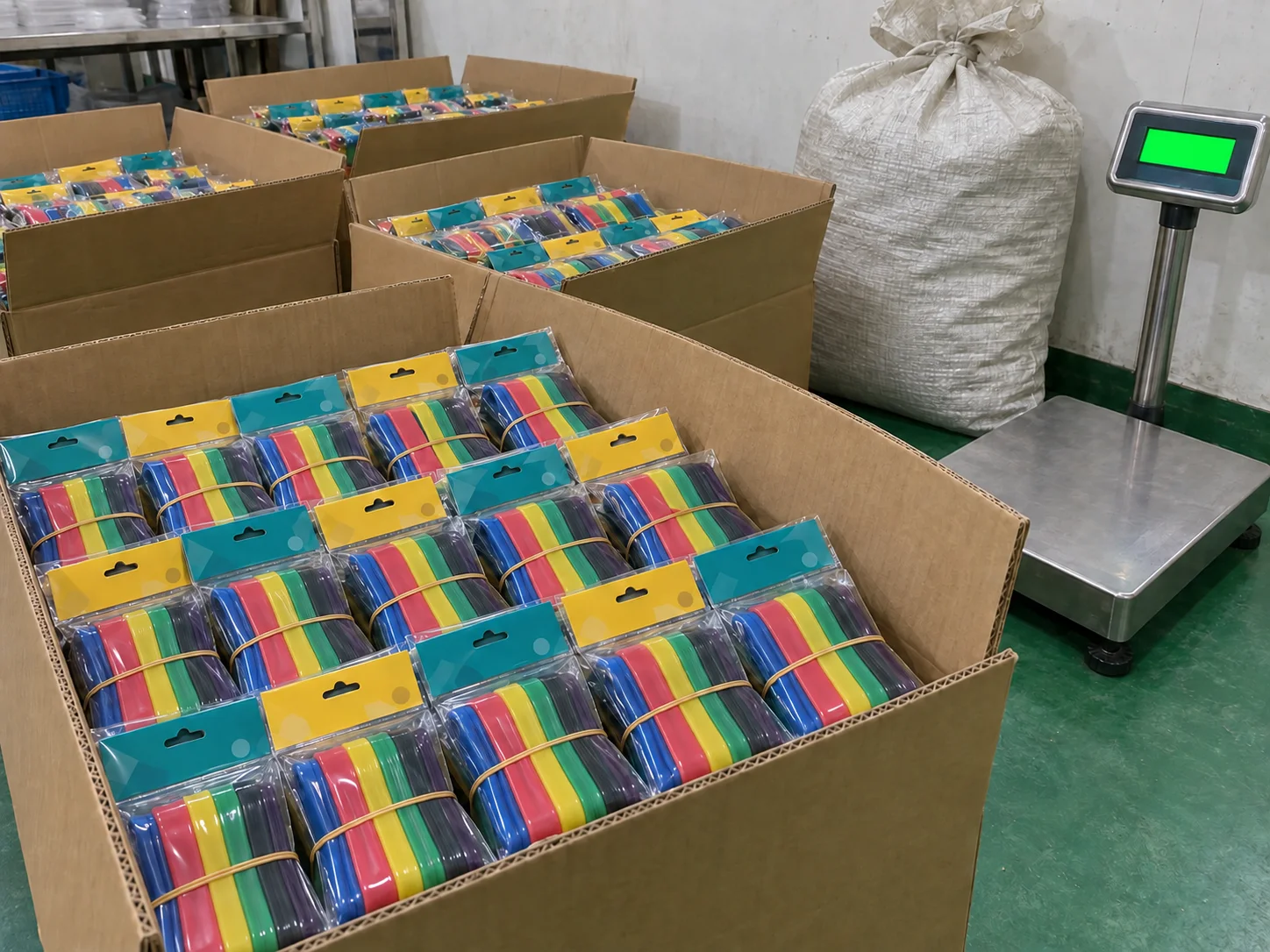
What it is: A transparent OPP or PE poly bag sealed at the top, with a printed cardboard hang tag clipped or heat-sealed to the bag. The bag is sealed by heat seal or adhesive; the header card is typically 350–400 gsm printed board.
What it communicates: Entry-level product. Appropriate for promotional pricing ($8–$18 retail), high-volume mass retail (big-box sporting goods, pharmacy chains), and products where the band specification is the message and packaging is purely functional.
Cost range: $0.08–$0.18 per unit for the bag and header card combined (at 500+ units).
Specification variables that matter: – Bag gauge (thickness): 60–80 micron is standard; thinner bags tear at retail hooks. Specify minimum 70 micron. – Header card print: one-side vs two-side print, finish (matte vs gloss laminate). Two-side matte is the minimum for a branded product. – Suffocation warning: required on any bag with an opening exceeding 5 inches — must be printed on the bag itself, not on a separate label.
When to use: Testing the market with a low MOQ, low-risk pricing tier, or channels where shelf presence is determined by price positioning rather than packaging design.
Format 2: Portable Carry Bag
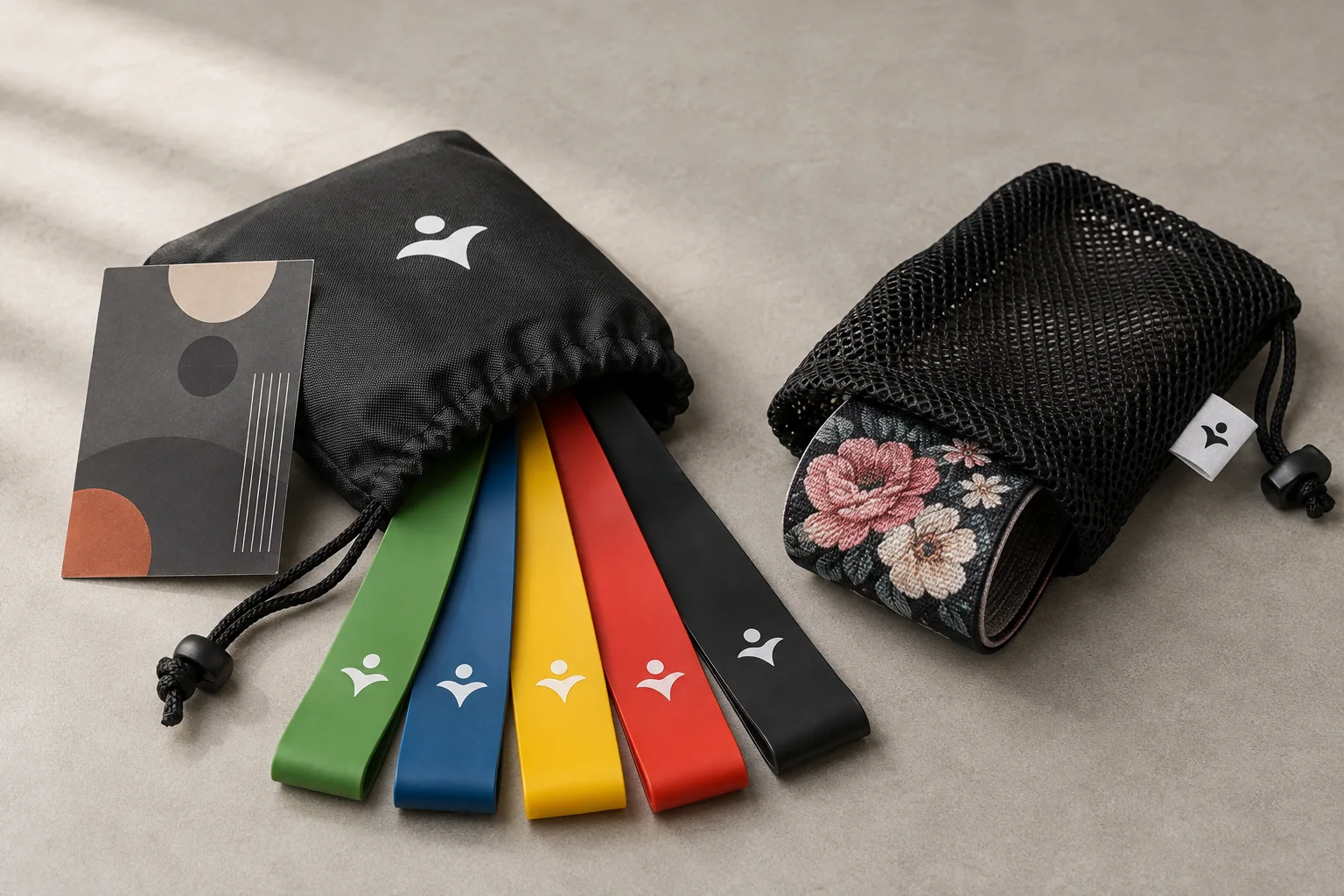
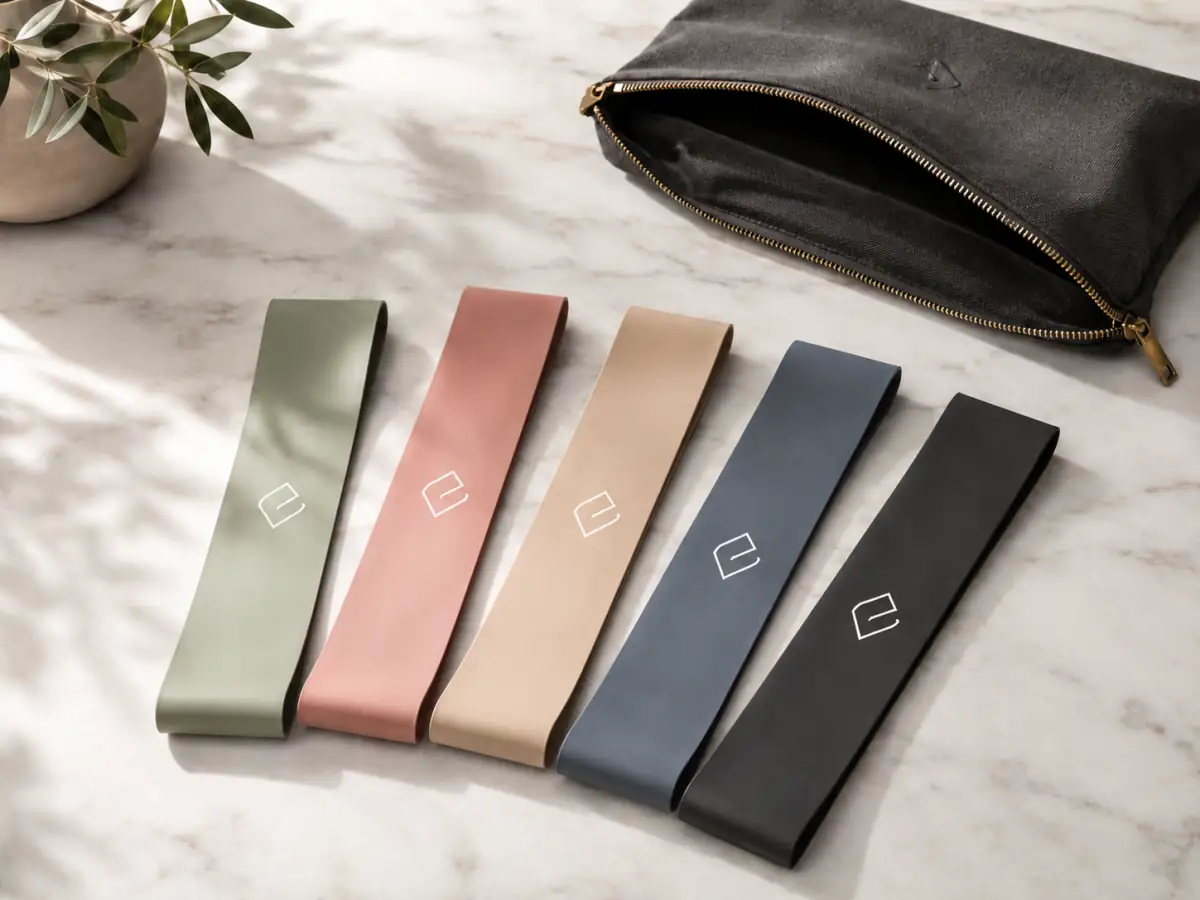
What it is: A compact, portable bag — typically 20–28cm in the longer dimension — made from nylon, polyester mesh, or canvas, designed to hold a resistance band set and double as a reusable carry accessory. The standard closure is a drawstring; premium variants use a zipper. The carry bag ships flat but opens into a functional gym bag that buyers keep and use beyond the initial unboxing.
The two main subtypes:
Drawstring carry bag (most common): Lightweight nylon or polyester bag with a dual drawstring closure. The drawstring pulls tight, the bag hangs closed. No hardware to fail. Easy to open and close in a gym setting. Printed logo via screen print on one or both sides. Cost range: $0.25–$0.55 per unit at 300 sets.
Mesh carry bag: Open-weave mesh construction — breathable and lightweight. Popular for studio and gym supply contexts where hygiene and ventilation matter. Logo applied via heat transfer or woven label. Cost range: $0.30–$0.60 per unit.
Zippered carry bag (premium variant): A bag with a zipper closure rather than a drawstring — slightly more structured than a drawstring bag, keeps contents more secure. More common in premium DTC and corporate gifting contexts. Cost range: $0.55–$0.95 per unit, depending on zipper grade.
What it communicates: Branded, functional product. This is the standard format for private label resistance band sets at $18–$45 retail across DTC, Amazon, and specialty fitness retail. The carry bag staying in the buyer’s gym bag keeps the brand present every session.
Specification variables that matter:
- Material: 210D or 420D nylon is standard for drawstring bags — 420D is heavier and more durable; 210D is lighter and appropriate for lightweight sets. Mesh bag weight is measured in grams per panel; 80–120 gsm mesh is standard for fitness accessories.
- Closure cord quality (drawstring bags): Flat woven cord holds its shape and is easier to grip than round cord. Cord thickness of 4–6mm reads as premium; thinner cord feels cheap and can snap under repeated use.
- Zipper grade (zippered variant): Same principle as all zipper applications — YKK or equivalent grade for any product where the zipper is touched repeatedly. Specify explicitly.
- Bag dimensions: The bag must comfortably hold the full band set plus the insert card without overfilling. For a 5-band set plus a folded insert card, a bag of approximately 22cm × 28cm is typical. Overfilled bags strain the closure; bags that are too large make the product feel underfilled.
- Print on bag: Screen print (most common, single or two-color logo) or heat transfer (multi-color or detailed design). Sublimation print on full-polyester bags allows full-surface color artwork. Specify print size with measurements, not just “logo on front.”
- Insert card: Fits flat inside the bag alongside the bands. Specify card dimensions, weight (350 gsm minimum), print finish, and content (resistance level guide, QR code, care instructions). A card that folds to fit is a quality downgrade — design it to fit flat.
When to use: Standard specification for any branded private label resistance band set sold on Amazon, through DTC, or at specialty fitness retail. The carry bag format scales across price points from $18 (entry branded, drawstring) to $45 (premium branded, zippered) depending on material and closure.
Format 3: Rigid Gift Box
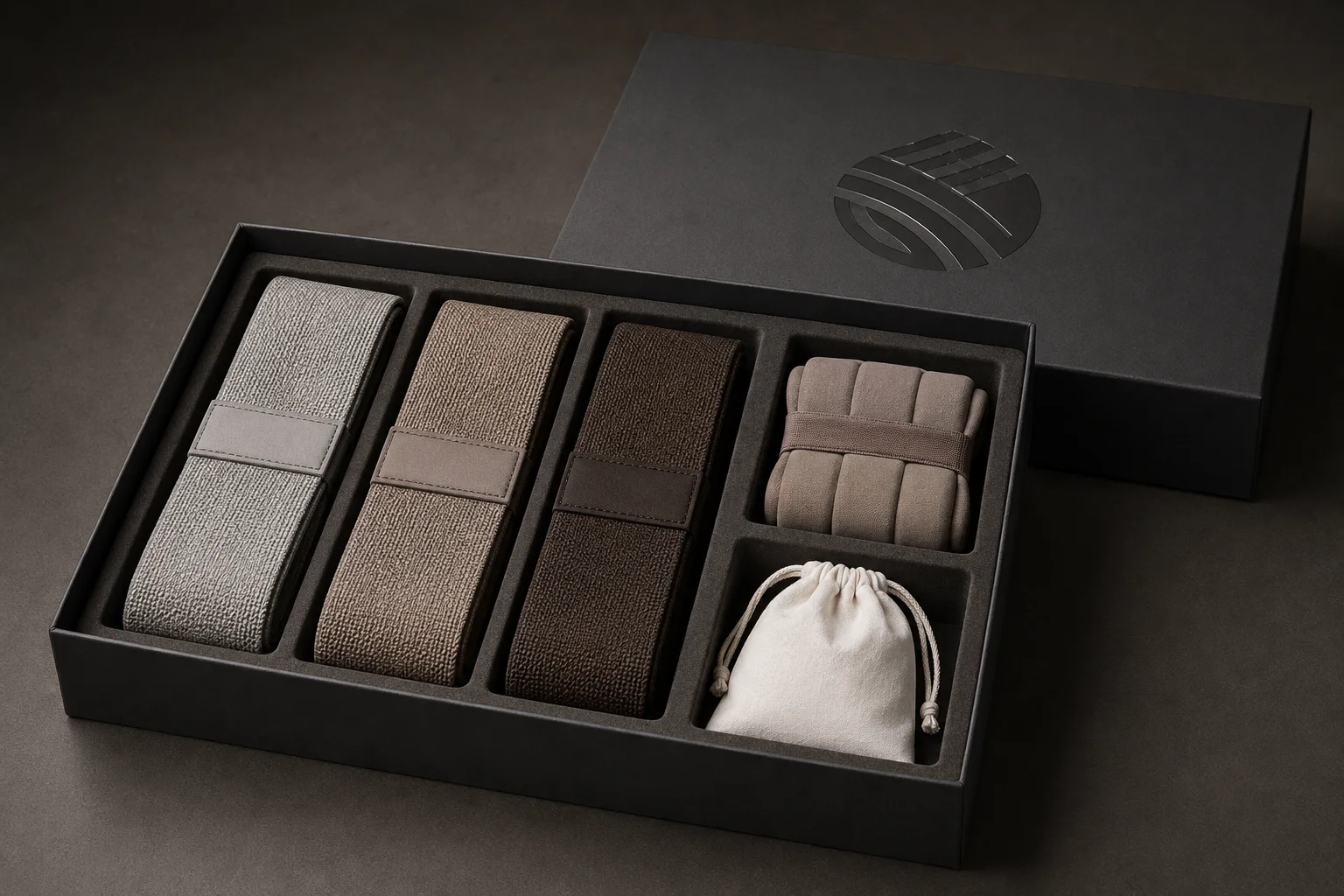
What it is: A two-piece rigid box with a fitted lid, typically full-bleed printed on the lid exterior and inside the lid. Resistance bands are arranged in a fitted insert tray inside the box. Some configurations add a ribbon pull or magnetic closure.
What it communicates: Premium product. Appropriate for $40–$80+ retail positioning, corporate wellness gifting programs, holiday SKUs, and products where the unboxing experience is part of the value proposition. The rigid box does not function as a practical long-term storage accessory the way a zip pouch does — it communicates occasion and quality at point of gift, then is typically discarded.
Cost range: $1.20–$2.80 per unit for the box and insert tray combined (at 300 sets), depending on board weight, print finish, and construction complexity.
Cost premium over carry bag: 100–200% on the packaging component alone. At a $2.00 box vs $0.45 drawstring carry bag, the packaging premium is $1.55 per set — which needs to be recovered in a higher retail price or offset by lower volume expectations.
Specification variables that matter:
- Board weight: 1,200 gsm is minimum for a box that holds its shape under normal handling. 1,500–1,800 gsm is the premium standard. Specify board weight explicitly.
- Lid fit: The lid should require slight resistance to remove — not loose (rattles on the shelf) and not tight (requires two-handed force). This is a factory calibration detail; request lid-fit verification on the pre-production sample.
- Drop test: Amazon FBA requires that boxed sets survive a 3-foot drop test without the lid separating. Request drop test verification if the product is going to FBA. Most rigid gift boxes produced for FBA use will pass, but confirming on the pre-production sample avoids a receiving rejection.
- Insert tray: A custom-formed pulp tray, EVA foam insert, or die-cut cardboard insert holds the bands in position. Without an insert, bands shift and tangle in transit, which generates a poor unboxing experience. Specify the insert material and band-securing format.
- Finish: Matte laminate with spot UV on the logo is the standard premium finish. Soft-touch (velvet) laminate adds tactile differentiation. Foil stamping (gold or silver) is appropriate for gifting SKUs. Each finish adds cost and lead time.
Dimensional weight note for FBA: A rigid gift box at 28cm × 20cm × 6cm has a dimensional weight of approximately 486g — which may exceed the actual weight of the product and shift it into a higher FBA fee tier. Calculate dimensional weight before finalizing box dimensions.
When to use: Holiday SKUs, corporate gifting programs, premium DTC positioning ($50+), or retail placements where shelf presence in a sporting goods store depends on packaging differentiation.
Format 4: Custom Cylinder or Tube
What it is: A cylindrical container — typically 8–12cm diameter, 25–35cm length — with a printed label wrapped around the tube. Bands are rolled and inserted vertically. Common end closures are a press-fit plastic cap or a pull-tab cardboard lid.
What it communicates: Distinctive shelf presence. The cylinder format stands out in a category where most products use flat carry bags or rectangular boxes. Appropriate for brands that want a packaging format that draws attention on a retail shelf.
Cost range: $0.90–$1.80 per unit at 500+ units. Higher tooling cost than boxes or pouches ($200–$500 for tube end cap tooling).
When to use: Niche: brands with strong retail distribution who want a format that stands out on a sports retail planogram. Not typically appropriate for Amazon (dimensional weight penalty, suboptimal for the flat-image listing format).
Channel-Packaging Match Matrix
| Channel | Recommended Format | Key Requirement |
|---|---|---|
| Amazon FBA | Carry bag (drawstring or zippered) or poly bag + header card | Suffocation warning if opening >5″, FNSKU, sealed |
| DTC direct ship | Drawstring or zippered carry bag | Mailer-compatible dimensions, no loose components |
| Specialty fitness retail | Carry bag or rigid gift box | Hang-hole or hang tag, UPC barcode |
| Big-box mass retail | Poly bag + header card | Planogram dimensions, price point compliance |
| Corporate wellness gifting | Rigid gift box or zippered carry bag | Individual unit mailer-compatible, branded insert |
| Studio / gym supply | Mesh carry bag or poly bag | Durability, breathability, bulk pricing |
Packaging Specification Checklist
A complete packaging specification for a private label resistance band set covers:
Carry bag or box:
– [ ] External dimensions (L × W × H in cm, or flat dimensions for carry bags)
– [ ] Material and weight (denier for nylon bags; gsm for board weight boxes)
– [ ] Closure method: drawstring (cord spec) or zipper (grade, color)
– [ ] Print specification: surfaces printed, color count, method (screen print / heat transfer / sublimation)
– [ ] Handle or hang-hole (if retail hook display required)
– [ ] Drop test requirement (if FBA, for rigid box format)
Insert card:
– [ ] Dimensions (must fit packaging interior without folding)
– [ ] Card weight (gsm)
– [ ] Print: two-side, color count, finish
– [ ] Content: resistance level guide, care instructions, brand information, URL/QR code
Labels and compliance:
– [ ] Suffocation warning (if bag opening exceeds 5 inches / 12.7cm)
– [ ] FNSKU placement and size
– [ ] UPC/EAN barcode (if retail)
– [ ] Country of origin label
– [ ] Material composition declaration (required for EU)
– [ ] Latex allergy warning (if applicable)
Reference:
– [ ] Physical pre-production sample approved and signed
PREGUNTAS FRECUENTES
Can we use our existing packaging design files with a new factory?
Yes, with qualification. Provide files in AI, EPS, or PDF format (CMYK, 300 DPI minimum). The factory’s print team checks bleed margins, text safe zones, and color gamut before going to production. A file that wasn’t prepared for a specific print process (offset vs digital vs screen print) may require revisions — typically 3–5 days. Supply the files before finalizing the order timeline.
How far in advance do we need to order custom packaging for a reorder?
For a carry bag reorder with an existing approved specification, 20–25 days production is standard. For a rigid gift box reorder, 25–35 days. If any packaging element changed (new artwork, new cord color, different dimensions), add a sample approval cycle: 7–10 days for a new packaging sample, 3–5 days for approval. Plan reorders so packaging lead time doesn’t become the critical path in the order timeline.
Is it possible to order packaging in larger quantities than the band MOQ to reduce per-unit cost?
Yes, and it’s often worth doing. Insert cards, header cards, and carry bags can typically be pre-ordered in quantities 2–3× the current band order and stored at the factory for use in subsequent reorders. This reduces per-unit packaging cost and removes the packaging component from the critical path of future orders. Confirm the factory’s willingness to hold packaging stock and whether they charge a storage fee.
What is the minimum order for a custom-printed carry bag?
Most factories require a minimum of 300 bags for a custom-printed drawstring or zippered carry bag (matching the standard band set MOQ). For custom fabric colors or weaves outside the factory’s stock range, the minimum may be higher (500–1,000 units) to justify the fabric dyeing batch. For mesh bags, minimum is often 500 units due to the mesh panel production setup. Confirm minimum bag quantity separately from band quantity when requesting a quote.
Related reading:
– OEM Resistance Band Sourcing: Complete B2B Guide — material selection, MOQ structure, and channel requirements for the full sourcing program
– Private Label Resistance Bands: MOQ, Branding & Packaging — logo methods, custom color approval, and spec documentation
– Selling Resistance Bands on Amazon: FBA Specs, Compliance & Listing Setup — FBA packaging rules, FNSKU requirements, and suffocation warning specifications
– Resistance Bands for Corporate Wellness Programs — packaging requirements for direct-to-employee delivery and gifting programs