
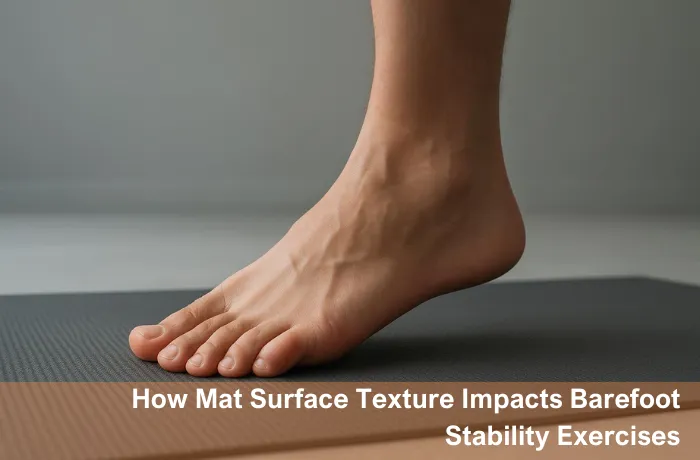
More grip feels safer—until it isn’t. Most conversations about “non-slip” mats stop at material labels, but in barefoot stability work, that’s only half the story.Surface texture determines how early the foot detects instability—and how easily it can correct it—long before a slip becomes obvious. The way a mat is textured changes how force transfers through the foot, how quickly the body senses drift, and how efficiently micro-corrections happen. This guide treats mat surface texture as a performance design variable, not a comfort preference. The audience is B2B: product managers, sourcing teams, brand owners, and performance leads who need repeatable tests, clear trade-offs, and manufacturing guardrails. The core claim we will support throughout: a well-designed micro-texture enables faster corrective reactions in dynamic barefoot tasks than very smooth or very aggressive textures. Stability isn’t about preventing movement; it’s about correcting it faster.
Why Surface Texture Matters in Barefoot Stability Training
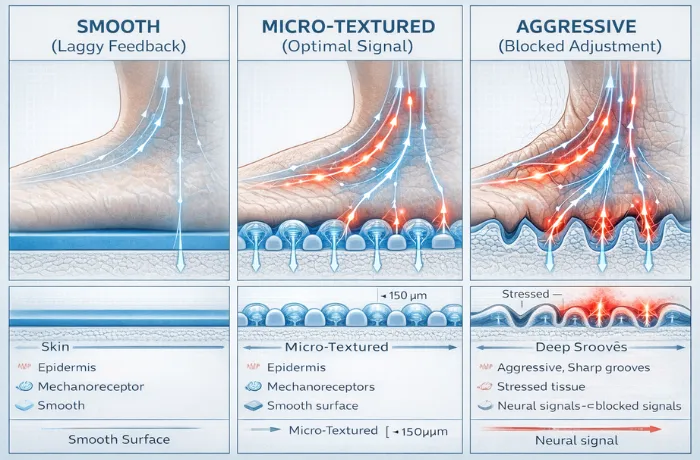
What This Means for Mat Design (Not Just Theory)
- Surface texture affects reaction speed, not just grip
- Too smooth delays feedback; too aggressive blocks correction
- The goal is predictable micro-adjustments, not zero movement
💡 Key Takeaway for Product Teams: Research indicates that micro-textured surfaces reduce postural sway by actively stimulating plantar mechanoreceptors, whereas overly smooth surfaces cause sensory delay (“laggy control”). Optimal stability requires predictable shear force—enough to signal drift, but low enough to permit micro-adjustments (~200ms reaction window).
Barefoot Training Changes How the Body Interacts With the Mat
Bare skin on a surface doesn’t behave like a shoe on a floor. The plantar skin deforms, slides minutely, and sends rich sensory signals that the nervous system uses to steady posture. Enhanced stimulation of the foot’s cutaneous receptors can reduce sway and sharpen orientation in challenging tasks, especially when other senses are less reliable. In controlled cohorts, facilitating plantar inputs has been shown to cut postural sway metrics—suggesting that better sensory data improves quiet-stance control—according to the authors of a 2016 older-adult study in which enhanced plantar input reduced center-of-pressure area and velocity, reported in the open-access article Effect of plantar cutaneous inputs on postural control by Wang and colleagues (2016) hosted by the U.S. National Library of Medicine: https://pmc.ncbi.nlm.nih.gov/articles/PMC5801714/.
Physically active participants also appear to adapt better when the support surface changes, and researchers recommend barefoot exercise that stimulates plantar mechanoreceptors to enhance postural function, as summarized in Maïtre and coauthors’ 2016 paper in Frontiers in Human Neuroscience, Influence of plantar cutaneous information in postural control: https://pmc.ncbi.nlm.nih.gov/articles/PMC4987371/. Think of micro-texture as a way to present graded, predictable cues to the foot—neither a glassy glide nor a sticky lock.For product teams, this means texture design directly affects reaction speed, not just perceived grip.
Stability Is About Controlled Friction Not Maximum Grip
If a surface is too slippery, corrections arrive late and sway grows. If it’s too sticky, the foot can’t make the tiny rotational and translational adjustments that keep balance efficient; the body may overwork other joints to compensate. What you’re after in barefoot work is controlled, predictable friction: enough resistance to inform the nervous system and resist unwanted drift, but still allow the foot to make small, fast adjustments. Too little friction delays feedback; too much friction blocks correction. Mechanically, horizontal shear at the foot–surface interface strongly influences tissue deformation and feedback even when simple stance metrics look similar, as highlighted in Jeong and colleagues’ 2021 PLOS ONE study on plantar shear and body mass, Added body mass effects on plantar shear spreading forces: https://journals.plos.org/plosone/article?id=10.1371%2Fjournal.pone.0246605.
Common Yoga Mat Surface Textures and Their Functional Differences
Smooth or Low Profile Surfaces
Feel: sleek, uniform, often visually premium.
Strengths: easy to clean, visually consistent, often lower cost and simpler to manufacture with tight aesthetic tolerances.
Risks: under dynamic transitions or with a thin moisture film, micro-slips can grow before the nervous system reacts. That delay feels like “laggy” control—fine for gentle static work, risky when balance is challenged.
Micro Textured or Patterned Surfaces
Feel: fine dots, waves, or shallow patterns that you sense more than see.
Benefits: provide progressive resistance as load increases; skin deforms slightly into the pattern, delivering predictable cues without locking the foot. Multiple studies on textured interfaces—not mats per se—show reduced sway or task-specific gains compared with smooth references. For example, Palazzo and coauthors reported that a firm textured surface reduced anterior–posterior sway velocity versus a smooth firm control in young and elderly adults in their 2021 open-access article Firm textured surfaces and postural control: https://pmc.ncbi.nlm.nih.gov/articles/PMC8282579/.
Deep or Aggressive Textures
Feel: prominent ridges, grooves, or peaks.
Benefits: very high friction for static holds, heavy bracing, or use with footwear or gloves.
Trade-offs: can over-constrain micro-movements in barefoot dynamic drills. Corrective steps may become choppy, and transitions can feel “stuck,” especially when the skin catches on edges.
How Surface Texture Affects Stability Exercises
Static Balance Single Leg Holds and Isometrics
In quiet stance, predictable contact is king. Both overly smooth and overly sticky surfaces amplify sway—one by delaying feedback, the other by resisting micro-adjustments. Micro-texture provides a “middle path,” letting the ankle strategy work efficiently while still damping drift.
Dynamic Stability Transitions and Weight Shifts
During step-throughs, slow lunges, or lateral taps, texture influences correction speed. With micro-texture, tiny slips are resisted early and consistently, helping you return to the center with fewer, smaller corrective actions. On deep textures, however, initial movements can snag, producing stop–go corrections that feel abrupt and energy-hungry. Here’s the deal: faster, smoother corrections beat peak grip once you start moving.
Rehab and Corrective Movements
In PT and return-to-function work, safety and predictability outrank peak friction. Texture should cue without surprising. Micro-texture usually balances early warning with adjustability, which is why many clinicians favor lightly patterned, easy-to-clean surfaces for progressive drills where confidence is paramount. A 2023 meta-analysis on plantar-sensory interventions in chronic ankle instability found modest improvements in certain balance components under specific conditions, reinforcing that sensory inputs can help but are task-dependent, as reported by Hu and colleagues in Plantar sensory treatment effects on balance: https://pmc.ncbi.nlm.nih.gov/articles/PMC10298754/.
💡 Sourcing Verdict: Texture vs. Function Laboratory observations suggest Micro-Textured surfaces offer the best versatility for dynamic barefoot training, balancing feedback speed with comfort. Smooth surfaces are viable for low-sweat/gentle yoga but risk “hydroplaning” instability under moisture. Aggressive textures should be reserved for shod training or static holds, as they can cause skin abrasion and hinder rotational foot adjustments.
Matching Surface Texture to Training Use Cases
Yoga and Studio Classes
Long sessions demand surfaces that don’t fight transitions or fatigue hands and feet. Smooth mats can feel elegant at first but may underperform in flow sequences as moisture rises. Deep textures can feel harsh in weight-bearing palms. Micro-texture often threads the needle: predictable, graded friction for standing balance and steady control in vinyasa-style transfers.
Functional Training and Balance Work
Multi-directional drills benefit from textures that resist drift early yet allow micro-rotations. Micro-texture typically supports fewer corrective steps after small perturbations. Smooth surfaces can lengthen recovery time; aggressive textures can lock the foot and slow fluid redirections.
Physical Therapy and Rehab Settings
Clinics need consistent behavior under dry and lightly moist conditions, with strict cleaning protocols. Choose textures that stay predictable after repeated disinfection and that clients describe as “secure but adjustable.” Define cleaning-compatible materials first, then select micro-texture that survives the regimen.
| Texture type | Best-fit use cases | Key benefits | Watch-outs |
|---|---|---|---|
| Smooth or low profile | Gentle yoga, low-sweat studio work, quick daily cleaning | Easy maintenance, uniform look, lower cost | Laggy control in dynamic barefoot tasks, sensitive to moisture films |
| Micro textured or patterned | Balance drills, dynamic yoga flows, progressive rehab | Predictable friction, faster micro-corrections, good all-rounder | Must validate under sweat and cleaning cycles; avoid patterns that trap residue |
| Deep or aggressive | Static holds, shod training, heavy bracing | Peak grip for planted positions | Can over-constrain barefoot dynamics, harsher on skin, harder to clean |
Design and Manufacturing Considerations Brands Often Overlook
Texture Consistency Across Production Batches
Texture is geometry. Depth, pitch, and edge radius drive tactile feedback and friction behavior. Small drifts from mold wear, temperature variation, or process changes can make the same SKU feel different lot to lot. Align suppliers on how texture is specified and verified. Areal surface texture parameters from ISO 25178 (e.g., Sa and Sdr) provide a consistent language across plants and time; see the ISO 25178-2 terms and parameters summary published by ITEH: https://cdn.standards.iteh.ai/samples/42785/043e77b9088d449fb2c328b8c6db329c/ISO-25178-2-2012.pdf.
Texture Versus Cleaning and Durability
Studios and clinics must clean after every session. Deep textures trap residue; harsh chemicals or UV can round micro-features and change friction over time. CDC infection control guidance for noncritical equipment advises cleaning first, then using an EPA-registered disinfectant per label instructions—practical context when choosing materials and patterns for shared mats, as explained in the CDC’s healthcare equipment disinfection overview: https://www.cdc.gov/infection-control/hcp/disinfection-sterilization/healthcare-equipment.html. Validate that your chosen micro-texture maintains performance after repeated cleaning cycles and air-dry periods.
How to Evaluate Mat Surface Texture Before Scaling Production
Simple In‑House Stability Tests
Goal: compare candidate textures using a standardized, low-instrument method centered on perturbation recovery time and success rate.
Setup: prepare three samples—smooth, micro-textured, and deep. Recruit 8–15 barefoot-experienced evaluators. Test in a level, well-lit room at 20–24°C. Run dry and then light-sweat conditions (use a fine mist with water plus ~0.1–0.2% mild soap for consistency). Record material, thickness, and hardness for each sample.
Task: single-leg stance on each surface for 10 seconds. At second three, apply a gentle, repeatable lateral tug at knee height using an elastic band or a spring scale to standardize force. The primary metric is time to regain a stable hold for two consecutive seconds without the foot touching down. Secondary metrics include success rate within the 10-second window, the count of visible corrective steps, and a 1–5 predictability rating from the evaluator.
Trials: perform three trials per surface per leg per condition. Randomize surface order and rest 60–90 seconds between trials. Compute mean and standard deviation per surface. Expect micro-texture to show shorter average recovery times than smooth, and smoother corrections than deep textures. Report your method, sample details, and conditions so others can replicate.
Standards context: classic slip-resistance tests are informative but not definitive for barefoot mats. Water-based DCOF per ANSI A326.3 is widely used for tile selection in certain interior applications, yet it isn’t designed to predict performance for textured mats under light sweat films and micro-movements; see the Tile Council of North America copy of ANSI A326.3 (2021) for scope and limitations: https://tcnatile.com/wp-content/uploads/2023/01/ANSI_A326.3_2021_February_2022_Locked.pdf. Barefoot ramp classifications from DIN 51097 and their successor frameworks in EN 16165 are often cited, but methods aren’t directly comparable to pendulum or DCOF tests; for a clear overview, consult the UK Slip Resistance guidance on DIN and EN ramp testing: https://www.ukslipresistance.org.uk/faq/what-is-din51130-din51097-ramp-testing/.
If you’re comparing standards, here’s the short version before the details.
Most slip standards were designed for footwear or flooring
Barefoot stability depends more on correction speed than peak friction
User Feedback Versus Marketing Claims
“Non-slip” is not a feeling—it’s a behavior under defined conditions. Ask evaluators to describe predictability, not just grip. Favor comments like “I could adjust without sticking” or “I felt drift earlier” over generic “grippy.” Capture failures and near-falls, not only successes. When in doubt, trust standardized tests over slogans.
Practical Example and Next Steps for B2B Teams
A practical way to move fast is to prototype two or three micro-texture geometries (for example, 80–200 micrometers depth with 1.0–2.0 millimeters pitch and rounded peaks), then run the perturbation protocol alongside a smooth control. In one OEM pilot, a micro-pattern with shallow domes produced shorter average recovery times and fewer corrective steps than the smooth sample under light-sweat conditions, while an aggressive ridge pattern increased stop–go corrections. Results like these are best treated as directional signals to refine geometry and cleaning plans.
For brands that don’t maintain in-house tooling, an experienced OEM can accelerate this loop by cutting texture coupons, running small-batch trials, and documenting batch-to-batch texture metrics. For instance, WellfitSource supports OEM and private-label prototyping with micro-texture options and can help teams pair texture specs with cleaning compatibility and QC sampling—kept strictly neutral and test-driven.
Short sourcing and QC checklist:
- Request numeric texture geometry with ranges and tolerances, plus areal parameters and metrology method.
- Define acceptance sampling and requalification triggers for molds and processes.
- Validate cleaning compatibility and run accelerated cleaning/UV aging with re-measurement of texture parameters.
- Capture field test data using the perturbation protocol and report mean ± SD and success rates.
Conclusion
Surface texture is a performance decision, not a cosmetic one. In barefoot stability work, the winner isn’t the surface with the highest raw grip but the one that produces fast, predictable corrections without trapping the foot. For most dynamic, barefoot use cases, a thoughtful micro-texture will outperform very smooth and very aggressive patterns—provided you validate it under sweat, cleaning, and real movement.
FAQ
Q: Is a grippier yoga mat better for barefoot stability training?
A: Not necessarily. In barefoot stability training, performance depends on controlled, predictable friction, not maximum grip. Extremely grippy surfaces can restrict the foot’s natural micro-adjustments, forcing the body to compensate at the ankle, knee, or hip. This often slows corrective reactions during dynamic balance tasks. A well-designed micro-textured surface typically enables faster and smoother balance corrections than either very smooth or overly sticky mats.
Q: Smooth vs textured yoga mats: which is better for barefoot balance?
A: The best surface texture for barefoot balance training is a shallow, evenly distributed micro-texture that delivers consistent tactile cues without sharp edges or deep grooves. Patterns such as fine dots or shallow waves allow the plantar skin to deform slightly, improving sensory feedback while still permitting micro-rotations and translations. This balance supports faster recovery from small perturbations and more efficient movement control in dynamic tasks.
Q: Why do some “non-slip” yoga mats feel unstable during barefoot balance exercises?
A: Some “non-slip” yoga mats feel unstable because excessive grip can actually interfere with balance correction. When the foot is overly constrained, it cannot perform the small, rapid adjustments needed to regain stability. Instead of correcting early and smoothly, the body may over-correct or rely on larger joint movements, which can feel abrupt and unstable—especially during transitions or lateral shifts.
Q: How should brands test surface texture before mass production?
A: Simulate barefoot balance movements, test under dry and sweaty conditions, and evaluate consistency across samples using a standardized perturbation recovery protocol—don’t rely solely on lab friction numbers.

 English
  German
  Spanish