
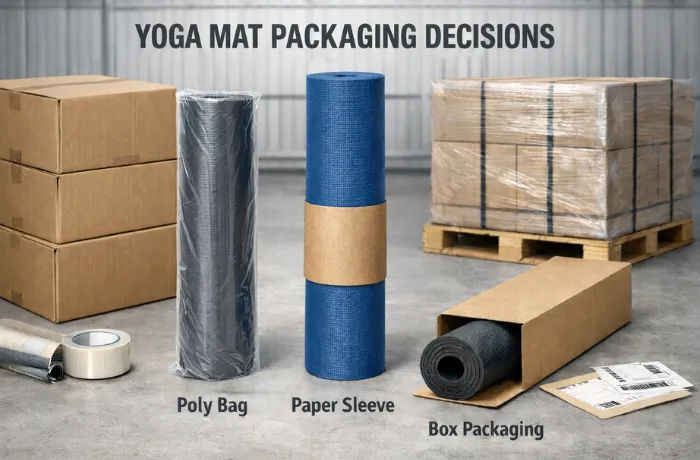
Most brands start by asking how their yoga mat packaging will look. In manufacturing and logistics, the first questions are different: Will it pass channel compliance (Amazon FBA or retail)? Will it survive a long ocean route without scuffs or crushed edges? Will it cube efficiently so your per‑unit cost doesn’t creep up? This guide treats yoga mat packaging as a supply‑chain decision. We prioritize channel compliance and risk control; unit cost follows from those choices.
For brands sourcing yoga mats at scale—especially those selling via Amazon FBA or cross-border retail—these packaging decisions directly affect landed cost, return rates, and channel compliance.
Why Packaging Design Matters in Yoga Mat Manufacturing
Packaging Impacts More Than Visual Branding
Appearance is only one variable. Packaging choices directly drive container utilization, warehouse footprint, and damage risk. In real projects we’ve seen tight‑rolled mats in low‑cube packs boost case counts and reduce per‑unit freight, while “prettier” but bulkier formats cut container yield and raise handling damage. Put simply: a good‑looking box can still be the wrong box for cross‑border supply chains.
For buyers, this means packaging choices should be evaluated as part of freight planning and damage control—not as a last-step branding decision.
Packaging as Part of the Product Experience
For B2B buyers, the experience is measured by complaint rates, return risk, and platform ratings—not unboxing drama. When packaging reduces inbound scuffs and scan failures, customer service tickets fall and listings stay healthy. When it doesn’t, the hidden costs show up as rework, relabeling, and lower seller metrics.
Common Packaging Types for Yoga Mats (And Their Trade‑offs)
Each packaging type optimizes a different constraint: cube efficiency, brand visibility, or retail readiness. There is no universally “better” option—only a better fit for your channel and logistics profile.
OPP/PE Bag Packaging
What you buy: Logistics efficiency, moisture resistance, and the most compact cube. Poly bags with clear barcodes can be efficient for FBA when appropriately labeled. Typical roll diameter commonly ranges in a modest band depending on material density and roll tightness.
What to watch: Puncture/abrasion at edges, label scannability on curved surfaces, and suffocation warning requirements for large openings. Export‑grade master cartons matter to avoid compression and edge damage during ocean legs and FC handling.
If you choose this, you’re spending brand presence to gain shipping density and simpler operations.
Paper Sleeve + Inner Protection
What you buy: Stronger brand presence than poly alone with still‑reasonable cube. With a tight roll and simple inner protection (e.g., film wrap and kraft end support), brands get clear shelf readability and acceptable case efficiency.
What to watch: Sleeve slippage if friction is low, edge crush during stacking, and higher MOQs for printed sleeves. The inner protection spec is the difference between a crisp arrival and compression wear.
If you choose this, you’re paying for brand readability while accepting moderate operational complexity and the need for tuned inner protection.
Full Color Printed Box
What you buy: Retail readiness, flat barcode placement, and puncture resistance. It’s the most familiar format for brick‑and‑mortar.
What to watch: Larger cube and weight reduce units per case and container. Long ocean routes demand upgraded board specs; otherwise boxes can panel or edge‑crush. For pure FBA/DTC, full boxes can be over‑packaging unless there’s a clear channel rationale.
If you choose this, you’re buying shelf impact at the cost of container utilization and potentially higher damage unless the board grade is increased.
Not sure which packaging option fits your brand best?
In real projects, packaging decisions usually depend on sales channels, shipping distance, and cost tolerance, not just design preference.
If you already have a target market or sales plan in mind, discussing packaging early with a manufacturer can help avoid unnecessary redesigns and cost overruns later.
How Packaging Affects Shipping, Storage, and Cost
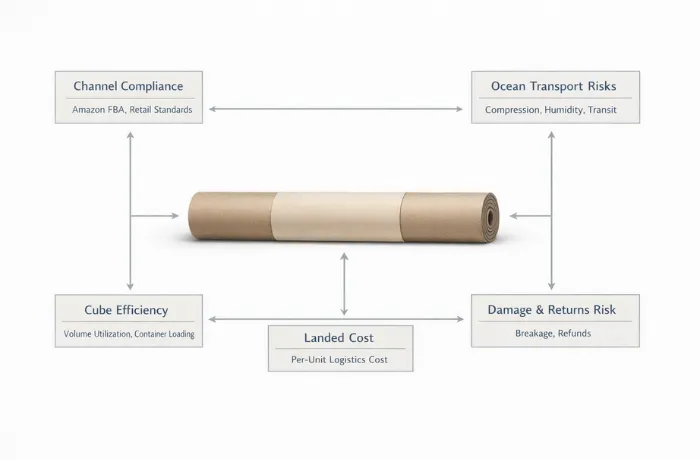
Packaging Size and Container Utilization
Even small changes in roll diameter step‑change case patterns and container yield. A 1–2 cm shift can move you from one case layout to another, compounding through a 40’HC. This sensitivity comes from geometry and discrete packing—tiny dimensional changes alter how rows and layers fit. For a primer on why “Tetris effects” matter, see Maersk’s explanation of container stuffing principles in the article on container stuffing and volume utilization, which clarifies how minor dimension changes cascade through a load plan in practice: Maersk’s container stuffing overview.
| Scenario | Typical roll diameter range (cm) | Example case pattern (units/case) | Indicative effect on 40’HC utilization | Best fit for channel |
|---|---|---|---|---|
| Tight‑roll poly bag | 12–14 | 4–6 | Higher yield; compared with 15–16 cm rolls, improvements often fall in a mid single‑digit to low double‑digit percent band | Amazon FBA / DTC (online-first, high-volume fulfillment) |
| Sleeve + inner ends | 13–15 | 3–5 | Mid yield; depends on end‑cap design and sleeve friction | Online + selective retail (balances branding and cube) |
| Unit box | 14–17 | 2–4 | Lower yield; more voids; requires up‑spec’d board for compression | Brick‑and‑mortar priority (retail‑ready display and shelf impact) |
These are safe ranges, not specifications. Actual outcomes depend on material density, roll tension, and carton geometry.
For sourcing teams, the takeaway is simple: lock your target roll diameter early, because even small changes can cascade into higher freight cost across an entire container.
Damage Risk and Return Costs
Where do failures actually happen? Ocean legs expose cartons to humidity and long compression cycles, which weaken corrugated over time. Hand‑offs—from container loading to deconsolidation to FC receiving—add puncture and edge risks. Practical mitigations include moisture‑resistant liners, desiccants, corner protection, correct stack heights, and export‑grade cartons. General logistics guidance outlines how moisture and compression interact over long routes; see Maersk’s discussion on packaging for long routes and compression/humidity risks in ocean shipping: Maersk’s packaging and resilience insight.
Many brands only realize packaging issues after the first shipment.
Container loading efficiency, damage rates, and storage space are often determined by packaging details decided much earlier.
Reviewing packaging feasibility before mass production can significantly reduce hidden logistics costs.
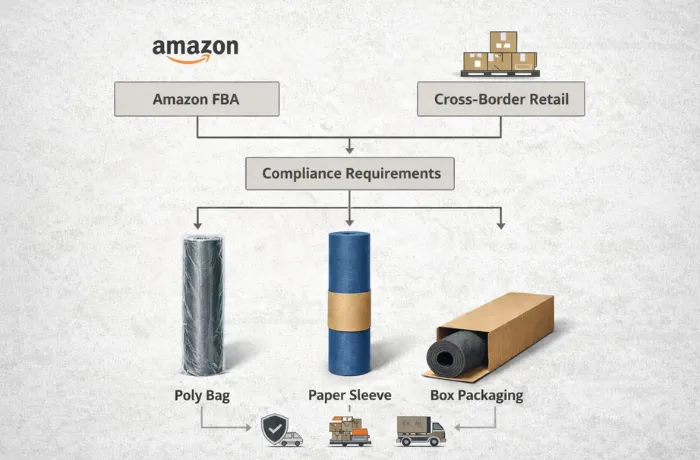
Amazon FBA & Channel Compliance Essentials
For sourcing teams, the takeaway is simple: lock your target roll diameter early, because even small changes can cascade into higher freight cost across an entire container.
Rolled goods introduce practical constraints for barcodes, warnings, and case‑pack setup. A few anchor points—quoted only where public, canonical sources exist—help align teams:
- Poly bagging and suffocation warnings: When a bag’s opening is large, Amazon specifies a suffocation warning on the bag or as a label. Confirm phrasing and placement in the current US Help Hub page: see the bagging requirements explaining suffocation warnings for five‑inch openings and larger: Amazon’s bagging requirements.
- Case‑packed vs. individual products: If shipment boxes contain identical items with matching SKUs, set them as case‑packed so quantities and labels align with receiving expectations. Detail is laid out in the Amazon guidance on case‑packed products for FBA shipments: Amazon’s guidance on case‑packed vs. individual.
- Product size tiers: Size tiers affect handling/fees and should be considered when selecting unit packaging dimensions. Review the current size tier thresholds in the official help page for product size tiers for FBA: Amazon’s product size tiers.
- SIPP (Ships in Product Packaging): If your packaging can ship without added Amazon material and passes testing, SIPP may provide fee relief and simpler prep. Program details and testing options are outlined in the SIPP overview for FBA sellers, including self‑drop tests and ISTA lab routes: Amazon’s SIPP overview.
When shifting formats (e.g., sleeve to unit box), consider transport testing to validate protection claims before scale. For e‑commerce parcels, ISTA 3A simulates common hazards; Amazon’s 6‑Amazon methods apply for SIPP/SIOC contexts. See the ISTA overview of 3‑Series procedures describing drops and vibrations relevant to parcel delivery: ISTA 3‑Series procedures overview.
Sustainability Considerations in Yoga Mat Packaging
What Brands Ask for vs What Actually Works
Requests for compostable films and minimal plastic are common. Under long, humid, compressive ocean legs, some compostable films underperform versus basic PE. Recycled‑content paper sleeves and responsibly sourced krafts typically balance messaging with performance. Avoid unqualified claims—regulatory guidance cautions against broad “biodegradable” promises without evidence and realistic disposal assumptions. The U.S. Federal Trade Commission’s Green Guides summarize what counts as competent, reliable scientific evidence for environmental claims: see the FTC’s environmental claims guidance for marketers and manufacturers: FTC’s Green Guides summary.
How to Balance Eco‑Friendly Packaging with Cost Control
Treat sustainability as a design constraint layered onto compliance and risk. Start with the channel: If FBA is primary, design to FBA first (barcodes, warnings, case‑pack, SIPP eligibility). Next, tune for durability on the ocean leg. Finally, choose the lowest‑impact materials that still pass those gates—e.g., recycled‑content sleeves, recyclable PE bags, or upgraded board grades that reduce damage (and thus waste). Packaging typically accounts for a small but non‑negligible portion of unit cost; damage‑driven returns are far more expensive.
For brands, the risk isn’t just compliance—it’s making sustainability claims that increase damage, returns, or re-packaging downstream.In many cases, reducing damage and returns is itself a sustainability win.
Packaging Customization: What Manufacturers Need From Brands
Key Information Needed Before Packaging Design
To make packaging decisions efficient, align early on:
- Target market and sales channels (Amazon FBA, retail, wholesale)
- Expected order volume and acceptable MOQ tiers (custom print often starts at several thousand units)
- Unit packaging cost tolerance band and cube/weight preferences
- Sustainability requirements and acceptable trade‑offs
- Any SIPP ambitions that may dictate tests, minimum pack rigidity, or dimensions
Disclosure: WellfitSource is one example drawn from our own manufacturing and export operations. The packaging principles discussed here are not platform- or supplier-specific; they reflect common constraints and trade-offs applicable to most export-capable OEM/ODM manufacturers with hands-on Amazon FBA experience.
Common Mistakes Brands Make When Requesting Custom Packaging
- Sending artwork without sales/channel context, which leads to revisions when FBA rules or retail fixtures are considered too late.
- Underestimating MOQs tied to print methods (e.g., flexo vs. offset), which can force mid‑project changes.
- Ignoring roll tightness/diameter targets, which later undermines case patterns and container plans.
How to Choose the Right Packaging for Your Yoga Mat Brand
Ask a few clarifying questions rather than chasing a universal “best” option:
- Who are you selling to, and where will it be sold? If Amazon FBA is primary, design for FBA first, then adapt for retail if needed.
- Which cost are you most afraid of—returns from damage, FBA non‑compliance, or unit packaging spend? Damage and non‑compliance usually dwarf small packaging savings.
- What MOQ and print‑method constraints can you accept? This narrows feasible sleeve/box paths.
- How tight can you roll without causing curl or deformation, and what diameter band does that imply for case/carton planning?
After working through packaging formats, logistics risks, and compliance constraints, most buyers still ask a few recurring questions. Here are the ones we hear most often.
FAQs
Q1: Is custom packaging for yoga mats always necessary for branding?
A: Not necessarily. For many brands selling online or wholesale, standard or semi‑custom solutions meet both branding and functional needs. Custom becomes more meaningful for retail shelves, mid‑to‑high positioning, or when packaging differentiates at the point of sale. Anchor the decision in channel and volume, not ambition alone.
Q2: How does packaging choice affect yoga mat shipping costs?
A: Packaging affects costs via roll diameter and overall package size, container loading efficiency, and damage risk during long transport. Small dimension changes can shift case counts and container rows, which changes per‑unit freight. That’s why “yoga mat packaging” decisions are primarily logistics optimization, not visual design.
Q3: What should brands prepare before discussing packaging with a manufacturer?
A: Clarify target market and channels (online, retail, wholesale), expected volume, unit cost range, and sustainability requirements. Without this, proposals are theoretical and require multiple revisions.
Conclusion
Packaging is a supply‑chain decision, not a decoration decision. Prioritize channel compliance and risk control first—cost improves as a consequence. Talking with an experienced manufacturer early can save far more cost than redesigning later.
Choosing yoga mat packaging is not about finding the ‘best‑looking’ option — it’s about finding the most suitable one for your brand and supply chain.
If you are evaluating packaging solutions or planning a custom yoga mat project, having a practical discussion with an experienced manufacturer can help you make clearer decisions before committing to tooling or large orders.



 English
  German
  Spanish