
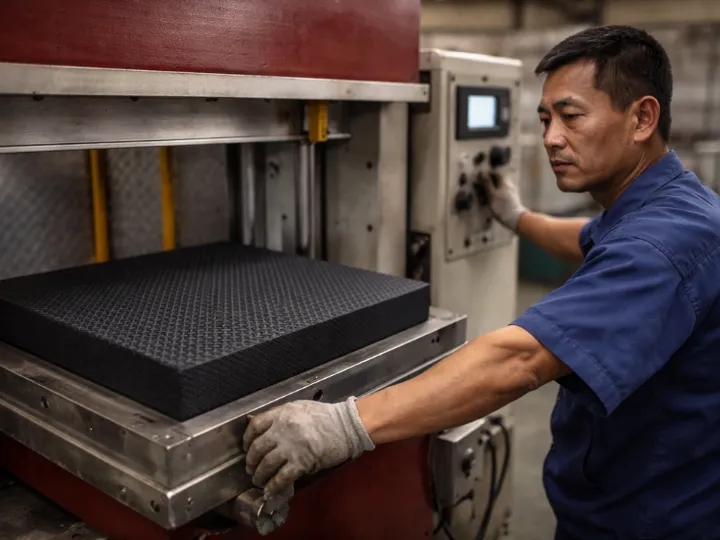
When choosing an OEM balance pad factory for Europe, focus on VOC control, logo durability, batch color stability, and REACH documentation before discussing price.
For fitness brands, the biggest launch risk is rarely a density figure on a spec sheet — it’s customer reviews. If the pad releases a strong odor on unboxing or the logo fades after cleaning, the first 20 reviews can shape the product’s trajectory. Retailers need shipments that clear customs smoothly, maintain consistent color, and deliver foam performance that holds up in real use. Anything less creates exposure, tension, and a stalled launch before momentum builds.
This ultimate guide is written for buyers evaluating an OEM balance pad factory for European retail channels (including Amazon and private DTC). We focus on what actually reduces retail risk: low‑VOC materials and odor control, logo and color stability across batches, and three‑month foam stability—then the paperwork and shipping discipline that keep deliveries moving smoothly.
What European retail brands actually fear (ranked risks)
At retail, perception becomes reality quickly. Here’s the practical order of risk we see across launches and replenishments:
- Unboxing odor (VOC) that triggers instant 1‑star reviews and returns.
- Logo fading or batch color shift that makes a brand look inconsistent.
- Foam collapse within ~3 months in busy gyms or clinics.
- “Silent” customs issues from documentation errors.
- Missing the shipping window before seasonal demand.
A 2–3% defect rate at factory level may translate into visible review damage at retail level. That’s why your OEM balance pad factory must show how they prevent the exact issues that create returns and bad reviews, not just how they make pads.
Micro‑summary: Control the first impression (odor, logo, color), then protect long‑term stability (compression and recovery), then keep paperwork and timing tight.
To translate these risks into practical buying criteria, use the checklist below.
Top 5 Evaluation Points for an OEM Balance Pad Factory in Europe
Before discussing price or MOQ, confirm the following:
- Low‑VOC validation with recent lab summaries
- Batch color ΔE records tied to Pantone targets
- Compression set reports with batch IDs
- Current REACH evidence within the last 12 months
- TARIC classification clarity for EU customs
Micro‑summary: If these five points are controlled, most retail review risks are already reduced.
REACH and CE — what buyers must verify
CE is not a generic badge. CE marking applies only if your product falls under a specific EU regulation or directive that requires CE after conformity assessment. Most non‑powered fitness accessories like EVA/TPE balance pads typically sit outside CE scope unless they’re placed as PPE, toys, or other regulated categories. For an official overview, see the European Commission’s page on CE marking in the single market. According to the Commission’s guidance, CE is a market‑access mechanism tied to defined legislation, not a “quality” logo. Reference: the European Commission’s CE marking overview page in the Single Market.
By contrast, REACH chemical safety obligations apply to articles regardless of CE status. Buyers should verify recent (≤12 months) materials safety reports from accredited labs covering SVHC screening and relevant Annex XVII restrictions (e.g., phthalates; confirm current entries and thresholds). The European Chemicals Agency maintains the canonical REACH portals buyers rely on.
- CE overview (European Commission): read the official explanation of when CE is required and what it means in practice at the Commission’s CE marking page: https://single-market-economy.ec.europa.eu/single-market/ce-marking_en
- REACH (ECHA): confirm Candidate List duties and Annex XVII restrictions at ECHA’s REACH portal: https://echa.europa.eu/regulations/reach
What to request from suppliers for each shipment lot: request a recent (≤12 months) REACH/materials safety report tied to representative production and a short statement on CE applicability (or non‑applicability) based on how the product is positioned. Keep both on file before PO release.
Micro‑summary: Don’t over‑index on CE for products out of scope; do insist on current REACH evidence.
Odor and VOC control — tests and mitigation that survive retail unboxing
Unboxing odor is the top retail risk. In closed‑cell EVA/TPE foams, perceived odor usually comes from residuals and foaming by‑products that off‑gas over time. Control the chemistry, the process, the degassing window, and the packaging—and you control the first impression.
What an OEM balance pad factory should prove they actually do: use low‑VOC inputs with accredited lab verification (e.g., headspace GC‑MS or emissions screens); apply an aeration/ventilation window by foam grade until emissions stabilize; and choose packaging that doesn’t trap odor so cartons open smoothly rather than releasing a strong smell. If VOC/emissions summaries aren’t available, ask the supplier to commission tests before launch.
Real‑World Retail Example
In one EU retail launch, the team shortened aeration time to hit a ship date. The result was predictable: early returns climbed, and customers described a “strong chemical smell” immediately after opening. After the factory extended ventilation and switched to micro‑vented packaging, returns stabilized within the next two replenishment cycles.
Optional micro‑example from practice: In our EU retail projects at WellfitSource, we set a minimum aeration window by foam grade and confirm with periodic VOC screens, then switch to micro‑vented polybags for SKUs prone to odor retention. This combination keeps the unboxing experience stable and consistent.
Micro‑summary: If it smells strong at opening, reviews turn negative fast. Prove low‑VOC inputs, controlled aeration, and packaging that lets odor escape before customers touch the product.
Logo and Color Stability Across Production Batches
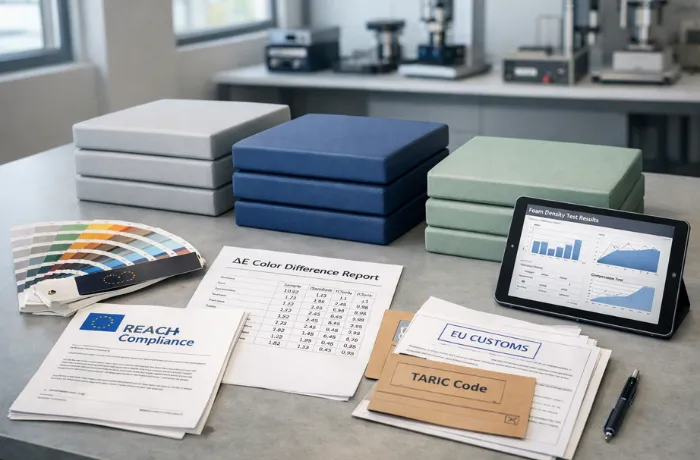
A balance pad can pass every foam test and still get hammered in reviews if the branding doesn’t hold up. In retail, shoppers don’t measure compression set—they notice whether the logo looks worn after cleaning, and whether the “same” color looks different from one restock to the next. That’s when brand teams feel exposed, even if the functional performance is fine.
Engraved vs Silk Printing — What Retail Buyers Should Consider
Engraved means the logo is molded into the pad during production (a recessed or raised mark), not added later. The practical upside is durability: it won’t smear, chip, or fade because there’s no ink layer to fail. That’s why rehab and clinic channels often prefer it—pads may be disinfected weekly, and the tactile “pressed-in” feel signals a stable, premium build.
The trade-offs are real. Engraved logos usually require mold changes (higher upfront tooling cost and less flexibility if you change the logo), and you can’t “print” a separate logo color—your mark will be the same color as the foam.
Silk printing (screen printing) applies ink on the surface after molding. For retail launches, it’s attractive because it’s lower-cost, supports small test runs, and gives you full color freedom for brand identity. The risk is also straightforward: if adhesion and curing aren’t dialed in, the edges can start looking fuzzy or faded after repeated wipe-downs. In a gym setting, that 3–6 month wear pattern shows up right when replenishment starts.
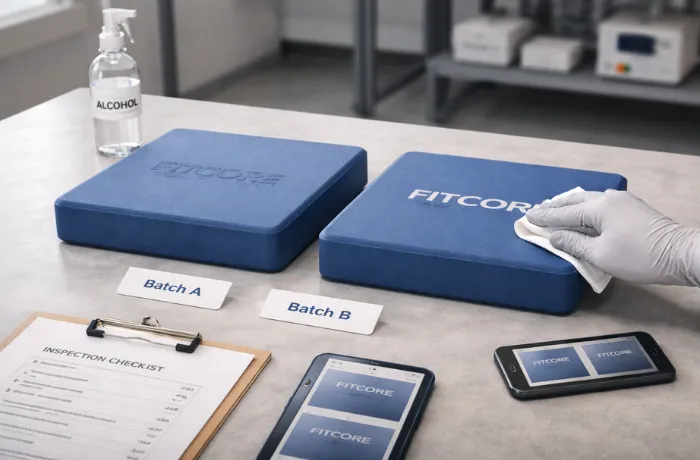
In practice, buyers should ask for simple, documented durability screens on silk-printed logos—cross-cut adhesion ratings (ISO 2409 or ASTM D3359) plus a cleaning rub test with before/after photos from the same batch.
Micro-summary: Engraved reduces long-term logo risk but costs more upfront. Silk printing buys flexibility and color, but it needs proof of adhesion and cleaning durability.
How to Decide Between Engraved and Silk Printing (Retail Checklist)
Use this quick three-step decision flow:
- Match the channel’s cleaning reality. If the product is going into physio/clinic or any channel with frequent disinfection, engraved is often the safer default.
- Decide whether this SKU is a test or a core item. For market tests and short runs, silk printing keeps your MOQs and iteration costs down.
- Set acceptance criteria before you approve samples. If you choose silk printing, define the adhesion method (ISO 2409/ASTM D3359), the minimum pass level you’ll accept, and a cleaning rub protocol that reflects how customers actually wipe the pad.
Micro-summary: Choose by cleaning frequency, SKU lifecycle, and how you’ll verify durability—not by what the factory says it “can do.”
Preventing Batch-to-Batch Color Shift
Color drift is usually subtle on a screen and obvious under retail lighting. If your first shipment matches your brand palette but the next batch lands a shade warmer or cooler, shoppers assume the brand is inconsistent.
Here’s what reduces that risk:
- Set a Pantone target and a ΔE tolerance in your PO or spec sheet (and agree on the measurement condition). Keep a signed master swatch as the physical reference.
- Approve color under consistent lighting, not just in natural light near a window. Many buyers use a light box or defined “retail lighting” checks so the decision is repeatable.
- Tie color records to batch IDs. For every production batch, record the color check results and keep photos next to the master swatch.
Micro-summary: Pantone + ΔE limits + controlled lighting + batch records is what makes “the same color” stay the same across restocks.
Foam performance — density, compression, and long‑term stability
Low‑density foam often feels reassuring at first press. But under daily load, it slowly flattens, losing that springy resistance customers expect. After three months in a busy clinic or gym, that “flattened” feel shows up as complaints and returns.
For many EU retail SKUs, a mid‑density EVA/TPE range is common; 35–45 kg/m³ often balances comfort and stability. Higher density is not always better—match density and compression behavior to use.
A simple way to brief your OEM partner: define the use case (rehab single‑user vs. class rotation), set target density and compression set limits using recognized methods (e.g., ISO 845 for density; ASTM D3575/ISO 1856 for compression behaviors), and approve a first‑article sample from the intended batch before mass run.
Example mapping (guidance ranges only; validate with testing and samples):
| Intended use | Typical density band (kg/m³) | Notes |
|---|---|---|
| Rehab/physio (lower traffic) | 35–40 | Softer feel; monitor compression set closely |
| General fitness retail | 38–45 | Balance of comfort and stability |
| High‑traffic studio/gym | 42–50 | Firmer feel; better long‑term shape retention |
What to see in the paperwork: batch‑labeled density and compression reports with method references (e.g., ISO 845; ASTM D3575/ISO 1856) and dates, plus visual/tactile checks of the anti‑slip surface and edges (no early fraying or burrs).
Micro‑summary: Match density to use, verify compression set with batch reports, and approve the actual batch you’ll ship—not just a golden sample.
Quality control that prevents returns in an OEM balance pad factory
Quality issues that seem minor in a factory can become a review problem in retail. Build your plan around checkpoints that catch what customers actually notice.
Core checkpoints your OEM balance pad factory should run and document include incoming foam checks for odor and apparent density; compression and recovery tests per batch using recognized methods (ASTM D3575/ISO 1856) with batch IDs on every report; tactile and visual checks on anti‑slip surfaces; logo durability screens like cross‑cut adhesion (ISO 2409/ASTM D3359) and a simple cleaning rub test with photo evidence; and random carton inspections that confirm odor after transit, print clarity, color under retail lighting, and correct labeling.
Reinforce the retail reality: A 2–3% defect rate at factory level may translate into visible review damage at retail level.
Micro‑summary: Inspect, test, verify, and confirm—especially for the things shoppers notice within seconds.
MOQ, lead time, and production planning for EU buyers
Industry norms are helpful starting points, but plan to your channel: typical MOQs run 500–1,000 units, and standard lead times sit around 20–35 days when materials are stable and no new tooling is needed. The real pressure isn’t factory days—it’s the outbound shipping window before seasonal demand. Lock bookings early and buffer for documentation checks so replenishments land smoothly and avoid nervous, last‑minute scrambles.
Micro‑summary: Align MOQ and lead time to your launch plan, then protect the shipping window.
Logistics to Europe — avoiding “silent delays”
Customs delays often start as small documentation errors: an imprecise HS code, vague product descriptions, or mismatched invoice and packing data. For foam balance pads, classification often falls under articles of plastics (final code depends on construction and use). Verify with the EU’s TARIC portal and consider Binding Tariff Information to remove ambiguity. Official EU TARIC consultation: https://ec.europa.eu/taxation_customs/dds2/taric/taric_consultation.jsp
Get the details right in prose: describe materials, dimensions, and intended use precisely; pick the correct HS/CN code and keep supporting notes; keep origin and valuation documentation clean; and make sure invoice and packing lists stay perfectly aligned across the set.
Micro‑summary: Incorrect paperwork creates a silent delay at customs—and silence makes buyers uneasy. Get classification and documents right the first time.
FAQs
- What certifications are required to sell balance pads in Europe?
- For typical EVA/TPE balance pads sold as fitness accessories, CE marking is usually not required unless the product is positioned within a regulated category (e.g., PPE, toys). Always verify positioning. REACH chemical safety applies regardless; request recent (≤12 months) materials safety reports and supplier declarations. See the European Commission’s CE overview and ECHA’s REACH portal for official guidance.
- What is the typical MOQ for OEM balance pads?
- Most OEM runs fall between 500 and 1,000 units depending on material and tooling. New tooling or special materials can shift both MOQ and lead time. Align your MOQ to launch and replenishment cadence.
- How do European buyers ensure consistent foam quality?
- Request batch‑labeled density and compression test reports (method/date visible), run first‑article approvals for every batch, and include logo adhesion and cleaning rub checks in acceptance criteria. Verify color under retail lighting and conduct random carton inspections that include an odor check.
Next steps — request a structured RFQ
If this guide matches how you evaluate risk, send a focused RFQ so we can respond with specifics. Include:
- Target MOQ and desired lead time
- Intended use (rehab, general retail, high‑traffic)
- Pantone color and ΔE tolerance expectations
- Logo method (engraved or silk) and any adhesion/cleaning requirements
- Compliance expectations (REACH/materials safety scope)
- Destination port and desired delivery window
We’ll reply with batch‑level QA commitments, test methods, and a proposed production plan built to keep your first 20 reviews stable and positive.


 English
  German
  Spanish