
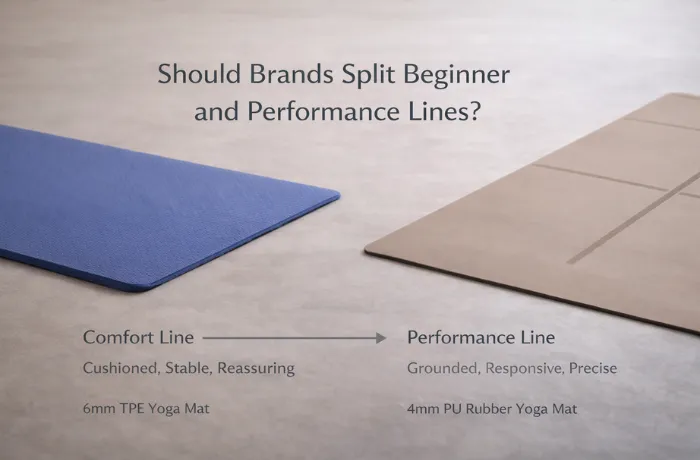
A beginner steps onto the mat wanting to feel supported, cushioned, and reassured. An experienced practitioner plants the heel, waits for subtle compression, and expects a grounded feel that stays steady during quick transitions. If bodies are asking for different things, should your product line reflect that?
As analyzed in our technical pillar on beginner vs advanced yoga mat design differences, the real gap shows up on the body—how stable, responsive, and connected the surface feels under pressure—not just in spec sheets. This article moves the question forward: is it smarter to separate lines, or to hold a performance core and address newcomers through positioning?
Editorial note (for transparency): This piece is written for product and sourcing teams and is based on three evidence types—recurring customer complaints/return reasons, coach/studio phrasing about “body feel,” and triangulation with independent testing/retailer guidance (linked where used). If you have first-party return data or studio feedback, you can drop it into the framework below to make decisions more defensible.
Do Beginners and Advanced Practitioners Actually Need Different Mats?
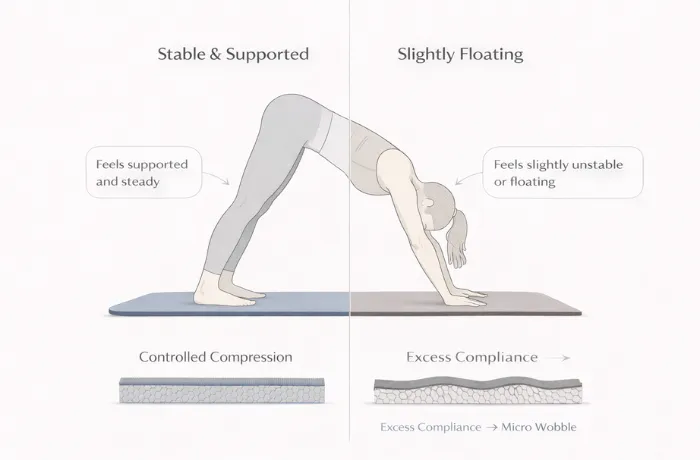
On the body, many first-time users want knee comfort and cushioned support so they feel supported and steady. But when foam is too compliant, that welcoming softness can turn slightly unstable during balance work—often described as a faint floating sensation under the palms.
Beginners Seek Stability That Feels Safe
Beginners are usually chasing padded reassurance under the knees and cushioned palms in Downward Dog. If the mat deforms too easily, that same softness can wobble as weight shifts, which chips away at confidence during transitions.
Independent long-form testing consistently flags two failure modes that beginners feel fast: wet-grip slippage when the pace (and sweat) picks up, and compressive wobble when softer foams deform under load—both of which make practice feel less steady (summarized in OutdoorGearLab’s Best Yoga Mats testing roundup, 2026 update).
Advanced Practitioners Notice Precision and Feedback
Advanced users don’t just want comfort—they want clarity under their feet: a heel pressing into a firm floor feel, subtle (not mushy) compression, and near-immediate correction without delayed micro-adjustment. That’s the crisp, grounded feel they’re looking for when they pivot and load. Brand education pages often underline the trade-off plainly: when mats get too thick or spongy, balance precision can fade; when they’re too thin, joints complain—captured well in Liforme’s thickness guidance, 2026.
When a Single All-Level Mat Starts Failing
Here’s the field signal that one SKU is overreaching: your review corpus and return notes concentrate around a few body-feel complaints.
- “Too soft.” Feels slightly unstable during balances; users report a floating sensation under palms and heels.
- “Not stable enough.” Under pressure, the mat compresses and rebounds slowly, delaying micro-adjustment and breaking the grounded feel.
- “Feels hard on my knees.” Thin, high-durometer builds can feel unsupportive on bone contacts; beginners lose the sense of being cushioned and supported.
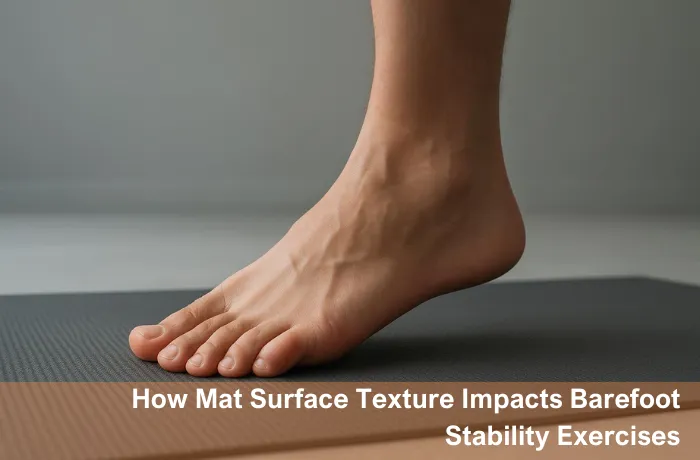
- “Slips during transitions.” Wet-grip limits show up fast in sweaty flows; people lose steady hand placement and feel disconnected.(See how surface texture impacts stability)
When one SKU tries to solve both ends of the experience spectrum, someone usually feels compromised: the beginner feels unstable and the advanced user feels disconnected. Independent testers repeatedly flag the same two failure modes—slippage when sweaty and compressive wobble under load—so you can use that language as a consistent taxonomy for your own review and returns analysis.
A Common Misassumption
Separating lines does not automatically solve instability complaints. If both SKUs share similar density and surface response, the body experience remains unchanged.
On the body, users may still feel slight wobble during balances, delayed correction in transitions, or a floating sensation under load—even if the product names differ. When structural variables remain similar, splitting lines simply duplicates the same feedback pattern across two price bands.
In business terms, this creates internal competition without resolving the root cause. Line separation only works when the physical response is meaningfully different—not when the catalog is.
The Operational Trade-Off of Beginner vs Performance Yoga Mat Lines
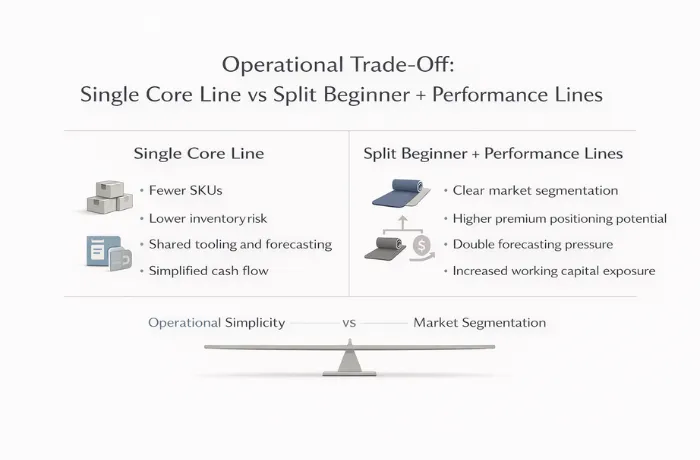
A split can sharpen positioning but it also reshapes your operations and P&L. The question isn’t academic; it shows up in inventory turns, cash tie-up, and your price-band defense.
SKU Complexity and Inventory Pressure
A split line may create clearer positioning—but it also doubles forecasting pressure. Two specs mean more SKUs to predict, greater risk of slow movers, and more working capital locked into steady yet potentially uneven demand. Industry context has been blunt about assortment bloat: broader ranges amplify stockouts and excess stock unless planning improves, a theme echoed in The State of Fashion 2025, which highlights inventory pressure and margin strain from proliferating assortments (McKinsey 2024). In practice, brands feel this as tighter cash flow, older stock with dulled surface grip, and markdowns that compress margins.
Pricing and Margin Positioning
Performance lines—firmer, denser, more stable under load—can justify a higher price when the body can actually feel the difference. Advanced users often accept premiums for responsiveness and durability if the mat stays steady, delivers quick correction, and remains grounded session after session. Retailers routinely anchor performance tiers around dense stability and long-wear construction (compare how pro-grade mats emphasize durability and dense support versus comfort-first lines that stress a cushioned ride and immediate grip; for a simple, buyer-facing explanation of the cushioning-versus-stability trade-off, see REI Co-op’s guidance on choosing yoga mats: REI Co-op Expert Advice: How to Choose a Yoga Mat). The margin risk is self-cannibalization: if the difference is only visual, price resistance hits fast and your premium band collapses.
As detailed in our broader guide on beginner vs advanced yoga mat design differences, the physical gap between user levels tends to center on stability feedback and surface response—what the mat tells the body under load.
Three Yoga Mat Product Line Strategy Paths
Option 1: One Balanced Core Line
Best fit when your audience isn’t clearly segmented and your DTC channel anchors the business. You keep operations simple and margins predictable. On the body, a well-tuned middle ground can feel steady enough for many while remaining cushioned for most. The risk: you bleed loyalty at the edges—newcomers who still feel slightly unstable, and experienced users who miss that crisp, grounded feedback.
Option 2: Comfort + Performance Dual Lines
Right for brands with stable volume, studio channels, or retailers needing a visible price ladder. On the body, the comfort line offers cushioned reassurance; the performance line delivers firm, precise support. Operationally, expect doubled forecasting complexity and cash commitments. The bet is that a true feel difference supports a clear premium and protects margin.
Option 3: Performance Core + Beginner Messaging Variation (Default)
| Strategy option | Target audience | Inventory risk | Margin potential | Lo mejor para |
|---|---|---|---|---|
| 1. Balanced core line | Mixed / general | Low (simple SKU) | Medio | DTC brands with broad reach |
| 2. Dual lines split | Clearly segmented | High (double forecasting) | High (clear premium) | Brands with strong studio channels |
| 3. Core plus messaging | Mixed but aspirational | Low (shared tooling) | High (protected core) | Most brands in 2026 (smartest play) |
Keep the manufacturing structure simple while asserting performance as your standard. On the body, your core spec stays firm, grounded, and responsive. For beginners, you lead with confidence-building messaging—joint comfort cues, set-up guidance, and stability coaching—possibly paired with minor density or surface-texture tweaks that retain a steady, supported platform. This route protects your top price band and avoids SKU sprawl. In practice, the copy does heavy lifting for reassurance; the product keeps its clear, crisp feedback under pressure.
In manufacturing practice, OEM partners often run controlled density or surface iterations to fine-tune feel without adding permanent SKUs—or requiring new tooling—so a mat can stay grounded for advanced users while offering a more cushioned, supported first impression to newcomers. (For a practical overview of customization levers, see WellfitSource’s custom yoga mats page.)
Quick Diagnostic Snapshot
If your brand is seeing:
- Rising “too soft/unstable” complaints → test higher density or a less-compressive structure before you add a new SKU.
- Rising “hard on knees” complaints → test minor cushioning or surface-compliance tweaks without losing a firm, grounded feel.
- Stable studio or advanced-user reorders → protect the performance core and segment beginners through messaging before you split the line.
Decision Framework for 2026
Use body-feel evidence and business signals—then decide. Think of this like a pre-flight checklist you can run quarterly.
- If more than 60% of customers are first-time buyers, consider a comfort-forward offer or, at minimum, beginner-focused messaging tests. Treat this threshold as a starting heuristic—not a universal rule—and calibrate it against your own channel mix and return reasons. The goal is to make newcomers feel supported and steady without compromising the grounded feel of your core.
- If studios and experienced users are a strong base, protect performance differentiation. Keep the platform firm and responsive so it stays stable under pressure and delivers immediate correction. Use your own repeat-rate and pro/studio reorder signals to validate that performance is actually driving willingness to pay.
- If returns and complaints lean toward instability or slipping in transitions, audit density and surface response before you add a new SKU. A subtle density shift or surface finish change can restore a grounded feel and reduce the slightly unstable wobble without splitting the line.
Two fast ways to collect decision-grade evidence:
- Review/return bucketing: export the last 6–12 months of reviews + return reasons, then tag each record with one primary complaint (e.g., “too soft/unstable,” “hard on knees,” “slips when sweaty,” “durability/tearing,” “odor/off-gassing”). Count frequency and compare by channel (DTC vs studio/wholesale).
- Keyword tally: run a quick phrase count on your review text for terms like “wobble,” “unstable,” “slip,” “sweaty,” “knees,” “wrists,” “grounded,” “too soft,” “too hard.” Even a simple spreadsheet tally will show which body-feel failures dominate.
- Coach interview prompts: ask 3 questions and record exact wording: (1) “When does a mat feel unstable under pressure?” (2) “What does ‘grounded feel’ mean in your classes?” (3) “What complaints do beginners repeat most in the first month?”
- Coach and studio quotes: do 5–10 short interviews and capture exact phrases like grounded feel, delayed micro-adjustment, cushioned support, and steady under pressure. For consumer-facing framing of the thickness-versus-stability trade-off, see Liforme’s thickness guidance, 2026.
A simple margin sanity check
| Trigger | What it feels like on the body | Action to test first | Margin implication |
|---|---|---|---|
| “Too soft/unstable” dominates | Slightly unstable, floating palms, delayed correction | Increase density or adjust surface finish on core spec | Protects premium; avoids new SKU |
| “Hard on knees” dominates | Not cushioned enough for bone contacts | Add messaging, props guidance, or minor cushioning tweak without losing firmness | Preserves band; minimal COGS change |
| “Slips in transitions” dominates | Hands slide, disconnected in sweaty flows | Test moisture-friendly texture/finish on core | Supports premium if feel change is clear |
If you do decide a true split is warranted, ensure the performance tier’s feel difference is unmistakable under pressure. That’s what defends the upper price band.
When Separation Becomes a Liability
Line splitting can backfire when structural differences don’t justify operational weight.
It typically becomes a liability when:
- Volume is insufficient to sustain two price bands without aging inventory.
- Core complaints stem from build quality, not user level (e.g., instability due to density, not skill gap).
- Channel segmentation is weak, meaning retailers or DTC messaging cannot clearly separate beginner and performance narratives.
On the body, this shows up as the same instability complaints appearing across both lines — slightly unstable balance, floating palm sensation, slipping in transitions — because the underlying structure hasn’t changed.
In business terms, the result is predictable: inventory aging, price compression, and internal competition between your own SKUs.
A split line only works when the body can feel the difference — not when the catalog does.
Conclusión
The decision isn’t about thickness or neat price tiers. It’s about whether your users are asking for different body experiences. Separate beginner vs performance yoga mat lines make sense when the physical feedback truly differs—not just the marketing message. For many brands in 2026, a performance core with beginner-targeted messaging—and carefully tested micro-adjustments—keeps the mat feeling grounded and steady for experts while helping newcomers feel cushioned and supported from day one.
If you need a quick feasibility read on density, surface, and tooling options before adding SKUs, consult your OEM partner; many can prototype subtle changes fast while preserving your premium feel and price band (Certifications).


 Spanish
  English
  German