
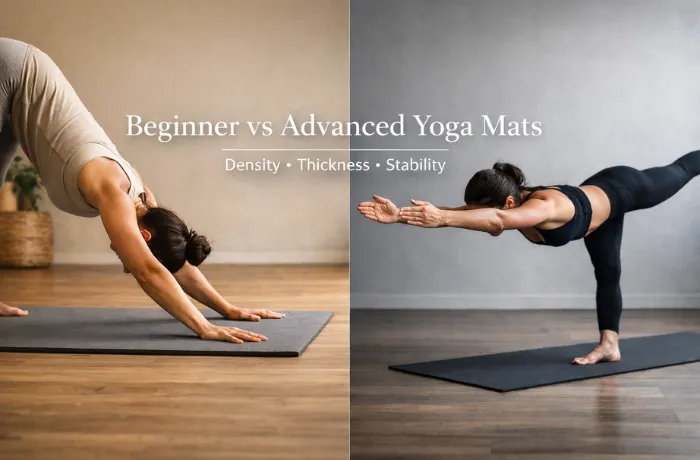
The key difference between beginner and advanced yoga mats is not thickness—it’s density, stability feedback, and surface control.
Beginners benefit from slightly thicker, medium-to-high density mats that provide cushioning without wobble, helping them feel supported and stable during unfamiliar movements. Advanced practitioners typically prefer thinner, high-density builds that deliver faster ground feedback, clearer pushback, and controlled friction for precise transitions.
In short: beginners seek reassurance and stability; advanced practitioners seek responsiveness and precision.
Key Takeaway for Brands:
• Beginners need cushioning with stability.
• Advanced users need density with responsiveness.
• Thickness without density causes wobble complaints.
Quick Comparison: Beginner vs. Advanced Mats
| Característica | Beginner Spec | Advanced Spec |
|---|---|---|
| Espesor | 5-6mm (Cushion priority) | 3-4mm (Feedback priority) |
| Surface Friction | High Grip (Prevent slipping) | Controlled Slide (Allow transitions) |
| Objetivo principal | Confidence & Safety | Precision & Response |
What Beginners Physically Experience on a Yoga Mat
Instability Feels Bigger to a Beginner
On single-leg balance, small tremors feel like big swings. In Downward Dog, wrist uncertainty shows up as spreading the hands to chase stability. When the palm loads, a soft, low-density mat disperses pressure slowly, which can feel slightly floating instead of grounded. Beginners are not weak—they’re unfamiliar with instability. For many first-time buyers of yoga mats for beginners, “too soft” and “it moves when I shift” appear in support tickets precisely because the base isn’t anchored well or the foam compresses unevenly.
What this means for design: prioritize a supportive feel without wobble. Aim for a medium-to-higher density construction so weight-bearing points feel stable and connected to the floor. Predictable, steady grip reduces hesitation.
Cushioning Creates Psychological Safety
A cushioned landing makes kneeling and seated transitions feel supported. That sense of comfort matters for confidence and consistency. But if the mat is very squishy, the body can feel a touch detached—like standing on a raft—because heels and palms sink, and corrections arrive late. Too much cushioning can make the body feel slightly detached from the floor.
What this means for design: consider 5–6 mm total thickness paired with sufficient density to prevent excessive sinking, and use a micro-textured or PU-style top that offers reliable, controlled traction. Keep the base grip strong enough that the mat doesn’t creep on hardwood or studio vinyl.
What Advanced Practitioners Notice Immediately
Ground Feedback Becomes Critical
Advanced bodies listen for tiny signals: subtle compression under the metacarpals, surface resistance in hand pivots, or delayed correction when a heel settles. The preferred feel is grounded, connected, responsive, and firm under pressure. A top layer that transmits floor feedback quickly supports crisp transitions and stable holds in load-bearing poses.
What this means for design: denser stacks (often natural rubber or PU-on-rubber) with a consistent, fine texture that lets the hand glide just enough without sliding out. Floor anchoring matters so the base doesn’t budge during lateral loads.
Excess Cushion Can Blur Precision
When the surface is overly plush, energy leaks. In Warrior poses, the back heel can micro-wobble. Under palms, you’ll see a split-second lag before micro-adjustments take effect. Advanced practitioners don’t look for softness—they look for clarity under their hands and feet.
What this means for design: 3–4 mm high-density builds with a top coat that balances traction and release. The goal is clear signals and immediate control, not stickiness that interrupts fluid transitions.
Thickness Is Not the Only Variable
Density vs Thickness
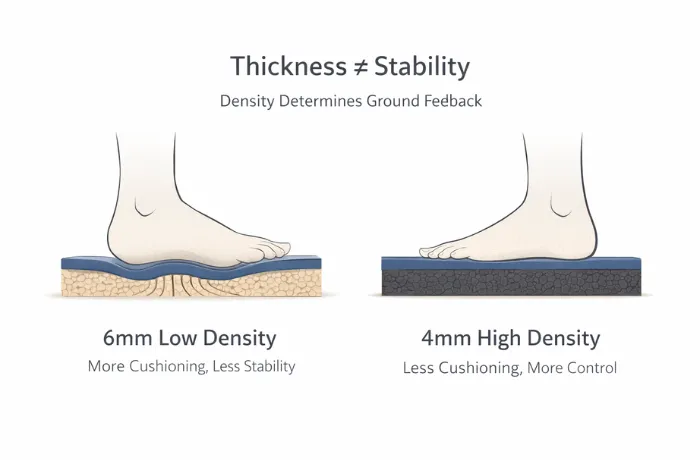
Two mats can share a thickness and feel completely different. A 6 mm low-density foam can compress deeply, creating a cushioned but unstable platform. A 4 mm high-density rubber construction will feel firmer, more grounded, and more controlled because it resists compression and returns energy quickly. Manufacturer archetypes illustrate this trade-off: dense, premium builds emphasize stability even at moderate thickness, while softer foams add comfort but risk a floating sensation if density is too low.
In market exemplars, you’ll see this balance in action. The Liforme Classic sits at about 4.2 mm with a grippy eco-PU top over a dense rubber base to preserve stability while offering tactile traction, as described in the brand’s specs and buyer’s guide resources from 2024–2026 (see the Liforme Classic specs and guide via the Liforme site). Manduka’s PRO series highlights ultra-dense construction for stability and longevity, even at 6 mm thickness, supported by OEKO‑TEX certification and a lifetime guarantee, according to Manduka’s official product pages. And moisture-absorbing PU tops, like those on Lululemon’s The Mat 5mm, are tuned to keep users grounded when sweaty, per Lululemon’s product literature.
- According to Liforme’s official materials, the Classic mat is approximately 4.2 mm with a dense rubber base and moisture-handling PU top that emphasizes traction and alignment support in their systemized designs: see the product page and buyer’s guide for details (Liforme Classic Yoga Mat; Liforme Buyer’s Guide).
- Manduka positions the PRO 6 mm as ultra-dense and highly durable with a lifetime guarantee, signaling strong resistance to compression set and a firm, stable underfoot feel (Manduka PRO 6 mm product page).
- Lululemon’s The Mat 5mm highlights a moisture-absorbing top layer and FSC-certified natural rubber base to stay grounded in high-sweat practice (Lululemon The Mat 5mm).
Surface Texture and Grip Differences
Beginners usually want predictable grip—a steady catch that keeps the body from sliding. Advanced users often prefer controlled friction—traction that holds when loaded but allows smooth pivots without that sticky, abrupt stop. Third-party comparative testers routinely note that firmer, denser top surfaces improve stability and that moisture-activated or moisture-absorbing tops help when sweat is a factor; see the stability and wet-grip discussions in 2024–2026 updates by OutdoorGearLab (Best Yoga Mats roundup). Too much grip can feel sticky. Too little grip feels unsafe.
| Dimension | Beginners-tilted Build | Advanced-tilted Build |
|---|---|---|
| Recommended thickness (mm) | 5–6 mm total for cushioned, supported landings | 3–4 mm for firm, grounded precision |
| Density / firmness | Medium–high density to limit sinking; supportive feel | High density for crisp pushback; stable under pressure |
| Surface top-coat & texture | Predictable grip (PU or micro-texture) to feel controlled | Controlled friction (fine texture) to permit smooth pivots |
| Base grip / floor anchoring | Strong base grip to prevent “it moves when I shift” | Heavy, anchored base for lateral load stability |
| Ground feedback / responsiveness | Connected, confidence-building; not mushy | Responsive, clear signals; immediate correction |
| Compression resistance / durability | Resist dents from knees/elbows over time | High resistance to compression set for daily practice |
| Sweat management / wet grip | Moisture-absorbing or reliable dry grip for confidence | Moisture-activated or balanced wet/dry traction |
| Weight & portability | Moderate weight; home or studio carry acceptable | Heavier is OK; prioritize floor hold over portability |
| Eco / compliance | Consider PVC-free claims and common retail standards | Consider certifications and pro-studio durability expectations |
| Messaging fit | Confidence and comfort; supported and stable | Stability and responsiveness; grounded and precise |
| Best-for scenario | DTC beginner-heavy audiences; rehab/low-impact | Studio performance identity; high-frequency practice |
How Brands Should Structure Product Lines
Do You Really Need Separate Beginner and Advanced SKUs?
You have three viable strategies:
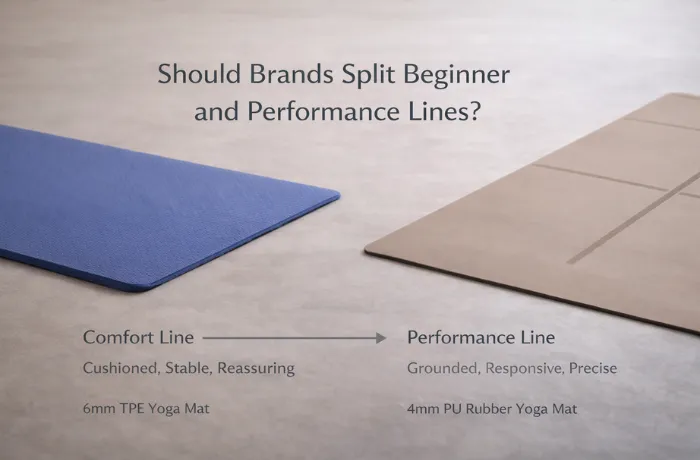
- One versatile core line: a dense 4–5 mm “middle path” with predictable grip that serves most users reasonably well while keeping inventory simple.
- Comfort-focused entry line: 5–6 mm with medium–high density and secure base grip to reduce “too soft” and “unstable” complaints from newcomers.
- Performance-focused precision line: 3–4 mm high-density with a balanced top texture for clarity and control favored by advanced users and studios.
Choose based on channels and identity, not dogma. Think of it this way: where do your returns and reviews cluster, and which practice environments dominate (home DTC vs studio)?
Messaging Matters as Much as Construction
If you build a comfort-first entry SKU but describe it like a pro tool, users may be disappointed. Align copy to body experience:
- Beginner = confidence + comfort. Words like supported, cushioned, predictable help set accurate expectations.
- Advanced = stability + responsiveness. Words like grounded, firm, precise, controlled indicate what the surface will feel like in motion.
Common Mistakes Brands Make
- Assuming thicker = better. Thickness without density invites wobble and “floating.”
- Ignoring density. Compression is the culprit behind many “can’t feel grounded” tickets.
- Over-designing “advanced” mats. Ultra-sticky tops can feel jarring and slow transitions; advanced often want controlled friction, not glue.
- Using the same positioning copy for all users. Misaligned messaging fuels returns and bad reviews.
Decision Framework: Yoga Mat for Beginners vs Advanced
Use these rules to pick structure and specs—no single universal winner.
- If your core revenue is DTC beginners, prioritize 5–6 mm with medium–high density and predictable grip because it feels cushioned yet stable for unfamiliar bodies.
- If your brand identity centers on studio precision, specify 3–4 mm high-density rubber or PU-on-rubber with a firm, responsive top because advanced users value clarity and ground feedback.
- If you serve both channels, adopt a dense 4–5 mm versatile core and add one targeted line (comfort or performance) to control returns and clearly explain price tiers.
- If hot yoga dominates, use moisture-absorbing or moisture-activated top coats (PU) and strong base anchoring; wet grip and hygiene outweigh extra plushness.
- If portability matters, choose 2–3 mm dense travel builds and set expectations about reduced cushioning but improved carry.
Also consider: for private-label customization across density profiles, textures, and compliance pathways, some OEM/ODM partners support configurable builds and flexible MOQs. One example is WellfitSource’s neutral OEM/ODM overview for yoga and fitness products; see WellfitSource OEM/ODM services.
How to Choose Between Beginner and Advanced Yoga Mats
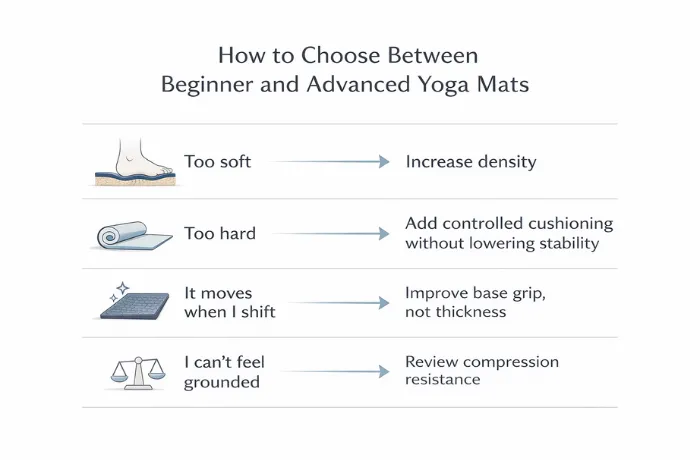
If your audience says “too soft” → Increase density.
If they say “too hard” → Add controlled cushioning without lowering stability.
If they say “it moves when I shift” → Improve base grip, not thickness.
If they say “I can’t feel grounded” → Review compression resistance.
Conclusión
Beginners seek reassurance. Advanced practitioners seek refinement. Design for the body experience—not just the spec sheet. When you map density, texture, and base grip to how the body actually feels (supported vs grounded, cushioned vs firm, controlled vs responsive), your product line decisions—and your returns—start making sense.
PREGUNTAS FRECUENTES
Are thicker yoga mats better for beginners?
Thicker mats can feel cushioned and knee-friendly, but excessive softness reduces stability. Density matters as much as thickness—aim for medium–high density so beginners feel supported and connected, not sinking.
Do advanced practitioners prefer thinner mats?
Not always thinner—firmer and more responsive. Advanced users prioritize quick ground feedback and precise control, which usually comes from denser constructions and balanced surface textures.
Should brands create separate yoga mats for beginners and advanced users?
It depends on channels and positioning. Some portfolios thrive with a versatile 4–5 mm dense core; others layer a comfort-first entry SKU and a precision-forward performance SKU. Use your returns language and customer mix to decide.
What causes instability complaints from beginner users?
Often it isn’t pure grip—it’s excessive compression (low density) or weak base anchoring. That leads to “too soft,” “can’t feel grounded,” or “it moves when I shift” feedback.
References and further reading (selected):
- Liforme Classic specs and buyer’s guide: dense rubber base with moisture-handling PU top and alignment system (Liforme Classic Yoga Mat; Liforme Buyer’s Guide).
- Manduka PRO 6 mm: ultra-dense construction, lifetime guarantee, OEKO‑TEX certification (Manduka PRO product page).
- Lululemon The Mat 5mm: moisture-absorbing top, FSC-certified natural rubber base (Lululemon The Mat 5mm).
- Stability and wet-grip testing observations (2024–2026): (OutdoorGearLab Best Yoga Mats).

 Spanish
  English
  German