
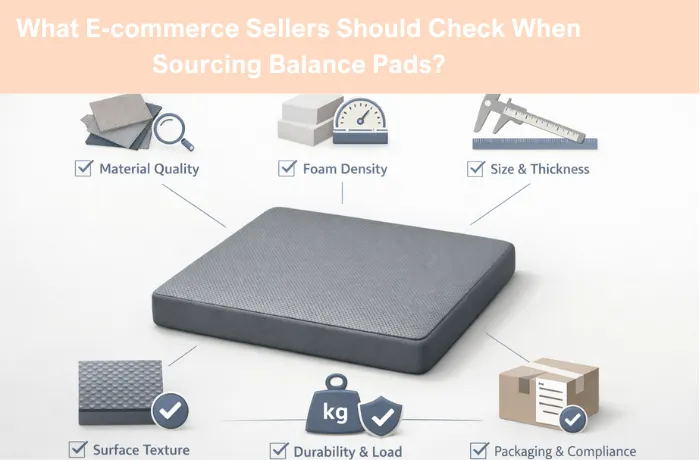
Balance pads rarely fail on day one. They look great in photos, feel fine in a quick squeeze test, and the sample you approve can seem identical to what you’ll receive in bulk. Then—often a few weeks after your Amazon DE/EU listing goes live—reviews start flagging dents that won’t disappear, slow rebound, and soft corners. Returns creep up, star ratings slip, and the second order may feel different from the first.
This guide focuses on what to verify before you place an order—so you protect your listing, keep 90-day returns at or below your target, and avoid the “older batch was better” spiral. No workout advice here—just practical sourcing checks.
Why Balance Pads Are Risky Products for E-commerce Sellers
First impressions can mislead. A pad that feels plush on a sample table may not hold its shape after dozens (or hundreds) of compressions—exactly what customers do over weeks. Shape loss, slow rebound, and edge collapse typically appear gradually rather than on day one.
For Amazon FBA sellers, durability maps directly to reviews and returns. When recovery slows or the surface stays uneven, buyers post photos that influence future conversions. Even if the first batch performs acceptably, small shifts in density, foaming, or curing often show up in reorders. That’s why sourcing balance pads is less about initial “feel” and more about controlling long-term behavior and batch consistency.
If you want a deeper explanation of why these issues occur at a structural level, this breakdown explains why balance pads lose shape over time.
The Most Common Issues That Trigger Returns
Shape Loss After Short-Term Use
Customers often describe “permanent footprints,” thinning in the standing zone, or dents that linger for hours. In practice, this points to compression set—foam that doesn’t fully recover its thickness after load. If damage appears within 12 hours of use, it likely indicates an issue with the foam’s ability to resist compression over time. Pads can look perfect out of the bag, but when used regularly, they lose height and feel “tired,” which quickly turns into low ratings and return requests.
If dents appear after a few sessions or within a single day’s use, this is a clear sign of insufficient material resilience. Long-lasting impressions typically occur when the foam fails to recover within a reasonable timeframe (usually 30-60 minutes). These premature signs of damage are a strong indicator that the material has poor shape retention, which directly leads to poor customer feedback and increased returns.
Slow Rebound and Uneven Surface
Another common pattern: the pad rebounds, but too slowly. After repeated steps or balance drills, sections feel “dead” or remain slightly depressed. Users notice inconsistent stability across the surface and call it out in reviews. Even if the pad recovers overnight, sluggish rebound during use still reads as “low quality” to shoppers.
Edge Collapse and Soft Corners
Corners can compress faster than the center. You’ll see photos of rounded, slumped corners or edges that won’t spring back. Edge softness is often a mix of weaker structure at the margins and avoidable stress during packaging and transit (tight packing and stacking can pre-compress corners). Once corners are “pre-tired,” they keep attracting returns.
What to Check Before You Place Your First Order When Sourcing Balance Pads
Foam Density: What Actually Matters for E-commerce
Density is mass relative to volume. In simple terms: higher density often correlates with better resistance to shape loss, while very low density may feel soft at first but deform faster. Don’t chase a single “magic number.” For e-commerce, what matters is stability you can repeat across lots.
Ask your supplier to confirm a narrow density range in writing—and verify it in a practical way with your samples. If two pads have the same dimensions and thickness, the one that consistently weighs more (within your target band) typically contains more material per unit volume and tends to hold shape better over time.
Important: don’t confuse firmness with density. Firmness is “how hard it feels to press.” Density is “how much material is inside,” and it’s a stronger predictor of long-term durability. If you need a plain-English refresher to align terminology across teams, The Foam Factory explains the difference clearly in their article on foam density vs firmness.
Recovery Behavior After Repeated Compression
Recovery is how fast a pad returns to its original thickness after load is removed. The critical point isn’t a single press—it’s how the pad behaves after many cycles across a workday.
If recovery slows noticeably after repeated compressions, the pad is trending toward a permanent set. In practice, that long-lasting impression relates to compression set—the deformation that remains after load and time. Lower compression set means better shape retention over weeks of use, not just on day one.
For sellers who want a deeper technical explanation, we break down the structural reasons behind balance pad deformation in a separate guide.
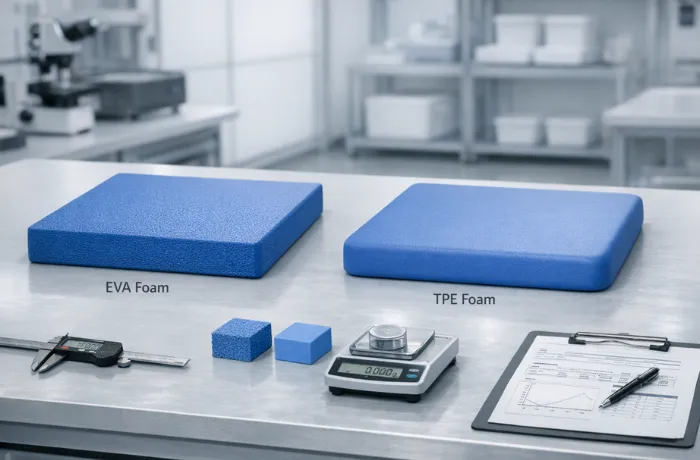
Material Trade-offs: EVA vs TPE vs NBR
Material labels help, but they don’t guarantee performance. Formulation, density, and process control usually matter more than the name on the spec sheet. Still, these trade-offs are useful for e-commerce decisions:
- EVA: Can be resilient and consistent when density and process are well controlled. Controlled foam structure is one reason crosslinked EVA ranges are often used where consistency matters; Zotefoams’ Evazote overview is a helpful reference point for how structure supports repeatability.
- TPE (your preferred direction): Tunable elasticity and rebound, often well accepted in EU e-commerce markets—typically at a higher cost. With TPE, insist on tight ranges (density and firmness) and validate recovery after repeated compression, not just day-one feel.
- NBR: Often feels soft and comfortable, but if formulation and density aren’t optimized (and curing control is weak), it can be more prone to deformation under cyclic load. Treat NBR as “test carefully, define acceptance clearly.”
These materials are just the starting point; it’s important to remember that no matter how well these materials perform on paper, their real-world performance can only be fully assessed through thorough sample testing.
Why Samples Can Be Misleading (and How Sellers Can Test Better)
Samples are often produced in small, tightly controlled runs—or selected from the best batch. Bulk production introduces variability: different oven zones, line speeds, curing conditions, and even dye lots. Small shifts can make a pad slightly softer, slower to rebound, or weaker at the edges.
Test smarter, not harder. Build a simple non-lab routine you can use on every sample—and later apply again to pre-shipment checks:
- Weight check (consistency proxy): weigh full pads of the same size/thickness and compare to your “golden sample.”
- Repeated-load recovery: run the same compression routine and record recovery behavior with photos and timestamps.
- Edge stability: place a 5 kg load 2–3 cm from each corner for a few hours; check again after 24 hours for visible set.
- Multi-point thickness: measure center plus 3–4 edge points and compare against your tolerance band.
Micro-example (disclosure): In OEM/ODM projects, an experienced partner can support “golden sample” retention, lot-level documentation, and written change notice before formula/process adjustments reach production. Disclosure: WellfitSource is our product. This doesn’t make defects impossible—it simply narrows the gap between sample and bulk so reorders behave like the last approved batch.
If you use third-party inspections, many importers follow ISO 2859-1 sampling (Level II) during final random inspection and define critical failures around recovery and edge stability. For a practical, buyer-friendly primer on AQL and sampling plans, see QualityInspection.org’s guide: https://qualityinspection.org/what-is-the-aql/.
As a result, what you see in the sample may not be what you get in bulk production. This variability between samples and bulk runs can become more pronounced over time, leading to batch consistency issues—which is exactly why it’s essential to set clear expectations and controls for reorders.
Batch Consistency: The Hidden Risk in Reorders
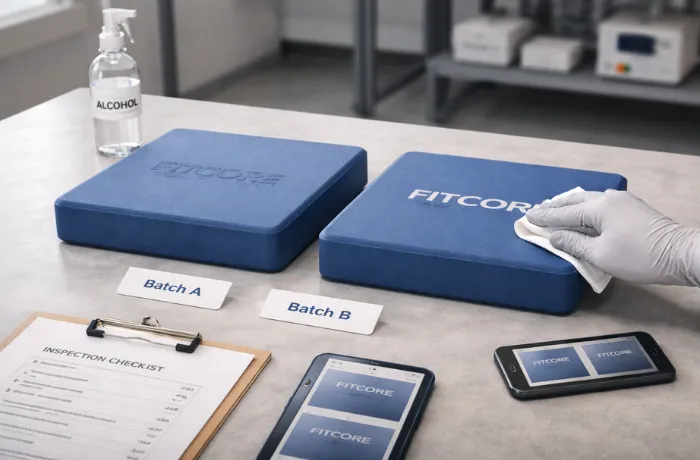
Problems often begin on the second or third order. Your first batch sets the review baseline; any drift in density, foaming, or curing can turn into “this batch feels different” reviews and higher return rates. The goal isn’t chasing perfect numbers—it’s locking down repeatability.
Practical reorder guardrails:
- Use signed specs (thickness, density range, firmness method, color/texture).
- Retain golden samples per lot and archive lot documentation.
- Require written change notice for formula or process changes before production.
- Run light inbound checks on arrival: weight comparison, a quick recovery check on 2–3 units, and a side-by-side finish/color check.
If you’re sourcing through a balance pad OEM or planning private label balance pads, these controls help ensure each bulk order behaves like the last approved lot.
Balance Pads in Bundle Sets: What Changes for Sellers
Bundles (balance pads + resistance bands) are common—but they change the risk math. The weakest item drives returns and ratings. If the pad deforms early, the entire bundle often gets labeled “cheap,” even if the bands perform fine. That’s why pad durability matters even more in sets than in single-SKU listings.
Packaging also matters more in bundles. Prevent bands (or accessories) from compressing pad corners in transit—especially for FBA. For EU FBA prep basics (polybagging, suffocation warnings, barcode visibility), Amazon’s bagging guidance is a commonly referenced baseline: https://sellercentral.amazon.com/help/hub/reference/external/G201685210.
Supplier Questions Every E-commerce Seller Should Ask
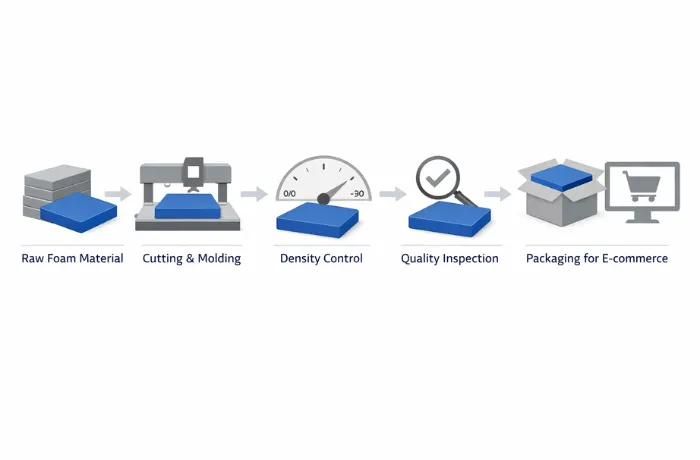
- What density range and firmness test method do you use, and will you sign tolerance bands in the contract?
- Can you provide lot-level documentation and retain a golden sample for at least 12 months?
- What is your change-notice procedure if formulation, foaming, or curing conditions shift—will you notify us in writing before production?
- Can you follow a simple recovery + edge stability protocol during pre-shipment checks and provide photos with measurements?
- Can you pack to our EU FBA prep spec (polybag/warning where needed, barcode visible) and document carton-level protection?
Red flags: vague answers about batch verification, reluctance to sign tolerance bands, no lot documentation, or evasive responses about process variability.
A Final Pre-Order Checklist for E-commerce Sellers
- Signed spec: thickness, density range (a weight-based consistency proxy is acceptable), firmness method, surface texture/color; both sides retain a golden sample.
- Recovery checks: repeated load routine + photos/measurements at immediate, 30–60 seconds, and 24 hours.
- Edge stability verified: corner load test with 24-hour recovery photos; packaging plan protects corners (avoid overly tight compression on thicker foams).
- Lot documentation + change notice: supplier commits to written notice before formula/process changes; samples archived for comparison.
- Pre-shipment sampling: define critical failures (permanent dents, edge collapse, uneven surface after rest), use ISO 2859-1 Level II if you’re running AQL.
- FBA prep confirmed: polybag/warning where applicable, barcodes unobstructed, pack method documented.
- Reorder guardrails: color/finish recorded, density/firmness within signed bands, quick inbound spot checks planned.
Durability is the lever that protects your listing. Treat sourcing as risk management: use simple tests that predict long-term behavior, lock them into specs, and protect consistency across lots. Prioritize pads that recover well after repeated compression, keep edges stable, and match your golden sample in weight and feel. If you want help setting realistic tolerance bands and a retention-sample plan, work with an experienced OEM/ODM partner who can support documentation and change notice—without turning your operation into a lab.


 Spanish
  English
  German