

When you look for the best foam roller in 2025, you will see many top materials for massage and physical therapy:
- EVA (Ethylene Vinyl Acetate): It is strong and bends easily. It has high density. It works well for tough routines.
- EPP (Expanded Polypropylene): It is light and good for the planet. It keeps its shape. It is great for people who want eco-friendly options.
- PE (Polyethylene): It feels soft and has cushion. It is good for beginners or people with sore muscles.
The foam roller material you pick changes how well and how comfy your massage tool feels. Density and texture matter a lot too. High-density foam rollers give strong pressure for deep tissue massage. Medium-density foam rollers give both comfort and good results.
| Foam Roller Density | User Comfort | Effektivität |
|---|---|---|
| High-Density | Gives strong pressure | Best for deep tissue massage |
| Medium-Density | Gives comfort and support | Works for many users |
| Low-Density | Not as strong | Not good for deep tissue massage |
If you choose the right foam roller, you can help your body recover, feel better, and make sure your foam roller works for you.
Wichtigste Erkenntnisse
- Pick the foam roller material that fits your needs. EPP works best for deep tissue massage. EVA is softer and good for daily use.
- Think about how dense the foam roller is. High-density rollers give strong pressure. Medium and low-density rollers feel softer. These are better for beginners.
- Texture is important! Smooth rollers are gentle for massages. Textured rollers help with knots and tight muscles.
- You can find eco-friendly rollers like cork and bamboo. These materials are good for the planet. They still work well for massages.
- Always choose a foam roller that fits your budget and goals. The right roller makes your massage better. It also helps your muscles recover.
Why Foam Roller Material Matters?
Effectiveness and Comfort
The foam roller material changes how you feel when you use it. The right material helps you get the best results from self-myofascial release and trigger-point work. You want a roller that feels nice and works for your needs. Some people like softer rollers because they give gentle pressure. This is good for tight or sore muscles. Other people want firmer rollers for deeper muscle release.
- Softer rollers are good for beginners or people with sensitive muscles.
- Firmer rollers give stronger pressure, which many experienced users like.
A survey showed that 51% of people think medium-density rollers help the most. But research says soft, medium, and hard rollers can all help joints move better and raise pain pressure levels. Rollers with textured surfaces may help myofascial tissues more than smooth ones. Vibrating rollers can also help you stretch and improve muscle performance.
Tip: If you want comfort, try a medium-density roller first. If you need stronger muscle work, pick a high-density roller.
Durability and Affordability
You want your foam roller to last a long time. How long it lasts depends on the material. Companies test rollers to see how strong they are and if they keep their shape. Good rollers do not tear and stay firm after lots of use.
| Test Typ | Was es misst |
|---|---|
| Reißfestigkeit | How well the foam resists tearing |
| Widerstandsfähigkeit | How much the foam bounces back after compression |
| Hysteresis | How well the foam keeps its firmness |
| Luftstrom | The openness of the foam’s cells |
| Entflammbarkeit | Safety for home and gym use |
You also want a roller that does not cost too much. Some cheap rollers, like the Amazon Basics High-Density Foam Roller, are a good deal but may feel too hard for new users. Small rollers, like the Brazyn Morpho Bravo, are easy to carry if you travel. When you pick a foam roller, think about price, comfort, and how long you want it to last.
Key Factors in Choosing the Best Foam Roller
Density: High vs. Soft
When you pick a foam roller, density is very important. Density tells you how much pressure you will feel. High-density foam rollers give strong and deep pressure. These are good for athletes or people who want strong muscle relief. If you are new to foam rolling or have sore muscles, try a medium or soft roller. These rollers feel softer and give more comfort.
| Typ der Schaumstoffrolle | Beschreibung |
|---|---|
| Standard Density | Medium firmness, good for self-massage and exercise, gives some cushion. |
| Soft Density | Extra cushion, made for comfort, gives a gentle massage. |
| Firm Density | Gives a deep and strong massage, best for athletes with tight muscles. |
| Specialized Use | Comes in different sizes and shapes, not just the usual round shape. |
Studies say foam rolling helps you move better. The density does not change recovery much. You should try different densities to see what feels best for you.
Tip: If you are a beginner, start with a soft foam roller. This helps you avoid pain and bruises. If you want a deeper massage, use a firmer roller.
Texture: Smooth vs. Textured
Texture changes how a foam roller feels on your body. A smooth roller gives gentle and even pressure. Most experts use smooth rollers for regular massage. If you want to work on knots or tight spots, use a textured foam roller. Textured rollers can press deeper into your muscles. Some studies say textured rollers help you move better and hurt less after use. Both types help with sore muscles after exercise.
- Smooth rollers are best for beginners or people with sore muscles.
- Textured rollers are good for people who want to work on certain spots.
Size and Shape Considerations
Size and shape change how you use a foam roller. Long rollers (36 inches) are good for your back and big muscles. Medium rollers (24 inches) work for smaller areas and are flexible. Short rollers (4–12 inches) are easy to carry and good for travel or small spots.
- Standard diameter (5–6 inches) feels comfy and is easy to use.
- Small diameter (3–4 inches) gives a deeper massage and is for people with experience.
Round rollers help with balance moves. Half-round rollers are stable and good for rehab. Pick the size and shape that feels best and fits the muscles you want to work on. Small rollers help you focus on one spot. Big rollers let you use them in many ways.
Note: The right size and shape of foam roller can make your massage easier and more comfortable.
Top Foam Roller Materials in 2025
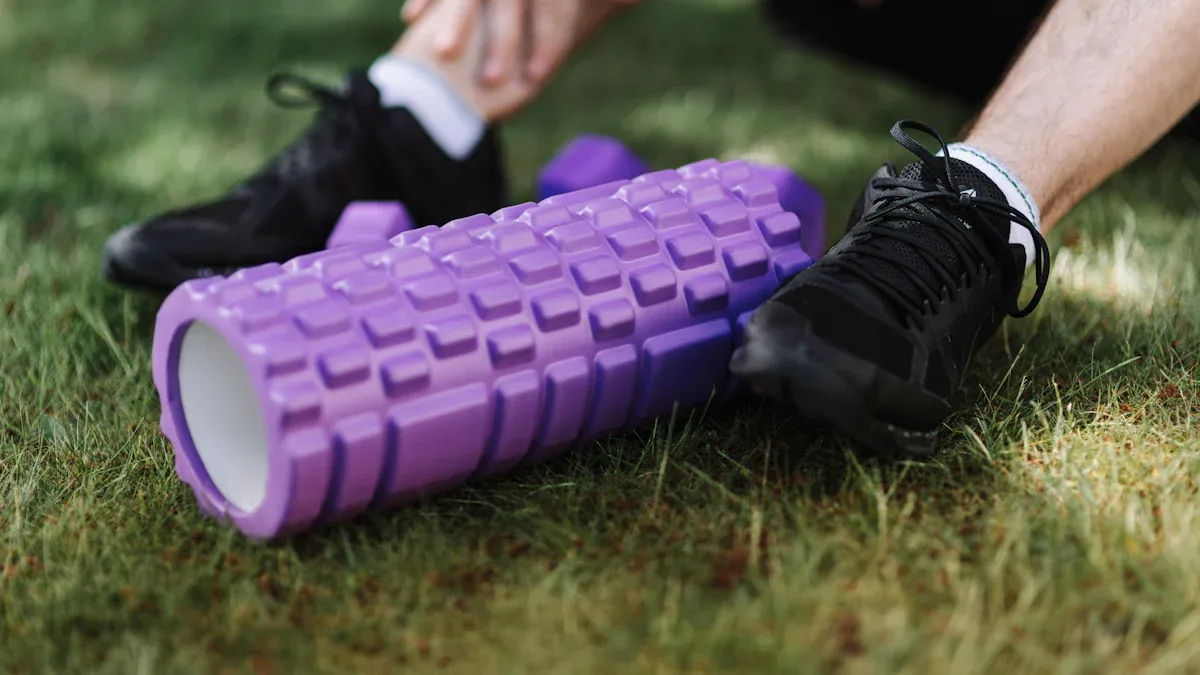
Picking the right foam roller material can change how you feel after a massage or workout. In 2025, there are many new choices. Each one has special benefits for massage, physical therapy, and fitness. Let’s look at the best materials you should think about for your foam roller.
Expandiertes Polypropylen (EPP)
Expanded Polypropylene, called EPP, is very tough and firm. EPP foam rollers do not lose their shape, even if you use them a lot. This material does not break down fast, so it is great for hard workouts and busy gyms. EPP is easy to clean, so you can use it with others.
EPP foam rollers help with muscle training, keeping your spine steady, and relaxing tight muscles. You can use them for balance, body position, and posture practice. The firm build works for big adults and active kids, so you get good support every time.
Here is how EPP stacks up against other foam roller materials:
| Eigentum | Expandiertes Polypropylen (EPP) | EVA | Polyethylen (PE) |
|---|---|---|---|
| Dauerhaftigkeit | Hoch | Mäßig | Niedrig |
| Dichte | Hoch | Mäßig | Niedrig |
| Hygienic qualities | Ausgezeichnet | Gut | Messe |
| Resistance to wear | Besser | Gut | Poor |
| Festigkeit | Hoch | Mäßig | Niedrig |
| Deformation resistance | Not easy to deform | Mäßig | Easy to deform |
| Suitable for | Moderate to heavy duty yoga | Light exercises | Casual use |
Note: EPP foam rollers are extra firm with a 2 lb. density. They are a top pick for deep tissue massage and advanced physical therapy.
Ethylen-Vinylacetat (EVA)
EVA foam rollers give both comfort and support. This material feels soft and bends easily, so it is liked by people who want a gentle massage. EVA soaks up shock well, so rolling does not hurt as much. The flexible foam lets you use it for many moves, like stretching and core work.
EVA foam rollers keep their shape after lots of use. They feel nice, but some people say they break down faster than EPP. Still, EVA is strong and takes in shock, so it works well for most people.
| Vorteile | Benachteiligungen |
|---|---|
| Provides nice-feeling massages | Material is flimsy and falls apart easily |
| Eigentum | Beschreibung | Impact on Performance |
|---|---|---|
| Softness | EVA foam is soft, providing comfort during use. | Higher comfort levels for users. |
| Flexibilität | The material is flexible, allowing for various applications. | Enhances usability in different contexts. |
| Strength | EVA foam exhibits strength, contributing to its durability. | Increases longevity of the foam roller. |
| Shock Absorption | The foam absorbs shocks effectively, reducing impact on the body. | Improves comfort during use and recovery. |
| Density Variability | Higher densities offer more support, while lower densities provide more comfort. | Balances durability and comfort based on user needs. |
- EVA foam rollers hold their shape after many uses.
- They last long and work well for most massage needs.
Tip: If you want a foam roller that is comfy but still gives support, EVA is a good pick for daily use.
Polyethylen (PE)
Polyethylene, or PE, is a common foam roller material. You see PE foam rollers in gyms and clinics because they are cheap and easy to buy. PE rollers feel softer than EPP or EVA, so they are good for beginners or people with sore muscles. The material is safe, has no smell, and bends easily, so anyone can use it.
PE foam rollers help you move better and stretch more. You can use them to warm up or cool down after exercise. They help you get more flexible and ease muscle pain. But PE rollers do not last as long and can lose their shape faster than other types.
| Eigentum | Beschreibung |
|---|---|
| Low Cost | Polyethylene is inexpensive, making it widely accessible. |
| Easy Processability | The material can be easily processed into various forms. |
| Excellent Electrical Insulation | Provides good insulation properties, making it useful in electrical applications. |
| High Chemical Inertness | Resistant to many chemicals, enhancing its durability. |
| Toughness and Flexibility | Offers a balance of strength and flexibility, suitable for various applications. |
| Nontoxic and Odorless | Safe for use in consumer products, contributing to its popularity. |
| Limitations | Includes low softening point, susceptibility to oxidation, and poor scratch resistance. |
- PE foam rollers help blood flow and muscle recovery.
- They are best for gentle massage and short-term use.
| Material | Erschwinglichkeit | Effektivität | Dauerhaftigkeit |
|---|---|---|---|
| PE Foam | Cheaper | Softer, suitable for beginners | Less durable |
| EVA/EPP | More expensive | More effective for deeper relief | More durable |
Note: If you want a cheap foam roller for light use, PE is a smart choice.
Specialty & Eco-Friendly Materials
In 2025, you will see more foam rollers made from special and eco-friendly materials. Brands use cork, bamboo, and recycled stuff to make green choices. These rollers work just as well as regular foam, but they are better for the planet. Many eco-friendly rollers fight germs, resist sweat, and last a long time.
| Marke | Materialien | Größe (Länge) | Preis | Vorteile |
|---|---|---|---|---|
| 42 Birds | 100 percent recycled cork | 18” | $59 | Large size, eco-friendly, supports pain relief, and gives back to environmental causes. |
| Scoria | 100 percent natural cork | 11.5” | $32 | Increases circulation, saves on water and emissions, and donates meals for each roller sold. |
| Mobeco | 100 percent natural cork | 11.8” | $54.90 AUD | Anti-microbial, sweat-resistant, and carbon-neutral shipping with a commitment to sustainability. |
| Casall | Natural cork or bamboo | 11.8”–13” | €19.90–€49.90 | Ethically made, partially powered by renewable energy, and sustainable materials. |
| CorkHouse | 100 percent natural cork | 12” | $38.95 | Versatile for various exercises, promotes eco-friendly practices, and durable. |
| Rawlogy | 100 percent natural cork | 1.9”–4” | $12–$19 | Portable, sustainable, and free from plastic and petroleum, ideal for on-the-go recovery. |
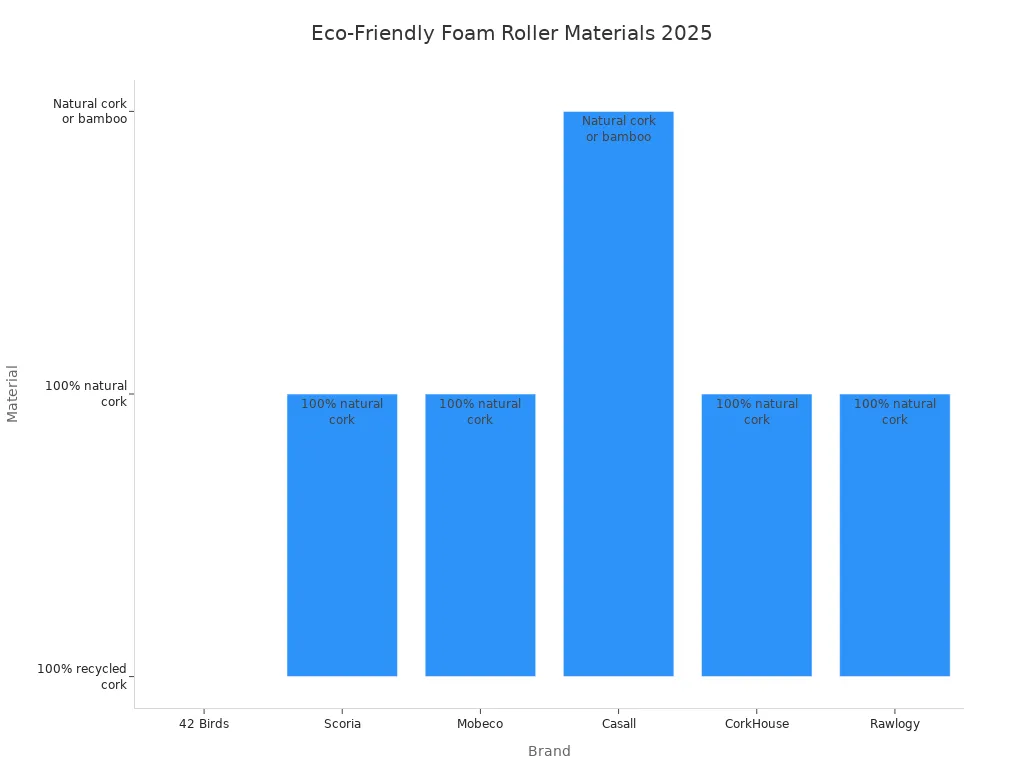
- More people now want foam rollers made from natural, earth-friendly materials.
- Plant-based and recycled rollers help lower pollution from making them.
- Eco-friendly foam rollers still work well and help the environment.
A new study shows that natural and biodegradable materials, like sodium alginate and cellulose, can be just as strong and stable as man-made foams. You can pick these special rollers for both good performance and to help the planet.
Tip: If you care about nature and want a good massage tool, try a cork or bamboo foam roller. Many special rollers are small, so they are easy to take with you or use as a portable vibrating foam roller.
When you know what each foam roller material does best, you can pick the right one for you—whether you want deep muscle help, a soft massage, or an eco-friendly choice.
Foam Roller Material Comparison Table
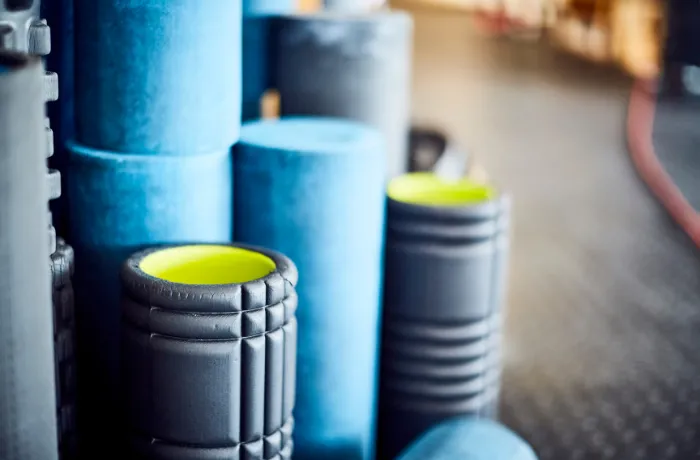
You need to pick the right foam roller for you. The material changes how it feels and how long it lasts. It also affects how well it works for massage or physical therapy. Look at this table to see the top foam roller materials in 2025.
| Material | Profis | Nachteile | Dauerhaftigkeit | Komfort | Bester Anwendungsfall |
|---|---|---|---|---|---|
| Expandiertes Polypropylen (EPP) | Very firm, keeps shape, easy to clean | Can feel too hard for beginners | Ausgezeichnet | Firma | Deep tissue massage, gyms |
| Ethylen-Vinylacetat (EVA) | Soft, flexible, absorbs shock | May break down faster than EPP | Gut | Comfortable | Daily use, stretching |
| Polyethylen (PE) | Affordable, soft, odorless | Loses shape quickly, less durable | Messe | Sanft | Beginners, light massage |
| Eco-Friendly (Cork/Bamboo) | Sustainable, anti-microbial, portable | Higher price, limited firmness options | Very good | Natural feel | Travel, eco-conscious users |
- Every foam roller material has good and bad points.
- EPP is best for hard workouts. EVA is comfy for daily rolling. PE is nice for people just starting. Eco-friendly rollers are good for the earth.
Tip: Pick EPP if you want a strong roller that lasts. If you like comfort or want to help the planet, try EVA or cork.
Choosing the Best Foam Roller Material
Matching Material to Your Needs
You want the best foam roller for your goals, comfort, and budget. The right choice depends on how much pressure you need, how long you want your roller to last, and how much you want to spend. Each material offers a different feel and level of support.
Here is a quick guide to help you match the material to your needs:
| Material Typ | Komfortstufe | Dauerhaftigkeit Level |
|---|---|---|
| EPP-Schaum | Weich | Mäßig |
| EVA-Schaum | Weich | Mäßig |
| Gummi | Mittel | Hoch |
| Hard Plastics/Metal | Hart | Sehr hoch |
If you are new to foam rolling, you may want a white foam roller. These feel soft and give gentle pressure. Blue foam rollers offer medium pressure and work well for intermediate users. Black foam rollers feel the firmest and suit experienced users who want intense massage.
You should also think about density. A softer roller may not give enough pressure for deep muscle relief. A firmer roller can help with self-myofascial release and trigger-point work, but it might feel uncomfortable if you have sensitive muscles. You need to choose a density that matches your pain tolerance and experience.
Tip: Start with a medium-density roller if you are unsure. This type gives a balance of comfort and effectiveness for most people.
If you want a self-massage tool for daily use, EVA foam works well. It feels soft and absorbs shock. For deep tissue work, EPP foam or a textured foam roller gives more pressure and lasts longer. If you care about the environment, try a cork or bamboo roller. These eco-friendly options support both your health and the planet.
Tipps für Erstkäufer
When you buy your first foam roller, you want to avoid common mistakes and get the most value. Physical therapists and fitness professionals suggest these tips:
- Pick a longer foam roller for large muscle groups like your back or legs. Use a smaller roller for targeted areas such as calves or arms.
- A medium-sized traditional foam roller works best for beginners. It gives you control and comfort.
- Choose a roller with a solid EVA foam core. This type offers good durability and firmness for regular use.
- Use your foam roller every day. Daily rolling helps prevent injuries and improves flexibility.
- Try a textured foam roller if you want to target knots or tight spots. This style can help with deep muscle relief.
You should also watch out for common mistakes:
- Roll slowly and let your muscles adapt to the pressure.
- Do not roll directly on painful areas. Start near the sore spot and work your way in.
- Keep good posture during rolling to avoid injury.
- Limit your time on sore spots. Too much pressure can cause harm.
- Never use a foam roller on your lower back. This can make your muscles tighten and cause pain.
Note: The best foam roller for you fits your body, matches your comfort level, and supports your goals. Take your time to test different types and densities. You will find the right fit for your self-massage routine.
A medium-density roller gives you a safe starting point. As you gain experience, you can try firmer or textured foam rollers for deeper results. Remember, the right foam roller helps you recover faster, move better, and enjoy your workouts.
You need to choose the right foam roller for your goals and comfort. Materials like EPP, EVA, PE, and eco-friendly options offer different levels of support and durability.
- Beginners should start with a soft foam roller for gentle massage.
- Athletes may prefer firm rollers for deep tissue work.
Always match your foam roller to your budget and recovery needs. The right design helps you get the most from massage and physical therapy.
FAQ
What foam roller material works best for deep tissue massage?
EPP foam rollers give you strong pressure and keep their shape. You get the best results for deep tissue massage and muscle recovery.
Can you use eco-friendly foam rollers for physical therapy?
Yes, you can use cork or bamboo foam rollers for physical therapy. These rollers support your muscles and help the environment.
How do you clean your foam roller?
- Wipe your foam roller with a damp cloth.
- Use mild soap for tough stains.
- Let it air dry before your next use.
Welche Schaumstoffrolle ist am besten für Anfänger geeignet?
| Material | Komfortstufe | Dauerhaftigkeit |
|---|---|---|
| PE Foam | Hoch | Mäßig |
| EVA-Schaum | Hoch | Gut |
You should start with PE or EVA Schaumstoffrollen. These feel soft and give gentle pressure.

 German
  English
  Spanish