
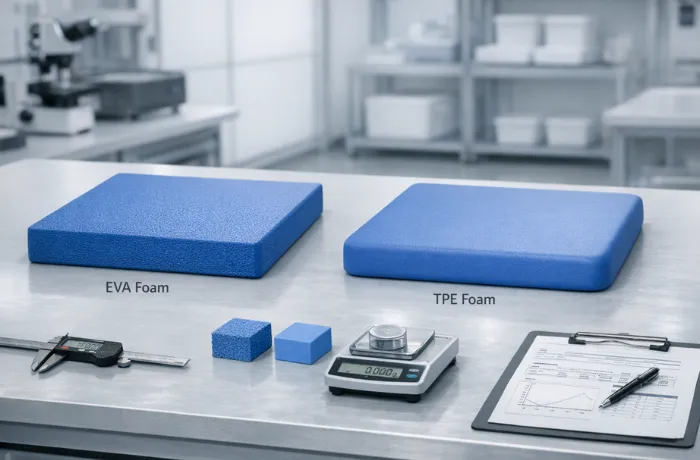
To choose between EVA and TPE balance pads, compare compression recovery, odor control, density stability, and supplier QA documentation rather than material labels alone.When European retail teams evaluate balance pads, attention often goes to colors, logos, and cartons. But the material inside determines what customers write three months later. Some pads still feel steady and slightly springy after heavy studio classes; others end up uneven underfoot with a “tired” feel. In real life, that difference is usually the foam: EVA or TPE. If your goal is to reduce return risk and protect star ratings, the right call on materials—and the QA that proves it—matters more than you might expect. For broader manufacturing controls and how to operationalize them, see our pillar on the OEM balance pad factory for European retail brands.
TL;DR verdict: There’s no across-the-board winner. If you need long-term, stable support for high-frequency studio use, higher-density EVA often holds shape well—provided the supplier can show compression-recovery evidence. If you need a softer first step for rehab or sensitive users, many TPE foams feel plush at first contact while maintaining closed-cell hygiene. If unboxing odor is the top risk for DTC/Amazon, prioritize suppliers with VOC control SOPs regardless of material. Sustainability messaging typically favors thermoplastic TPE. Always validate with simple tests and lot documentation.
Decision quick pick
Choose EVA when: you’re buying for high-frequency studio use, stability-first positioning, and a firmer underfoot feel.
Choose TPE when: you’re building a comfort-first line for rehab/home users and want a softer first step.
Odor risk (don’t overthink the material): reviews are usually driven more by ventilation, storage time, and packaging SOPs than by EVA vs TPE alone.
Why balance pad material choice matters more than buyers expect
Balance pads live a tough life: repeated stepping in studio circuits, wobble drills in rehab, and daily home workouts. That constant load exposes the material’s true character. When density is too low or recovery is weak, the pad may feel slightly compressed after weeks, or even develop a subtle dip that makes balance work feel less secure. The retail consequences are predictable: “cheap foam” comments, star-rating drag, and unnecessary returns. Choosing between an EVA foam balance pad and a TPE foam balance pad isn’t a chemistry decision—it’s a retail outcome decision tied to odor at unboxing, compression set over time, and batch consistency across replenishments.
EVA foam balance pads: why they became the standard
Well-selected EVA grades are widely available, budget-friendly, and tunable. Good EVA typically feels firm yet slightly springy underfoot, which many trainers prefer for stability drills. With appropriate density and crosslinking, EVA can resist taking a permanent set, keeping support more stable over months of use.
What to watch: very soft or lower-density EVA can fatigue sooner in high-frequency classes, leading to that uneven, “tired” feel. Because EVA is often crosslinked, recyclability options are more limited than thermoplastics. Procurement actions: specify a target density band, ask for compression-set data or a short cyclic-load demo, and require batch COAs so each replenishment lands in the same feel window.
TPE balance pads: why some retail brands are switching
TPE foams, particularly in mid-density formulations, often feel softer at first step and pleasantly cushioned. Many buyers use this to position comfort in rehab and home wellness. TPE is thermoplastic, which supports recyclability messaging in principle and can align with eco-forward brand positioning.
Trade-offs: TPE generally prices higher and may have tighter MOQs depending on the exact polymer family (e.g., SEBS vs TPU-based foams). Performance varies by formulation; you’ll still want recovery evidence and batch documentation. Procurement actions: define density/firmness targets for the catalog, confirm rebound and recovery via a demo, and capture VOC/odor-handling SOPs in the PO.
Odor and first impression: what buyers notice immediately
Unboxing creates your first 30 seconds of review risk. Odor typically comes from residual compounds left from foaming/curing that build up inside sealed packaging. Material does influence odor potential, but real-world results hinge on supplier controls: post-molding ventilation, storage time before sealing, and packaging specs. For compliance framing in the EU, review the European Chemicals Agency’s overview of REACH duties in articles: ECHA REACH overview. In practice, ask suppliers to send one production sample sealed for seven days; open on arrival and assess whether the smell is sharp or mild.
Long-term stability: compression and recovery in real use
After months of studio stepping, lower-density foams may feel slightly compressed, with a subtle dip that shifts balance. To keep “stable support,” you need evidence before committing the PO. The simplest validation is a two-part check: request basic compression-recovery proof (a simple before/after compression check is enough) and a short cyclic-load video simulating repeated steps on a sample pad. The goal isn’t laboratory research—it’s simply confirming a clear trend: does it spring back consistently, or does it stay slightly flat after repeated loading? Capture those expectations in writing so both sides measure the same outcome.
Side-by-side comparison: EVA vs TPE at a glance
Below is a practical, procurement-focused comparison. Performance varies by formulation and density; use this as a conversation map with suppliers.
| Dimension | EVA foam balance pads | TPE foam balance pads |
|---|---|---|
| Initial feel | Firm with a slightly springy response; stable underfoot | Softer at first step; cushioned contact feel |
| Odor at unboxing | Can be noticeable if sealed too soon; mitigated by ventilation and staging | Often framed as lower-odor; still needs ventilation SOPs and sealed-sample checks |
| Compression & recovery | Typically strong in higher-density grades; lower-density may tire sooner | Often shows lively rebound; confirm with cyclic demo for your target density |
| Durability over months | Good with appropriate density; edges can fatigue if too soft | Good in mid/high densities; performance depends on exact TPE family |
| Hygiene & cleanability | Closed-cell; wipes clean easily | Usually closed-cell; similar wipe-down care |
| Grip/texture options | Common emboss patterns; request COF tests if slip complaints matter | Similar range of textures; request COF tests for your pattern |
| Sustainability angle | Crosslinked; recycling options are limited | Thermoplastic; recyclability-in-principle supports eco messaging |
| Cost & MOQs | Generally lower cost; flexible MOQs common | Typically higher cost; MOQs can be tighter by grade/color |
| Batch consistency | Needs COA and tolerance controls to keep feel steady | Same controls required; document tolerances and retain samples |
| Compliance docs | Request REACH/ROHS statements and SDS | Same documentation expectations |
Which material do retail buyers usually choose?
There isn’t a single winner; it’s a scenario choice. For high-frequency studio use where long-term support matters most, many retailers pick firmer, higher-density EVA and lock it with compression-recovery proof. For rehab and comfort-first positioning, TPE’s softer first contact often “feels right” to end users. For Amazon/DTC launches where unboxing odor drives early reviews, the leader is any material paired with disciplined VOC controls. For sustainability messaging, TPE typically fits better because it’s thermoplastic.
Questions retail buyers should ask their supplier
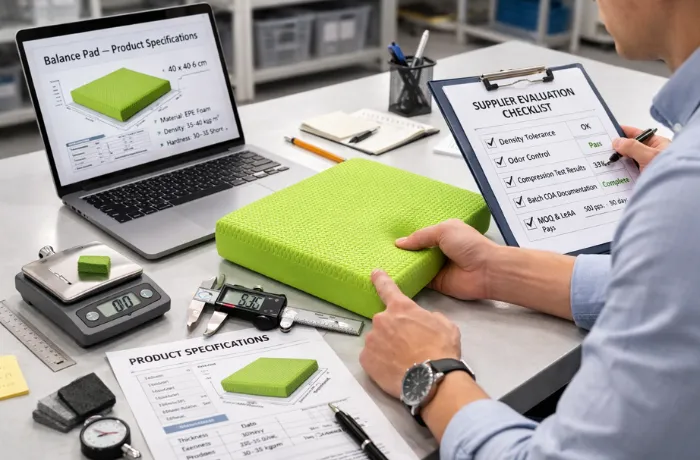
These questions convert material talk into predictable retail outcomes. If you need a template, link expectations back to your internal SOPs and the mid-body guide on the Schaumstoff-Balancepad process.
- What density range and firmness do you recommend for studio classes, and what tolerances will you guarantee on the COA?
- How do you manage odor before shipment (ventilation days, storage conditions, packaging)? Can you send a 7‑day sealed sample for a sniff check?
- Can you share numeric compression-set results and a short cyclic-load demo video simulating repeated steps?
- Do you retain batch samples and provide prior-lot COAs so we can compare feel across replenishments?
- What are the MOQs and lead times by material, density, texture, and color, including pigment surcharges?
Material choice and production control
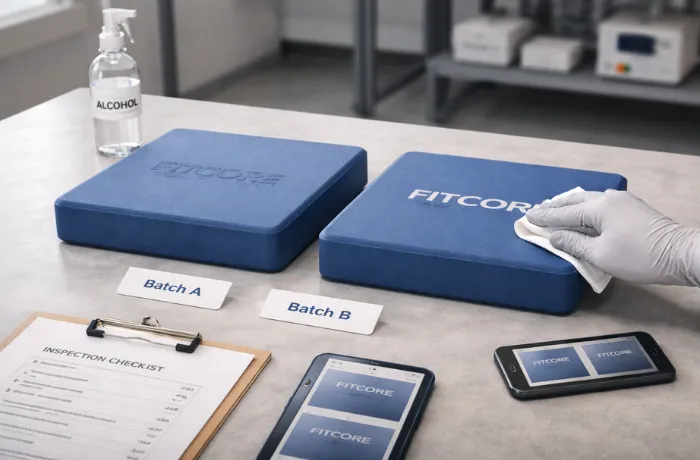
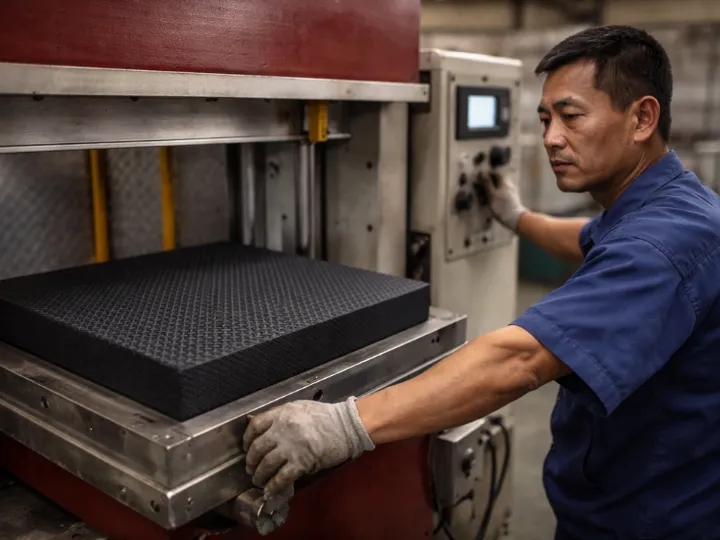
Material is the start; production control keeps your catalog consistent. Lock density/firmness targets into the PO, require batch COAs, and make sealed-sample odor checks part of inbound QA. Ask suppliers to document simple, reproducible tests so both sides can verify recovery and odor without a lab. For a broader, step-by-step playbook you can hand to your team, review our retail production control guide.
Also consider: If you need an OEM/ODM partner that can stage ventilation, share cyclic‑load demos, and maintain retain‑sample controls with flexible MOQs, WellfitSource supports scenario-based assortments for fitness retailers.
FAQ
How do I decide between EVA and TPE for studio classes?
Choose the option that preserves stable support after months of use. Many brands select higher-density EVA and validate recovery with a simple cyclic demo before PO.
Why do some pads smell when first opened?
Residual volatiles from foaming/curing can build up in sealed cartons. Mitigate by staging ventilation before packing and requesting a 7‑day sealed sample sniff check.
Is TPE always more durable than EVA?
No. Durability depends on density, formulation, and texture. Both materials can perform well if you specify the right grade and verify recovery.
What’s the fastest way to check recovery without a lab?
Request numeric compression‑set results plus a short video of repeated stepping on a sample. You’ll quickly see whether the pad springs back or stays slightly compressed.
Can I position TPE as more sustainable?
Often yes, because many TPE foams are thermoplastic and recyclable in principle. Keep claims grounded in supplier documentation.
Prices, MOQs, and availability vary by supplier, density, additives, color, and season. Treat cost guidance as indicative and confirm with current quotes before locking your PO and shipping window. Performance varies by formulation and density; always request supplier COAs and simple demos before committing a PO.

 German
  English
  Spanish