Shared studio mats live a much tougher life than a mat at home. If you’re buying yoga mats for studios in bulk, the only question that really matters is: will they still perform after months of traffic and daily wipe-downs? This guide breaks down studio vs home mats in plain terms—so you can choose faster, replace less often, and verify suppliers beyond the catalog.
Why Studio Mats Fail Faster Than Expected
Studio operators often discover their “new” mats aging in months, not years. The reasons are practical:
- High usage and shared contact: Multiple classes a day concentrate friction on the same zones (heels, hands, front edges and transition areas), wearing textures and curling edges sooner.
- Sweat and residues: Sweat, body oils, and skincare products interact with surfaces before each wipe-down.
- Frequent sanitization: Post-class wipes and daily disinfection increase chemical exposure and mechanical abrasion.
In studio environments, frequent sanitization is unavoidable—and this is exactly why durability becomes a material-selection issue, not a cleaning-protocol issue. Public-health guidance from the CDC on cleaning and disinfecting facilities reflects what studios already know: repeated disinfectant contact and drying cycles add chemical and mechanical stress to shared, nonporous surfaces over time. The takeaway isn’t “clean less.” It’s “choose materials that survive cleaning.”
Studio Use vs Home Use: The Core Differences That Actually Matter
Usage Frequency and Wear Patterns
In studios, wear concentrates in the same spots day after day—hands, heels, and front edges—so texture fades fast. A practical way for buyers to sanity-check durability is abrasion resistance, often measured with the Taber test (ASTM D4060). Testing labs like Intertek explain Taber abrasion and why it’s a useful indicator for surfaces that get wiped and stepped on constantly.
At home, a single user with fewer sessions translates to far less mechanical wear and minimal chemical exposure, so softer foams and textured tops often last years.
Durability Under Repeated Cleaning
Durability under frequent sanitization is the deciding factor for studio environments. When mats are shared, wiped down between classes, and exposed to sweat and disinfectants day after day, long-term performance depends less on first impressions and more on how specific design choices hold up over time. Two factors consistently shape outcomes.
Closed-Cell vs Open-Cell Surfaces
Surface structure plays a critical role in how mats age under studio conditions. Many brands note—and it’s commonly described across industry guides—that closed-cell yoga mats resist moisture absorption, keeping sweat and contaminants on the surface so they can be wiped away between classes. This makes closed-cell constructions better suited for shared, high-traffic environments where frequent cleaning is unavoidable.
Open-cell surfaces, by contrast, tend to absorb moisture. While this can enhance grip initially, it complicates hygiene and accelerates breakdown when mats are repeatedly sanitized. Brand education resources such as Manduka’s overview of closed-cell vs open-cell yoga mats help illustrate how these structural differences affect maintenance and longevity in practice.
Chemistry Compatibility: Material Meets Cleaning Protocol
The second determinant is how well a material tolerates the chemicals used to keep studios safe. Public-health principles are clear—shared equipment must be disinfected and allowed to dry—but manufacturer-defined material limits ultimately govern lifespan. When cleaning protocols exceed those limits, mat life shortens regardless of brand or price point.
Common material tendencies include:
- PVC: Often the most chemically tolerant option for commercial settings. However, long-term exposure to strong agents can dry the surface or alter feel, making manufacturer-approved cleaners essential for preserving performance and warranty. Consumer guidance highlights the importance of matching cleaners to material properties (see Consumer Reports’ overview of cleaning yoga mats).
- TPE: Many formulations are more sensitive to alcohols and bleach, requiring milder, mat-safe cleaning protocols to avoid premature surface degradation.
- Natural rubber: Known for strong traction, but typically incompatible with alcohol, bleach, and harsh disinfectants. Longevity depends on gentle, rubber-safe cleaners specified by the manufacturer.
- PU-coated tops: Frequently deliver excellent wet grip, especially in sweaty classes, but are more delicate. Many brands recommend alcohol-free cleaners and lighter wipe-downs to preserve the top layer over time.
The takeaway for studio buyers isn’t to clean less—it’s to select materials whose chemical tolerance aligns with the cleaning reality of a busy schedule.
A Practical Rule of Thumb for Studios
For most high-traffic studios, durability improves when closed-cell, high-density surfaces are paired with a brand-approved cleaner and a standardized wipe protocol. Hot classes often warrant additional safeguards—towels on top, gentler cleaners, and more frequent mat rotation—to balance hygiene with surface longevity.
Choosing with these constraints in mind helps studios reduce unexpected wear, extend replacement cycles, and maintain consistent performance across classes, not just on day one.
Grip Performance After Sweat and Sanitization
Grip that feels great on day one but degrades after weeks of sweat and wipe-downs is a false economy for studios. In shared environments, the real test isn’t initial traction—it’s whether grip remains reliable after repeated cleaning cycles.
Different surface types behave differently over time:
- PU-coated and other absorbent tops often deliver excellent wet grip, even in sweaty classes. The trade-off is that they’re more sensitive to harsh cleaners and aggressive wiping, which can shorten usable life if protocols aren’t well matched.
- Natural rubber typically maintains strong traction when dry or lightly damp, but frequent exposure to alcohol or bleach-based cleaners can accelerate surface breakdown.
- PVC tends to tolerate disinfectants better, but many formulations become slick when wet. As a result, studios using PVC in hot or high-intensity classes often rely on towels to maintain traction.
The operational question for studios isn’t “Which mat feels grippiest out of the box?”
It’s “Which surface maintains acceptable grip after dozens—or hundreds—of wipe-downs?”
If you don’t have a lab team, ask suppliers for a simple before-and-after cleaning grip summary that reflects real studio use.
If you do have QA support, standardized friction testing (such as ASTM D1894) can help quantify how grip changes after repeated cleaning cycles.
Thickness and Stability for Group Classes
Studios benefit from firmer, high-density mats in the 3–5 mm range (up to 6 mm if very dense). That firmness improves balance in standing sequences, keeps storage stacks compact, and speeds wipe-downs. Home users tend to favor 6–8+ mm softer foams for comfort, which can feel spongy in fast flows and compress under repeated studio use. For a quick primer on typical thickness trade-offs, see buyer guides like DIYogi’s overview of mat thickness considerations.
If you’re deciding fast, this table is the cheat sheet.
| Dimension | Studio-grade expectation | Home-grade typical behavior | Why it matters | Test/verification |
|---|---|---|---|---|
| Usage frequency | Multiple users daily; heavy abrasion at hot spots | Single user, fewer sessions | Signals expected wear rate and edge curling | Abrasion testing (lab-verified) |
| Cleaning tolerance (key factor) | Compatible with standardized disinfectant protocol | Light cleaning, mild soaps | Determines lifespan under sanitization | Maker-approved cleaner list; small-batch trials |
| Wet grip after cleaning | Must remain consistent post-wipe | Can be inconsistent when sweaty | Safety in hot or high-intensity classes | COF data (ASTM D1894) before/after cycles |
| Thickness/density | 3–5 mm high density (up to 6 mm if very dense) | 6–8+ mm softer foams | Stability for balance and quick wipe-down | Spec sheet: thickness, density, hardness |
| Replacement cycle | Typical range depends on grade and care(set replacement triggers) | 3–7 years for casual home use | Drives total cost-per-use | Condition-based triggers, warranty terms |
Why Using Home-Grade Mats in Studios Is a Costly Mistake
Shorter Replacement Cycles
In busy studios, replacement is usually driven by performance triggers—grip loss, surface cracking, edge curl, or persistent odor—rather than a fixed calendar. Under daily wipe-downs, lower-grade mats reach those failure points much sooner, increasing total cost-per-use even when the unit price looks attractive
Inconsistent User Experience
Softer foams compress and lose uniform grip; PVC can be slick when wet; PU/open-cell tops have stellar wet grip but demand careful cleaning and drying. The result is variability class to class and room to room—exactly what studio standards aim to avoid.
Hidden Costs Beyond Unit Price
Cheaper mats can be more expensive in practice. Add up: extra replacements, potential safety incidents from slipping, time lost to slower cleaning, and warranty voids from incompatible disinfectants. Your budget lives or dies on cost-per-use, not unit price.
What Studio Buyers Should Verify Before Ordering Yoga Mats in Bulk
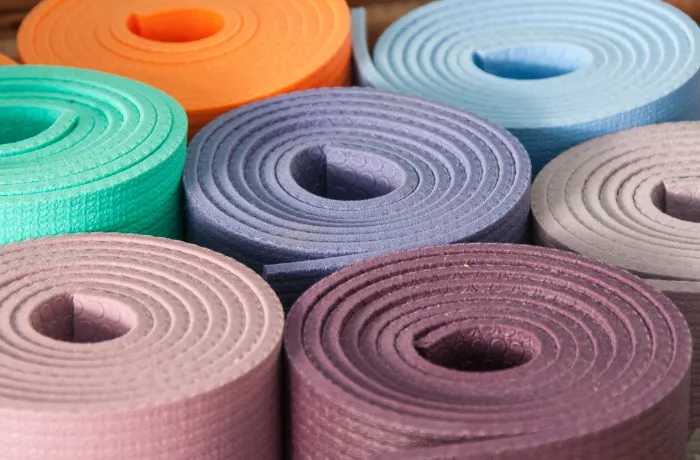
If you want mats that last under real studio conditions—not just on day one—use this checklist before placing a bulk order. Start with the essentials, then go deeper if you have QA support.
Must-Ask (Every Studio Buyer Can Do This)
These questions don’t require a lab or technical background—just clear answers from your supplier.
- How do the mats hold up after repeated cleaning?
Ask which cleaners are approved for the material and whether daily wipe-downs with disinfectant affect grip or surface feel over time. - Does grip stay consistent after sweat and wipe-downs?
Request a simple before/after cleaning grip summary that reflects real studio use, not just “out-of-box” performance. - What usually triggers replacement in studio settings?
Listen for practical signs—grip loss, surface cracking, edge curl, or persistent odor—not vague lifespan promises. - Can I reorder later and get the same feel and color?
Ask whether future batches are matched to the original order, especially if you plan to replace mats gradually. - What compliance basics are covered?
Confirm restricted substances (e.g., REACH, CA Prop 65 where applicable) and whether the mats are latex-free if your studio requires it.
Nice-to-Have (For Teams With QA or Technical Support)
If you have internal QA resources—or want deeper verification—these checks add another layer of confidence.
- Abrasion and durability data:
Ask for lab results that show how the surface handles repeated friction and wiping (for example, abrasion testing used for coatings or rubber). - Grip data before and after cleaning:
If available, request dry and wet grip measurements taken after multiple cleaning cycles—not just initial results. - Basic batch tracking:
Ask for lot numbers on cartons and a simple change-notice policy, so you’re informed if materials or processes change between orders. - Quality system overview:
A brief explanation of how the factory controls consistency from batch to batch is often more useful than a stack of certificates.
Why This Matters
Studios don’t fail mats on a calendar—they fail them on performance.
Asking the right questions upfront helps you avoid premature replacements, inconsistent class experiences, and the hidden costs that come with buying solely on unit price.
Which Buyer Types Can Still Consider Home-Grade Mats?
- Low-traffic studios or boutique rooms with limited shared use: Acceptable if expectations are clear—shorter replacement cycles and stricter towel policies in sweaty classes.
- Pop-ups, short-term programs, rentals: When the operational horizon is measured in weeks/months, home-grade can be a rational choice; plan for disposal or donation at program end.
- Corporate wellness with assigned mats and low frequency: Consumer mats may suffice if mild cleaning is used and clear care instructions are enforced.
This distinction helps buyers match mat grade to actual usage—so they don’t overbuy for scenarios that don’t require it.
Final Thoughts: Studio Mats Are an Operational Decision, Not a Personal Preference
Home mats are chosen for comfort. Studio mats are chosen for durability, consistency after sweat and sanitization, and operational reality. Specify material and cleaning protocol together, verify abrasion and grip retention with data, and protect batch consistency with lot-level documentation. That’s how bulk buyers avoid premature replacements and unpredictable class experiences.If you’d like, share your class volume and cleaning routine—we can suggest a material + density range that fits.
Also consider: This guide is published by WellfitSource, a yoga mat OEM/ODM manufacturer. We included our perspective based on production and bulk-buyer feedback. We recommend verifying specs and test results with any supplier before placing an order.
Learn more about our studio-grade options here: WellfitSource
Häufig gestellte Fragen
Can studios use regular home yoga mats?
Yes—but only with clear trade-offs. In shared, high-traffic studios, home-grade mats typically wear out faster and are more likely to feel slippery after repeated sweat and daily wipe-downs. For regular class use, studios are better served by closed-cell, high-density mats designed for frequent cleaning and consistent performance. The key is choosing mats that maintain grip and surface integrity over time, not just on day one.
How often should studios replace yoga mats?
Replacement in studios is typically driven by performance triggers, not a fixed calendar—such as grip loss, surface cracking, edge curl, or persistent odor.
That said, for directional planning purposes only, many studios find that low-end PVC may reach those limits in roughly 6–12 months under busy conditions, mid-range synthetics around 2–3 years, and premium natural rubber or high-end PVC 3–5+ years when cared for correctly. These ranges are planning references, not guarantees, and mats should always be replaced sooner once performance degrades.
What materials hold up best under frequent sanitization?
In many commercial studio settings, dense, closed-cell PVC mats often tolerate disinfectants better than softer or more absorbent materials, making them a common choice where daily wipe-downs are unavoidable. That said, performance still depends on the specific formulation and surface finish, and long-term exposure to strong cleaners can alter feel or grip over time.Natural rubber and PU-coated surfaces typically offer superior wet grip, but they usually require milder, material-specific cleaning protocols to maintain performance. Because cleaning tolerance varies by formulation—not just material type—studio buyers should always verify cleaner compatibility in writing with the manufacturer before committing to bulk orders.